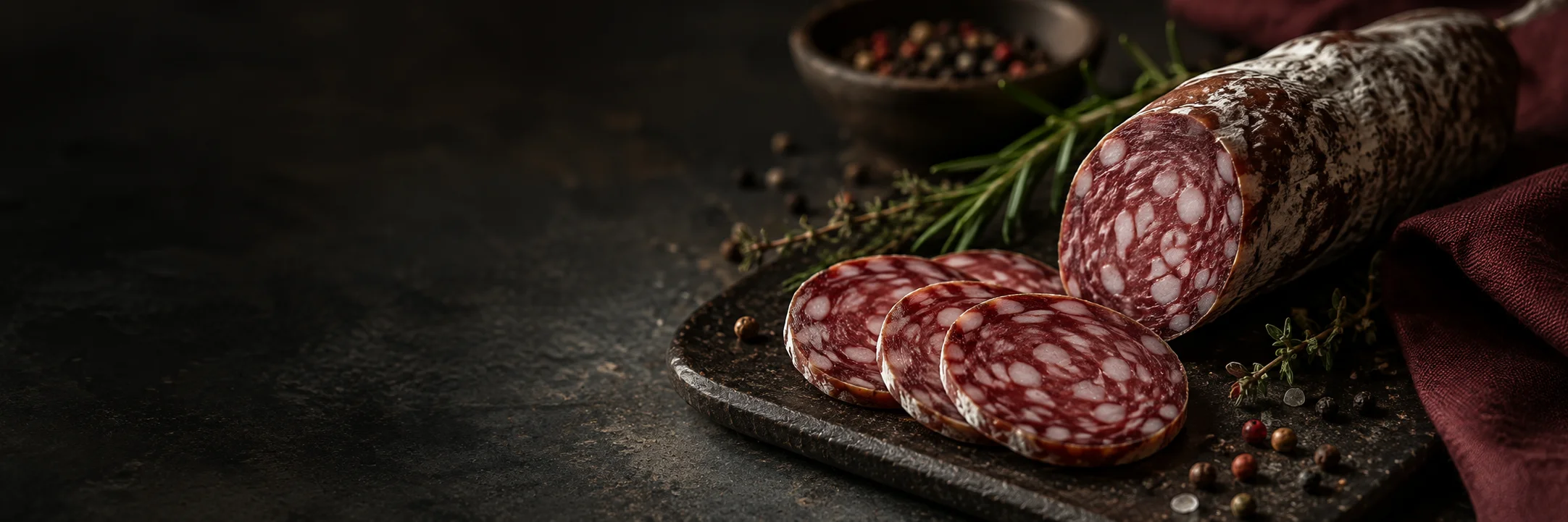
Overview
This provisional ingredient page records source-specific measurements for salami. Its population contamination profile has not been synthesized. See Ingredients for the ingredient inventory.
Heavy metal contamination profile
| Analyte | Coverage | Typical (ppb) | Confidence | Key sources |
|---|---|---|---|---|
| lead (Pb) | pending | — | — | — |
| cadmium (Cd) | pending | — | — | — |
| inorganic arsenic (iAs) | pending | — | — | — |
| total arsenic (tAs) | pending | — | — | — |
| total mercury (tHg) | pending | — | — | — |
| nickel (Ni) | pending | — | — | — |
| aluminum (Al) | pending | — | — | — |
| chromium (Cr) | pending | — | — | — |
| tin (Sn) | pending | — | — | — |
| uranium (U) | pending | — | — | — |
The profile fields remain pending until an evidence synthesis supports a population estimate. Source observations are listed separately below.
Reported measurements from source notes are below. No typical or upper-tail value is calculated here, and no certification limit is stated. The contamination profile in the page frontmatter is unchanged.
Reported measurements
The 2014 Iasi note reports salami (n = 12) in mg/kg wet weight. The note states that mg/kg wet weight equals ppm and is equivalent to 1,000 ppb. This page repeats that statement and does not convert the salami figures into ppb. Lead was mean +/- standard error 0.96 +/- 0.004 mg/kg, minimum 0.72 mg/kg, maximum 1.06 mg/kg. Cadmium was 0.21 +/- 0.005 mg/kg, minimum 0.09 mg/kg, maximum 0.24 mg/kg. Copper was 1.32 mg/kg. Zinc was 32.19 mg/kg. The authors’ comparators are 1.0 mg/kg for lead in meat products, 0.1 mg/kg for cadmium in pork products, 3 mg/kg for copper, and 50 mg/kg for zinc. The note states that the salami lead maximum of 1.06 mg/kg exceeded the authors’ 1.0 mg/kg comparator, beside the salami lead mean of 0.96 mg/kg. It states that all four product-type cadmium means exceeded 0.1 mg/kg, beside ranges that include values below 0.1 mg/kg. Bacon, ham, and sausage rows are not salami and are not repeated here. A figure above 2.5 ppm lead is the authors’ statement about pepper used in processing, not a salami concentration, and is not repeated as one. Heavy metals contamination levels in processed meat marketed in Romania
Salami fermentation and gut studies of lead, cadmium, zinc, and copper
Salami is a fermented cured meat. The starter cultures and the ripening microbiota belong to the product. They are not the infant gut, the mouse cecum, or an occupational yogurt trial. The studies below match lead, cadmium, zinc, and copper in those other models.
Sitarik et al. 2020 measured tooth lead and stool microbiota at 1 month and 6 months in 146 maternal-child pairs in the Detroit-area WHEALS cohort. In utero tooth lead was associated with fungal community composition at 1 month. Lead was not associated with overall bacterial community structure. Taxon-level bacterial shifts were higher Collinsella at 1 month, higher Bilophila at 6 months, and lower Bacteroides. The direction is lead exposure toward microbiota composition. Tooth lead is a biomarker, not a concentration in this ingredient.
Eggers et al. 2023, per WikiBiome source summary, DOI 10.3389/fmicb.2023.1193919, followed 123 children in the Mexico City PROGRESS cohort. Maternal blood lead means were 33.6 µg/L in the second trimester and 34.9 µg/L in the third. Stool metagenomes at ages 9 to 11 showed lower Bacteroides caccae with lead exposure. Weighted quantile sum regression gave a negative overall mixture effect (beta = -0.17) in both trimesters. The direction is prenatal lead toward the childhood gut microbiota. The summary does not support a lead concentration in food.
Liu et al. 2023, per WikiBiome source summary, DOI 10.3389/fvets.2023.1219729, exposed Sprague-Dawley rats to cadmium chloride for 30 days. The note states lower intestinal ZO-1, higher TNF-alpha and IL-6 in intestine and blood, and Muribaculaceae in blood that was absent in the unexposed group. The note does not print the dose or the number of rats. The direction is cadmium toward gut and blood microbiota and barrier markers.
Zhang et al. 2015, per WikiBiome source summary, DOI 10.1021/acs.chemrestox.5b00237, gave mice 10 mg/L cadmium in drinking water for 10 weeks. Firmicutes and gamma-proteobacteria decreased in feces after 4 weeks, and Firmicutes decreased in cecum contents after 10 weeks. The direction is cadmium toward gut microbiota, alongside hepatic energy-metabolism changes in the same animals. The summary does not name a food.
Chen et al. 2021, per WikiBiome source summary, DOI 10.1128/Spectrum.00483-21, fed C57BL/6 mice diets with 0, 30, 150, or 600 mg/kg zinc for 4 weeks and for 8 weeks. A 4-week diet with no added zinc increased Proteobacteria and Desulfovibrio. An 8-week diet with 150 mg/kg zinc suppressed total short-chain fatty acids, butyric acid, acetic acid, and short-chain-fatty-acid-producing genera. A 600 mg/kg diet decreased Shannon diversity. The mouse count is not in the note. The direction is dietary zinc status toward cecal microbiota. The diets are experimental, not this ingredient.
Feng et al. 2022, per WikiBiome source summary, DOI 10.1038/s41522-022-00326-8, randomized 152 occupationally exposed workers in Pakistan, 76 in each arm, to yogurt with Pediococcus acidilactici GR-1 or to conventional yogurt for 12 weeks. In the probiotic arm, blood copper fell 34.45 percent, from 1,246 ± 20.7 to 817 ± 145.1 µg/L (p < 0.0001), and fecal copper rose. The direction is a microbiota intervention toward copper body burden. The workers were occupationally exposed. The trial is not a test of copper in this ingredient.
Study table
| Study | Model | Metal and dose | Main finding | Limitation |
|---|---|---|---|---|
| Sitarik et al. 2020 | Human infants; tooth lead and stool; n = 146 | Lead; tooth biomarker, not a food dose | Fungal composition at 1 month shifted; overall bacterial structure did not | Not this ingredient |
| Eggers et al. 2023 | Human children, ages 9 to 11; n = 123 | Maternal blood lead; means 33.6 and 34.9 µg/L | Lower Bacteroides caccae; mixture beta = -0.17 | Per WikiBiome source summary; not this ingredient |
| Liu et al. 2023 | Rats; cadmium chloride; 30 days | Cadmium; dose not printed in the source note | Lower intestinal ZO-1; Muribaculaceae appeared in blood | Per WikiBiome source summary; n and dose unstated |
| Zhang et al. 2015 | Mice; drinking water; 10 weeks | Cadmium; 10 mg/L | Lower fecal Firmicutes and gamma-proteobacteria by 4 weeks | Per WikiBiome source summary; not this ingredient |
| Chen et al. 2021 | Mice; experimental diets; 4 and 8 weeks | Zinc; 0, 30, 150, or 600 mg/kg diet | No-added-zinc raised Proteobacteria; 150 mg/kg for 8 weeks lowered short-chain fatty acids | Per WikiBiome source summary; not this ingredient |
| Feng et al. 2022 | Human workers; yogurt; 12 weeks; n = 152 | Occupational copper; not a food concentration | Probiotic arm: blood copper fell 34.45 percent; fecal copper rose | Per WikiBiome source summary; occupational cohort |
What remains uncertain
No study cited here fed salami or sequenced stool after cured meat. A plate count on a salami lot is not a gut result, and these gut papers are not fermentation results. Liu and colleagues do not print the cadmium dose. Zinc diets are experimental. The copper trial is occupational.
FDA TDS FY2018–FY2020 source observations
FDA measured the prepared foods named below. Each row describes that food and preparation, not every form of this ingredient. Values are µg/kg (ppb) on the FDA sample basis. ND means not detected; it is not a measured zero. Reporting limits can vary between composites. FY2018-FY2020 TDS Elements Analytical Results
| FDA food and preparation | Analyte | Composites | Detected | Detected concentrations (ppb) | Reporting limits (ppb) |
|---|---|---|---|---|---|
| 389: Salami, dry/hard | tAs | 27 | 0 | ND in all composites | 3 |
| 389: Salami, dry/hard | Cd | 27 | 10 | 1–2.4 | 1 |
| 389: Salami, dry/hard | Cr | 27 | 2 | 87–200 | 50 |
| 389: Salami, dry/hard | Pb | 27 | 1 | 4.9 | 4 |
| 389: Salami, dry/hard | tHg | 27 | 0 | ND in all composites | 1 |
| 389: Salami, dry/hard | Ni | 27 | 2 | 56–120 | 40 |
| 389: Salami, dry/hard | U | 27 | 1 | 1.8 | 1 |
References
Works cited in this page’s text, in first-appearance order. See Sources for this page’s source inventory. Each title links to a source record with bibliographic details, reported findings, and document provenance.
- Heavy metals contamination levels in processed meat marketed in RomaniaPeer-reviewed
- Fetal and early postnatal lead exposure measured in teeth associates with infant gut microbiotaPeer-reviewed
- Prenatal lead exposure is negatively associated with the gut microbiome in childhoodPeer-reviewed
- Environmental cadmium exposure alters the internal microbiota and metabolome of Sprague-Dawley ratsPeer-reviewed
- Subchronic Exposure of Mice to Cadmium Perturbs Their Hepatic Energy Metabolism and Gut MicrobiomePeer-reviewed
- Effect of long-term and short-term imbalanced zinc manipulation on gut microbiota and screening for microbial markers sensitive to zinc statusPeer-reviewed
- Human supplementation with Pediococcus acidilactici GR-1 decreases heavy metal levels through modifying the gut microbiota and metabolomePeer-reviewed
- FY2018-FY2020 TDS Elements Analytical ResultsDataset
Sources
Sources catalogued for this page. The last column says how each source is used here.
| # | Citation | Year | Type | Used on this page for |
|---|---|---|---|---|
| 1 | FDA 2022. FY2018-FY2020 TDS Elements Analytical Results, FDA Total Diet Study | 2022 | Government dataset | US-FDA Pb, Cd, tAs, iAs, tHg, Ni, Cr, U, Sb occurrence in 3276 prepared food, beverage and water composites across 307 TDS foods, FY2018-FY2020 US collections (n=3276) |
Update history
No substantive edit history is available in this build. The full commit record is available in git.