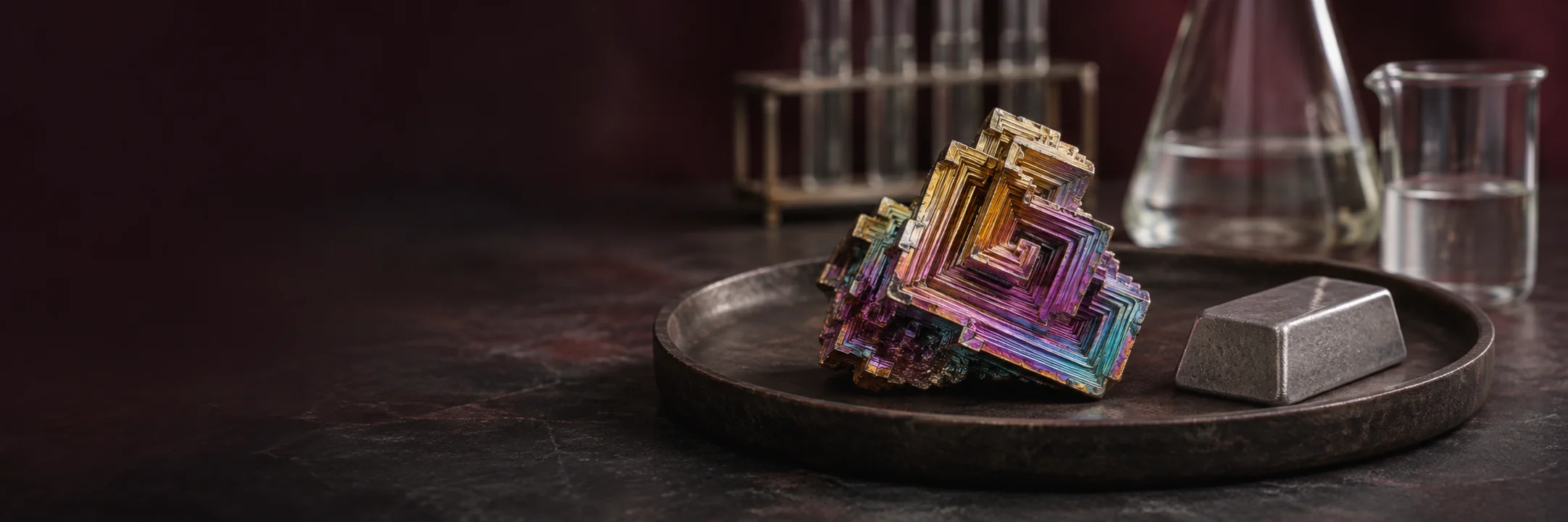
In the cited evidence bismuth appears as a medicine, an antibacterial and a material for sensors and water treatment; none of the papers measured bismuth in food, so dietary levels remain unknown.
- Role: A metal used in Helicobacter pylori treatment and studied as an antibacterial, with short-term animal studies showing kidney uptake but no injury signal.
- Main exposure: Oral medicines are the documented route; release from water-treatment material and proposed use in fish farming are possible routes not measured in food.
- Key distinction: Bismuth is often the electrode material in lead and cadmium tests, not the substance being measured.
This page draws on 20 peer-reviewed studies. The complete citation list is at the bottom of the page.
Overview
The cited evidence on bismuth consists of 20 papers, and most of them use bismuth as a material rather than study it as a contaminant. Seven describe electrochemical sensors in which a bismuth film or bismuth particles form part of the electrode used to detect lead, cadmium, nitrite, an antibiotic or glucose 1 2 3 4 5 6 7. Six more are energy, catalysis or other materials studies 8 9 10 11 12 13.
The remaining papers concern bismuth as a medicine and an antibacterial. Two clinical studies document oral bismuth doses used to treat Helicobacter pylori infection 14 15. Two mouse studies examine bismuth compounds as drugs, one for kidney protection and one against H. pylori 16 17. Others test bismuth against aquaculture pathogens, as an antibacterial nanomaterial, and as a water-treatment material 18 19 20.
None of the 20 papers measured bismuth in food, so this page cannot describe typical dietary bismuth levels or intake.
Toxicology
The cited evidence contains no human dose-response data for bismuth and no chronic toxicity study. What it does contain is short-term animal and clinical information on medicinal bismuth.
In mice, a single oral dose of 50 mg/kg of the synthetic compound bismuth tetraphenylporphyrinate produced a peak plasma bismuth of 16.8 µg/L at one hour, with an estimated plasma half-life of about six hours, and bismuth then accumulated in the kidney 16. Given alone, this compound and two other bismuth compounds caused no or negligible increase in blood urea nitrogen, a marker of kidney injury, and the synthesized bismuth compounds had half-cytotoxic concentrations above 100 µM in two cell types 16. The same study found the compound protected mouse kidneys against the cancer drug cisplatin. Its authors state that bismuth reaches its highest internal concentrations in the kidney’s proximal tubule cells, citing earlier work.
In a five-day mouse study of a bismuth nanoparticle drug, body weights stayed stable and no obvious lesions were seen in major organs, but the authors state that tissue accumulation, pharmacokinetics and long-term safety still need evaluation 17. Uninfected farmed sole injected with 65 µM bismuth showed no deaths or apparent side effects over the observation period 18.
In people treated for H. pylori with a regimen containing 1,048 mg bismuth subsalicylate twice daily plus three other drugs, common adverse events included nausea and vomiting, abdominal discomfort, bitter taste and black stool 14. In the 14-day arms, nausea and vomiting affected 26 percent of patients on placebo and 6 percent of those given a probiotic. These effects cannot be assigned to bismuth, because every patient also received two antibiotics and a proton pump inhibitor.
Several papers repeat background claims from earlier literature rather than testing them: that bismuth has low toxicity compared with neighboring heavy metals, with rat median lethal doses of about 5 g/kg for bismuth and many of its compounds 12, and that excessive intake can lead to tissue accumulation and kidney, liver and circulatory problems 20. These statements are reported here as the authors’ background, not as findings.
Typical exposure routes
The route documented in the cited evidence is oral medicine. Patients in a Thai trial took 1,048 mg of bismuth subsalicylate twice daily for 7 or 14 days 14, and patients in a Hungarian clinic took bismuth oxide or bismuth citrate at 120 mg four times daily 15. Neither study measured bismuth in blood or urine.
Drinking water treatment is a second possible route. In laboratory reactors, metallic bismuth used to remove bromate left 10 to 20 µg/L of dissolved bismuth in the treated water, and mechanical stirring increased release 20. This was a laboratory test, not a survey of water supplies.
Two further routes are proposed but not measured. Bismuth chelated with deferiprone was proposed as an antibiotic alternative in fish farming 18, and bismuth nitrate has been used as a reagent to make the flavor compound vanillin from curcumin 13. Neither paper measured bismuth left in fish or in the product.
Measured results
| Study / location | Material / design | Metal species | Value (units and basis) | n | Interpretation / limitation |
|---|---|---|---|---|---|
| 20 laboratory | Water after bromate reduction by bismuth microspheres | Dissolved Bi | 10 to 20 µg/L | Not stated | Laboratory reactor; per-condition values in a supplement not reviewed |
| 20 laboratory | Same water after clinoptilolite filtration | Dissolved Bi | Not detected (below 0.3 µg/L) | Not stated | Removal demonstrated at laboratory scale only |
| 16 laboratory | Mouse plasma after one oral dose of 50 mg/kg bismuth tetraphenylporphyrinate | Bi from a synthetic drug compound | Peak 16.8 µg/L at 1 hour; half-life about 6 hours | 3 mice per time point | Animal pharmacokinetics of a drug candidate, not dietary exposure |
Food sources
The cited evidence does not establish bismuth levels in any food. No paper measured bismuth in a food, beverage, supplement or feed.
Food appears in these papers only indirectly. Several sensors that use bismuth electrodes were applied to foods to measure other substances: lead and cadmium in herbal food supplements 1, cadmium in rice 3, and an antibiotic in milk 6. None of these tested whether bismuth from the electrode transfers to the sample. The proposed use of bismuth to treat bacterial disease in farmed fish could put bismuth into fish, but the study gave bismuth by injection and measured no residues in fish tissue 18.
Regulatory limits
The cited evidence does not establish any food, water, feed or supplement limit for bismuth. One mouse study states that plasma bismuth stayed below a documented safety level of 50 µg/L and an alarm level of 100 µg/L, values it cites from earlier clinical literature rather than from a regulator 16. The water-treatment study argues that residual bismuth in treated drinking water should be regulated, but cites no existing limit 20.
Testing
Two methods for measuring bismuth itself appear in the cited papers. Dissolved bismuth in treated water was measured by ICP-AES, with water after filtration reported as not detected below 0.3 µg/L 20. Bismuth ion release from a nanodrug and intracellular metals in bacteria were measured by ICP-MS 17. Neither paper describes a validated method for bismuth in food.
Much more of the cited literature uses bismuth as part of the test for other metals. Bismuth films and particles are used as electrode coatings in anodic stripping voltammetry, where several authors chose them as a lower-toxicity replacement for mercury electrodes 3 4. Reported detection limits for these bismuth-based electrodes were 0.72 ppb for lead and 1.06 ppb for cadmium in herbal supplements 1, 0.05 µg/L for cadmium in soil extracts 2, 3.55 µg/L for cadmium in water and rice 3, and 5 and 7 µg/L for lead and cadmium in water 4. For a laboratory reviewing results, the presence of bismuth in a method description often refers to the electrode, not to the analyte.
Microbiome effects
Bismuth’s antibacterial action is the main microbiome-related theme in the cited evidence. In culture, bismuth(III) inhibited many aquaculture pathogens, with minimum inhibitory concentrations from 13 µM to more than 780 µM depending on species and strain, and most strains grew much less at 1.3 to 13 µM 18. Silica spheres coated with bismuth nanoparticles completely inhibited H. pylori and had minimum inhibitory concentrations of 74 to 595 µg/mL against other bacteria 19.
In the gut, the cited evidence is limited to mice and to whole treatment regimens. A polyphenol-coated bismuth nanodrug left the fecal bacterial community of infected mice close to that of uninfected mice, while a standard quadruple therapy containing bismuth potassium citrate plus two antibiotics and a proton pump inhibitor clearly altered it and lowered fecal caproic, acetic and butyric acids 17. The authors attribute probiotic survival to lower iron dependence and higher bismuth tolerance than H. pylori; they also report activity against H. pylori biofilms, a theme covered more broadly under metals and biofilms. Because the comparison regimen contained antibiotics, this study does not show what bismuth alone does to gut bacteria.
In people, adding a probiotic to bismuth-containing H. pylori regimens raised cure rates in a Hungarian clinic review 15 and lowered nausea, abdominal discomfort and bitter taste in the 14-day arms of a Thai trial 14. Neither study measured the microbiota.
Vulnerable populations
The cited evidence does not identify populations at higher risk from bismuth. The clinical studies enrolled adults treated for H. pylori and reported no subgroup safety analysis 14 15. Kidney accumulation in mice 16 raises a question about people with reduced kidney function that the cited papers do not address.
Mitigation
The only removal method in the cited evidence concerns water. Dissolved bismuth released from bismuth microspheres during laboratory water treatment fell from 10 to 20 µg/L to below the 0.3 µg/L reporting threshold after filtration through natural clinoptilolite, and the authors suggest that reactor designs that reduce particle collisions would lower release in the first place 20. The cited evidence does not establish any method for reducing bismuth in food.
Open questions
- Food sources: no cited paper measured bismuth in any food, beverage, supplement or feed.
- Dietary intake: no estimate of bismuth intake from diet exists in the cited evidence.
- Toxicology: no human dose-response, chronic toxicity or reproductive data; animal data are short-term studies of drug compounds.
- Regulatory limits: no food, water or feed limit is established or cited; the plasma safety and alarm levels are cited from earlier clinical literature.
- Testing: no validated method for bismuth in food is described.
- Vulnerable populations: not established; kidney accumulation in mice has not been examined in people with kidney disease in the cited papers.
- Microbiome effects of bismuth alone, separated from antibiotics, in people or animals.
- Whether bismuth used in fish farming leaves residues in fish flesh.
- Whether bismuth reagents used in making flavor compounds leave residues in the product.
- Whether bismuth-based water-treatment materials release bismuth at full scale.
- Mitigation for food: not established.
What remains uncertain
The cited evidence was assembled around the word bismuth, and most of it is about bismuth as a material in sensors, batteries and catalysts. These papers say nothing about how much bismuth people take in. The clinical and animal studies describe deliberate, short-term medicinal doses, which are far easier to quantify than dietary background exposure but tell us little about it.
The toxicology on this page rests on short mouse experiments with synthetic drug compounds, observation of injected fish, and a clinical trial in which bismuth was always given with other drugs. The repeated description of bismuth as a low-toxicity metal comes from background statements in these papers, not from new evidence in them, and the plasma safety and alarm levels are quoted from earlier literature. Until bismuth is measured in foods and in people with known dietary patterns, its place among food contaminants cannot be assessed from this evidence.
References
Works cited in this page’s text, in first-appearance order. See Sources for this page’s source inventory. Each title links to a source record with bibliographic details, reported findings, and document provenance.
- Determination of Heavy Metals in Herbal Food Supplements using Bismuth/Multi-walled Carbon Nanotubes/Nafion modified Graphite Electrodes sourced from Waste BatteriesPeer-reviewed
- Screen-Printed Electrode Modified by Bismuth /Fe3O4 Nanoparticle/Ionic Liquid Composite Using Internal Standard Normalization for Accurate Determination of Cd(II) in SoilPeer-reviewed
- In situ deposition of bismuth on pre-anodized screen-printed electrode for sensitive determination of Cd2+ in water and rice with a portable devicePeer-reviewed
- Bismuth Film-Coated Gold Ultramicroelectrode Array for Simultaneous Quantification of Pb(II) and Cd(II) by Square Wave Anodic Stripping VoltammetryPeer-reviewed
- Bismuth-Decorated Honeycomb-like Carbon Nanofibers: An Active Electrocatalyst for the Construction of a Sensitive Nitrite SensorPeer-reviewed
- Effects of sonochemical approach and induced contraction of core-shell bismuth sulfide/graphitic carbon nitride as an efficient electrode materials for electrocatalytic detection of antibiotic drug in foodstuffsPeer-reviewed
- Silver-functionalized bismuth oxide (AgBi2O3) nanoparticles for the superior electrochemical detection of glucose, NO2- and H2O2Peer-reviewed
- Carbon Quantum Dot-Anchored Bismuth Oxide Composites as Potential Electrode for Lithium-Ion Battery and Supercapacitor ApplicationsPeer-reviewed
- Exploring the electrical and magnetic characteristics of novel barium-doped bismuth ferrite (Bi0.9Ba0.1FeO3) nanocomposites and their applications for electrocatalytic degradation of Congo red dyePeer-reviewed
- Thermoelectric Characteristics of Bismuth Selenide Thin Films Prepared by Vacuum Thermal Evaporation of Bismuth Selenide Nanoparticles Synthesized by Hot InjectionPeer-reviewed
- Green hydrogen generation using mushroom-like shape bismuth molybdate-bismuth oxide/poly(1 H-pyrrole) core-shell nanocomposite from sanitation waterPeer-reviewed
- A Robust and Biocompatible Bismuth Ellagate MOF Synthesized Under Green Ambient ConditionsPeer-reviewed
- Bismuth nitrate-induced microwave-assisted expeditious synthesis of vanillin from curcuminPeer-reviewed
- High Effective of 14-Day High-Dose PPI- Bismuth-Containing Quadruple Therapy with Probiotics Supplement for Helicobacter Pylori Eradication: A Double Blinded-Randomized Placebo-Controlled StudyPeer-reviewed
- Optimizing the Routine Use of Clinical Guidelines by Addition of Supplements (Probiotics and/or Bismuth) to Helicobacter pylori Eradication Protocols in a Clarithromycin Resistant and Tetracycline/Bismuth Naive Area: A Real-World Data Retrospective Analysis of 402 Cases (2016-24) in a Single Gastroenterology UnitPeer-reviewed
- Bismuth Porphyrin Antagonizes Cisplatin-Induced Nephrotoxicity via Unexpected Metallothionein-Independent MechanismsPeer-reviewed
- Disrupting Helicobacter pylori Iron Homeostasis With Bismuth Nanodrug-Mediated Nutritional Trap for Targeted Gastric Infection TherapyPeer-reviewed
- Susceptibility to Bismuth(III) of Aquaculture Bacterial Pathogens: Effectiveness of Bismuth-Deferiprone Therapy against Vibrio anguillarum Infection in FishPeer-reviewed
- Silica Spheres Functionalized with Silver and Bismuth Nanoparticles: Antibacterial Activity Against Clinically Relevant Bacterial PathogensPeer-reviewed
- A novel zero valent metal bismuth for bromate removal: direct and ultraviolet enhanced reductionPeer-reviewed
Sources
- Bismuth-modified electrode for lead and cadmium in herbal supplements (2019; peer-reviewed): off-topic for dietary exposure: bismuth is the electrode coating; used here for testing context.
- Bismuth-film electrode for cadmium in soil (2018; peer-reviewed): off-topic for dietary exposure: bismuth is the electrode film; used here for testing context.
- Bismuth-modified electrode for cadmium in water and rice (2024; peer-reviewed): off-topic for dietary exposure: bismuth is the electrode modifier; used here for testing context.
- Bismuth film microelectrode array for lead and cadmium (2021; peer-reviewed): off-topic for dietary exposure: bismuth is the electrode film; used here for testing context.
- Bismuth carbon nanofiber nitrite sensor (2023; peer-reviewed): off-topic for dietary exposure: bismuth is an electrocatalyst for nitrite detection.
- Bismuth sulfide antibiotic sensor (2021; peer-reviewed): off-topic for dietary exposure: bismuth sulfide is the electrode material for an antibiotic test.
- Silver bismuth oxide sensor for glucose, nitrite and peroxide (2023; peer-reviewed): off-topic for dietary exposure: bismuth oxide is the electrode material.
- Bismuth oxide battery and supercapacitor electrodes (2019; peer-reviewed): off-topic for dietary exposure: energy materials.
- Barium-doped bismuth ferrite nanoparticles (2025; peer-reviewed): off-topic for dietary exposure: magnetic materials and dye degradation.
- Bismuth selenide thermoelectric films (2026; peer-reviewed): off-topic for dietary exposure: thermoelectric materials.
- Bismuth molybdate hydrogen photocathode (2025; peer-reviewed): off-topic for dietary exposure: hydrogen-generation materials.
- Bismuth ellagate framework material (2020; peer-reviewed): off-topic for dietary exposure: materials chemistry; one cell cytotoxicity test and background toxicity statement.
- Bismuth nitrate route from curcumin to vanillin (2012; peer-reviewed): off-topic for dietary exposure: synthetic chemistry; shows bismuth as a reagent for a flavor compound, residues not measured.
- Bismuth quadruple therapy with probiotics in Thailand (2019; peer-reviewed): medicinal bismuth dose and adverse events of a combined regimen.
- Bismuth and probiotic add-ons in a Hungarian clinic (2025; peer-reviewed): medicinal bismuth doses and comparison of bismuth preparations.
- Bismuth porphyrin and cisplatin kidney injury in mice (2020; peer-reviewed): oral absorption, plasma kinetics and kidney accumulation of a bismuth compound in mice.
- Bismuth nanodrug against H. pylori (2026; peer-reviewed): antibacterial mechanism and mouse gut microbiota comparison.
- Bismuth against aquaculture pathogens (2021; peer-reviewed): antibacterial concentrations and proposed use of bismuth in fish farming.
- Silica spheres with silver or bismuth nanoparticles (2025; peer-reviewed): antibacterial nanomaterial; minimum inhibitory concentrations in culture.
- Metallic bismuth for bromate removal from water (2020; peer-reviewed): bismuth release into laboratory-treated water and removal by filtration.
Update history
No substantive edit history is available in this build. The full commit record is available in git.