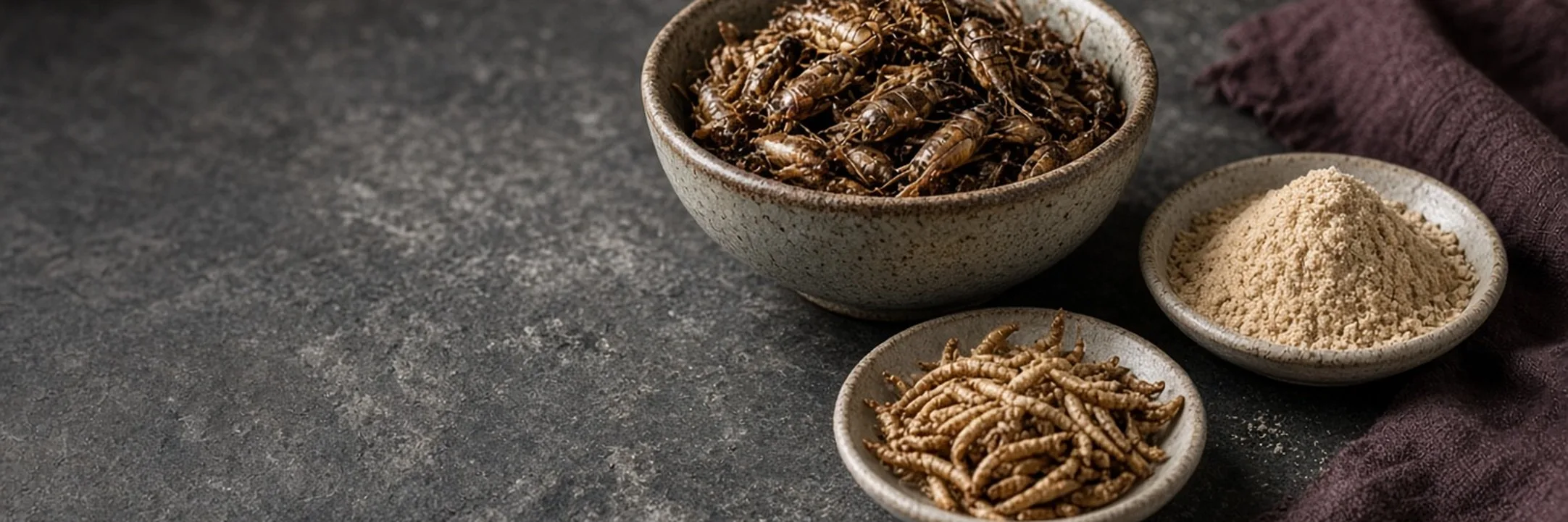
Edible insects in the HMI library has 1,104 reported results for lead, cadmium, total arsenic, total mercury, nickel, chromium, aluminium, antimony, uranium, Co, Cu, Fe, Mn, Zn, Se, Ag, B, Ba, Be, Bi, Ca, K, Li, Mg, Mo, Na, P, Pt, Sr, Tl and W from 12 sources.1GEMS/Food Contaminants database heavy-metal exportsGEMS/Food Contamination Monitoring and Assessment ProgrammeRead source →2Novel Food Safety Evaluation: Potentially Toxic Elements in Acheta domesticus (House Cricket) Reared on Seaweed-Enriched DietsMolecules 2025, 30, 3958Read source →3Multi-Elemental Analysis of Edible Insects, Scorpions, and Tarantulas from French (Online) Market and Human Health Risk Assessment Due to Their Consumption: A Pilot StudyFoods 2024, 13, 2353Read source →4Influence of Feeding Substrates on the Presence of Toxic Metals (Cd, Pb, Ni, As, Hg) in Larvae of Tenebrio molitor: Risk Assessment for Human ConsumptionInternational Journal of Environmental Research and Public Health 2019, 16, 4815Read source →5Entomophagy and chemical element residues: Noncarcinogenic risk assessment for human consumptionPLOS Global Public Health 5(4): e0003462Read source →6Mineral profile of cricket powders, some edible insect species and their implication for gastronomyJournal of Food Composition and Analysis 107 (2022) 104340Read source →
-
Metals measured:
Lead, cadmium, total arsenic, total mercury, nickel and chromium and others, in 1,104 results from 12 sources.1GEMS/Food Contaminants database heavy-metal exportsGEMS/Food Contamination Monitoring and Assessment ProgrammeRead source →2Novel Food Safety Evaluation: Potentially Toxic Elements in Acheta domesticus (House Cricket) Reared on Seaweed-Enriched DietsMolecules 2025, 30, 3958Read source →3Multi-Elemental Analysis of Edible Insects, Scorpions, and Tarantulas from French (Online) Market and Human Health Risk Assessment Due to Their Consumption: A Pilot StudyFoods 2024, 13, 2353Read source →4Influence of Feeding Substrates on the Presence of Toxic Metals (Cd, Pb, Ni, As, Hg) in Larvae of Tenebrio molitor: Risk Assessment for Human ConsumptionInternational Journal of Environmental Research and Public Health 2019, 16, 4815Read source →
-
Main drivers:
Edible insects, as sold from trial 1 control diet, 0% Palmaria palmata (Ctrl-PP) (experiment) had lead higher at 18 µg/kg, against 14 µg/kg for trial 2 control diet, 0% Ascophyllum nodosum (Ctrl-AN) in the same study.2Novel Food Safety Evaluation: Potentially Toxic Elements in Acheta domesticus (House Cricket) Reared on Seaweed-Enriched DietsMolecules 2025, 30, 3958Read source →
-
Practical framing:
Ask for lot results with a quantification limit well below the limit that applies in the destination market.1GEMS/Food Contaminants database heavy-metal exportsGEMS/Food Contamination Monitoring and Assessment ProgrammeRead source →2Novel Food Safety Evaluation: Potentially Toxic Elements in Acheta domesticus (House Cricket) Reared on Seaweed-Enriched DietsMolecules 2025, 30, 3958Read source →3Multi-Elemental Analysis of Edible Insects, Scorpions, and Tarantulas from French (Online) Market and Human Health Risk Assessment Due to Their Consumption: A Pilot StudyFoods 2024, 13, 2353Read source →4Influence of Feeding Substrates on the Presence of Toxic Metals (Cd, Pb, Ni, As, Hg) in Larvae of Tenebrio molitor: Risk Assessment for Human ConsumptionInternational Journal of Environmental Research and Public Health 2019, 16, 4815Read source →
Edible insects overview
Edible insects in the HMI library has 1,104 reported results for lead, cadmium, total arsenic, total mercury, nickel, chromium, aluminium, antimony, uranium, Co, Cu, Fe, Mn, Zn, Se, Ag, B, Ba, Be, Bi, Ca, K, Li, Mg, Mo, Na, P, Pt, Sr, Tl and W from 12 sources.1GEMS/Food Contaminants database heavy-metal exportsGEMS/Food Contamination Monitoring and Assessment ProgrammeRead source →2Novel Food Safety Evaluation: Potentially Toxic Elements in Acheta domesticus (House Cricket) Reared on Seaweed-Enriched DietsMolecules 2025, 30, 3958Read source →3Multi-Elemental Analysis of Edible Insects, Scorpions, and Tarantulas from French (Online) Market and Human Health Risk Assessment Due to Their Consumption: A Pilot StudyFoods 2024, 13, 2353Read source →4Influence of Feeding Substrates on the Presence of Toxic Metals (Cd, Pb, Ni, As, Hg) in Larvae of Tenebrio molitor: Risk Assessment for Human ConsumptionInternational Journal of Environmental Research and Public Health 2019, 16, 4815Read source →5Entomophagy and chemical element residues: Noncarcinogenic risk assessment for human consumptionPLOS Global Public Health 5(4): e0003462Read source →6Mineral profile of cricket powders, some edible insect species and their implication for gastronomyJournal of Food Composition and Analysis 107 (2022) 104340Read source → WHO GEMS/Food submissions reported total arsenic in edible insects, as sold from 2 results in 1 reporting region, with a subgroup median of 21 µg/kg.1GEMS/Food Contaminants database heavy-metal exportsGEMS/Food Contamination Monitoring and Assessment ProgrammeRead source →
Across 2 other studies of ordinary farms and markets, reported lead means and medians on a dry-weight basis ranged from 60 µg/kg (San et al. 2024) to 210 µg/kg (San et al. 2024).7Presence of Trace Elements in Edible Insects Commercialized through Online E-Commerce PlatformToxics 2024, 12, 741Read source → For cadmium, 2 studies on a dry-weight basis reported means and medians from 31 µg/kg (Ezeonyejiaku et al. 2025) to 1,500 µg/kg (San et al. 2024).5Entomophagy and chemical element residues: Noncarcinogenic risk assessment for human consumptionPLOS Global Public Health 5(4): e0003462Read source →7Presence of Trace Elements in Edible Insects Commercialized through Online E-Commerce PlatformToxics 2024, 12, 741Read source → Higher results came from contaminated or exposed settings rather than ordinary supply. Edible insects, as sold from defatted cake after supercritical CO2/ethanol extraction (SFE) had cadmium higher at 281 µg/kg, against 31.5 µg/kg for defatted cake after supercritical CO2/ethanol extraction (SFE) in the same study.8HPLC-MS/MS and ICP-MS for Evaluation of Mycotoxins and Heavy Metals in Edible Insects and Their Defatted Cakes Resulting from Supercritical Fluid ExtractionFoods 2024, 13, 3233Read source →
For a buyer the practical points are the form bought, the basis a result is reported on, where the edible insects came from and the laboratory’s reporting limit. Testing finds contamination but does not remove it.
What counts as edible insects
This page covers edible insects in 6 forms kept separate in every comparison: edible insects, as sold (727 results), edible insects, dried (210 results), edible insects, powder or ground (68 results), edible insects, flour or meal (42 results), edible insects, oil (38 results) and edible insects, frozen (19 results).1GEMS/Food Contaminants database heavy-metal exportsGEMS/Food Contamination Monitoring and Assessment ProgrammeRead source →2Novel Food Safety Evaluation: Potentially Toxic Elements in Acheta domesticus (House Cricket) Reared on Seaweed-Enriched DietsMolecules 2025, 30, 3958Read source →3Multi-Elemental Analysis of Edible Insects, Scorpions, and Tarantulas from French (Online) Market and Human Health Risk Assessment Due to Their Consumption: A Pilot StudyFoods 2024, 13, 2353Read source →4Influence of Feeding Substrates on the Presence of Toxic Metals (Cd, Pb, Ni, As, Hg) in Larvae of Tenebrio molitor: Risk Assessment for Human ConsumptionInternational Journal of Environmental Research and Public Health 2019, 16, 4815Read source →5Entomophagy and chemical element residues: Noncarcinogenic risk assessment for human consumptionPLOS Global Public Health 5(4): e0003462Read source →6Mineral profile of cricket powders, some edible insect species and their implication for gastronomyJournal of Food Composition and Analysis 107 (2022) 104340Read source →
Results stay on the basis each source reports: as sold or fresh weight, dry weight, or unstated. Dry-weight, as-sold and unstated results are never pooled, and no moisture conversion is applied.
Heavy metal contamination profile of edible insects
The table holds every extracted edible insects result: one row for each statistic a source reports for a form, group and metal, 1,104 rows in all, grouped by metal and form; percentiles, ranges and maxima for the same samples as a mean or median are shown on that row.1GEMS/Food Contaminants database heavy-metal exportsGEMS/Food Contamination Monitoring and Assessment ProgrammeRead source →2Novel Food Safety Evaluation: Potentially Toxic Elements in Acheta domesticus (House Cricket) Reared on Seaweed-Enriched DietsMolecules 2025, 30, 3958Read source →3Multi-Elemental Analysis of Edible Insects, Scorpions, and Tarantulas from French (Online) Market and Human Health Risk Assessment Due to Their Consumption: A Pilot StudyFoods 2024, 13, 2353Read source →4Influence of Feeding Substrates on the Presence of Toxic Metals (Cd, Pb, Ni, As, Hg) in Larvae of Tenebrio molitor: Risk Assessment for Human ConsumptionInternational Journal of Environmental Research and Public Health 2019, 16, 4815Read source →5Entomophagy and chemical element residues: Noncarcinogenic risk assessment for human consumptionPLOS Global Public Health 5(4): e0003462Read source →6Mineral profile of cricket powders, some edible insect species and their implication for gastronomyJournal of Food Composition and Analysis 107 (2022) 104340Read source → Monitoring medians are HMI calculations from individual submissions; non-detects remain intervals between zero and the reporting limit and are never read as zero.1GEMS/Food Contaminants database heavy-metal exportsGEMS/Food Contamination Monitoring and Assessment ProgrammeRead source →
678 rows can be rated against an HMI reference for the same form and basis, 124 rows have a direct same-study comparison, and the rest stay unrated with the reason recorded. 1 value from 1 source failed a check against their own source and are shown but not compared.5Entomophagy and chemical element residues: Noncarcinogenic risk assessment for human consumptionPLOS Global Public Health 5(4): e0003462Read source →
Comparison methods and scope
Each row is one statistic a source reports for one form of edible insects, group and metal; percentiles, ranges and maxima reported for the same samples as a mean or median are shown on that row. Different forms and preparation states are kept apart, and dry-weight results never share a reference with as-sold or fresh-weight results. Ratings place a result against an HMI reference built from monitoring results and ordinary-setting medians for the same form and basis. Same-study contrasts compare a contaminated or treated site with its control, targeted with random sampling, a prepared form with the unprocessed one, or one group of a study with the median of its other groups. Held rows failed a check against their own source and are shown but not compared.
First displayed analyte: Lead: 106 findings from 11 sources. Each row retains its statistic and measurement basis.
Filter findings
1098 of 1098 findings · 31 analytes
About this table
| Food form | Collection scope | Finding (µg/kg) | Comparison | Evidence |
|---|---|---|---|---|
66 findings · 9 studies · 2 spread figures folded in | ||||
| Edible insects, as soldAjdini et al. 2025 | trial 1 control diet, 0% Palmaria palmata (Ctrl-PP)Collection date unreportedAs sold / fresh | mean. | ||
| Edible insects, as soldAjdini et al. 2025 | trial 1 diet with 5% Palmaria palmata (PP5)Collection date unreportedAs sold / fresh | mean. | ||
| Edible insects, as soldAjdini et al. 2025 | trial 1 diet with 10% Palmaria palmata (PP10)Collection date unreportedAs sold / fresh | mean. | ||
| Edible insects, as soldAjdini et al. 2025 | trial 1 diet with 20% Palmaria palmata (PP20)Collection date unreportedAs sold / fresh | mean. | ||
| Edible insects, as soldAjdini et al. 2025 | trial 2 control diet, 0% Ascophyllum nodosum (Ctrl-AN)Collection date unreportedAs sold / fresh | mean. | ||
| Edible insects, as soldAjdini et al. 2025 | trial 2 diet with 20% Ascophyllum nodosum (AN20)Collection date unreportedAs sold / fresh | mean. | ||
| Edible insects, as soldAjdini et al. 2025 | trial 2 diet with 40% Ascophyllum nodosum (AN40)Collection date unreportedAs sold / fresh | mean. | ||
| Edible insects, as soldHolowaty et al. 2024 | Ants 1, origin Columbia, French market/onlineCollection date unreportedAs sold / fresh | sample value. | ||
| Edible insects, as soldHolowaty et al. 2024 | Ants 2, origin Columbia, French market/onlineCollection date unreportedAs sold / fresh | sample value. | ||
| Edible insects, as soldHolowaty et al. 2024 | Crickets 4, origin Thailand, French market/onlineCollection date unreportedAs sold / fresh | sample value. | ||
| Edible insects, as soldHolowaty et al. 2024 | Locusts 1, origin origin not stated, French market/onlineCollection date unreportedAs sold / fresh | sample value. | ||
| Edible insects, as soldHolowaty et al. 2024 | Locusts 2, origin origin not stated, French market/onlineCollection date unreportedAs sold / fresh | sample value. | ||
| Edible insects, as soldHolowaty et al. 2024 | Worms 1, origin EU, French market/onlineCollection date unreportedAs sold / fresh | sample value. | ||
| Edible insects, as soldTruzzi et al. 2019 | reared on 25% organic wheatmeal + 75% organic olive-pomaceCollection date unreportedAs sold / fresh | mean. | ||
| Edible insects, as soldTruzzi et al. 2019 | reared on 50% organic wheatmeal + 50% organic olive-pomaceCollection date unreportedAs sold / fresh | mean. | ||
| Edible insects, as soldTruzzi et al. 2019 | reared on 75% organic wheatmeal + 25% organic olive-pomaceCollection date unreportedAs sold / fresh | mean. | ||
| Edible insects, as soldTruzzi et al. 2019 | reared on 100% organic wheat flourCollection date unreportedAs sold / fresh | mean. | ||
| Edible insects, as soldTruzzi et al. 2019 | reared on 100% organic wheatmealCollection date unreportedAs sold / fresh | mean. | ||
| Edible insects, as soldAjdini et al. 2025 | trial 1 control diet, 0% Palmaria palmata (Ctrl-PP)Collection date unreportedDry weight | mean. | ||
| Edible insects, as soldAjdini et al. 2025 | trial 1 diet with 10% Palmaria palmata (PP10)Collection date unreportedDry weight | mean. | ||
| Edible insects, as soldAjdini et al. 2025 | trial 1 diet with 20% Palmaria palmata (PP20)Collection date unreportedDry weight | mean. | ||
| Edible insects, as soldAjdini et al. 2025 | trial 2 control diet, 0% Ascophyllum nodosum (Ctrl-AN)Collection date unreportedDry weight | mean. | ||
| Edible insects, as soldAjdini et al. 2025 | trial 2 diet with 20% Ascophyllum nodosum (AN20)Collection date unreportedDry weight | mean. | ||
| Edible insects, as soldAjdini et al. 2025 | trial 2 diet with 40% Ascophyllum nodosum (AN40)Collection date unreportedDry weight | mean. | ||
| Edible insects, as soldEzeonyejiaku et al. 2025 | market vendors, 12 sites, Anambra State (pooled)Collection date unreportedDry weight | mean. | ||
| Edible insects, as soldEzeonyejiaku et al. 2025 | market vendors, 12 sites, Anambra State (pooled)Collection date unreportedDry weight | mean. | ||
| Edible insects, as soldKosečková et al. 2022 | whole farmed insectsCollection date unreportedDry weight | min. | ||
| Edible insects, as soldKosečková et al. 2022 | whole farmed insectsCollection date unreportedDry weight | min. | ||
| Edible insects, as soldKosečková et al. 2022 | whole farmed insectsCollection date unreportedDry weight | min. | ||
| Edible insects, as soldKosečková et al. 2022 | whole farmed insectsCollection date unreportedDry weight | min. | ||
| Edible insects, as soldKosečková et al. 2022 | whole farmed insectsCollection date unreportedDry weight | max. | ||
| Edible insects, as soldKosečková et al. 2022 | whole farmed insectsCollection date unreportedDry weight | max. | ||
| Edible insects, as soldKosečková et al. 2022 | whole farmed insectsCollection date unreportedDry weight | max. | ||
| Edible insects, as soldKosečková et al. 2022 | whole farmed insectsCollection date unreportedDry weight | max. | ||
| Edible insects, as soldSan et al. 2024 | all 31 products2021Dry weight | mean.Same samples: 11 µg/kg (minimum); 754 µg/kg (maximum) | ||
| Edible insects, as soldSan et al. 2024 | all 31 products2021Dry weight | min. | ||
| Edible insects, as soldSan et al. 2024 | all 31 products2021Dry weight | max. | ||
| Edible insects, as soldSan et al. 2024 | CJ4, labeled origin Spain, insect-based food, % insect not2021Dry weight | sample value. | ||
| Edible insects, as soldSan et al. 2024 | CJ7, labeled origin Mexico, insect-based food, 87% insect2021Dry weight | sample value. | ||
| Edible insects, as soldSan et al. 2024 | CJ8, labeled origin United Kingdom, insect-based food, 87%2021Dry weight | sample value. | ||
| Edible insects, as soldSan et al. 2024 | CJ9, labeled origin Thailand, edible insect, 100% insect2021Dry weight | sample value. | ||
| Edible insects, as soldSan et al. 2024 | CJ10, labeled origin Mexico, insect-based food, 87% insect2021Dry weight | sample value. | ||
| Edible insects, as soldSan et al. 2024 | CJ11, labeled origin Colombia, edible insect, 99.5% insect2021Dry weight | sample value. | ||
| Edible insects, as soldSan et al. 2024 | CJ12, labeled origin United Kingdom, edible insect, 87% insect2021Dry weight | sample value. | ||
| Edible insects, as soldSan et al. 2024 | CJ13, labeled origin Netherlands and United Kingdom,2021Dry weight | sample value. | ||
| Edible insects, as soldSan et al. 2024 | CJ14, labeled origin Spain, insect-based food, 5% insect2021Dry weight | sample value. | ||
| Edible insects, as soldSan et al. 2024 | CJ15, labeled origin United Kingdom, insect-based food, 83%2021Dry weight | sample value. | ||
| Edible insects, as soldSan et al. 2024 | CJ17, labeled origin Mexico, insect-based food, 73% insect2021Dry weight | sample value. | ||
| Edible insects, as soldSan et al. 2024 | CJ18, labeled origin Netherlands and United Kingdom,2021Dry weight | sample value. | ||
| Edible insects, as soldSan et al. 2024 | CJ19, labeled origin Mexico, insect-based food, 73% insect2021Dry weight | sample value. | ||
| Edible insects, as soldSan et al. 2024 | CJ22, labeled origin Finland, insect-based food, 7.5% insect2021Dry weight | sample value. | ||
| Edible insects, as soldSan et al. 2024 | CJ23, labeled origin United Kingdom, insect-based food, 83%2021Dry weight | sample value. | ||
| Edible insects, as soldSan et al. 2024 | CJ27, labeled origin Spain, insect-based food, 5% insect2021Dry weight | sample value. | ||
| Edible insects, as soldSan et al. 2024 | CJ31, labeled origin Finland, insect-based food, 7.5% insect2021Dry weight | sample value. | ||
| Edible insects, as soldSan et al. 2024 | products of America origin2021Dry weight | mean. | ||
| Edible insects, as soldSan et al. 2024 | products of Asia origin2021Dry weight | mean. | ||
| Edible insects, as soldSan et al. 2024 | products of Europe origin2021Dry weight | mean. | ||
| Edible insects, as soldBanjo et al. 2013 | after 3 months of storage, Ijebu division (Ogun State)Collection date unreportedBasis not stated | sample value. | ||
| Edible insects, as soldBanjo et al. 2013 | after 3 months of storage, Ijebu division (Ogun State)Collection date unreportedBasis not stated | sample value. | ||
| Edible insects, as soldBanjo et al. 2013 | initial reading, freshly caught, Ijebu division (Ogun State)Collection date unreportedBasis not stated | sample value. | ||
| Edible insects, as soldBanjo et al. 2013 | initial reading, freshly caught, Ijebu division (Ogun State)Collection date unreportedBasis not stated | sample value. | ||
| Edible insects, as soldCuesta et al. 2024 | defatted cake after supercritical CO2/ethanol extraction (SFE)Collection date unreportedBasis not stated | mean. | ||
| Edible insects, as soldCuesta et al. 2024 | raw material, local market, ValenciaCollection date unreportedBasis not stated | mean. | ||
| Edible insects, as soldCuesta et al. 2024 | raw material, local market, ValenciaCollection date unreportedBasis not stated | mean. | ||
| Edible insects, as soldMintah et al. 2026 | boiled palm weevil larvae (Bo-PWL)Collection date unreportedBasis not stated | mean. | ||
| Edible insects, as soldMintah et al. 2026 | fresh/raw palm weevil larvae (F-PWL)Collection date unreportedBasis not stated | mean. | ||
| Edible insects, as soldMintah et al. 2026 | fried palm weevil larvae (Fd-PWL)Collection date unreportedBasis not stated | mean. | ||
| Edible insects, as soldMintah et al. 2026 | roasted palm weevil larvae (Ro-PWL)Collection date unreportedBasis not stated | mean. | ||
15 findings · 2 studies | ||||
| Edible insects, driedEFSA NDA Panel 2024 | production batch #49Collection date unreportedAs sold / fresh | sample value. | ||
| Edible insects, driedEFSA NDA Panel 2024 | production batch #50Collection date unreportedAs sold / fresh | sample value. | ||
| Edible insects, driedEFSA NDA Panel 2024 | production batch #51Collection date unreportedAs sold / fresh | not detected. | ||
| Edible insects, driedEFSA NDA Panel 2024 | production batch #52Collection date unreportedAs sold / fresh | sample value. | ||
| Edible insects, driedEFSA NDA Panel 2024 | production batch #53Collection date unreportedAs sold / fresh | sample value. | ||
| Edible insects, driedHolowaty et al. 2024 | Crickets 1, origin Toulouse, France, French market/onlineCollection date unreportedAs sold / fresh | sample value. | ||
| Edible insects, driedHolowaty et al. 2024 | Crickets 2, origin Toulouse, France, French market/onlineCollection date unreportedAs sold / fresh | sample value. | ||
| Edible insects, driedHolowaty et al. 2024 | Crickets 3, origin Toulouse, France, French market/onlineCollection date unreportedAs sold / fresh | sample value. | ||
| Edible insects, driedHolowaty et al. 2024 | Crickets 5, origin origin not stated, French market/onlineCollection date unreportedAs sold / fresh | sample value. | ||
| Edible insects, driedHolowaty et al. 2024 | Crickets 6, origin origin not stated, French market/onlineCollection date unreportedAs sold / fresh | sample value. | ||
| Edible insects, driedHolowaty et al. 2024 | Crickets 7, origin Netherlands, French market/onlineCollection date unreportedAs sold / fresh | sample value. | ||
| Edible insects, driedHolowaty et al. 2024 | Crickets 8, origin Netherlands, French market/onlineCollection date unreportedAs sold / fresh | sample value. | ||
| Edible insects, driedHolowaty et al. 2024 | Worms 4, origin Toulouse, France, French market/onlineCollection date unreportedAs sold / fresh | sample value. | ||
| Edible insects, driedHolowaty et al. 2024 | Worms 5, origin Toulouse, France, French market/onlineCollection date unreportedAs sold / fresh | sample value. | ||
| Edible insects, driedHolowaty et al. 2024 | Worms 6, origin Toulouse, France, French market/onlineCollection date unreportedAs sold / fresh | sample value. | ||
12 findings · 3 studies | ||||
| Edible insects, powder or groundEFSA NDA Panel 2024 | production batch #59Collection date unreportedAs sold / fresh | sample value. | ||
| Edible insects, powder or groundEFSA NDA Panel 2024 | production batch #60Collection date unreportedAs sold / fresh | sample value. | ||
| Edible insects, powder or groundEFSA NDA Panel 2024 | production batch #61Collection date unreportedAs sold / fresh | sample value. | ||
| Edible insects, powder or groundEFSA NDA Panel 2024 | production batch #62Collection date unreportedAs sold / fresh | sample value. | ||
| Edible insects, powder or groundEFSA NDA Panel 2024 | production batch #63Collection date unreportedAs sold / fresh | sample value. | ||
| Edible insects, powder or groundEFSA NDA Panel 2026 | production batch #1Collection date unreportedAs sold / fresh | sample value. | ||
| Edible insects, powder or groundEFSA NDA Panel 2026 | production batch #2Collection date unreportedAs sold / fresh | sample value. | ||
| Edible insects, powder or groundEFSA NDA Panel 2026 | production batch #3Collection date unreportedAs sold / fresh | sample value. | ||
| Edible insects, powder or groundEFSA NDA Panel 2026 | production batch #4Collection date unreportedAs sold / fresh | sample value. | ||
| Edible insects, powder or groundEFSA NDA Panel 2026 | production batch #5Collection date unreportedAs sold / fresh | sample value. | ||
| Edible insects, powder or groundKosečková et al. 2022 | commercial cricket powderCollection date unreportedDry weight | min. | ||
| Edible insects, powder or groundKosečková et al. 2022 | commercial cricket powderCollection date unreportedDry weight | max. | ||
4 findings · 2 studies | ||||
| Edible insects, flour or mealSan et al. 2024 | CJ5, labeled origin Thailand, edible insect, 100% insect2021Dry weight | sample value. | ||
| Edible insects, flour or mealSan et al. 2024 | CJ20, labeled origin Belgium, edible insect, 97% insect2021Dry weight | sample value. | ||
| Edible insects, flour or mealCuesta et al. 2024 | raw material, local market, ValenciaCollection date unreportedBasis not stated | mean. | ||
| Edible insects, flour or mealCuesta et al. 2024 | raw material, local market, ValenciaCollection date unreportedBasis not stated | mean. | ||
2 findings · 1 study | ||||
| Edible insects, oilHolowaty et al. 2024 | Water bug 1, origin origin not stated, French market/onlineCollection date unreportedAs sold / fresh | sample value. | ||
| Edible insects, oilHolowaty et al. 2024 | Water bug 2, origin origin not stated, French market/onlineCollection date unreportedAs sold / fresh | sample value. | ||
5 findings · 1 study | ||||
| Edible insects, frozenEFSA NDA Panel 2024 | production batch #3Collection date unreportedAs sold / fresh | sample value. | ||
| Edible insects, frozenEFSA NDA Panel 2024 | production batch #4Collection date unreportedAs sold / fresh | sample value. | ||
| Edible insects, frozenEFSA NDA Panel 2024 | production batch #5Collection date unreportedAs sold / fresh | sample value. | ||
| Edible insects, frozenEFSA NDA Panel 2024 | production batch #9Collection date unreportedAs sold / fresh | sample value. | ||
| Edible insects, frozenEFSA NDA Panel 2024 | production batch #10Collection date unreportedAs sold / fresh | sample value. | ||
67 findings · 9 studies · 1 spread figure folded in | ||||
| Edible insects, as soldAjdini et al. 2025 | trial 1 control diet, 0% Palmaria palmata (Ctrl-PP)Collection date unreportedAs sold / fresh | mean. | ||
| Edible insects, as soldAjdini et al. 2025 | trial 1 diet with 5% Palmaria palmata (PP5)Collection date unreportedAs sold / fresh | mean. | ||
| Edible insects, as soldAjdini et al. 2025 | trial 1 diet with 10% Palmaria palmata (PP10)Collection date unreportedAs sold / fresh | mean. | ||
| Edible insects, as soldAjdini et al. 2025 | trial 1 diet with 20% Palmaria palmata (PP20)Collection date unreportedAs sold / fresh | mean. | ||
| Edible insects, as soldAjdini et al. 2025 | trial 2 control diet, 0% Ascophyllum nodosum (Ctrl-AN)Collection date unreportedAs sold / fresh | mean. | ||
| Edible insects, as soldAjdini et al. 2025 | trial 2 diet with 20% Ascophyllum nodosum (AN20)Collection date unreportedAs sold / fresh | mean. | ||
| Edible insects, as soldAjdini et al. 2025 | trial 2 diet with 40% Ascophyllum nodosum (AN40)Collection date unreportedAs sold / fresh | mean. | ||
| Edible insects, as soldHolowaty et al. 2024 | Ants 1, origin Columbia, French market/onlineCollection date unreportedAs sold / fresh | sample value. | ||
| Edible insects, as soldHolowaty et al. 2024 | Ants 2, origin Columbia, French market/onlineCollection date unreportedAs sold / fresh | sample value. | ||
| Edible insects, as soldHolowaty et al. 2024 | Crickets 4, origin Thailand, French market/onlineCollection date unreportedAs sold / fresh | sample value. | ||
| Edible insects, as soldHolowaty et al. 2024 | Locusts 1, origin origin not stated, French market/onlineCollection date unreportedAs sold / fresh | sample value. | ||
| Edible insects, as soldHolowaty et al. 2024 | Locusts 2, origin origin not stated, French market/onlineCollection date unreportedAs sold / fresh | sample value. | ||
| Edible insects, as soldHolowaty et al. 2024 | Worms 1, origin EU, French market/onlineCollection date unreportedAs sold / fresh | sample value. | ||
| Edible insects, as soldTruzzi et al. 2019 | reared on 25% organic wheatmeal + 75% organic olive-pomaceCollection date unreportedAs sold / fresh | mean. | ||
| Edible insects, as soldTruzzi et al. 2019 | reared on 50% organic wheatmeal + 50% organic olive-pomaceCollection date unreportedAs sold / fresh | mean. | ||
| Edible insects, as soldTruzzi et al. 2019 | reared on 75% organic wheatmeal + 25% organic olive-pomaceCollection date unreportedAs sold / fresh | mean. | ||
| Edible insects, as soldTruzzi et al. 2019 | reared on 100% organic wheat flourCollection date unreportedAs sold / fresh | mean. | ||
| Edible insects, as soldTruzzi et al. 2019 | reared on 100% organic wheatmealCollection date unreportedAs sold / fresh | mean. | ||
| Edible insects, as soldAjdini et al. 2025 | trial 1, all dietsCollection date unreportedDry weight | mean. | ||
| Edible insects, as soldAjdini et al. 2025 | trial 2 control diet, 0% Ascophyllum nodosum (Ctrl-AN)Collection date unreportedDry weight | mean. | ||
| Edible insects, as soldAjdini et al. 2025 | trial 2 diet with 40% Ascophyllum nodosum (AN40)Collection date unreportedDry weight | mean. | ||
| Edible insects, as soldEzeonyejiaku et al. 2025 | market vendors, 12 sites, Anambra State (pooled)Collection date unreportedDry weight | mean. | ||
| Edible insects, as soldEzeonyejiaku et al. 2025 | market vendors, 12 sites, Anambra State (pooled)Collection date unreportedDry weight | mean. | ||
| Edible insects, as soldKosečková et al. 2022 | whole farmed insectsCollection date unreportedDry weight | min. | ||
| Edible insects, as soldKosečková et al. 2022 | whole farmed insectsCollection date unreportedDry weight | min. | ||
| Edible insects, as soldKosečková et al. 2022 | whole farmed insectsCollection date unreportedDry weight | min. | ||
| Edible insects, as soldKosečková et al. 2022 | whole farmed insectsCollection date unreportedDry weight | min. | ||
| Edible insects, as soldKosečková et al. 2022 | whole farmed insectsCollection date unreportedDry weight | max. | ||
| Edible insects, as soldKosečková et al. 2022 | whole farmed insectsCollection date unreportedDry weight | max. | ||
| Edible insects, as soldKosečková et al. 2022 | whole farmed insectsCollection date unreportedDry weight | max. | ||
| Edible insects, as soldKosečková et al. 2022 | whole farmed insectsCollection date unreportedDry weight | max. | ||
| Edible insects, as soldSan et al. 2024 | all 31 products2021Dry weight | mean.Same samples: 4,530 µg/kg (maximum) | ||
| Edible insects, as soldSan et al. 2024 | all 31 products2021Dry weight | min. | ||
| Edible insects, as soldSan et al. 2024 | all 31 products2021Dry weight | max. | ||
| Edible insects, as soldSan et al. 2024 | CJ4, labeled origin Spain, insect-based food, % insect not2021Dry weight | sample value. | ||
| Edible insects, as soldSan et al. 2024 | CJ7, labeled origin Mexico, insect-based food, 87% insect2021Dry weight | sample value. | ||
| Edible insects, as soldSan et al. 2024 | CJ8, labeled origin United Kingdom, insect-based food, 87%2021Dry weight | not detected. | ||
| Edible insects, as soldSan et al. 2024 | CJ9, labeled origin Thailand, edible insect, 100% insect2021Dry weight | sample value. | ||
| Edible insects, as soldSan et al. 2024 | CJ10, labeled origin Mexico, insect-based food, 87% insect2021Dry weight | sample value. | ||
| Edible insects, as soldSan et al. 2024 | CJ11, labeled origin Colombia, edible insect, 99.5% insect2021Dry weight | not detected. | ||
| Edible insects, as soldSan et al. 2024 | CJ12, labeled origin United Kingdom, edible insect, 87% insect2021Dry weight | sample value. | ||
| Edible insects, as soldSan et al. 2024 | CJ13, labeled origin Netherlands and United Kingdom,2021Dry weight | sample value. | ||
| Edible insects, as soldSan et al. 2024 | CJ14, labeled origin Spain, insect-based food, 5% insect2021Dry weight | sample value. | ||
| Edible insects, as soldSan et al. 2024 | CJ15, labeled origin United Kingdom, insect-based food, 83%2021Dry weight | sample value. | ||
| Edible insects, as soldSan et al. 2024 | CJ17, labeled origin Mexico, insect-based food, 73% insect2021Dry weight | sample value. | ||
| Edible insects, as soldSan et al. 2024 | CJ18, labeled origin Netherlands and United Kingdom,2021Dry weight | sample value. | ||
| Edible insects, as soldSan et al. 2024 | CJ19, labeled origin Mexico, insect-based food, 73% insect2021Dry weight | sample value. | ||
| Edible insects, as soldSan et al. 2024 | CJ22, labeled origin Finland, insect-based food, 7.5% insect2021Dry weight | not detected. | ||
| Edible insects, as soldSan et al. 2024 | CJ23, labeled origin United Kingdom, insect-based food, 83%2021Dry weight | sample value. | ||
| Edible insects, as soldSan et al. 2024 | CJ27, labeled origin Spain, insect-based food, 5% insect2021Dry weight | sample value. | ||
| Edible insects, as soldSan et al. 2024 | CJ31, labeled origin Finland, insect-based food, 7.5% insect2021Dry weight | not detected. | ||
| Edible insects, as soldSan et al. 2024 | products of America origin2021Dry weight | mean. | ||
| Edible insects, as soldSan et al. 2024 | products of Asia origin2021Dry weight | mean. | ||
| Edible insects, as soldSan et al. 2024 | products of Europe origin2021Dry weight | mean. | ||
| Edible insects, as soldBanjo et al. 2013 | after 3 months of storage, Ijebu division (Ogun State)Collection date unreportedBasis not stated | sample value. | ||
| Edible insects, as soldBanjo et al. 2013 | after 3 months of storage, Ijebu division (Ogun State)Collection date unreportedBasis not stated | sample value. | ||
| Edible insects, as soldBanjo et al. 2013 | initial reading, freshly caught, Ijebu division (Ogun State)Collection date unreportedBasis not stated | sample value. | ||
| Edible insects, as soldBanjo et al. 2013 | initial reading, freshly caught, Ijebu division (Ogun State)Collection date unreportedBasis not stated | sample value. | ||
| Edible insects, as soldCuesta et al. 2024 | defatted cake after supercritical CO2/ethanol extraction (SFE)Collection date unreportedBasis not stated | mean. | ||
| Edible insects, as soldCuesta et al. 2024 | defatted cake after supercritical CO2/ethanol extraction (SFE)Collection date unreportedBasis not stated | mean. | ||
| Edible insects, as soldCuesta et al. 2024 | defatted cake after supercritical CO2/ethanol extraction (SFE)Collection date unreportedBasis not stated | mean. | ||
| Edible insects, as soldCuesta et al. 2024 | defatted cake after supercritical CO2/ethanol extraction (SFE)Collection date unreportedBasis not stated | mean. | ||
| Edible insects, as soldCuesta et al. 2024 | raw material, local market, ValenciaCollection date unreportedBasis not stated | mean. | ||
| Edible insects, as soldCuesta et al. 2024 | raw material, local market, ValenciaCollection date unreportedBasis not stated | mean. | ||
| Edible insects, as soldMintah et al. 2026 | boiled palm weevil larvae (Bo-PWL)Collection date unreportedBasis not stated | mean. | ||
| Edible insects, as soldMintah et al. 2026 | fresh/raw palm weevil larvae (F-PWL)Collection date unreportedBasis not stated | mean. | ||
| Edible insects, as soldMintah et al. 2026 | fried palm weevil larvae (Fd-PWL)Collection date unreportedBasis not stated | mean. | ||
| Edible insects, as soldMintah et al. 2026 | roasted palm weevil larvae (Ro-PWL)Collection date unreportedBasis not stated | mean. | ||
15 findings · 2 studies | ||||
| Edible insects, driedEFSA NDA Panel 2024 | production batch #49Collection date unreportedAs sold / fresh | sample value. | ||
| Edible insects, driedEFSA NDA Panel 2024 | production batch #50Collection date unreportedAs sold / fresh | sample value. | ||
| Edible insects, driedEFSA NDA Panel 2024 | production batch #51Collection date unreportedAs sold / fresh | sample value. | ||
| Edible insects, driedEFSA NDA Panel 2024 | production batch #52Collection date unreportedAs sold / fresh | sample value. | ||
| Edible insects, driedEFSA NDA Panel 2024 | production batch #53Collection date unreportedAs sold / fresh | sample value. | ||
| Edible insects, driedHolowaty et al. 2024 | Crickets 1, origin Toulouse, France, French market/onlineCollection date unreportedAs sold / fresh | sample value. | ||
| Edible insects, driedHolowaty et al. 2024 | Crickets 2, origin Toulouse, France, French market/onlineCollection date unreportedAs sold / fresh | sample value. | ||
| Edible insects, driedHolowaty et al. 2024 | Crickets 3, origin Toulouse, France, French market/onlineCollection date unreportedAs sold / fresh | sample value. | ||
| Edible insects, driedHolowaty et al. 2024 | Crickets 5, origin origin not stated, French market/onlineCollection date unreportedAs sold / fresh | sample value. | ||
| Edible insects, driedHolowaty et al. 2024 | Crickets 6, origin origin not stated, French market/onlineCollection date unreportedAs sold / fresh | sample value. | ||
| Edible insects, driedHolowaty et al. 2024 | Crickets 7, origin Netherlands, French market/onlineCollection date unreportedAs sold / fresh | sample value. | ||
| Edible insects, driedHolowaty et al. 2024 | Crickets 8, origin Netherlands, French market/onlineCollection date unreportedAs sold / fresh | sample value. | ||
| Edible insects, driedHolowaty et al. 2024 | Worms 4, origin Toulouse, France, French market/onlineCollection date unreportedAs sold / fresh | sample value. | ||
| Edible insects, driedHolowaty et al. 2024 | Worms 5, origin Toulouse, France, French market/onlineCollection date unreportedAs sold / fresh | sample value. | ||
| Edible insects, driedHolowaty et al. 2024 | Worms 6, origin Toulouse, France, French market/onlineCollection date unreportedAs sold / fresh | sample value. | ||
12 findings · 3 studies | ||||
| Edible insects, powder or groundEFSA NDA Panel 2024 | production batch #59Collection date unreportedAs sold / fresh | sample value. | ||
| Edible insects, powder or groundEFSA NDA Panel 2024 | production batch #60Collection date unreportedAs sold / fresh | sample value. | ||
| Edible insects, powder or groundEFSA NDA Panel 2024 | production batch #61Collection date unreportedAs sold / fresh | sample value. | ||
| Edible insects, powder or groundEFSA NDA Panel 2024 | production batch #62Collection date unreportedAs sold / fresh | sample value. | ||
| Edible insects, powder or groundEFSA NDA Panel 2024 | production batch #63Collection date unreportedAs sold / fresh | sample value. | ||
| Edible insects, powder or groundEFSA NDA Panel 2026 | production batch #1Collection date unreportedAs sold / fresh | sample value. | ||
| Edible insects, powder or groundEFSA NDA Panel 2026 | production batch #2Collection date unreportedAs sold / fresh | sample value. | ||
| Edible insects, powder or groundEFSA NDA Panel 2026 | production batch #3Collection date unreportedAs sold / fresh | sample value. | ||
| Edible insects, powder or groundEFSA NDA Panel 2026 | production batch #4Collection date unreportedAs sold / fresh | sample value. | ||
| Edible insects, powder or groundEFSA NDA Panel 2026 | production batch #5Collection date unreportedAs sold / fresh | sample value. | ||
| Edible insects, powder or groundKosečková et al. 2022 | commercial cricket powderCollection date unreportedDry weight | min. | ||
| Edible insects, powder or groundKosečková et al. 2022 | commercial cricket powderCollection date unreportedDry weight | max. | ||
4 findings · 2 studies | ||||
| Edible insects, flour or mealSan et al. 2024 | CJ5, labeled origin Thailand, edible insect, 100% insect2021Dry weight | sample value. | ||
| Edible insects, flour or mealSan et al. 2024 | CJ20, labeled origin Belgium, edible insect, 97% insect2021Dry weight | sample value. | ||
| Edible insects, flour or mealCuesta et al. 2024 | raw material, local market, ValenciaCollection date unreportedBasis not stated | mean. | ||
| Edible insects, flour or mealCuesta et al. 2024 | raw material, local market, ValenciaCollection date unreportedBasis not stated | mean. | ||
2 findings · 1 study | ||||
| Edible insects, oilHolowaty et al. 2024 | Water bug 1, origin origin not stated, French market/onlineCollection date unreportedAs sold / fresh | sample value. | ||
| Edible insects, oilHolowaty et al. 2024 | Water bug 2, origin origin not stated, French market/onlineCollection date unreportedAs sold / fresh | sample value. | ||
4 findings · 1 study | ||||
| Edible insects, frozenEFSA NDA Panel 2024 | production batch #2Collection date unreportedAs sold / fresh | sample value. | ||
| Edible insects, frozenEFSA NDA Panel 2024 | production batch #3Collection date unreportedAs sold / fresh | sample value. | ||
| Edible insects, frozenEFSA NDA Panel 2024 | production batch #4Collection date unreportedAs sold / fresh | sample value. | ||
| Edible insects, frozenEFSA NDA Panel 2024 | production batch #5Collection date unreportedAs sold / fresh | sample value. | ||
54 findings · 8 studies · 1 spread figure folded in | ||||
| Edible insects, as soldWHO GEMS/Food | EURO2023As sold / fresh | median. | ||
| Edible insects, as soldAjdini et al. 2025 | trial 1 control diet, 0% Palmaria palmata (Ctrl-PP)Collection date unreportedAs sold / fresh | mean. | ||
| Edible insects, as soldAjdini et al. 2025 | trial 1 diet with 5% Palmaria palmata (PP5)Collection date unreportedAs sold / fresh | mean. | ||
| Edible insects, as soldAjdini et al. 2025 | trial 1 diet with 10% Palmaria palmata (PP10)Collection date unreportedAs sold / fresh | mean. | ||
| Edible insects, as soldAjdini et al. 2025 | trial 1 diet with 20% Palmaria palmata (PP20)Collection date unreportedAs sold / fresh | mean. | ||
| Edible insects, as soldAjdini et al. 2025 | trial 2 control diet, 0% Ascophyllum nodosum (Ctrl-AN)Collection date unreportedAs sold / fresh | mean. | ||
| Edible insects, as soldAjdini et al. 2025 | trial 2 diet with 20% Ascophyllum nodosum (AN20)Collection date unreportedAs sold / fresh | mean. | ||
| Edible insects, as soldAjdini et al. 2025 | trial 2 diet with 40% Ascophyllum nodosum (AN40)Collection date unreportedAs sold / fresh | mean. | ||
| Edible insects, as soldHolowaty et al. 2024 | Ants 1, origin Columbia, French market/onlineCollection date unreportedAs sold / fresh | sample value. | ||
| Edible insects, as soldHolowaty et al. 2024 | Ants 2, origin Columbia, French market/onlineCollection date unreportedAs sold / fresh | sample value. | ||
| Edible insects, as soldHolowaty et al. 2024 | Crickets 4, origin Thailand, French market/onlineCollection date unreportedAs sold / fresh | sample value. | ||
| Edible insects, as soldHolowaty et al. 2024 | Locusts 1, origin origin not stated, French market/onlineCollection date unreportedAs sold / fresh | sample value. | ||
| Edible insects, as soldHolowaty et al. 2024 | Locusts 2, origin origin not stated, French market/onlineCollection date unreportedAs sold / fresh | sample value. | ||
| Edible insects, as soldHolowaty et al. 2024 | Worms 1, origin EU, French market/onlineCollection date unreportedAs sold / fresh | sample value. | ||
| Edible insects, as soldTruzzi et al. 2019 | reared on 25% organic wheatmeal + 75% organic olive-pomaceCollection date unreportedAs sold / fresh | mean. | ||
| Edible insects, as soldTruzzi et al. 2019 | reared on 50% organic wheatmeal + 50% organic olive-pomaceCollection date unreportedAs sold / fresh | mean. | ||
| Edible insects, as soldTruzzi et al. 2019 | reared on 75% organic wheatmeal + 25% organic olive-pomaceCollection date unreportedAs sold / fresh | mean. | ||
| Edible insects, as soldTruzzi et al. 2019 | reared on 100% organic wheat flourCollection date unreportedAs sold / fresh | mean. | ||
| Edible insects, as soldTruzzi et al. 2019 | reared on 100% organic wheatmealCollection date unreportedAs sold / fresh | mean. | ||
| Edible insects, as soldAjdini et al. 2025 | trial 1 control diet, 0% Palmaria palmata (Ctrl-PP)Collection date unreportedDry weight | mean. | ||
| Edible insects, as soldAjdini et al. 2025 | trial 1 diet with 20% Palmaria palmata (PP20)Collection date unreportedDry weight | mean. | ||
| Edible insects, as soldAjdini et al. 2025 | trial 2 control diet, 0% Ascophyllum nodosum (Ctrl-AN)Collection date unreportedDry weight | mean. | ||
| Edible insects, as soldAjdini et al. 2025 | trial 2 diet with 40% Ascophyllum nodosum (AN40)Collection date unreportedDry weight | mean. | ||
| Edible insects, as soldEzeonyejiaku et al. 2025 | market vendors, 12 sites, Anambra State (pooled)Collection date unreportedDry weight | not detected. | ||
| Edible insects, as soldEzeonyejiaku et al. 2025 | market vendors, 12 sites, Anambra State (pooled)Collection date unreportedDry weight | not detected. | ||
| Edible insects, as soldSan et al. 2024 | all 31 products2021Dry weight | mean.Same samples: 1,770 µg/kg (maximum) | ||
| Edible insects, as soldSan et al. 2024 | all 31 products2021Dry weight | min. | ||
| Edible insects, as soldSan et al. 2024 | all 31 products2021Dry weight | max. | ||
| Edible insects, as soldSan et al. 2024 | CJ4, labeled origin Spain, insect-based food, % insect not2021Dry weight | sample value. | ||
| Edible insects, as soldSan et al. 2024 | CJ7, labeled origin Mexico, insect-based food, 87% insect2021Dry weight | sample value. | ||
| Edible insects, as soldSan et al. 2024 | CJ8, labeled origin United Kingdom, insect-based food, 87%2021Dry weight | sample value. | ||
| Edible insects, as soldSan et al. 2024 | CJ9, labeled origin Thailand, edible insect, 100% insect2021Dry weight | sample value. | ||
| Edible insects, as soldSan et al. 2024 | CJ10, labeled origin Mexico, insect-based food, 87% insect2021Dry weight | not detected. | ||
| Edible insects, as soldSan et al. 2024 | CJ11, labeled origin Colombia, edible insect, 99.5% insect2021Dry weight | not detected. | ||
| Edible insects, as soldSan et al. 2024 | CJ12, labeled origin United Kingdom, edible insect, 87% insect2021Dry weight | not detected. | ||
| Edible insects, as soldSan et al. 2024 | CJ13, labeled origin Netherlands and United Kingdom,2021Dry weight | sample value. | ||
| Edible insects, as soldSan et al. 2024 | CJ14, labeled origin Spain, insect-based food, 5% insect2021Dry weight | sample value. | ||
| Edible insects, as soldSan et al. 2024 | CJ15, labeled origin United Kingdom, insect-based food, 83%2021Dry weight | sample value. | ||
| Edible insects, as soldSan et al. 2024 | CJ17, labeled origin Mexico, insect-based food, 73% insect2021Dry weight | sample value. | ||
| Edible insects, as soldSan et al. 2024 | CJ18, labeled origin Netherlands and United Kingdom,2021Dry weight | sample value. | ||
| Edible insects, as soldSan et al. 2024 | CJ19, labeled origin Mexico, insect-based food, 73% insect2021Dry weight | sample value. | ||
| Edible insects, as soldSan et al. 2024 | CJ22, labeled origin Finland, insect-based food, 7.5% insect2021Dry weight | sample value. | ||
| Edible insects, as soldSan et al. 2024 | CJ23, labeled origin United Kingdom, insect-based food, 83%2021Dry weight | not detected. | ||
| Edible insects, as soldSan et al. 2024 | CJ27, labeled origin Spain, insect-based food, 5% insect2021Dry weight | sample value. | ||
| Edible insects, as soldSan et al. 2024 | CJ31, labeled origin Finland, insect-based food, 7.5% insect2021Dry weight | not detected. | ||
| Edible insects, as soldSan et al. 2024 | products of America origin2021Dry weight | mean. | ||
| Edible insects, as soldSan et al. 2024 | products of Asia origin2021Dry weight | mean. | ||
| Edible insects, as soldSan et al. 2024 | products of Europe origin2021Dry weight | mean. | ||
| Edible insects, as soldCuesta et al. 2024 | defatted cake after supercritical CO2/ethanol extraction (SFE)Collection date unreportedBasis not stated | mean. | ||
| Edible insects, as soldCuesta et al. 2024 | raw material, local market, ValenciaCollection date unreportedBasis not stated | mean. | ||
| Edible insects, as soldCuesta et al. 2024 | raw material, local market, ValenciaCollection date unreportedBasis not stated | not detected. | ||
| Edible insects, as soldMintah et al. 2026 | boiled palm weevil larvae (Bo-PWL)Collection date unreportedBasis not stated | not detected. | ||
| Edible insects, as soldMintah et al. 2026 | fresh/raw palm weevil larvae (F-PWL)Collection date unreportedBasis not stated | not detected. | ||
| Edible insects, as soldMintah et al. 2026 | fried palm weevil larvae (Fd-PWL)Collection date unreportedBasis not stated | not detected. | ||
| Edible insects, as soldMintah et al. 2026 | roasted palm weevil larvae (Ro-PWL)Collection date unreportedBasis not stated | not detected. | ||
15 findings · 2 studies | ||||
| Edible insects, driedEFSA NDA Panel 2024 | production batch #49Collection date unreportedAs sold / fresh | sample value. | ||
| Edible insects, driedEFSA NDA Panel 2024 | production batch #50Collection date unreportedAs sold / fresh | sample value. | ||
| Edible insects, driedEFSA NDA Panel 2024 | production batch #51Collection date unreportedAs sold / fresh | sample value. | ||
| Edible insects, driedEFSA NDA Panel 2024 | production batch #52Collection date unreportedAs sold / fresh | sample value. | ||
| Edible insects, driedEFSA NDA Panel 2024 | production batch #53Collection date unreportedAs sold / fresh | sample value. | ||
| Edible insects, driedHolowaty et al. 2024 | Crickets 1, origin Toulouse, France, French market/onlineCollection date unreportedAs sold / fresh | sample value. | ||
| Edible insects, driedHolowaty et al. 2024 | Crickets 2, origin Toulouse, France, French market/onlineCollection date unreportedAs sold / fresh | sample value. | ||
| Edible insects, driedHolowaty et al. 2024 | Crickets 3, origin Toulouse, France, French market/onlineCollection date unreportedAs sold / fresh | sample value. | ||
| Edible insects, driedHolowaty et al. 2024 | Crickets 5, origin origin not stated, French market/onlineCollection date unreportedAs sold / fresh | sample value. | ||
| Edible insects, driedHolowaty et al. 2024 | Crickets 6, origin origin not stated, French market/onlineCollection date unreportedAs sold / fresh | sample value. | ||
| Edible insects, driedHolowaty et al. 2024 | Crickets 7, origin Netherlands, French market/onlineCollection date unreportedAs sold / fresh | sample value. | ||
| Edible insects, driedHolowaty et al. 2024 | Crickets 8, origin Netherlands, French market/onlineCollection date unreportedAs sold / fresh | sample value. | ||
| Edible insects, driedHolowaty et al. 2024 | Worms 4, origin Toulouse, France, French market/onlineCollection date unreportedAs sold / fresh | sample value. | ||
| Edible insects, driedHolowaty et al. 2024 | Worms 5, origin Toulouse, France, French market/onlineCollection date unreportedAs sold / fresh | sample value. | ||
| Edible insects, driedHolowaty et al. 2024 | Worms 6, origin Toulouse, France, French market/onlineCollection date unreportedAs sold / fresh | sample value. | ||
10 findings · 2 studies | ||||
| Edible insects, powder or groundEFSA NDA Panel 2024 | production batch #59Collection date unreportedAs sold / fresh | sample value. | ||
| Edible insects, powder or groundEFSA NDA Panel 2024 | production batch #60Collection date unreportedAs sold / fresh | sample value. | ||
| Edible insects, powder or groundEFSA NDA Panel 2024 | production batch #61Collection date unreportedAs sold / fresh | sample value. | ||
| Edible insects, powder or groundEFSA NDA Panel 2024 | production batch #62Collection date unreportedAs sold / fresh | sample value. | ||
| Edible insects, powder or groundEFSA NDA Panel 2024 | production batch #63Collection date unreportedAs sold / fresh | sample value. | ||
| Edible insects, powder or groundEFSA NDA Panel 2026 | production batch #1Collection date unreportedAs sold / fresh | sample value. | ||
| Edible insects, powder or groundEFSA NDA Panel 2026 | production batch #2Collection date unreportedAs sold / fresh | sample value. | ||
| Edible insects, powder or groundEFSA NDA Panel 2026 | production batch #3Collection date unreportedAs sold / fresh | sample value. | ||
| Edible insects, powder or groundEFSA NDA Panel 2026 | production batch #4Collection date unreportedAs sold / fresh | sample value. | ||
| Edible insects, powder or groundEFSA NDA Panel 2026 | production batch #5Collection date unreportedAs sold / fresh | sample value. | ||
4 findings · 2 studies | ||||
| Edible insects, flour or mealSan et al. 2024 | CJ5, labeled origin Thailand, edible insect, 100% insect2021Dry weight | sample value. | ||
| Edible insects, flour or mealSan et al. 2024 | CJ20, labeled origin Belgium, edible insect, 97% insect2021Dry weight | sample value. | ||
| Edible insects, flour or mealCuesta et al. 2024 | raw material, local market, ValenciaCollection date unreportedBasis not stated | mean. | ||
| Edible insects, flour or mealCuesta et al. 2024 | raw material, local market, ValenciaCollection date unreportedBasis not stated | mean. | ||
2 findings · 1 study | ||||
| Edible insects, oilHolowaty et al. 2024 | Water bug 1, origin origin not stated, French market/onlineCollection date unreportedAs sold / fresh | sample value. | ||
| Edible insects, oilHolowaty et al. 2024 | Water bug 2, origin origin not stated, French market/onlineCollection date unreportedAs sold / fresh | sample value. | ||
5 findings · 1 study | ||||
| Edible insects, frozenEFSA NDA Panel 2024 | production batch #2Collection date unreportedAs sold / fresh | not detected. | ||
| Edible insects, frozenEFSA NDA Panel 2024 | production batch #3Collection date unreportedAs sold / fresh | not detected. | ||
| Edible insects, frozenEFSA NDA Panel 2024 | production batch #4Collection date unreportedAs sold / fresh | not detected. | ||
| Edible insects, frozenEFSA NDA Panel 2024 | production batch #5Collection date unreportedAs sold / fresh | not detected. | ||
| Edible insects, frozenEFSA NDA Panel 2024 | production batch #9Collection date unreportedAs sold / fresh | sample value. | ||
46 findings · 6 studies · 2 spread figures folded in | ||||
| Edible insects, as soldAjdini et al. 2025 | trial 1 control diet, 0% Palmaria palmata (Ctrl-PP)Collection date unreportedAs sold / fresh | mean. | ||
| Edible insects, as soldAjdini et al. 2025 | trial 1 diet with 5% Palmaria palmata (PP5)Collection date unreportedAs sold / fresh | mean. | ||
| Edible insects, as soldAjdini et al. 2025 | trial 1 diet with 10% Palmaria palmata (PP10)Collection date unreportedAs sold / fresh | mean. | ||
| Edible insects, as soldAjdini et al. 2025 | trial 1 diet with 20% Palmaria palmata (PP20)Collection date unreportedAs sold / fresh | mean. | ||
| Edible insects, as soldAjdini et al. 2025 | trial 2 control diet, 0% Ascophyllum nodosum (Ctrl-AN)Collection date unreportedAs sold / fresh | mean. | ||
| Edible insects, as soldAjdini et al. 2025 | trial 2 diet with 20% Ascophyllum nodosum (AN20)Collection date unreportedAs sold / fresh | mean. | ||
| Edible insects, as soldAjdini et al. 2025 | trial 2 diet with 40% Ascophyllum nodosum (AN40)Collection date unreportedAs sold / fresh | mean. | ||
| Edible insects, as soldTruzzi et al. 2019 | reared on 25% organic wheatmeal + 75% organic olive-pomaceCollection date unreportedAs sold / fresh | mean. | ||
| Edible insects, as soldTruzzi et al. 2019 | reared on 50% organic wheatmeal + 50% organic olive-pomaceCollection date unreportedAs sold / fresh | mean. | ||
| Edible insects, as soldTruzzi et al. 2019 | reared on 75% organic wheatmeal + 25% organic olive-pomaceCollection date unreportedAs sold / fresh | mean. | ||
| Edible insects, as soldTruzzi et al. 2019 | reared on 100% organic wheat flourCollection date unreportedAs sold / fresh | mean. | ||
| Edible insects, as soldTruzzi et al. 2019 | reared on 100% organic wheatmealCollection date unreportedAs sold / fresh | mean. | ||
| Edible insects, as soldAjdini et al. 2025 | trial 1 control diet, 0% Palmaria palmata (Ctrl-PP)Collection date unreportedDry weight | mean. | ||
| Edible insects, as soldAjdini et al. 2025 | trial 1 diet with 20% Palmaria palmata (PP20)Collection date unreportedDry weight | mean. | ||
| Edible insects, as soldAjdini et al. 2025 | trial 2 control diet, 0% Ascophyllum nodosum (Ctrl-AN)Collection date unreportedDry weight | mean. | ||
| Edible insects, as soldAjdini et al. 2025 | trial 2 diet with 20% Ascophyllum nodosum (AN20)Collection date unreportedDry weight | mean. | ||
| Edible insects, as soldAjdini et al. 2025 | trial 2 diet with 40% Ascophyllum nodosum (AN40)Collection date unreportedDry weight | mean. | ||
| Edible insects, as soldEzeonyejiaku et al. 2025 | market vendors, 12 sites, Anambra State (pooled)Collection date unreportedDry weight | mean. | ||
| Edible insects, as soldEzeonyejiaku et al. 2025 | market vendors, 12 sites, Anambra State (pooled)Collection date unreportedDry weight | mean. | ||
| Edible insects, as soldSan et al. 2024 | all 31 products2021Dry weight | mean.Same samples: 17 µg/kg (minimum); 659 µg/kg (maximum) | ||
| Edible insects, as soldSan et al. 2024 | all 31 products2021Dry weight | min. | ||
| Edible insects, as soldSan et al. 2024 | all 31 products2021Dry weight | max. | ||
| Edible insects, as soldSan et al. 2024 | CJ4, labeled origin Spain, insect-based food, % insect not2021Dry weight | sample value. | ||
| Edible insects, as soldSan et al. 2024 | CJ7, labeled origin Mexico, insect-based food, 87% insect2021Dry weight | sample value. | ||
| Edible insects, as soldSan et al. 2024 | CJ8, labeled origin United Kingdom, insect-based food, 87%2021Dry weight | sample value. | ||
| Edible insects, as soldSan et al. 2024 | CJ9, labeled origin Thailand, edible insect, 100% insect2021Dry weight | sample value. | ||
| Edible insects, as soldSan et al. 2024 | CJ10, labeled origin Mexico, insect-based food, 87% insect2021Dry weight | sample value. | ||
| Edible insects, as soldSan et al. 2024 | CJ11, labeled origin Colombia, edible insect, 99.5% insect2021Dry weight | sample value. | ||
| Edible insects, as soldSan et al. 2024 | CJ12, labeled origin United Kingdom, edible insect, 87% insect2021Dry weight | sample value. | ||
| Edible insects, as soldSan et al. 2024 | CJ13, labeled origin Netherlands and United Kingdom,2021Dry weight | sample value. | ||
| Edible insects, as soldSan et al. 2024 | CJ14, labeled origin Spain, insect-based food, 5% insect2021Dry weight | sample value. | ||
| Edible insects, as soldSan et al. 2024 | CJ15, labeled origin United Kingdom, insect-based food, 83%2021Dry weight | sample value. | ||
| Edible insects, as soldSan et al. 2024 | CJ17, labeled origin Mexico, insect-based food, 73% insect2021Dry weight | sample value. | ||
| Edible insects, as soldSan et al. 2024 | CJ18, labeled origin Netherlands and United Kingdom,2021Dry weight | sample value. | ||
| Edible insects, as soldSan et al. 2024 | CJ19, labeled origin Mexico, insect-based food, 73% insect2021Dry weight | sample value. | ||
| Edible insects, as soldSan et al. 2024 | CJ22, labeled origin Finland, insect-based food, 7.5% insect2021Dry weight | sample value. | ||
| Edible insects, as soldSan et al. 2024 | CJ23, labeled origin United Kingdom, insect-based food, 83%2021Dry weight | sample value. | ||
| Edible insects, as soldSan et al. 2024 | CJ27, labeled origin Spain, insect-based food, 5% insect2021Dry weight | sample value. | ||
| Edible insects, as soldSan et al. 2024 | CJ31, labeled origin Finland, insect-based food, 7.5% insect2021Dry weight | sample value. | ||
| Edible insects, as soldSan et al. 2024 | products of America origin2021Dry weight | mean. | ||
| Edible insects, as soldSan et al. 2024 | products of Asia origin2021Dry weight | mean. | ||
| Edible insects, as soldSan et al. 2024 | products of Europe origin2021Dry weight | mean. | ||
| Edible insects, as soldCuesta et al. 2024 | raw material, local market, ValenciaCollection date unreportedBasis not stated | not detected. | ||
| Edible insects, as soldCuesta et al. 2024 | raw material, local market, ValenciaCollection date unreportedBasis not stated | not detected. | ||
| Edible insects, as soldMintah et al. 2026 | boiled palm weevil larvae (Bo-PWL)Collection date unreportedBasis not stated | not detected. | ||
| Edible insects, as soldMintah et al. 2026 | fresh/raw palm weevil larvae (F-PWL)Collection date unreportedBasis not stated | not detected. | ||
| Edible insects, as soldMintah et al. 2026 | fried palm weevil larvae (Fd-PWL)Collection date unreportedBasis not stated | not detected. | ||
| Edible insects, as soldMintah et al. 2026 | roasted palm weevil larvae (Ro-PWL)Collection date unreportedBasis not stated | not detected. | ||
5 findings · 1 study | ||||
| Edible insects, driedEFSA NDA Panel 2024 | production batch #49Collection date unreportedAs sold / fresh | not detected. | ||
| Edible insects, driedEFSA NDA Panel 2024 | production batch #50Collection date unreportedAs sold / fresh | not detected. | ||
| Edible insects, driedEFSA NDA Panel 2024 | production batch #51Collection date unreportedAs sold / fresh | not detected. | ||
| Edible insects, driedEFSA NDA Panel 2024 | production batch #52Collection date unreportedAs sold / fresh | not detected. | ||
| Edible insects, driedEFSA NDA Panel 2024 | production batch #53Collection date unreportedAs sold / fresh | not detected. | ||
10 findings · 2 studies | ||||
| Edible insects, powder or groundEFSA NDA Panel 2024 | production batch #59Collection date unreportedAs sold / fresh | not detected. | ||
| Edible insects, powder or groundEFSA NDA Panel 2024 | production batch #60Collection date unreportedAs sold / fresh | not detected. | ||
| Edible insects, powder or groundEFSA NDA Panel 2024 | production batch #61Collection date unreportedAs sold / fresh | not detected. | ||
| Edible insects, powder or groundEFSA NDA Panel 2024 | production batch #62Collection date unreportedAs sold / fresh | not detected. | ||
| Edible insects, powder or groundEFSA NDA Panel 2024 | production batch #63Collection date unreportedAs sold / fresh | not detected. | ||
| Edible insects, powder or groundEFSA NDA Panel 2026 | production batch #1Collection date unreportedAs sold / fresh | sample value. | ||
| Edible insects, powder or groundEFSA NDA Panel 2026 | production batch #2Collection date unreportedAs sold / fresh | sample value. | ||
| Edible insects, powder or groundEFSA NDA Panel 2026 | production batch #3Collection date unreportedAs sold / fresh | not detected. | ||
| Edible insects, powder or groundEFSA NDA Panel 2026 | production batch #4Collection date unreportedAs sold / fresh | sample value. | ||
| Edible insects, powder or groundEFSA NDA Panel 2026 | production batch #5Collection date unreportedAs sold / fresh | not detected. | ||
4 findings · 2 studies | ||||
| Edible insects, flour or mealSan et al. 2024 | CJ5, labeled origin Thailand, edible insect, 100% insect2021Dry weight | sample value. | ||
| Edible insects, flour or mealSan et al. 2024 | CJ20, labeled origin Belgium, edible insect, 97% insect2021Dry weight | sample value. | ||
| Edible insects, flour or mealCuesta et al. 2024 | raw material, local market, ValenciaCollection date unreportedBasis not stated | not detected. | ||
| Edible insects, flour or mealCuesta et al. 2024 | raw material, local market, ValenciaCollection date unreportedBasis not stated | not detected. | ||
5 findings · 1 study | ||||
| Edible insects, frozenEFSA NDA Panel 2024 | production batch #2Collection date unreportedAs sold / fresh | not detected. | ||
| Edible insects, frozenEFSA NDA Panel 2024 | production batch #3Collection date unreportedAs sold / fresh | not detected. | ||
| Edible insects, frozenEFSA NDA Panel 2024 | production batch #4Collection date unreportedAs sold / fresh | not detected. | ||
| Edible insects, frozenEFSA NDA Panel 2024 | production batch #5Collection date unreportedAs sold / fresh | not detected. | ||
| Edible insects, frozenEFSA NDA Panel 2024 | production batch #9Collection date unreportedAs sold / fresh | sample value. | ||
44 findings · 5 studies | ||||
| Edible insects, as soldAjdini et al. 2025 | trial 1 control diet, 0% Palmaria palmata (Ctrl-PP)Collection date unreportedAs sold / fresh | mean. | ||
| Edible insects, as soldAjdini et al. 2025 | trial 1 diet with 5% Palmaria palmata (PP5)Collection date unreportedAs sold / fresh | mean. | ||
| Edible insects, as soldAjdini et al. 2025 | trial 1 diet with 10% Palmaria palmata (PP10)Collection date unreportedAs sold / fresh | mean. | ||
| Edible insects, as soldAjdini et al. 2025 | trial 1 diet with 20% Palmaria palmata (PP20)Collection date unreportedAs sold / fresh | mean. | ||
| Edible insects, as soldAjdini et al. 2025 | trial 2 control diet, 0% Ascophyllum nodosum (Ctrl-AN)Collection date unreportedAs sold / fresh | mean. | ||
| Edible insects, as soldAjdini et al. 2025 | trial 2 diet with 20% Ascophyllum nodosum (AN20)Collection date unreportedAs sold / fresh | mean. | ||
| Edible insects, as soldAjdini et al. 2025 | trial 2 diet with 40% Ascophyllum nodosum (AN40)Collection date unreportedAs sold / fresh | mean. | ||
| Edible insects, as soldTruzzi et al. 2019 | reared on 25% organic wheatmeal + 75% organic olive-pomaceCollection date unreportedAs sold / fresh | mean. | ||
| Edible insects, as soldTruzzi et al. 2019 | reared on 50% organic wheatmeal + 50% organic olive-pomaceCollection date unreportedAs sold / fresh | mean. | ||
| Edible insects, as soldTruzzi et al. 2019 | reared on 75% organic wheatmeal + 25% organic olive-pomaceCollection date unreportedAs sold / fresh | mean. | ||
| Edible insects, as soldTruzzi et al. 2019 | reared on 100% organic wheat flourCollection date unreportedAs sold / fresh | mean. | ||
| Edible insects, as soldTruzzi et al. 2019 | reared on 100% organic wheatmealCollection date unreportedAs sold / fresh | mean. | ||
| Edible insects, as soldAjdini et al. 2025 | trial 1 control diet, 0% Palmaria palmata (Ctrl-PP)Collection date unreportedDry weight | mean. | ||
| Edible insects, as soldAjdini et al. 2025 | trial 2, all dietsCollection date unreportedDry weight | mean. | ||
| Edible insects, as soldEzeonyejiaku et al. 2025 | market vendors, 12 sites, Anambra State (pooled)Collection date unreportedDry weight | mean. | ||
| Edible insects, as soldEzeonyejiaku et al. 2025 | market vendors, 12 sites, Anambra State (pooled)Collection date unreportedDry weight | mean. | ||
| Edible insects, as soldKosečková et al. 2022 | whole farmed insectsCollection date unreportedDry weight | min. | ||
| Edible insects, as soldKosečková et al. 2022 | whole farmed insectsCollection date unreportedDry weight | min. | ||
| Edible insects, as soldKosečková et al. 2022 | whole farmed insectsCollection date unreportedDry weight | min. | ||
| Edible insects, as soldKosečková et al. 2022 | whole farmed insectsCollection date unreportedDry weight | min. | ||
| Edible insects, as soldKosečková et al. 2022 | whole farmed insectsCollection date unreportedDry weight | max. | ||
| Edible insects, as soldKosečková et al. 2022 | whole farmed insectsCollection date unreportedDry weight | max. | ||
| Edible insects, as soldKosečková et al. 2022 | whole farmed insectsCollection date unreportedDry weight | max. | ||
| Edible insects, as soldKosečková et al. 2022 | whole farmed insectsCollection date unreportedDry weight | max. | ||
| Edible insects, as soldSan et al. 2024 | CJ4, labeled origin Spain, insect-based food, % insect not2021Dry weight | sample value. | ||
| Edible insects, as soldSan et al. 2024 | CJ7, labeled origin Mexico, insect-based food, 87% insect2021Dry weight | sample value. | ||
| Edible insects, as soldSan et al. 2024 | CJ8, labeled origin United Kingdom, insect-based food, 87%2021Dry weight | sample value. | ||
| Edible insects, as soldSan et al. 2024 | CJ9, labeled origin Thailand, edible insect, 100% insect2021Dry weight | sample value. | ||
| Edible insects, as soldSan et al. 2024 | CJ10, labeled origin Mexico, insect-based food, 87% insect2021Dry weight | sample value. | ||
| Edible insects, as soldSan et al. 2024 | CJ11, labeled origin Colombia, edible insect, 99.5% insect2021Dry weight | sample value. | ||
| Edible insects, as soldSan et al. 2024 | CJ12, labeled origin United Kingdom, edible insect, 87% insect2021Dry weight | sample value. | ||
| Edible insects, as soldSan et al. 2024 | CJ13, labeled origin Netherlands and United Kingdom,2021Dry weight | sample value. | ||
| Edible insects, as soldSan et al. 2024 | CJ14, labeled origin Spain, insect-based food, 5% insect2021Dry weight | sample value. | ||
| Edible insects, as soldSan et al. 2024 | CJ15, labeled origin United Kingdom, insect-based food, 83%2021Dry weight | sample value. | ||
| Edible insects, as soldSan et al. 2024 | CJ17, labeled origin Mexico, insect-based food, 73% insect2021Dry weight | sample value. | ||
| Edible insects, as soldSan et al. 2024 | CJ18, labeled origin Netherlands and United Kingdom,2021Dry weight | sample value. | ||
| Edible insects, as soldSan et al. 2024 | CJ19, labeled origin Mexico, insect-based food, 73% insect2021Dry weight | sample value. | ||
| Edible insects, as soldSan et al. 2024 | CJ22, labeled origin Finland, insect-based food, 7.5% insect2021Dry weight | sample value. | ||
| Edible insects, as soldSan et al. 2024 | CJ23, labeled origin United Kingdom, insect-based food, 83%2021Dry weight | sample value. | ||
| Edible insects, as soldSan et al. 2024 | CJ27, labeled origin Spain, insect-based food, 5% insect2021Dry weight | sample value. | ||
| Edible insects, as soldSan et al. 2024 | CJ31, labeled origin Finland, insect-based food, 7.5% insect2021Dry weight | sample value. | ||
| Edible insects, as soldSan et al. 2024 | products of America origin2021Dry weight | mean. | ||
| Edible insects, as soldSan et al. 2024 | products of Asia origin2021Dry weight | mean. | ||
| Edible insects, as soldSan et al. 2024 | products of Europe origin2021Dry weight | mean. | ||
2 findings · 1 study | ||||
| Edible insects, powder or groundKosečková et al. 2022 | commercial cricket powderCollection date unreportedDry weight | min. | ||
| Edible insects, powder or groundKosečková et al. 2022 | commercial cricket powderCollection date unreportedDry weight | max. | ||
2 findings · 1 study | ||||
| Edible insects, flour or mealSan et al. 2024 | CJ5, labeled origin Thailand, edible insect, 100% insect2021Dry weight | sample value. | ||
| Edible insects, flour or mealSan et al. 2024 | CJ20, labeled origin Belgium, edible insect, 97% insect2021Dry weight | sample value. | ||
27 findings · 4 studies | ||||
| Edible insects, as soldAjdini et al. 2025 | trial 1 control diet, 0% Palmaria palmata (Ctrl-PP)Collection date unreportedAs sold / fresh | mean. | ||
| Edible insects, as soldAjdini et al. 2025 | trial 1 diet with 5% Palmaria palmata (PP5)Collection date unreportedAs sold / fresh | mean. | ||
| Edible insects, as soldAjdini et al. 2025 | trial 1 diet with 10% Palmaria palmata (PP10)Collection date unreportedAs sold / fresh | mean. | ||
| Edible insects, as soldAjdini et al. 2025 | trial 1 diet with 20% Palmaria palmata (PP20)Collection date unreportedAs sold / fresh | mean. | ||
| Edible insects, as soldAjdini et al. 2025 | trial 2 control diet, 0% Ascophyllum nodosum (Ctrl-AN)Collection date unreportedAs sold / fresh | mean. | ||
| Edible insects, as soldAjdini et al. 2025 | trial 2 diet with 20% Ascophyllum nodosum (AN20)Collection date unreportedAs sold / fresh | mean. | ||
| Edible insects, as soldAjdini et al. 2025 | trial 2 diet with 40% Ascophyllum nodosum (AN40)Collection date unreportedAs sold / fresh | mean. | ||
| Edible insects, as soldHolowaty et al. 2024 | Ants 1, origin Columbia, French market/onlineCollection date unreportedAs sold / fresh | sample value. | ||
| Edible insects, as soldHolowaty et al. 2024 | Ants 2, origin Columbia, French market/onlineCollection date unreportedAs sold / fresh | sample value. | ||
| Edible insects, as soldHolowaty et al. 2024 | Crickets 4, origin Thailand, French market/onlineCollection date unreportedAs sold / fresh | sample value. | ||
| Edible insects, as soldHolowaty et al. 2024 | Locusts 1, origin origin not stated, French market/onlineCollection date unreportedAs sold / fresh | sample value. | ||
| Edible insects, as soldHolowaty et al. 2024 | Locusts 2, origin origin not stated, French market/onlineCollection date unreportedAs sold / fresh | sample value. | ||
| Edible insects, as soldHolowaty et al. 2024 | Worms 1, origin EU, French market/onlineCollection date unreportedAs sold / fresh | sample value. | ||
| Edible insects, as soldAjdini et al. 2025 | trial 1 control diet, 0% Palmaria palmata (Ctrl-PP)Collection date unreportedDry weight | mean. | ||
| Edible insects, as soldAjdini et al. 2025 | trial 2 control diet, 0% Ascophyllum nodosum (Ctrl-AN)Collection date unreportedDry weight | mean. | ||
| Edible insects, as soldAjdini et al. 2025 | trial 2 diet with 20% Ascophyllum nodosum (AN20)Collection date unreportedDry weight | mean. | ||
| Edible insects, as soldAjdini et al. 2025 | trial 2 diet with 40% Ascophyllum nodosum (AN40)Collection date unreportedDry weight | mean. | ||
| Edible insects, as soldEzeonyejiaku et al. 2025 | market vendors, 12 sites, Anambra State (pooled)Collection date unreportedDry weight | mean. | ||
| Edible insects, as soldEzeonyejiaku et al. 2025 | market vendors, 12 sites, Anambra State (pooled)Collection date unreportedDry weight | mean. | ||
| Edible insects, as soldKosečková et al. 2022 | whole farmed insectsCollection date unreportedDry weight | min. | ||
| Edible insects, as soldKosečková et al. 2022 | whole farmed insectsCollection date unreportedDry weight | min. | ||
| Edible insects, as soldKosečková et al. 2022 | whole farmed insectsCollection date unreportedDry weight | min. | ||
| Edible insects, as soldKosečková et al. 2022 | whole farmed insectsCollection date unreportedDry weight | min. | ||
| Edible insects, as soldKosečková et al. 2022 | whole farmed insectsCollection date unreportedDry weight | max. | ||
| Edible insects, as soldKosečková et al. 2022 | whole farmed insectsCollection date unreportedDry weight | max. | ||
| Edible insects, as soldKosečková et al. 2022 | whole farmed insectsCollection date unreportedDry weight | max. | ||
| Edible insects, as soldKosečková et al. 2022 | whole farmed insectsCollection date unreportedDry weight | max. | ||
10 findings · 1 study | ||||
| Edible insects, driedHolowaty et al. 2024 | Crickets 1, origin Toulouse, France, French market/onlineCollection date unreportedAs sold / fresh | sample value. | ||
| Edible insects, driedHolowaty et al. 2024 | Crickets 2, origin Toulouse, France, French market/onlineCollection date unreportedAs sold / fresh | sample value. | ||
| Edible insects, driedHolowaty et al. 2024 | Crickets 3, origin Toulouse, France, French market/onlineCollection date unreportedAs sold / fresh | sample value. | ||
| Edible insects, driedHolowaty et al. 2024 | Crickets 5, origin origin not stated, French market/onlineCollection date unreportedAs sold / fresh | sample value. | ||
| Edible insects, driedHolowaty et al. 2024 | Crickets 6, origin origin not stated, French market/onlineCollection date unreportedAs sold / fresh | sample value. | ||
| Edible insects, driedHolowaty et al. 2024 | Crickets 7, origin Netherlands, French market/onlineCollection date unreportedAs sold / fresh | sample value. | ||
| Edible insects, driedHolowaty et al. 2024 | Crickets 8, origin Netherlands, French market/onlineCollection date unreportedAs sold / fresh | sample value. | ||
| Edible insects, driedHolowaty et al. 2024 | Worms 4, origin Toulouse, France, French market/onlineCollection date unreportedAs sold / fresh | sample value. | ||
| Edible insects, driedHolowaty et al. 2024 | Worms 5, origin Toulouse, France, French market/onlineCollection date unreportedAs sold / fresh | sample value. | ||
| Edible insects, driedHolowaty et al. 2024 | Worms 6, origin Toulouse, France, French market/onlineCollection date unreportedAs sold / fresh | sample value. | ||
2 findings · 1 study | ||||
| Edible insects, powder or groundKosečková et al. 2022 | commercial cricket powderCollection date unreportedDry weight | min. | ||
| Edible insects, powder or groundKosečková et al. 2022 | commercial cricket powderCollection date unreportedDry weight | max. | ||
2 findings · 1 study | ||||
| Edible insects, oilHolowaty et al. 2024 | Water bug 1, origin origin not stated, French market/onlineCollection date unreportedAs sold / fresh | sample value. | ||
| Edible insects, oilHolowaty et al. 2024 | Water bug 2, origin origin not stated, French market/onlineCollection date unreportedAs sold / fresh | sample value. | ||
34 findings · 3 studies | ||||
| Edible insects, as soldAjdini et al. 2025 | trial 1 control diet, 0% Palmaria palmata (Ctrl-PP)Collection date unreportedAs sold / fresh | mean. | ||
| Edible insects, as soldAjdini et al. 2025 | trial 1 diet with 5% Palmaria palmata (PP5)Collection date unreportedAs sold / fresh | mean. | ||
| Edible insects, as soldAjdini et al. 2025 | trial 1 diet with 10% Palmaria palmata (PP10)Collection date unreportedAs sold / fresh | mean. | ||
| Edible insects, as soldAjdini et al. 2025 | trial 1 diet with 20% Palmaria palmata (PP20)Collection date unreportedAs sold / fresh | mean. | ||
| Edible insects, as soldAjdini et al. 2025 | trial 2 control diet, 0% Ascophyllum nodosum (Ctrl-AN)Collection date unreportedAs sold / fresh | mean. | ||
| Edible insects, as soldAjdini et al. 2025 | trial 2 diet with 20% Ascophyllum nodosum (AN20)Collection date unreportedAs sold / fresh | mean. | ||
| Edible insects, as soldAjdini et al. 2025 | trial 2 diet with 40% Ascophyllum nodosum (AN40)Collection date unreportedAs sold / fresh | mean. | ||
| Edible insects, as soldHolowaty et al. 2024 | Ants 1, origin Columbia, French market/onlineCollection date unreportedAs sold / fresh | sample value. | ||
| Edible insects, as soldHolowaty et al. 2024 | Ants 2, origin Columbia, French market/onlineCollection date unreportedAs sold / fresh | sample value. | ||
| Edible insects, as soldHolowaty et al. 2024 | Crickets 4, origin Thailand, French market/onlineCollection date unreportedAs sold / fresh | sample value. | ||
| Edible insects, as soldHolowaty et al. 2024 | Locusts 1, origin origin not stated, French market/onlineCollection date unreportedAs sold / fresh | sample value. | ||
| Edible insects, as soldHolowaty et al. 2024 | Locusts 2, origin origin not stated, French market/onlineCollection date unreportedAs sold / fresh | sample value. | ||
| Edible insects, as soldHolowaty et al. 2024 | Worms 1, origin EU, French market/onlineCollection date unreportedAs sold / fresh | sample value. | ||
| Edible insects, as soldAjdini et al. 2025 | trial 1 control diet, 0% Palmaria palmata (Ctrl-PP)Collection date unreportedDry weight | mean. | ||
| Edible insects, as soldAjdini et al. 2025 | trial 2 control diet, 0% Ascophyllum nodosum (Ctrl-AN)Collection date unreportedDry weight | mean. | ||
| Edible insects, as soldAjdini et al. 2025 | trial 2 diet with 20% Ascophyllum nodosum (AN20)Collection date unreportedDry weight | mean. | ||
| Edible insects, as soldAjdini et al. 2025 | trial 2 diet with 40% Ascophyllum nodosum (AN40)Collection date unreportedDry weight | mean. | ||
| Edible insects, as soldSan et al. 2024 | CJ4, labeled origin Spain, insect-based food, % insect not2021Dry weight | sample value. | ||
| Edible insects, as soldSan et al. 2024 | CJ7, labeled origin Mexico, insect-based food, 87% insect2021Dry weight | sample value. | ||
| Edible insects, as soldSan et al. 2024 | CJ8, labeled origin United Kingdom, insect-based food, 87%2021Dry weight | sample value. | ||
| Edible insects, as soldSan et al. 2024 | CJ9, labeled origin Thailand, edible insect, 100% insect2021Dry weight | not detected. | ||
| Edible insects, as soldSan et al. 2024 | CJ10, labeled origin Mexico, insect-based food, 87% insect2021Dry weight | sample value. | ||
| Edible insects, as soldSan et al. 2024 | CJ11, labeled origin Colombia, edible insect, 99.5% insect2021Dry weight | sample value. | ||
| Edible insects, as soldSan et al. 2024 | CJ12, labeled origin United Kingdom, edible insect, 87% insect2021Dry weight | sample value. | ||
| Edible insects, as soldSan et al. 2024 | CJ13, labeled origin Netherlands and United Kingdom,2021Dry weight | sample value. | ||
| Edible insects, as soldSan et al. 2024 | CJ14, labeled origin Spain, insect-based food, 5% insect2021Dry weight | sample value. | ||
| Edible insects, as soldSan et al. 2024 | CJ15, labeled origin United Kingdom, insect-based food, 83%2021Dry weight | sample value. | ||
| Edible insects, as soldSan et al. 2024 | CJ17, labeled origin Mexico, insect-based food, 73% insect2021Dry weight | sample value. | ||
| Edible insects, as soldSan et al. 2024 | CJ18, labeled origin Netherlands and United Kingdom,2021Dry weight | sample value. | ||
| Edible insects, as soldSan et al. 2024 | CJ19, labeled origin Mexico, insect-based food, 73% insect2021Dry weight | sample value. | ||
| Edible insects, as soldSan et al. 2024 | CJ22, labeled origin Finland, insect-based food, 7.5% insect2021Dry weight | sample value. | ||
| Edible insects, as soldSan et al. 2024 | CJ23, labeled origin United Kingdom, insect-based food, 83%2021Dry weight | sample value. | ||
| Edible insects, as soldSan et al. 2024 | CJ27, labeled origin Spain, insect-based food, 5% insect2021Dry weight | sample value. | ||
| Edible insects, as soldSan et al. 2024 | CJ31, labeled origin Finland, insect-based food, 7.5% insect2021Dry weight | sample value. | ||
10 findings · 1 study | ||||
| Edible insects, driedHolowaty et al. 2024 | Crickets 1, origin Toulouse, France, French market/onlineCollection date unreportedAs sold / fresh | sample value. | ||
| Edible insects, driedHolowaty et al. 2024 | Crickets 2, origin Toulouse, France, French market/onlineCollection date unreportedAs sold / fresh | sample value. | ||
| Edible insects, driedHolowaty et al. 2024 | Crickets 3, origin Toulouse, France, French market/onlineCollection date unreportedAs sold / fresh | sample value. | ||
| Edible insects, driedHolowaty et al. 2024 | Crickets 5, origin origin not stated, French market/onlineCollection date unreportedAs sold / fresh | sample value. | ||
| Edible insects, driedHolowaty et al. 2024 | Crickets 6, origin origin not stated, French market/onlineCollection date unreportedAs sold / fresh | sample value. | ||
| Edible insects, driedHolowaty et al. 2024 | Crickets 7, origin Netherlands, French market/onlineCollection date unreportedAs sold / fresh | sample value. | ||
| Edible insects, driedHolowaty et al. 2024 | Crickets 8, origin Netherlands, French market/onlineCollection date unreportedAs sold / fresh | sample value. | ||
| Edible insects, driedHolowaty et al. 2024 | Worms 4, origin Toulouse, France, French market/onlineCollection date unreportedAs sold / fresh | sample value. | ||
| Edible insects, driedHolowaty et al. 2024 | Worms 5, origin Toulouse, France, French market/onlineCollection date unreportedAs sold / fresh | sample value. | ||
| Edible insects, driedHolowaty et al. 2024 | Worms 6, origin Toulouse, France, French market/onlineCollection date unreportedAs sold / fresh | sample value. | ||
2 findings · 1 study | ||||
| Edible insects, flour or mealSan et al. 2024 | CJ5, labeled origin Thailand, edible insect, 100% insect2021Dry weight | sample value. | ||
| Edible insects, flour or mealSan et al. 2024 | CJ20, labeled origin Belgium, edible insect, 97% insect2021Dry weight | sample value. | ||
2 findings · 1 study | ||||
| Edible insects, oilHolowaty et al. 2024 | Water bug 1, origin origin not stated, French market/onlineCollection date unreportedAs sold / fresh | sample value. | ||
| Edible insects, oilHolowaty et al. 2024 | Water bug 2, origin origin not stated, French market/onlineCollection date unreportedAs sold / fresh | sample value. | ||
17 findings · 1 study | ||||
| Edible insects, as soldSan et al. 2024 | CJ4, labeled origin Spain, insect-based food, % insect not2021Dry weight | not detected. | ||
| Edible insects, as soldSan et al. 2024 | CJ7, labeled origin Mexico, insect-based food, 87% insect2021Dry weight | sample value. | ||
| Edible insects, as soldSan et al. 2024 | CJ8, labeled origin United Kingdom, insect-based food, 87%2021Dry weight | sample value. | ||
| Edible insects, as soldSan et al. 2024 | CJ9, labeled origin Thailand, edible insect, 100% insect2021Dry weight | sample value. | ||
| Edible insects, as soldSan et al. 2024 | CJ10, labeled origin Mexico, insect-based food, 87% insect2021Dry weight | sample value. | ||
| Edible insects, as soldSan et al. 2024 | CJ11, labeled origin Colombia, edible insect, 99.5% insect2021Dry weight | sample value. | ||
| Edible insects, as soldSan et al. 2024 | CJ12, labeled origin United Kingdom, edible insect, 87% insect2021Dry weight | sample value. | ||
| Edible insects, as soldSan et al. 2024 | CJ13, labeled origin Netherlands and United Kingdom,2021Dry weight | sample value. | ||
| Edible insects, as soldSan et al. 2024 | CJ14, labeled origin Spain, insect-based food, 5% insect2021Dry weight | sample value. | ||
| Edible insects, as soldSan et al. 2024 | CJ15, labeled origin United Kingdom, insect-based food, 83%2021Dry weight | sample value. | ||
| Edible insects, as soldSan et al. 2024 | CJ17, labeled origin Mexico, insect-based food, 73% insect2021Dry weight | sample value. | ||
| Edible insects, as soldSan et al. 2024 | CJ18, labeled origin Netherlands and United Kingdom,2021Dry weight | sample value. | ||
| Edible insects, as soldSan et al. 2024 | CJ19, labeled origin Mexico, insect-based food, 73% insect2021Dry weight | sample value. | ||
| Edible insects, as soldSan et al. 2024 | CJ22, labeled origin Finland, insect-based food, 7.5% insect2021Dry weight | sample value. | ||
| Edible insects, as soldSan et al. 2024 | CJ23, labeled origin United Kingdom, insect-based food, 83%2021Dry weight | not detected. | ||
| Edible insects, as soldSan et al. 2024 | CJ27, labeled origin Spain, insect-based food, 5% insect2021Dry weight | sample value. | ||
| Edible insects, as soldSan et al. 2024 | CJ31, labeled origin Finland, insect-based food, 7.5% insect2021Dry weight | not detected. | ||
2 findings · 1 study | ||||
| Edible insects, flour or mealSan et al. 2024 | CJ5, labeled origin Thailand, edible insect, 100% insect2021Dry weight | sample value. | ||
| Edible insects, flour or mealSan et al. 2024 | CJ20, labeled origin Belgium, edible insect, 97% insect2021Dry weight | sample value. | ||
17 findings · 1 study | ||||
| Edible insects, as soldSan et al. 2024 | CJ4, labeled origin Spain, insect-based food, % insect not2021Dry weight | sample value. | ||
| Edible insects, as soldSan et al. 2024 | CJ7, labeled origin Mexico, insect-based food, 87% insect2021Dry weight | sample value. | ||
| Edible insects, as soldSan et al. 2024 | CJ8, labeled origin United Kingdom, insect-based food, 87%2021Dry weight | sample value. | ||
| Edible insects, as soldSan et al. 2024 | CJ9, labeled origin Thailand, edible insect, 100% insect2021Dry weight | sample value. | ||
| Edible insects, as soldSan et al. 2024 | CJ10, labeled origin Mexico, insect-based food, 87% insect2021Dry weight | sample value. | ||
| Edible insects, as soldSan et al. 2024 | CJ11, labeled origin Colombia, edible insect, 99.5% insect2021Dry weight | sample value. | ||
| Edible insects, as soldSan et al. 2024 | CJ12, labeled origin United Kingdom, edible insect, 87% insect2021Dry weight | sample value. | ||
| Edible insects, as soldSan et al. 2024 | CJ13, labeled origin Netherlands and United Kingdom,2021Dry weight | sample value. | ||
| Edible insects, as soldSan et al. 2024 | CJ14, labeled origin Spain, insect-based food, 5% insect2021Dry weight | sample value. | ||
| Edible insects, as soldSan et al. 2024 | CJ15, labeled origin United Kingdom, insect-based food, 83%2021Dry weight | sample value. | ||
| Edible insects, as soldSan et al. 2024 | CJ17, labeled origin Mexico, insect-based food, 73% insect2021Dry weight | sample value. | ||
| Edible insects, as soldSan et al. 2024 | CJ18, labeled origin Netherlands and United Kingdom,2021Dry weight | sample value. | ||
| Edible insects, as soldSan et al. 2024 | CJ19, labeled origin Mexico, insect-based food, 73% insect2021Dry weight | sample value. | ||
| Edible insects, as soldSan et al. 2024 | CJ22, labeled origin Finland, insect-based food, 7.5% insect2021Dry weight | sample value. | ||
| Edible insects, as soldSan et al. 2024 | CJ23, labeled origin United Kingdom, insect-based food, 83%2021Dry weight | sample value. | ||
| Edible insects, as soldSan et al. 2024 | CJ27, labeled origin Spain, insect-based food, 5% insect2021Dry weight | sample value. | ||
| Edible insects, as soldSan et al. 2024 | CJ31, labeled origin Finland, insect-based food, 7.5% insect2021Dry weight | not detected. | ||
2 findings · 1 study | ||||
| Edible insects, flour or mealSan et al. 2024 | CJ5, labeled origin Thailand, edible insect, 100% insect2021Dry weight | sample value. | ||
| Edible insects, flour or mealSan et al. 2024 | CJ20, labeled origin Belgium, edible insect, 97% insect2021Dry weight | sample value. | ||
14 findings · 2 studies | ||||
| Edible insects, as soldHolowaty et al. 2024 | Ants 1, origin Columbia, French market/onlineCollection date unreportedAs sold / fresh | sample value. | ||
| Edible insects, as soldHolowaty et al. 2024 | Ants 2, origin Columbia, French market/onlineCollection date unreportedAs sold / fresh | sample value. | ||
| Edible insects, as soldHolowaty et al. 2024 | Crickets 4, origin Thailand, French market/onlineCollection date unreportedAs sold / fresh | sample value. | ||
| Edible insects, as soldHolowaty et al. 2024 | Locusts 1, origin origin not stated, French market/onlineCollection date unreportedAs sold / fresh | sample value. | ||
| Edible insects, as soldHolowaty et al. 2024 | Locusts 2, origin origin not stated, French market/onlineCollection date unreportedAs sold / fresh | sample value. | ||
| Edible insects, as soldHolowaty et al. 2024 | Worms 1, origin EU, French market/onlineCollection date unreportedAs sold / fresh | sample value. | ||
| Edible insects, as soldKosečková et al. 2022 | whole farmed insectsCollection date unreportedDry weight | min. | ||
| Edible insects, as soldKosečková et al. 2022 | whole farmed insectsCollection date unreportedDry weight | min. | ||
| Edible insects, as soldKosečková et al. 2022 | whole farmed insectsCollection date unreportedDry weight | min. | ||
| Edible insects, as soldKosečková et al. 2022 | whole farmed insectsCollection date unreportedDry weight | min. | ||
| Edible insects, as soldKosečková et al. 2022 | whole farmed insectsCollection date unreportedDry weight | max. | ||
| Edible insects, as soldKosečková et al. 2022 | whole farmed insectsCollection date unreportedDry weight | max. | ||
| Edible insects, as soldKosečková et al. 2022 | whole farmed insectsCollection date unreportedDry weight | max. | ||
| Edible insects, as soldKosečková et al. 2022 | whole farmed insectsCollection date unreportedDry weight | max. | ||
10 findings · 1 study | ||||
| Edible insects, driedHolowaty et al. 2024 | Crickets 1, origin Toulouse, France, French market/onlineCollection date unreportedAs sold / fresh | sample value. | ||
| Edible insects, driedHolowaty et al. 2024 | Crickets 2, origin Toulouse, France, French market/onlineCollection date unreportedAs sold / fresh | sample value. | ||
| Edible insects, driedHolowaty et al. 2024 | Crickets 3, origin Toulouse, France, French market/onlineCollection date unreportedAs sold / fresh | sample value. | ||
| Edible insects, driedHolowaty et al. 2024 | Crickets 5, origin origin not stated, French market/onlineCollection date unreportedAs sold / fresh | sample value. | ||
| Edible insects, driedHolowaty et al. 2024 | Crickets 6, origin origin not stated, French market/onlineCollection date unreportedAs sold / fresh | sample value. | ||
| Edible insects, driedHolowaty et al. 2024 | Crickets 7, origin Netherlands, French market/onlineCollection date unreportedAs sold / fresh | sample value. | ||
| Edible insects, driedHolowaty et al. 2024 | Crickets 8, origin Netherlands, French market/onlineCollection date unreportedAs sold / fresh | sample value. | ||
| Edible insects, driedHolowaty et al. 2024 | Worms 4, origin Toulouse, France, French market/onlineCollection date unreportedAs sold / fresh | sample value. | ||
| Edible insects, driedHolowaty et al. 2024 | Worms 5, origin Toulouse, France, French market/onlineCollection date unreportedAs sold / fresh | sample value. | ||
| Edible insects, driedHolowaty et al. 2024 | Worms 6, origin Toulouse, France, French market/onlineCollection date unreportedAs sold / fresh | sample value. | ||
2 findings · 1 study | ||||
| Edible insects, powder or groundKosečková et al. 2022 | commercial cricket powderCollection date unreportedDry weight | min. | ||
| Edible insects, powder or groundKosečková et al. 2022 | commercial cricket powderCollection date unreportedDry weight | max. | ||
2 findings · 1 study | ||||
| Edible insects, oilHolowaty et al. 2024 | Water bug 1, origin origin not stated, French market/onlineCollection date unreportedAs sold / fresh | sample value. | ||
| Edible insects, oilHolowaty et al. 2024 | Water bug 2, origin origin not stated, French market/onlineCollection date unreportedAs sold / fresh | sample value. | ||
37 findings · 5 studies | ||||
| Edible insects, as soldHolowaty et al. 2024 | Ants 1, origin Columbia, French market/onlineCollection date unreportedAs sold / fresh | sample value. | ||
| Edible insects, as soldHolowaty et al. 2024 | Ants 2, origin Columbia, French market/onlineCollection date unreportedAs sold / fresh | sample value. | ||
| Edible insects, as soldHolowaty et al. 2024 | Crickets 4, origin Thailand, French market/onlineCollection date unreportedAs sold / fresh | sample value. | ||
| Edible insects, as soldHolowaty et al. 2024 | Locusts 1, origin origin not stated, French market/onlineCollection date unreportedAs sold / fresh | sample value. | ||
| Edible insects, as soldHolowaty et al. 2024 | Locusts 2, origin origin not stated, French market/onlineCollection date unreportedAs sold / fresh | sample value. | ||
| Edible insects, as soldHolowaty et al. 2024 | Worms 1, origin EU, French market/onlineCollection date unreportedAs sold / fresh | sample value. | ||
| Edible insects, as soldEzeonyejiaku et al. 2025 | market vendors, 12 sites, Anambra State (pooled)Collection date unreportedDry weight | mean. | ||
| Edible insects, as soldEzeonyejiaku et al. 2025 | market vendors, 12 sites, Anambra State (pooled)Collection date unreportedDry weight | mean. | ||
| Edible insects, as soldKosečková et al. 2022 | whole farmed insectsCollection date unreportedDry weight | min. | ||
| Edible insects, as soldKosečková et al. 2022 | whole farmed insectsCollection date unreportedDry weight | min. | ||
| Edible insects, as soldKosečková et al. 2022 | whole farmed insectsCollection date unreportedDry weight | min. | ||
| Edible insects, as soldKosečková et al. 2022 | whole farmed insectsCollection date unreportedDry weight | min. | ||
| Edible insects, as soldKosečková et al. 2022 | whole farmed insectsCollection date unreportedDry weight | max. | ||
| Edible insects, as soldKosečková et al. 2022 | whole farmed insectsCollection date unreportedDry weight | max. | ||
| Edible insects, as soldKosečková et al. 2022 | whole farmed insectsCollection date unreportedDry weight | max. | ||
| Edible insects, as soldKosečková et al. 2022 | whole farmed insectsCollection date unreportedDry weight | max. | ||
| Edible insects, as soldSan et al. 2024 | CJ4, labeled origin Spain, insect-based food, % insect not2021Dry weight | sample value. | ||
| Edible insects, as soldSan et al. 2024 | CJ7, labeled origin Mexico, insect-based food, 87% insect2021Dry weight | sample value. | ||
| Edible insects, as soldSan et al. 2024 | CJ8, labeled origin United Kingdom, insect-based food, 87%2021Dry weight | sample value. | ||
| Edible insects, as soldSan et al. 2024 | CJ9, labeled origin Thailand, edible insect, 100% insect2021Dry weight | sample value. | ||
| Edible insects, as soldSan et al. 2024 | CJ10, labeled origin Mexico, insect-based food, 87% insect2021Dry weight | sample value. | ||
| Edible insects, as soldSan et al. 2024 | CJ11, labeled origin Colombia, edible insect, 99.5% insect2021Dry weight | sample value. | ||
| Edible insects, as soldSan et al. 2024 | CJ12, labeled origin United Kingdom, edible insect, 87% insect2021Dry weight | sample value. | ||
| Edible insects, as soldSan et al. 2024 | CJ13, labeled origin Netherlands and United Kingdom,2021Dry weight | sample value. | ||
| Edible insects, as soldSan et al. 2024 | CJ14, labeled origin Spain, insect-based food, 5% insect2021Dry weight | sample value. | ||
| Edible insects, as soldSan et al. 2024 | CJ15, labeled origin United Kingdom, insect-based food, 83%2021Dry weight | sample value. | ||
| Edible insects, as soldSan et al. 2024 | CJ17, labeled origin Mexico, insect-based food, 73% insect2021Dry weight | sample value. | ||
| Edible insects, as soldSan et al. 2024 | CJ18, labeled origin Netherlands and United Kingdom,2021Dry weight | sample value. | ||
| Edible insects, as soldSan et al. 2024 | CJ19, labeled origin Mexico, insect-based food, 73% insect2021Dry weight | sample value. | ||
| Edible insects, as soldSan et al. 2024 | CJ22, labeled origin Finland, insect-based food, 7.5% insect2021Dry weight | sample value. | ||
| Edible insects, as soldSan et al. 2024 | CJ23, labeled origin United Kingdom, insect-based food, 83%2021Dry weight | sample value. | ||
| Edible insects, as soldSan et al. 2024 | CJ27, labeled origin Spain, insect-based food, 5% insect2021Dry weight | sample value. | ||
| Edible insects, as soldSan et al. 2024 | CJ31, labeled origin Finland, insect-based food, 7.5% insect2021Dry weight | sample value. | ||
| Edible insects, as soldMintah et al. 2026 | boiled palm weevil larvae (Bo-PWL)Collection date unreportedBasis not stated | mean. | ||
| Edible insects, as soldMintah et al. 2026 | fresh/raw palm weevil larvae (F-PWL)Collection date unreportedBasis not stated | mean. | ||
| Edible insects, as soldMintah et al. 2026 | fried palm weevil larvae (Fd-PWL)Collection date unreportedBasis not stated | mean. | ||
| Edible insects, as soldMintah et al. 2026 | roasted palm weevil larvae (Ro-PWL)Collection date unreportedBasis not stated | mean. | ||
10 findings · 1 study | ||||
| Edible insects, driedHolowaty et al. 2024 | Crickets 1, origin Toulouse, France, French market/onlineCollection date unreportedAs sold / fresh | sample value. | ||
| Edible insects, driedHolowaty et al. 2024 | Crickets 2, origin Toulouse, France, French market/onlineCollection date unreportedAs sold / fresh | sample value. | ||
| Edible insects, driedHolowaty et al. 2024 | Crickets 3, origin Toulouse, France, French market/onlineCollection date unreportedAs sold / fresh | sample value. | ||
| Edible insects, driedHolowaty et al. 2024 | Crickets 5, origin origin not stated, French market/onlineCollection date unreportedAs sold / fresh | sample value. | ||
| Edible insects, driedHolowaty et al. 2024 | Crickets 6, origin origin not stated, French market/onlineCollection date unreportedAs sold / fresh | sample value. | ||
| Edible insects, driedHolowaty et al. 2024 | Crickets 7, origin Netherlands, French market/onlineCollection date unreportedAs sold / fresh | sample value. | ||
| Edible insects, driedHolowaty et al. 2024 | Crickets 8, origin Netherlands, French market/onlineCollection date unreportedAs sold / fresh | sample value. | ||
| Edible insects, driedHolowaty et al. 2024 | Worms 4, origin Toulouse, France, French market/onlineCollection date unreportedAs sold / fresh | sample value. | ||
| Edible insects, driedHolowaty et al. 2024 | Worms 5, origin Toulouse, France, French market/onlineCollection date unreportedAs sold / fresh | sample value. | ||
| Edible insects, driedHolowaty et al. 2024 | Worms 6, origin Toulouse, France, French market/onlineCollection date unreportedAs sold / fresh | sample value. | ||
2 findings · 1 study | ||||
| Edible insects, powder or groundKosečková et al. 2022 | commercial cricket powderCollection date unreportedDry weight | min. | ||
| Edible insects, powder or groundKosečková et al. 2022 | commercial cricket powderCollection date unreportedDry weight | max. | ||
2 findings · 1 study | ||||
| Edible insects, flour or mealSan et al. 2024 | CJ5, labeled origin Thailand, edible insect, 100% insect2021Dry weight | sample value. | ||
| Edible insects, flour or mealSan et al. 2024 | CJ20, labeled origin Belgium, edible insect, 97% insect2021Dry weight | sample value. | ||
2 findings · 1 study | ||||
| Edible insects, oilHolowaty et al. 2024 | Water bug 1, origin origin not stated, French market/onlineCollection date unreportedAs sold / fresh | sample value. | ||
| Edible insects, oilHolowaty et al. 2024 | Water bug 2, origin origin not stated, French market/onlineCollection date unreportedAs sold / fresh | sample value. | ||
20 findings · 4 studies | ||||
| Edible insects, as soldHolowaty et al. 2024 | Ants 1, origin Columbia, French market/onlineCollection date unreportedAs sold / fresh | sample value. | ||
| Edible insects, as soldHolowaty et al. 2024 | Ants 2, origin Columbia, French market/onlineCollection date unreportedAs sold / fresh | sample value. | ||
| Edible insects, as soldHolowaty et al. 2024 | Crickets 4, origin Thailand, French market/onlineCollection date unreportedAs sold / fresh | sample value. | ||
| Edible insects, as soldHolowaty et al. 2024 | Locusts 1, origin origin not stated, French market/onlineCollection date unreportedAs sold / fresh | sample value. | ||
| Edible insects, as soldHolowaty et al. 2024 | Locusts 2, origin origin not stated, French market/onlineCollection date unreportedAs sold / fresh | sample value. | ||
| Edible insects, as soldHolowaty et al. 2024 | Worms 1, origin EU, French market/onlineCollection date unreportedAs sold / fresh | sample value. | ||
| Edible insects, as soldEzeonyejiaku et al. 2025 | market vendors, 12 sites, Anambra State (pooled)Collection date unreportedDry weight | mean. | ||
| Edible insects, as soldEzeonyejiaku et al. 2025 | market vendors, 12 sites, Anambra State (pooled)Collection date unreportedDry weight | mean. | ||
| Edible insects, as soldKosečková et al. 2022 | whole farmed insectsCollection date unreportedDry weight | min. | ||
| Edible insects, as soldKosečková et al. 2022 | whole farmed insectsCollection date unreportedDry weight | min. | ||
| Edible insects, as soldKosečková et al. 2022 | whole farmed insectsCollection date unreportedDry weight | min. | ||
| Edible insects, as soldKosečková et al. 2022 | whole farmed insectsCollection date unreportedDry weight | min. | ||
| Edible insects, as soldKosečková et al. 2022 | whole farmed insectsCollection date unreportedDry weight | max. | ||
| Edible insects, as soldKosečková et al. 2022 | whole farmed insectsCollection date unreportedDry weight | max. | ||
| Edible insects, as soldKosečková et al. 2022 | whole farmed insectsCollection date unreportedDry weight | max. | ||
| Edible insects, as soldKosečková et al. 2022 | whole farmed insectsCollection date unreportedDry weight | max. | ||
| Edible insects, as soldMintah et al. 2026 | boiled palm weevil larvae (Bo-PWL)Collection date unreportedBasis not stated | mean. | ||
| Edible insects, as soldMintah et al. 2026 | fresh/raw palm weevil larvae (F-PWL)Collection date unreportedBasis not stated | mean. | ||
| Edible insects, as soldMintah et al. 2026 | fried palm weevil larvae (Fd-PWL)Collection date unreportedBasis not stated | mean. | ||
| Edible insects, as soldMintah et al. 2026 | roasted palm weevil larvae (Ro-PWL)Collection date unreportedBasis not stated | mean. | ||
10 findings · 1 study | ||||
| Edible insects, driedHolowaty et al. 2024 | Crickets 1, origin Toulouse, France, French market/onlineCollection date unreportedAs sold / fresh | sample value. | ||
| Edible insects, driedHolowaty et al. 2024 | Crickets 2, origin Toulouse, France, French market/onlineCollection date unreportedAs sold / fresh | sample value. | ||
| Edible insects, driedHolowaty et al. 2024 | Crickets 3, origin Toulouse, France, French market/onlineCollection date unreportedAs sold / fresh | sample value. | ||
| Edible insects, driedHolowaty et al. 2024 | Crickets 5, origin origin not stated, French market/onlineCollection date unreportedAs sold / fresh | sample value. | ||
| Edible insects, driedHolowaty et al. 2024 | Crickets 6, origin origin not stated, French market/onlineCollection date unreportedAs sold / fresh | sample value. | ||
| Edible insects, driedHolowaty et al. 2024 | Crickets 7, origin Netherlands, French market/onlineCollection date unreportedAs sold / fresh | sample value. | ||
| Edible insects, driedHolowaty et al. 2024 | Crickets 8, origin Netherlands, French market/onlineCollection date unreportedAs sold / fresh | sample value. | ||
| Edible insects, driedHolowaty et al. 2024 | Worms 4, origin Toulouse, France, French market/onlineCollection date unreportedAs sold / fresh | sample value. | ||
| Edible insects, driedHolowaty et al. 2024 | Worms 5, origin Toulouse, France, French market/onlineCollection date unreportedAs sold / fresh | sample value. | ||
| Edible insects, driedHolowaty et al. 2024 | Worms 6, origin Toulouse, France, French market/onlineCollection date unreportedAs sold / fresh | sample value. | ||
2 findings · 1 study | ||||
| Edible insects, powder or groundKosečková et al. 2022 | commercial cricket powderCollection date unreportedDry weight | min. | ||
| Edible insects, powder or groundKosečková et al. 2022 | commercial cricket powderCollection date unreportedDry weight | max. | ||
2 findings · 1 study | ||||
| Edible insects, oilHolowaty et al. 2024 | Water bug 1, origin origin not stated, French market/onlineCollection date unreportedAs sold / fresh | sample value. | ||
| Edible insects, oilHolowaty et al. 2024 | Water bug 2, origin origin not stated, French market/onlineCollection date unreportedAs sold / fresh | sample value. | ||
24 findings · 5 studies | ||||
| Edible insects, as soldHolowaty et al. 2024 | Ants 1, origin Columbia, French market/onlineCollection date unreportedAs sold / fresh | sample value. | ||
| Edible insects, as soldHolowaty et al. 2024 | Ants 2, origin Columbia, French market/onlineCollection date unreportedAs sold / fresh | sample value. | ||
| Edible insects, as soldHolowaty et al. 2024 | Crickets 4, origin Thailand, French market/onlineCollection date unreportedAs sold / fresh | sample value. | ||
| Edible insects, as soldHolowaty et al. 2024 | Locusts 1, origin origin not stated, French market/onlineCollection date unreportedAs sold / fresh | sample value. | ||
| Edible insects, as soldHolowaty et al. 2024 | Locusts 2, origin origin not stated, French market/onlineCollection date unreportedAs sold / fresh | sample value. | ||
| Edible insects, as soldHolowaty et al. 2024 | Worms 1, origin EU, French market/onlineCollection date unreportedAs sold / fresh | sample value. | ||
| Edible insects, as soldEzeonyejiaku et al. 2025 | market vendors, 12 sites, Anambra State (pooled)Collection date unreportedDry weight | mean. | ||
| Edible insects, as soldEzeonyejiaku et al. 2025 | market vendors, 12 sites, Anambra State (pooled)Collection date unreportedDry weight | mean. | ||
| Edible insects, as soldKosečková et al. 2022 | whole farmed insectsCollection date unreportedDry weight | min. | ||
| Edible insects, as soldKosečková et al. 2022 | whole farmed insectsCollection date unreportedDry weight | min. | ||
| Edible insects, as soldKosečková et al. 2022 | whole farmed insectsCollection date unreportedDry weight | min. | ||
| Edible insects, as soldKosečková et al. 2022 | whole farmed insectsCollection date unreportedDry weight | min. | ||
| Edible insects, as soldKosečková et al. 2022 | whole farmed insectsCollection date unreportedDry weight | max. | ||
| Edible insects, as soldKosečková et al. 2022 | whole farmed insectsCollection date unreportedDry weight | max. | ||
| Edible insects, as soldKosečková et al. 2022 | whole farmed insectsCollection date unreportedDry weight | max. | ||
| Edible insects, as soldKosečková et al. 2022 | whole farmed insectsCollection date unreportedDry weight | max. | ||
| Edible insects, as soldBanjo et al. 2013 | after 3 months of storage, Ijebu division (Ogun State)Collection date unreportedBasis not stated | sample value. | ||
| Edible insects, as soldBanjo et al. 2013 | after 3 months of storage, Ijebu division (Ogun State)Collection date unreportedBasis not stated | sample value. | ||
| Edible insects, as soldBanjo et al. 2013 | initial reading, freshly caught, Ijebu division (Ogun State)Collection date unreportedBasis not stated | sample value. | ||
| Edible insects, as soldBanjo et al. 2013 | initial reading, freshly caught, Ijebu division (Ogun State)Collection date unreportedBasis not stated | sample value. | ||
| Edible insects, as soldMintah et al. 2026 | boiled palm weevil larvae (Bo-PWL)Collection date unreportedBasis not stated | mean. | ||
| Edible insects, as soldMintah et al. 2026 | fresh/raw palm weevil larvae (F-PWL)Collection date unreportedBasis not stated | mean. | ||
| Edible insects, as soldMintah et al. 2026 | fried palm weevil larvae (Fd-PWL)Collection date unreportedBasis not stated | mean. | ||
| Edible insects, as soldMintah et al. 2026 | roasted palm weevil larvae (Ro-PWL)Collection date unreportedBasis not stated | mean. | ||
10 findings · 1 study | ||||
| Edible insects, driedHolowaty et al. 2024 | Crickets 1, origin Toulouse, France, French market/onlineCollection date unreportedAs sold / fresh | sample value. | ||
| Edible insects, driedHolowaty et al. 2024 | Crickets 2, origin Toulouse, France, French market/onlineCollection date unreportedAs sold / fresh | sample value. | ||
| Edible insects, driedHolowaty et al. 2024 | Crickets 3, origin Toulouse, France, French market/onlineCollection date unreportedAs sold / fresh | sample value. | ||
| Edible insects, driedHolowaty et al. 2024 | Crickets 5, origin origin not stated, French market/onlineCollection date unreportedAs sold / fresh | sample value. | ||
| Edible insects, driedHolowaty et al. 2024 | Crickets 6, origin origin not stated, French market/onlineCollection date unreportedAs sold / fresh | sample value. | ||
| Edible insects, driedHolowaty et al. 2024 | Crickets 7, origin Netherlands, French market/onlineCollection date unreportedAs sold / fresh | sample value. | ||
| Edible insects, driedHolowaty et al. 2024 | Crickets 8, origin Netherlands, French market/onlineCollection date unreportedAs sold / fresh | sample value. | ||
| Edible insects, driedHolowaty et al. 2024 | Worms 4, origin Toulouse, France, French market/onlineCollection date unreportedAs sold / fresh | sample value. | ||
| Edible insects, driedHolowaty et al. 2024 | Worms 5, origin Toulouse, France, French market/onlineCollection date unreportedAs sold / fresh | sample value. | ||
| Edible insects, driedHolowaty et al. 2024 | Worms 6, origin Toulouse, France, French market/onlineCollection date unreportedAs sold / fresh | sample value. | ||
2 findings · 1 study | ||||
| Edible insects, powder or groundKosečková et al. 2022 | commercial cricket powderCollection date unreportedDry weight | min. | ||
| Edible insects, powder or groundKosečková et al. 2022 | commercial cricket powderCollection date unreportedDry weight | max. | ||
2 findings · 1 study | ||||
| Edible insects, oilHolowaty et al. 2024 | Water bug 1, origin origin not stated, French market/onlineCollection date unreportedAs sold / fresh | sample value. | ||
| Edible insects, oilHolowaty et al. 2024 | Water bug 2, origin origin not stated, French market/onlineCollection date unreportedAs sold / fresh | sample value. | ||
6 findings · 1 study | ||||
| Edible insects, as soldHolowaty et al. 2024 | Ants 1, origin Columbia, French market/onlineCollection date unreportedAs sold / fresh | sample value. | ||
| Edible insects, as soldHolowaty et al. 2024 | Ants 2, origin Columbia, French market/onlineCollection date unreportedAs sold / fresh | sample value. | ||
| Edible insects, as soldHolowaty et al. 2024 | Crickets 4, origin Thailand, French market/onlineCollection date unreportedAs sold / fresh | sample value. | ||
| Edible insects, as soldHolowaty et al. 2024 | Locusts 1, origin origin not stated, French market/onlineCollection date unreportedAs sold / fresh | sample value. | ||
| Edible insects, as soldHolowaty et al. 2024 | Locusts 2, origin origin not stated, French market/onlineCollection date unreportedAs sold / fresh | sample value. | ||
| Edible insects, as soldHolowaty et al. 2024 | Worms 1, origin EU, French market/onlineCollection date unreportedAs sold / fresh | sample value. | ||
10 findings · 1 study | ||||
| Edible insects, driedHolowaty et al. 2024 | Crickets 1, origin Toulouse, France, French market/onlineCollection date unreportedAs sold / fresh | sample value. | ||
| Edible insects, driedHolowaty et al. 2024 | Crickets 2, origin Toulouse, France, French market/onlineCollection date unreportedAs sold / fresh | sample value. | ||
| Edible insects, driedHolowaty et al. 2024 | Crickets 3, origin Toulouse, France, French market/onlineCollection date unreportedAs sold / fresh | sample value. | ||
| Edible insects, driedHolowaty et al. 2024 | Crickets 5, origin origin not stated, French market/onlineCollection date unreportedAs sold / fresh | sample value. | ||
| Edible insects, driedHolowaty et al. 2024 | Crickets 6, origin origin not stated, French market/onlineCollection date unreportedAs sold / fresh | sample value. | ||
| Edible insects, driedHolowaty et al. 2024 | Crickets 7, origin Netherlands, French market/onlineCollection date unreportedAs sold / fresh | sample value. | ||
| Edible insects, driedHolowaty et al. 2024 | Crickets 8, origin Netherlands, French market/onlineCollection date unreportedAs sold / fresh | sample value. | ||
| Edible insects, driedHolowaty et al. 2024 | Worms 4, origin Toulouse, France, French market/onlineCollection date unreportedAs sold / fresh | sample value. | ||
| Edible insects, driedHolowaty et al. 2024 | Worms 5, origin Toulouse, France, French market/onlineCollection date unreportedAs sold / fresh | sample value. | ||
| Edible insects, driedHolowaty et al. 2024 | Worms 6, origin Toulouse, France, French market/onlineCollection date unreportedAs sold / fresh | sample value. | ||
2 findings · 1 study | ||||
| Edible insects, oilHolowaty et al. 2024 | Water bug 1, origin origin not stated, French market/onlineCollection date unreportedAs sold / fresh | sample value. | ||
| Edible insects, oilHolowaty et al. 2024 | Water bug 2, origin origin not stated, French market/onlineCollection date unreportedAs sold / fresh | sample value. | ||
17 findings · 1 study | ||||
| Edible insects, as soldSan et al. 2024 | CJ4, labeled origin Spain, insect-based food, % insect not2021Dry weight | sample value. | ||
| Edible insects, as soldSan et al. 2024 | CJ7, labeled origin Mexico, insect-based food, 87% insect2021Dry weight | sample value. | ||
| Edible insects, as soldSan et al. 2024 | CJ8, labeled origin United Kingdom, insect-based food, 87%2021Dry weight | not detected. | ||
| Edible insects, as soldSan et al. 2024 | CJ9, labeled origin Thailand, edible insect, 100% insect2021Dry weight | sample value. | ||
| Edible insects, as soldSan et al. 2024 | CJ10, labeled origin Mexico, insect-based food, 87% insect2021Dry weight | sample value. | ||
| Edible insects, as soldSan et al. 2024 | CJ11, labeled origin Colombia, edible insect, 99.5% insect2021Dry weight | sample value. | ||
| Edible insects, as soldSan et al. 2024 | CJ12, labeled origin United Kingdom, edible insect, 87% insect2021Dry weight | sample value. | ||
| Edible insects, as soldSan et al. 2024 | CJ13, labeled origin Netherlands and United Kingdom,2021Dry weight | sample value. | ||
| Edible insects, as soldSan et al. 2024 | CJ14, labeled origin Spain, insect-based food, 5% insect2021Dry weight | sample value. | ||
| Edible insects, as soldSan et al. 2024 | CJ15, labeled origin United Kingdom, insect-based food, 83%2021Dry weight | sample value. | ||
| Edible insects, as soldSan et al. 2024 | CJ17, labeled origin Mexico, insect-based food, 73% insect2021Dry weight | sample value. | ||
| Edible insects, as soldSan et al. 2024 | CJ18, labeled origin Netherlands and United Kingdom,2021Dry weight | sample value. | ||
| Edible insects, as soldSan et al. 2024 | CJ19, labeled origin Mexico, insect-based food, 73% insect2021Dry weight | sample value. | ||
| Edible insects, as soldSan et al. 2024 | CJ22, labeled origin Finland, insect-based food, 7.5% insect2021Dry weight | not detected. | ||
| Edible insects, as soldSan et al. 2024 | CJ23, labeled origin United Kingdom, insect-based food, 83%2021Dry weight | sample value. | ||
| Edible insects, as soldSan et al. 2024 | CJ27, labeled origin Spain, insect-based food, 5% insect2021Dry weight | sample value. | ||
| Edible insects, as soldSan et al. 2024 | CJ31, labeled origin Finland, insect-based food, 7.5% insect2021Dry weight | sample value. | ||
2 findings · 1 study | ||||
| Edible insects, flour or mealSan et al. 2024 | CJ5, labeled origin Thailand, edible insect, 100% insect2021Dry weight | sample value. | ||
| Edible insects, flour or mealSan et al. 2024 | CJ20, labeled origin Belgium, edible insect, 97% insect2021Dry weight | sample value. | ||
6 findings · 1 study | ||||
| Edible insects, as soldHolowaty et al. 2024 | Ants 1, origin Columbia, French market/onlineCollection date unreportedAs sold / fresh | sample value. | ||
| Edible insects, as soldHolowaty et al. 2024 | Ants 2, origin Columbia, French market/onlineCollection date unreportedAs sold / fresh | sample value. | ||
| Edible insects, as soldHolowaty et al. 2024 | Crickets 4, origin Thailand, French market/onlineCollection date unreportedAs sold / fresh | sample value. | ||
| Edible insects, as soldHolowaty et al. 2024 | Locusts 1, origin origin not stated, French market/onlineCollection date unreportedAs sold / fresh | sample value. | ||
| Edible insects, as soldHolowaty et al. 2024 | Locusts 2, origin origin not stated, French market/onlineCollection date unreportedAs sold / fresh | sample value. | ||
| Edible insects, as soldHolowaty et al. 2024 | Worms 1, origin EU, French market/onlineCollection date unreportedAs sold / fresh | sample value. | ||
10 findings · 1 study | ||||
| Edible insects, driedHolowaty et al. 2024 | Crickets 1, origin Toulouse, France, French market/onlineCollection date unreportedAs sold / fresh | sample value. | ||
| Edible insects, driedHolowaty et al. 2024 | Crickets 2, origin Toulouse, France, French market/onlineCollection date unreportedAs sold / fresh | sample value. | ||
| Edible insects, driedHolowaty et al. 2024 | Crickets 3, origin Toulouse, France, French market/onlineCollection date unreportedAs sold / fresh | sample value. | ||
| Edible insects, driedHolowaty et al. 2024 | Crickets 5, origin origin not stated, French market/onlineCollection date unreportedAs sold / fresh | sample value. | ||
| Edible insects, driedHolowaty et al. 2024 | Crickets 6, origin origin not stated, French market/onlineCollection date unreportedAs sold / fresh | sample value. | ||
| Edible insects, driedHolowaty et al. 2024 | Crickets 7, origin Netherlands, French market/onlineCollection date unreportedAs sold / fresh | sample value. | ||
| Edible insects, driedHolowaty et al. 2024 | Crickets 8, origin Netherlands, French market/onlineCollection date unreportedAs sold / fresh | sample value. | ||
| Edible insects, driedHolowaty et al. 2024 | Worms 4, origin Toulouse, France, French market/onlineCollection date unreportedAs sold / fresh | sample value. | ||
| Edible insects, driedHolowaty et al. 2024 | Worms 5, origin Toulouse, France, French market/onlineCollection date unreportedAs sold / fresh | sample value. | ||
| Edible insects, driedHolowaty et al. 2024 | Worms 6, origin Toulouse, France, French market/onlineCollection date unreportedAs sold / fresh | sample value. | ||
2 findings · 1 study | ||||
| Edible insects, oilHolowaty et al. 2024 | Water bug 1, origin origin not stated, French market/onlineCollection date unreportedAs sold / fresh | not detected. | ||
| Edible insects, oilHolowaty et al. 2024 | Water bug 2, origin origin not stated, French market/onlineCollection date unreportedAs sold / fresh | not detected. | ||
6 findings · 1 study | ||||
| Edible insects, as soldHolowaty et al. 2024 | Ants 1, origin Columbia, French market/onlineCollection date unreportedAs sold / fresh | sample value. | ||
| Edible insects, as soldHolowaty et al. 2024 | Ants 2, origin Columbia, French market/onlineCollection date unreportedAs sold / fresh | sample value. | ||
| Edible insects, as soldHolowaty et al. 2024 | Crickets 4, origin Thailand, French market/onlineCollection date unreportedAs sold / fresh | sample value. | ||
| Edible insects, as soldHolowaty et al. 2024 | Locusts 1, origin origin not stated, French market/onlineCollection date unreportedAs sold / fresh | sample value. | ||
| Edible insects, as soldHolowaty et al. 2024 | Locusts 2, origin origin not stated, French market/onlineCollection date unreportedAs sold / fresh | sample value. | ||
| Edible insects, as soldHolowaty et al. 2024 | Worms 1, origin EU, French market/onlineCollection date unreportedAs sold / fresh | sample value. | ||
10 findings · 1 study | ||||
| Edible insects, driedHolowaty et al. 2024 | Crickets 1, origin Toulouse, France, French market/onlineCollection date unreportedAs sold / fresh | sample value. | ||
| Edible insects, driedHolowaty et al. 2024 | Crickets 2, origin Toulouse, France, French market/onlineCollection date unreportedAs sold / fresh | sample value. | ||
| Edible insects, driedHolowaty et al. 2024 | Crickets 3, origin Toulouse, France, French market/onlineCollection date unreportedAs sold / fresh | sample value. | ||
| Edible insects, driedHolowaty et al. 2024 | Crickets 5, origin origin not stated, French market/onlineCollection date unreportedAs sold / fresh | sample value. | ||
| Edible insects, driedHolowaty et al. 2024 | Crickets 6, origin origin not stated, French market/onlineCollection date unreportedAs sold / fresh | sample value. | ||
| Edible insects, driedHolowaty et al. 2024 | Crickets 7, origin Netherlands, French market/onlineCollection date unreportedAs sold / fresh | sample value. | ||
| Edible insects, driedHolowaty et al. 2024 | Crickets 8, origin Netherlands, French market/onlineCollection date unreportedAs sold / fresh | sample value. | ||
| Edible insects, driedHolowaty et al. 2024 | Worms 4, origin Toulouse, France, French market/onlineCollection date unreportedAs sold / fresh | sample value. | ||
| Edible insects, driedHolowaty et al. 2024 | Worms 5, origin Toulouse, France, French market/onlineCollection date unreportedAs sold / fresh | sample value. | ||
| Edible insects, driedHolowaty et al. 2024 | Worms 6, origin Toulouse, France, French market/onlineCollection date unreportedAs sold / fresh | sample value. | ||
2 findings · 1 study | ||||
| Edible insects, oilHolowaty et al. 2024 | Water bug 1, origin origin not stated, French market/onlineCollection date unreportedAs sold / fresh | sample value. | ||
| Edible insects, oilHolowaty et al. 2024 | Water bug 2, origin origin not stated, French market/onlineCollection date unreportedAs sold / fresh | sample value. | ||
17 findings · 1 study | ||||
| Edible insects, as soldSan et al. 2024 | CJ4, labeled origin Spain, insect-based food, % insect not2021Dry weight | not detected. | ||
| Edible insects, as soldSan et al. 2024 | CJ7, labeled origin Mexico, insect-based food, 87% insect2021Dry weight | sample value. | ||
| Edible insects, as soldSan et al. 2024 | CJ8, labeled origin United Kingdom, insect-based food, 87%2021Dry weight | sample value. | ||
| Edible insects, as soldSan et al. 2024 | CJ9, labeled origin Thailand, edible insect, 100% insect2021Dry weight | not detected. | ||
| Edible insects, as soldSan et al. 2024 | CJ10, labeled origin Mexico, insect-based food, 87% insect2021Dry weight | not detected. | ||
| Edible insects, as soldSan et al. 2024 | CJ11, labeled origin Colombia, edible insect, 99.5% insect2021Dry weight | sample value. | ||
| Edible insects, as soldSan et al. 2024 | CJ12, labeled origin United Kingdom, edible insect, 87% insect2021Dry weight | sample value. | ||
| Edible insects, as soldSan et al. 2024 | CJ13, labeled origin Netherlands and United Kingdom,2021Dry weight | not detected. | ||
| Edible insects, as soldSan et al. 2024 | CJ14, labeled origin Spain, insect-based food, 5% insect2021Dry weight | not detected. | ||
| Edible insects, as soldSan et al. 2024 | CJ15, labeled origin United Kingdom, insect-based food, 83%2021Dry weight | sample value. | ||
| Edible insects, as soldSan et al. 2024 | CJ17, labeled origin Mexico, insect-based food, 73% insect2021Dry weight | sample value. | ||
| Edible insects, as soldSan et al. 2024 | CJ18, labeled origin Netherlands and United Kingdom,2021Dry weight | sample value. | ||
| Edible insects, as soldSan et al. 2024 | CJ19, labeled origin Mexico, insect-based food, 73% insect2021Dry weight | sample value. | ||
| Edible insects, as soldSan et al. 2024 | CJ22, labeled origin Finland, insect-based food, 7.5% insect2021Dry weight | not detected. | ||
| Edible insects, as soldSan et al. 2024 | CJ23, labeled origin United Kingdom, insect-based food, 83%2021Dry weight | not detected. | ||
| Edible insects, as soldSan et al. 2024 | CJ27, labeled origin Spain, insect-based food, 5% insect2021Dry weight | sample value. | ||
| Edible insects, as soldSan et al. 2024 | CJ31, labeled origin Finland, insect-based food, 7.5% insect2021Dry weight | sample value. | ||
2 findings · 1 study | ||||
| Edible insects, flour or mealSan et al. 2024 | CJ5, labeled origin Thailand, edible insect, 100% insect2021Dry weight | sample value. | ||
| Edible insects, flour or mealSan et al. 2024 | CJ20, labeled origin Belgium, edible insect, 97% insect2021Dry weight | not detected. | ||
17 findings · 1 study | ||||
| Edible insects, as soldSan et al. 2024 | CJ4, labeled origin Spain, insect-based food, % insect not2021Dry weight | sample value. | ||
| Edible insects, as soldSan et al. 2024 | CJ7, labeled origin Mexico, insect-based food, 87% insect2021Dry weight | sample value. | ||
| Edible insects, as soldSan et al. 2024 | CJ8, labeled origin United Kingdom, insect-based food, 87%2021Dry weight | sample value. | ||
| Edible insects, as soldSan et al. 2024 | CJ9, labeled origin Thailand, edible insect, 100% insect2021Dry weight | sample value. | ||
| Edible insects, as soldSan et al. 2024 | CJ10, labeled origin Mexico, insect-based food, 87% insect2021Dry weight | sample value. | ||
| Edible insects, as soldSan et al. 2024 | CJ11, labeled origin Colombia, edible insect, 99.5% insect2021Dry weight | sample value. | ||
| Edible insects, as soldSan et al. 2024 | CJ12, labeled origin United Kingdom, edible insect, 87% insect2021Dry weight | sample value. | ||
| Edible insects, as soldSan et al. 2024 | CJ13, labeled origin Netherlands and United Kingdom,2021Dry weight | sample value. | ||
| Edible insects, as soldSan et al. 2024 | CJ14, labeled origin Spain, insect-based food, 5% insect2021Dry weight | sample value. | ||
| Edible insects, as soldSan et al. 2024 | CJ15, labeled origin United Kingdom, insect-based food, 83%2021Dry weight | sample value. | ||
| Edible insects, as soldSan et al. 2024 | CJ17, labeled origin Mexico, insect-based food, 73% insect2021Dry weight | sample value. | ||
| Edible insects, as soldSan et al. 2024 | CJ18, labeled origin Netherlands and United Kingdom,2021Dry weight | sample value. | ||
| Edible insects, as soldSan et al. 2024 | CJ19, labeled origin Mexico, insect-based food, 73% insect2021Dry weight | sample value. | ||
| Edible insects, as soldSan et al. 2024 | CJ22, labeled origin Finland, insect-based food, 7.5% insect2021Dry weight | sample value. | ||
| Edible insects, as soldSan et al. 2024 | CJ23, labeled origin United Kingdom, insect-based food, 83%2021Dry weight | sample value. | ||
| Edible insects, as soldSan et al. 2024 | CJ27, labeled origin Spain, insect-based food, 5% insect2021Dry weight | sample value. | ||
| Edible insects, as soldSan et al. 2024 | CJ31, labeled origin Finland, insect-based food, 7.5% insect2021Dry weight | sample value. | ||
2 findings · 1 study | ||||
| Edible insects, flour or mealSan et al. 2024 | CJ5, labeled origin Thailand, edible insect, 100% insect2021Dry weight | sample value. | ||
| Edible insects, flour or mealSan et al. 2024 | CJ20, labeled origin Belgium, edible insect, 97% insect2021Dry weight | sample value. | ||
18 findings · 3 studies | ||||
| Edible insects, as soldHolowaty et al. 2024 | Ants 1, origin Columbia, French market/onlineCollection date unreportedAs sold / fresh | sample value. | ||
| Edible insects, as soldHolowaty et al. 2024 | Ants 2, origin Columbia, French market/onlineCollection date unreportedAs sold / fresh | sample value. | ||
| Edible insects, as soldHolowaty et al. 2024 | Crickets 4, origin Thailand, French market/onlineCollection date unreportedAs sold / fresh | sample value. | ||
| Edible insects, as soldHolowaty et al. 2024 | Locusts 1, origin origin not stated, French market/onlineCollection date unreportedAs sold / fresh | sample value. | ||
| Edible insects, as soldHolowaty et al. 2024 | Locusts 2, origin origin not stated, French market/onlineCollection date unreportedAs sold / fresh | sample value. | ||
| Edible insects, as soldHolowaty et al. 2024 | Worms 1, origin EU, French market/onlineCollection date unreportedAs sold / fresh | sample value. | ||
| Edible insects, as soldKosečková et al. 2022 | whole farmed insectsCollection date unreportedDry weight | min. | ||
| Edible insects, as soldKosečková et al. 2022 | whole farmed insectsCollection date unreportedDry weight | min. | ||
| Edible insects, as soldKosečková et al. 2022 | whole farmed insectsCollection date unreportedDry weight | min. | ||
| Edible insects, as soldKosečková et al. 2022 | whole farmed insectsCollection date unreportedDry weight | min. | ||
| Edible insects, as soldKosečková et al. 2022 | whole farmed insectsCollection date unreportedDry weight | max. | ||
| Edible insects, as soldKosečková et al. 2022 | whole farmed insectsCollection date unreportedDry weight | max. | ||
| Edible insects, as soldKosečková et al. 2022 | whole farmed insectsCollection date unreportedDry weight | max. | ||
| Edible insects, as soldKosečková et al. 2022 | whole farmed insectsCollection date unreportedDry weight | max. | ||
| Edible insects, as soldMintah et al. 2026 | boiled palm weevil larvae (Bo-PWL)Collection date unreportedBasis not stated | mean. | ||
| Edible insects, as soldMintah et al. 2026 | fresh/raw palm weevil larvae (F-PWL)Collection date unreportedBasis not stated | mean. | ||
| Edible insects, as soldMintah et al. 2026 | fried palm weevil larvae (Fd-PWL)Collection date unreportedBasis not stated | mean. | ||
| Edible insects, as soldMintah et al. 2026 | roasted palm weevil larvae (Ro-PWL)Collection date unreportedBasis not stated | mean. | ||
10 findings · 1 study | ||||
| Edible insects, driedHolowaty et al. 2024 | Crickets 1, origin Toulouse, France, French market/onlineCollection date unreportedAs sold / fresh | sample value. | ||
| Edible insects, driedHolowaty et al. 2024 | Crickets 2, origin Toulouse, France, French market/onlineCollection date unreportedAs sold / fresh | sample value. | ||
| Edible insects, driedHolowaty et al. 2024 | Crickets 3, origin Toulouse, France, French market/onlineCollection date unreportedAs sold / fresh | sample value. | ||
| Edible insects, driedHolowaty et al. 2024 | Crickets 5, origin origin not stated, French market/onlineCollection date unreportedAs sold / fresh | sample value. | ||
| Edible insects, driedHolowaty et al. 2024 | Crickets 6, origin origin not stated, French market/onlineCollection date unreportedAs sold / fresh | sample value. | ||
| Edible insects, driedHolowaty et al. 2024 | Crickets 7, origin Netherlands, French market/onlineCollection date unreportedAs sold / fresh | sample value. | ||
| Edible insects, driedHolowaty et al. 2024 | Crickets 8, origin Netherlands, French market/onlineCollection date unreportedAs sold / fresh | sample value. | ||
| Edible insects, driedHolowaty et al. 2024 | Worms 4, origin Toulouse, France, French market/onlineCollection date unreportedAs sold / fresh | sample value. | ||
| Edible insects, driedHolowaty et al. 2024 | Worms 5, origin Toulouse, France, French market/onlineCollection date unreportedAs sold / fresh | sample value. | ||
| Edible insects, driedHolowaty et al. 2024 | Worms 6, origin Toulouse, France, French market/onlineCollection date unreportedAs sold / fresh | sample value. | ||
2 findings · 1 study | ||||
| Edible insects, powder or groundKosečková et al. 2022 | commercial cricket powderCollection date unreportedDry weight | min. | ||
| Edible insects, powder or groundKosečková et al. 2022 | commercial cricket powderCollection date unreportedDry weight | max. | ||
2 findings · 1 study | ||||
| Edible insects, oilHolowaty et al. 2024 | Water bug 1, origin origin not stated, French market/onlineCollection date unreportedAs sold / fresh | sample value. | ||
| Edible insects, oilHolowaty et al. 2024 | Water bug 2, origin origin not stated, French market/onlineCollection date unreportedAs sold / fresh | sample value. | ||
14 findings · 2 studies | ||||
| Edible insects, as soldHolowaty et al. 2024 | Ants 1, origin Columbia, French market/onlineCollection date unreportedAs sold / fresh | sample value. | ||
| Edible insects, as soldHolowaty et al. 2024 | Ants 2, origin Columbia, French market/onlineCollection date unreportedAs sold / fresh | sample value. | ||
| Edible insects, as soldHolowaty et al. 2024 | Crickets 4, origin Thailand, French market/onlineCollection date unreportedAs sold / fresh | sample value. | ||
| Edible insects, as soldHolowaty et al. 2024 | Locusts 1, origin origin not stated, French market/onlineCollection date unreportedAs sold / fresh | sample value. | ||
| Edible insects, as soldHolowaty et al. 2024 | Locusts 2, origin origin not stated, French market/onlineCollection date unreportedAs sold / fresh | sample value. | ||
| Edible insects, as soldHolowaty et al. 2024 | Worms 1, origin EU, French market/onlineCollection date unreportedAs sold / fresh | sample value. | ||
| Edible insects, as soldKosečková et al. 2022 | whole farmed insectsCollection date unreportedDry weight | min. | ||
| Edible insects, as soldKosečková et al. 2022 | whole farmed insectsCollection date unreportedDry weight | min. | ||
| Edible insects, as soldKosečková et al. 2022 | whole farmed insectsCollection date unreportedDry weight | min. | ||
| Edible insects, as soldKosečková et al. 2022 | whole farmed insectsCollection date unreportedDry weight | min. | ||
| Edible insects, as soldKosečková et al. 2022 | whole farmed insectsCollection date unreportedDry weight | max. | ||
| Edible insects, as soldKosečková et al. 2022 | whole farmed insectsCollection date unreportedDry weight | max. | ||
| Edible insects, as soldKosečková et al. 2022 | whole farmed insectsCollection date unreportedDry weight | max. | ||
| Edible insects, as soldKosečková et al. 2022 | whole farmed insectsCollection date unreportedDry weight | max. | ||
10 findings · 1 study | ||||
| Edible insects, driedHolowaty et al. 2024 | Crickets 1, origin Toulouse, France, French market/onlineCollection date unreportedAs sold / fresh | sample value. | ||
| Edible insects, driedHolowaty et al. 2024 | Crickets 2, origin Toulouse, France, French market/onlineCollection date unreportedAs sold / fresh | sample value. | ||
| Edible insects, driedHolowaty et al. 2024 | Crickets 3, origin Toulouse, France, French market/onlineCollection date unreportedAs sold / fresh | sample value. | ||
| Edible insects, driedHolowaty et al. 2024 | Crickets 5, origin origin not stated, French market/onlineCollection date unreportedAs sold / fresh | sample value. | ||
| Edible insects, driedHolowaty et al. 2024 | Crickets 6, origin origin not stated, French market/onlineCollection date unreportedAs sold / fresh | sample value. | ||
| Edible insects, driedHolowaty et al. 2024 | Crickets 7, origin Netherlands, French market/onlineCollection date unreportedAs sold / fresh | sample value. | ||
| Edible insects, driedHolowaty et al. 2024 | Crickets 8, origin Netherlands, French market/onlineCollection date unreportedAs sold / fresh | sample value. | ||
| Edible insects, driedHolowaty et al. 2024 | Worms 4, origin Toulouse, France, French market/onlineCollection date unreportedAs sold / fresh | sample value. | ||
| Edible insects, driedHolowaty et al. 2024 | Worms 5, origin Toulouse, France, French market/onlineCollection date unreportedAs sold / fresh | sample value. | ||
| Edible insects, driedHolowaty et al. 2024 | Worms 6, origin Toulouse, France, French market/onlineCollection date unreportedAs sold / fresh | sample value. | ||
2 findings · 1 study | ||||
| Edible insects, powder or groundKosečková et al. 2022 | commercial cricket powderCollection date unreportedDry weight | min. | ||
| Edible insects, powder or groundKosečková et al. 2022 | commercial cricket powderCollection date unreportedDry weight | max. | ||
2 findings · 1 study | ||||
| Edible insects, oilHolowaty et al. 2024 | Water bug 1, origin origin not stated, French market/onlineCollection date unreportedAs sold / fresh | sample value. | ||
| Edible insects, oilHolowaty et al. 2024 | Water bug 2, origin origin not stated, French market/onlineCollection date unreportedAs sold / fresh | sample value. | ||
17 findings · 1 study | ||||
| Edible insects, as soldSan et al. 2024 | CJ4, labeled origin Spain, insect-based food, % insect not2021Dry weight | sample value. | ||
| Edible insects, as soldSan et al. 2024 | CJ7, labeled origin Mexico, insect-based food, 87% insect2021Dry weight | sample value. | ||
| Edible insects, as soldSan et al. 2024 | CJ8, labeled origin United Kingdom, insect-based food, 87%2021Dry weight | sample value. | ||
| Edible insects, as soldSan et al. 2024 | CJ9, labeled origin Thailand, edible insect, 100% insect2021Dry weight | not detected. | ||
| Edible insects, as soldSan et al. 2024 | CJ10, labeled origin Mexico, insect-based food, 87% insect2021Dry weight | sample value. | ||
| Edible insects, as soldSan et al. 2024 | CJ11, labeled origin Colombia, edible insect, 99.5% insect2021Dry weight | sample value. | ||
| Edible insects, as soldSan et al. 2024 | CJ12, labeled origin United Kingdom, edible insect, 87% insect2021Dry weight | not detected. | ||
| Edible insects, as soldSan et al. 2024 | CJ13, labeled origin Netherlands and United Kingdom,2021Dry weight | sample value. | ||
| Edible insects, as soldSan et al. 2024 | CJ14, labeled origin Spain, insect-based food, 5% insect2021Dry weight | sample value. | ||
| Edible insects, as soldSan et al. 2024 | CJ15, labeled origin United Kingdom, insect-based food, 83%2021Dry weight | sample value. | ||
| Edible insects, as soldSan et al. 2024 | CJ17, labeled origin Mexico, insect-based food, 73% insect2021Dry weight | sample value. | ||
| Edible insects, as soldSan et al. 2024 | CJ18, labeled origin Netherlands and United Kingdom,2021Dry weight | sample value. | ||
| Edible insects, as soldSan et al. 2024 | CJ19, labeled origin Mexico, insect-based food, 73% insect2021Dry weight | sample value. | ||
| Edible insects, as soldSan et al. 2024 | CJ22, labeled origin Finland, insect-based food, 7.5% insect2021Dry weight | not detected. | ||
| Edible insects, as soldSan et al. 2024 | CJ23, labeled origin United Kingdom, insect-based food, 83%2021Dry weight | sample value. | ||
| Edible insects, as soldSan et al. 2024 | CJ27, labeled origin Spain, insect-based food, 5% insect2021Dry weight | sample value. | ||
| Edible insects, as soldSan et al. 2024 | CJ31, labeled origin Finland, insect-based food, 7.5% insect2021Dry weight | sample value. | ||
2 findings · 1 study | ||||
| Edible insects, flour or mealSan et al. 2024 | CJ5, labeled origin Thailand, edible insect, 100% insect2021Dry weight | sample value. | ||
| Edible insects, flour or mealSan et al. 2024 | CJ20, labeled origin Belgium, edible insect, 97% insect2021Dry weight | sample value. | ||
31 findings · 3 studies | ||||
| Edible insects, as soldHolowaty et al. 2024 | Ants 1, origin Columbia, French market/onlineCollection date unreportedAs sold / fresh | sample value. | ||
| Edible insects, as soldHolowaty et al. 2024 | Ants 2, origin Columbia, French market/onlineCollection date unreportedAs sold / fresh | sample value. | ||
| Edible insects, as soldHolowaty et al. 2024 | Crickets 4, origin Thailand, French market/onlineCollection date unreportedAs sold / fresh | sample value. | ||
| Edible insects, as soldHolowaty et al. 2024 | Locusts 1, origin origin not stated, French market/onlineCollection date unreportedAs sold / fresh | sample value. | ||
| Edible insects, as soldHolowaty et al. 2024 | Locusts 2, origin origin not stated, French market/onlineCollection date unreportedAs sold / fresh | sample value. | ||
| Edible insects, as soldHolowaty et al. 2024 | Worms 1, origin EU, French market/onlineCollection date unreportedAs sold / fresh | sample value. | ||
| Edible insects, as soldKosečková et al. 2022 | whole farmed insectsCollection date unreportedDry weight | min. | ||
| Edible insects, as soldKosečková et al. 2022 | whole farmed insectsCollection date unreportedDry weight | min. | ||
| Edible insects, as soldKosečková et al. 2022 | whole farmed insectsCollection date unreportedDry weight | min. | ||
| Edible insects, as soldKosečková et al. 2022 | whole farmed insectsCollection date unreportedDry weight | min. | ||
| Edible insects, as soldKosečková et al. 2022 | whole farmed insectsCollection date unreportedDry weight | max. | ||
| Edible insects, as soldKosečková et al. 2022 | whole farmed insectsCollection date unreportedDry weight | max. | ||
| Edible insects, as soldKosečková et al. 2022 | whole farmed insectsCollection date unreportedDry weight | max. | ||
| Edible insects, as soldKosečková et al. 2022 | whole farmed insectsCollection date unreportedDry weight | max. | ||
| Edible insects, as soldSan et al. 2024 | CJ4, labeled origin Spain, insect-based food, % insect not2021Dry weight | sample value. | ||
| Edible insects, as soldSan et al. 2024 | CJ7, labeled origin Mexico, insect-based food, 87% insect2021Dry weight | sample value. | ||
| Edible insects, as soldSan et al. 2024 | CJ8, labeled origin United Kingdom, insect-based food, 87%2021Dry weight | sample value. | ||
| Edible insects, as soldSan et al. 2024 | CJ9, labeled origin Thailand, edible insect, 100% insect2021Dry weight | sample value. | ||
| Edible insects, as soldSan et al. 2024 | CJ10, labeled origin Mexico, insect-based food, 87% insect2021Dry weight | sample value. | ||
| Edible insects, as soldSan et al. 2024 | CJ11, labeled origin Colombia, edible insect, 99.5% insect2021Dry weight | sample value. | ||
| Edible insects, as soldSan et al. 2024 | CJ12, labeled origin United Kingdom, edible insect, 87% insect2021Dry weight | sample value. | ||
| Edible insects, as soldSan et al. 2024 | CJ13, labeled origin Netherlands and United Kingdom,2021Dry weight | sample value. | ||
| Edible insects, as soldSan et al. 2024 | CJ14, labeled origin Spain, insect-based food, 5% insect2021Dry weight | sample value. | ||
| Edible insects, as soldSan et al. 2024 | CJ15, labeled origin United Kingdom, insect-based food, 83%2021Dry weight | sample value. | ||
| Edible insects, as soldSan et al. 2024 | CJ17, labeled origin Mexico, insect-based food, 73% insect2021Dry weight | sample value. | ||
| Edible insects, as soldSan et al. 2024 | CJ18, labeled origin Netherlands and United Kingdom,2021Dry weight | sample value. | ||
| Edible insects, as soldSan et al. 2024 | CJ19, labeled origin Mexico, insect-based food, 73% insect2021Dry weight | sample value. | ||
| Edible insects, as soldSan et al. 2024 | CJ22, labeled origin Finland, insect-based food, 7.5% insect2021Dry weight | sample value. | ||
| Edible insects, as soldSan et al. 2024 | CJ23, labeled origin United Kingdom, insect-based food, 83%2021Dry weight | sample value. | ||
| Edible insects, as soldSan et al. 2024 | CJ27, labeled origin Spain, insect-based food, 5% insect2021Dry weight | sample value. | ||
| Edible insects, as soldSan et al. 2024 | CJ31, labeled origin Finland, insect-based food, 7.5% insect2021Dry weight | sample value. | ||
10 findings · 1 study | ||||
| Edible insects, driedHolowaty et al. 2024 | Crickets 1, origin Toulouse, France, French market/onlineCollection date unreportedAs sold / fresh | sample value. | ||
| Edible insects, driedHolowaty et al. 2024 | Crickets 2, origin Toulouse, France, French market/onlineCollection date unreportedAs sold / fresh | sample value. | ||
| Edible insects, driedHolowaty et al. 2024 | Crickets 3, origin Toulouse, France, French market/onlineCollection date unreportedAs sold / fresh | sample value. | ||
| Edible insects, driedHolowaty et al. 2024 | Crickets 5, origin origin not stated, French market/onlineCollection date unreportedAs sold / fresh | sample value. | ||
| Edible insects, driedHolowaty et al. 2024 | Crickets 6, origin origin not stated, French market/onlineCollection date unreportedAs sold / fresh | sample value. | ||
| Edible insects, driedHolowaty et al. 2024 | Crickets 7, origin Netherlands, French market/onlineCollection date unreportedAs sold / fresh | sample value. | ||
| Edible insects, driedHolowaty et al. 2024 | Crickets 8, origin Netherlands, French market/onlineCollection date unreportedAs sold / fresh | sample value. | ||
| Edible insects, driedHolowaty et al. 2024 | Worms 4, origin Toulouse, France, French market/onlineCollection date unreportedAs sold / fresh | sample value. | ||
| Edible insects, driedHolowaty et al. 2024 | Worms 5, origin Toulouse, France, French market/onlineCollection date unreportedAs sold / fresh | sample value. | ||
| Edible insects, driedHolowaty et al. 2024 | Worms 6, origin Toulouse, France, French market/onlineCollection date unreportedAs sold / fresh | sample value. | ||
2 findings · 1 study | ||||
| Edible insects, powder or groundKosečková et al. 2022 | commercial cricket powderCollection date unreportedDry weight | min. | ||
| Edible insects, powder or groundKosečková et al. 2022 | commercial cricket powderCollection date unreportedDry weight | max. | ||
2 findings · 1 study | ||||
| Edible insects, flour or mealSan et al. 2024 | CJ5, labeled origin Thailand, edible insect, 100% insect2021Dry weight | sample value. | ||
| Edible insects, flour or mealSan et al. 2024 | CJ20, labeled origin Belgium, edible insect, 97% insect2021Dry weight | sample value. | ||
2 findings · 1 study | ||||
| Edible insects, oilHolowaty et al. 2024 | Water bug 1, origin origin not stated, French market/onlineCollection date unreportedAs sold / fresh | sample value. | ||
| Edible insects, oilHolowaty et al. 2024 | Water bug 2, origin origin not stated, French market/onlineCollection date unreportedAs sold / fresh | sample value. | ||
6 findings · 1 study | ||||
| Edible insects, as soldHolowaty et al. 2024 | Ants 1, origin Columbia, French market/onlineCollection date unreportedAs sold / fresh | sample value. | ||
| Edible insects, as soldHolowaty et al. 2024 | Ants 2, origin Columbia, French market/onlineCollection date unreportedAs sold / fresh | sample value. | ||
| Edible insects, as soldHolowaty et al. 2024 | Crickets 4, origin Thailand, French market/onlineCollection date unreportedAs sold / fresh | sample value. | ||
| Edible insects, as soldHolowaty et al. 2024 | Locusts 1, origin origin not stated, French market/onlineCollection date unreportedAs sold / fresh | sample value. | ||
| Edible insects, as soldHolowaty et al. 2024 | Locusts 2, origin origin not stated, French market/onlineCollection date unreportedAs sold / fresh | sample value. | ||
| Edible insects, as soldHolowaty et al. 2024 | Worms 1, origin EU, French market/onlineCollection date unreportedAs sold / fresh | sample value. | ||
10 findings · 1 study | ||||
| Edible insects, driedHolowaty et al. 2024 | Crickets 1, origin Toulouse, France, French market/onlineCollection date unreportedAs sold / fresh | sample value. | ||
| Edible insects, driedHolowaty et al. 2024 | Crickets 2, origin Toulouse, France, French market/onlineCollection date unreportedAs sold / fresh | sample value. | ||
| Edible insects, driedHolowaty et al. 2024 | Crickets 3, origin Toulouse, France, French market/onlineCollection date unreportedAs sold / fresh | sample value. | ||
| Edible insects, driedHolowaty et al. 2024 | Crickets 5, origin origin not stated, French market/onlineCollection date unreportedAs sold / fresh | sample value. | ||
| Edible insects, driedHolowaty et al. 2024 | Crickets 6, origin origin not stated, French market/onlineCollection date unreportedAs sold / fresh | sample value. | ||
| Edible insects, driedHolowaty et al. 2024 | Crickets 7, origin Netherlands, French market/onlineCollection date unreportedAs sold / fresh | sample value. | ||
| Edible insects, driedHolowaty et al. 2024 | Crickets 8, origin Netherlands, French market/onlineCollection date unreportedAs sold / fresh | sample value. | ||
| Edible insects, driedHolowaty et al. 2024 | Worms 4, origin Toulouse, France, French market/onlineCollection date unreportedAs sold / fresh | sample value. | ||
| Edible insects, driedHolowaty et al. 2024 | Worms 5, origin Toulouse, France, French market/onlineCollection date unreportedAs sold / fresh | sample value. | ||
| Edible insects, driedHolowaty et al. 2024 | Worms 6, origin Toulouse, France, French market/onlineCollection date unreportedAs sold / fresh | sample value. | ||
2 findings · 1 study | ||||
| Edible insects, oilHolowaty et al. 2024 | Water bug 1, origin origin not stated, French market/onlineCollection date unreportedAs sold / fresh | sample value. | ||
| Edible insects, oilHolowaty et al. 2024 | Water bug 2, origin origin not stated, French market/onlineCollection date unreportedAs sold / fresh | sample value. | ||
14 findings · 2 studies | ||||
| Edible insects, as soldHolowaty et al. 2024 | Ants 1, origin Columbia, French market/onlineCollection date unreportedAs sold / fresh | sample value. | ||
| Edible insects, as soldHolowaty et al. 2024 | Ants 2, origin Columbia, French market/onlineCollection date unreportedAs sold / fresh | sample value. | ||
| Edible insects, as soldHolowaty et al. 2024 | Crickets 4, origin Thailand, French market/onlineCollection date unreportedAs sold / fresh | sample value. | ||
| Edible insects, as soldHolowaty et al. 2024 | Locusts 1, origin origin not stated, French market/onlineCollection date unreportedAs sold / fresh | sample value. | ||
| Edible insects, as soldHolowaty et al. 2024 | Locusts 2, origin origin not stated, French market/onlineCollection date unreportedAs sold / fresh | sample value. | ||
| Edible insects, as soldHolowaty et al. 2024 | Worms 1, origin EU, French market/onlineCollection date unreportedAs sold / fresh | sample value. | ||
| Edible insects, as soldKosečková et al. 2022 | whole farmed insectsCollection date unreportedDry weight | min. | ||
| Edible insects, as soldKosečková et al. 2022 | whole farmed insectsCollection date unreportedDry weight | min. | ||
| Edible insects, as soldKosečková et al. 2022 | whole farmed insectsCollection date unreportedDry weight | min. | ||
| Edible insects, as soldKosečková et al. 2022 | whole farmed insectsCollection date unreportedDry weight | min. | ||
| Edible insects, as soldKosečková et al. 2022 | whole farmed insectsCollection date unreportedDry weight | max. | ||
| Edible insects, as soldKosečková et al. 2022 | whole farmed insectsCollection date unreportedDry weight | max. | ||
| Edible insects, as soldKosečková et al. 2022 | whole farmed insectsCollection date unreportedDry weight | max. | ||
| Edible insects, as soldKosečková et al. 2022 | whole farmed insectsCollection date unreportedDry weight | max. | ||
10 findings · 1 study | ||||
| Edible insects, driedHolowaty et al. 2024 | Crickets 1, origin Toulouse, France, French market/onlineCollection date unreportedAs sold / fresh | sample value. | ||
| Edible insects, driedHolowaty et al. 2024 | Crickets 2, origin Toulouse, France, French market/onlineCollection date unreportedAs sold / fresh | sample value. | ||
| Edible insects, driedHolowaty et al. 2024 | Crickets 3, origin Toulouse, France, French market/onlineCollection date unreportedAs sold / fresh | sample value. | ||
| Edible insects, driedHolowaty et al. 2024 | Crickets 5, origin origin not stated, French market/onlineCollection date unreportedAs sold / fresh | sample value. | ||
| Edible insects, driedHolowaty et al. 2024 | Crickets 6, origin origin not stated, French market/onlineCollection date unreportedAs sold / fresh | sample value. | ||
| Edible insects, driedHolowaty et al. 2024 | Crickets 7, origin Netherlands, French market/onlineCollection date unreportedAs sold / fresh | sample value. | ||
| Edible insects, driedHolowaty et al. 2024 | Crickets 8, origin Netherlands, French market/onlineCollection date unreportedAs sold / fresh | sample value. | ||
| Edible insects, driedHolowaty et al. 2024 | Worms 4, origin Toulouse, France, French market/onlineCollection date unreportedAs sold / fresh | sample value. | ||
| Edible insects, driedHolowaty et al. 2024 | Worms 5, origin Toulouse, France, French market/onlineCollection date unreportedAs sold / fresh | sample value. | ||
| Edible insects, driedHolowaty et al. 2024 | Worms 6, origin Toulouse, France, French market/onlineCollection date unreportedAs sold / fresh | sample value. | ||
2 findings · 1 study | ||||
| Edible insects, powder or groundKosečková et al. 2022 | commercial cricket powderCollection date unreportedDry weight | min. | ||
| Edible insects, powder or groundKosečková et al. 2022 | commercial cricket powderCollection date unreportedDry weight | max. | ||
2 findings · 1 study | ||||
| Edible insects, oilHolowaty et al. 2024 | Water bug 1, origin origin not stated, French market/onlineCollection date unreportedAs sold / fresh | sample value. | ||
| Edible insects, oilHolowaty et al. 2024 | Water bug 2, origin origin not stated, French market/onlineCollection date unreportedAs sold / fresh | sample value. | ||
8 findings · 1 study | ||||
| Edible insects, as soldKosečková et al. 2022 | whole farmed insectsCollection date unreportedDry weight | min. | ||
| Edible insects, as soldKosečková et al. 2022 | whole farmed insectsCollection date unreportedDry weight | min. | ||
| Edible insects, as soldKosečková et al. 2022 | whole farmed insectsCollection date unreportedDry weight | min. | ||
| Edible insects, as soldKosečková et al. 2022 | whole farmed insectsCollection date unreportedDry weight | min. | ||
| Edible insects, as soldKosečková et al. 2022 | whole farmed insectsCollection date unreportedDry weight | max. | ||
| Edible insects, as soldKosečková et al. 2022 | whole farmed insectsCollection date unreportedDry weight | max. | ||
| Edible insects, as soldKosečková et al. 2022 | whole farmed insectsCollection date unreportedDry weight | max. | ||
| Edible insects, as soldKosečková et al. 2022 | whole farmed insectsCollection date unreportedDry weight | max. | ||
2 findings · 1 study | ||||
| Edible insects, powder or groundKosečková et al. 2022 | commercial cricket powderCollection date unreportedDry weight | min. | ||
| Edible insects, powder or groundKosečková et al. 2022 | commercial cricket powderCollection date unreportedDry weight | max. | ||
17 findings · 1 study | ||||
| Edible insects, as soldSan et al. 2024 | CJ4, labeled origin Spain, insect-based food, % insect not2021Dry weight | sample value. | ||
| Edible insects, as soldSan et al. 2024 | CJ7, labeled origin Mexico, insect-based food, 87% insect2021Dry weight | sample value. | ||
| Edible insects, as soldSan et al. 2024 | CJ8, labeled origin United Kingdom, insect-based food, 87%2021Dry weight | sample value. | ||
| Edible insects, as soldSan et al. 2024 | CJ9, labeled origin Thailand, edible insect, 100% insect2021Dry weight | sample value. | ||
| Edible insects, as soldSan et al. 2024 | CJ10, labeled origin Mexico, insect-based food, 87% insect2021Dry weight | sample value. | ||
| Edible insects, as soldSan et al. 2024 | CJ11, labeled origin Colombia, edible insect, 99.5% insect2021Dry weight | sample value. | ||
| Edible insects, as soldSan et al. 2024 | CJ12, labeled origin United Kingdom, edible insect, 87% insect2021Dry weight | sample value. | ||
| Edible insects, as soldSan et al. 2024 | CJ13, labeled origin Netherlands and United Kingdom,2021Dry weight | sample value. | ||
| Edible insects, as soldSan et al. 2024 | CJ14, labeled origin Spain, insect-based food, 5% insect2021Dry weight | sample value. | ||
| Edible insects, as soldSan et al. 2024 | CJ15, labeled origin United Kingdom, insect-based food, 83%2021Dry weight | sample value. | ||
| Edible insects, as soldSan et al. 2024 | CJ17, labeled origin Mexico, insect-based food, 73% insect2021Dry weight | sample value. | ||
| Edible insects, as soldSan et al. 2024 | CJ18, labeled origin Netherlands and United Kingdom,2021Dry weight | sample value. | ||
| Edible insects, as soldSan et al. 2024 | CJ19, labeled origin Mexico, insect-based food, 73% insect2021Dry weight | sample value. | ||
| Edible insects, as soldSan et al. 2024 | CJ22, labeled origin Finland, insect-based food, 7.5% insect2021Dry weight | sample value. | ||
| Edible insects, as soldSan et al. 2024 | CJ23, labeled origin United Kingdom, insect-based food, 83%2021Dry weight | sample value. | ||
| Edible insects, as soldSan et al. 2024 | CJ27, labeled origin Spain, insect-based food, 5% insect2021Dry weight | sample value. | ||
| Edible insects, as soldSan et al. 2024 | CJ31, labeled origin Finland, insect-based food, 7.5% insect2021Dry weight | sample value. | ||
2 findings · 1 study | ||||
| Edible insects, flour or mealSan et al. 2024 | CJ5, labeled origin Thailand, edible insect, 100% insect2021Dry weight | sample value. | ||
| Edible insects, flour or mealSan et al. 2024 | CJ20, labeled origin Belgium, edible insect, 97% insect2021Dry weight | sample value. | ||
6 findings · 1 study | ||||
| Edible insects, as soldHolowaty et al. 2024 | Ants 1, origin Columbia, French market/onlineCollection date unreportedAs sold / fresh | sample value. | ||
| Edible insects, as soldHolowaty et al. 2024 | Ants 2, origin Columbia, French market/onlineCollection date unreportedAs sold / fresh | sample value. | ||
| Edible insects, as soldHolowaty et al. 2024 | Crickets 4, origin Thailand, French market/onlineCollection date unreportedAs sold / fresh | sample value. | ||
| Edible insects, as soldHolowaty et al. 2024 | Locusts 1, origin origin not stated, French market/onlineCollection date unreportedAs sold / fresh | sample value. | ||
| Edible insects, as soldHolowaty et al. 2024 | Locusts 2, origin origin not stated, French market/onlineCollection date unreportedAs sold / fresh | sample value. | ||
| Edible insects, as soldHolowaty et al. 2024 | Worms 1, origin EU, French market/onlineCollection date unreportedAs sold / fresh | sample value. | ||
10 findings · 1 study | ||||
| Edible insects, driedHolowaty et al. 2024 | Crickets 1, origin Toulouse, France, French market/onlineCollection date unreportedAs sold / fresh | sample value. | ||
| Edible insects, driedHolowaty et al. 2024 | Crickets 2, origin Toulouse, France, French market/onlineCollection date unreportedAs sold / fresh | sample value. | ||
| Edible insects, driedHolowaty et al. 2024 | Crickets 3, origin Toulouse, France, French market/onlineCollection date unreportedAs sold / fresh | sample value. | ||
| Edible insects, driedHolowaty et al. 2024 | Crickets 5, origin origin not stated, French market/onlineCollection date unreportedAs sold / fresh | sample value. | ||
| Edible insects, driedHolowaty et al. 2024 | Crickets 6, origin origin not stated, French market/onlineCollection date unreportedAs sold / fresh | sample value. | ||
| Edible insects, driedHolowaty et al. 2024 | Crickets 7, origin Netherlands, French market/onlineCollection date unreportedAs sold / fresh | sample value. | ||
| Edible insects, driedHolowaty et al. 2024 | Crickets 8, origin Netherlands, French market/onlineCollection date unreportedAs sold / fresh | sample value. | ||
| Edible insects, driedHolowaty et al. 2024 | Worms 4, origin Toulouse, France, French market/onlineCollection date unreportedAs sold / fresh | sample value. | ||
| Edible insects, driedHolowaty et al. 2024 | Worms 5, origin Toulouse, France, French market/onlineCollection date unreportedAs sold / fresh | sample value. | ||
| Edible insects, driedHolowaty et al. 2024 | Worms 6, origin Toulouse, France, French market/onlineCollection date unreportedAs sold / fresh | sample value. | ||
2 findings · 1 study | ||||
| Edible insects, oilHolowaty et al. 2024 | Water bug 1, origin origin not stated, French market/onlineCollection date unreportedAs sold / fresh | sample value. | ||
| Edible insects, oilHolowaty et al. 2024 | Water bug 2, origin origin not stated, French market/onlineCollection date unreportedAs sold / fresh | sample value. | ||
17 findings · 1 study | ||||
| Edible insects, as soldSan et al. 2024 | CJ4, labeled origin Spain, insect-based food, % insect not2021Dry weight | sample value. | ||
| Edible insects, as soldSan et al. 2024 | CJ7, labeled origin Mexico, insect-based food, 87% insect2021Dry weight | sample value. | ||
| Edible insects, as soldSan et al. 2024 | CJ8, labeled origin United Kingdom, insect-based food, 87%2021Dry weight | sample value. | ||
| Edible insects, as soldSan et al. 2024 | CJ9, labeled origin Thailand, edible insect, 100% insect2021Dry weight | sample value. | ||
| Edible insects, as soldSan et al. 2024 | CJ10, labeled origin Mexico, insect-based food, 87% insect2021Dry weight | sample value. | ||
| Edible insects, as soldSan et al. 2024 | CJ11, labeled origin Colombia, edible insect, 99.5% insect2021Dry weight | sample value. | ||
| Edible insects, as soldSan et al. 2024 | CJ12, labeled origin United Kingdom, edible insect, 87% insect2021Dry weight | sample value. | ||
| Edible insects, as soldSan et al. 2024 | CJ13, labeled origin Netherlands and United Kingdom,2021Dry weight | sample value. | ||
| Edible insects, as soldSan et al. 2024 | CJ14, labeled origin Spain, insect-based food, 5% insect2021Dry weight | sample value. | ||
| Edible insects, as soldSan et al. 2024 | CJ15, labeled origin United Kingdom, insect-based food, 83%2021Dry weight | sample value. | ||
| Edible insects, as soldSan et al. 2024 | CJ17, labeled origin Mexico, insect-based food, 73% insect2021Dry weight | sample value. | ||
| Edible insects, as soldSan et al. 2024 | CJ18, labeled origin Netherlands and United Kingdom,2021Dry weight | sample value. | ||
| Edible insects, as soldSan et al. 2024 | CJ19, labeled origin Mexico, insect-based food, 73% insect2021Dry weight | sample value. | ||
| Edible insects, as soldSan et al. 2024 | CJ22, labeled origin Finland, insect-based food, 7.5% insect2021Dry weight | sample value. | ||
| Edible insects, as soldSan et al. 2024 | CJ23, labeled origin United Kingdom, insect-based food, 83%2021Dry weight | sample value. | ||
| Edible insects, as soldSan et al. 2024 | CJ27, labeled origin Spain, insect-based food, 5% insect2021Dry weight | not detected. | ||
| Edible insects, as soldSan et al. 2024 | CJ31, labeled origin Finland, insect-based food, 7.5% insect2021Dry weight | sample value. | ||
2 findings · 1 study | ||||
| Edible insects, flour or mealSan et al. 2024 | CJ5, labeled origin Thailand, edible insect, 100% insect2021Dry weight | sample value. | ||
| Edible insects, flour or mealSan et al. 2024 | CJ20, labeled origin Belgium, edible insect, 97% insect2021Dry weight | sample value. | ||
17 findings · 1 study | ||||
| Edible insects, as soldSan et al. 2024 | CJ4, labeled origin Spain, insect-based food, % insect not2021Dry weight | sample value. | ||
| Edible insects, as soldSan et al. 2024 | CJ7, labeled origin Mexico, insect-based food, 87% insect2021Dry weight | sample value. | ||
| Edible insects, as soldSan et al. 2024 | CJ8, labeled origin United Kingdom, insect-based food, 87%2021Dry weight | sample value. | ||
| Edible insects, as soldSan et al. 2024 | CJ9, labeled origin Thailand, edible insect, 100% insect2021Dry weight | sample value. | ||
| Edible insects, as soldSan et al. 2024 | CJ10, labeled origin Mexico, insect-based food, 87% insect2021Dry weight | sample value. | ||
| Edible insects, as soldSan et al. 2024 | CJ11, labeled origin Colombia, edible insect, 99.5% insect2021Dry weight | sample value. | ||
| Edible insects, as soldSan et al. 2024 | CJ12, labeled origin United Kingdom, edible insect, 87% insect2021Dry weight | sample value. | ||
| Edible insects, as soldSan et al. 2024 | CJ13, labeled origin Netherlands and United Kingdom,2021Dry weight | sample value. | ||
| Edible insects, as soldSan et al. 2024 | CJ14, labeled origin Spain, insect-based food, 5% insect2021Dry weight | sample value. | ||
| Edible insects, as soldSan et al. 2024 | CJ15, labeled origin United Kingdom, insect-based food, 83%2021Dry weight | sample value. | ||
| Edible insects, as soldSan et al. 2024 | CJ17, labeled origin Mexico, insect-based food, 73% insect2021Dry weight | sample value. | ||
| Edible insects, as soldSan et al. 2024 | CJ18, labeled origin Netherlands and United Kingdom,2021Dry weight | sample value. | ||
| Edible insects, as soldSan et al. 2024 | CJ19, labeled origin Mexico, insect-based food, 73% insect2021Dry weight | sample value. | ||
| Edible insects, as soldSan et al. 2024 | CJ22, labeled origin Finland, insect-based food, 7.5% insect2021Dry weight | sample value. | ||
| Edible insects, as soldSan et al. 2024 | CJ23, labeled origin United Kingdom, insect-based food, 83%2021Dry weight | sample value. | ||
| Edible insects, as soldSan et al. 2024 | CJ27, labeled origin Spain, insect-based food, 5% insect2021Dry weight | sample value. | ||
| Edible insects, as soldSan et al. 2024 | CJ31, labeled origin Finland, insect-based food, 7.5% insect2021Dry weight | sample value. | ||
2 findings · 1 study | ||||
| Edible insects, flour or mealSan et al. 2024 | CJ5, labeled origin Thailand, edible insect, 100% insect2021Dry weight | sample value. | ||
| Edible insects, flour or mealSan et al. 2024 | CJ20, labeled origin Belgium, edible insect, 97% insect2021Dry weight | sample value. | ||
Shared dataset methods and interpretation
Source summaries retain their original statistic, material, basis and censoring. Each source drawer identifies methods and overlapping samples. No matched reference or pooled distribution is inferred.
HMI edible insects Pb reference · Edible insects, as sold
Reference and scope
HMI edible insects Pb reference · Edible insects, as sold. Edible insects, as sold; As sold, as eaten or fresh weight, µg/kg; no moisture conversion. Distribution of subgroup median concentration values.
| Reference (µg/kg) | Q1 | Median | Q3 |
|---|---|---|---|
| Primary HMI reference | 36.6 | 61.8 | 104 |
| Alternative weighting | 36.6 | 61.8 | 104 |
6 reference units; 1 sampling family. Counts describe evidence units, not independent studies or certainty.
| Contributing family | Reference units | Weight |
|---|---|---|
| Holowaty et al. 2024 | 6 | 100% |
Methods
HMI pools subgroup medians for edible insects, as sold on a as sold, as eaten or fresh weight basis: monitoring results summarized as one median per reporting region, sampling type and collection year, total diet composites and printed sample values as single observations, and printed subgroup medians from ordinary farms or markets. Each sampling family has equal total weight. Non-detects stay as zero-to-limit intervals, so quartiles carry lower and upper bounds. Means, ranges and maxima never enter as observations. Other forms, other bases, targeted sampling and results from mining, industrial, wastewater-affected, experimental, fertiliser or manufacturer settings are kept out of this reference.
Inverse weighted empirical CDF; midpoint at exact cumulative-weight boundaries. At least four reference units and a definitely positive Q1 to Q3 spread are required. This is a display eligibility rule, not statistical validation.
Limitations
Holowaty et al. 2024 is the only compatible sampling family for edible insects, as sold on this basis in the completed edible insects ledger, so this single-family reference cannot represent other markets. Reporting regions and purchase markets are not growing areas. Non-detects with differing limits widen the bounds. A position is descriptive concentration, not a safety or compliance judgment.
Admitted source families
Reference version and interpretation
Frozen evidence selection: 2026-10-22. Method: hmi-pooled-reference-v2.
hmi-pooled-reference-v2:edible-insects-fae358f2333f:681afc461f3d
The reference is computed by HMI from admitted evidence, not copied from a study baseline. It describes the evidence currently in this scope; it is not a worldwide or current-lot benchmark. Source, year and region filters do not change it. Different HMI scopes are not one common ranking.
HMI edible insects Pb reference · Edible insects, as sold, dry weight
Reference and scope
HMI edible insects Pb reference · Edible insects, as sold, dry weight. Edible insects, as sold; Dry weight, µg/kg; no moisture conversion. Distribution of subgroup median concentration values.
| Reference (µg/kg) | Q1 | Median | Q3 |
|---|---|---|---|
| Primary HMI reference | 20 | 61 | 135 |
| Alternative weighting | 20 | 61 | 135 |
17 reference units; 1 sampling family. Counts describe evidence units, not independent studies or certainty.
| Contributing family | Reference units | Weight |
|---|---|---|
| San et al. 2024 | 17 | 100% |
Methods
HMI pools subgroup medians for edible insects, as sold on a dry weight basis: monitoring results summarized as one median per reporting region, sampling type and collection year, total diet composites and printed sample values as single observations, and printed subgroup medians from ordinary farms or markets. Each sampling family has equal total weight. Non-detects stay as zero-to-limit intervals, so quartiles carry lower and upper bounds. Means, ranges and maxima never enter as observations. Other forms, other bases, targeted sampling and results from mining, industrial, wastewater-affected, experimental, fertiliser or manufacturer settings are kept out of this reference.
Inverse weighted empirical CDF; midpoint at exact cumulative-weight boundaries. At least four reference units and a definitely positive Q1 to Q3 spread are required. This is a display eligibility rule, not statistical validation.
Limitations
San et al. 2024 is the only compatible sampling family for edible insects, as sold on this basis in the completed edible insects ledger, so this single-family reference cannot represent other markets. Reporting regions and purchase markets are not growing areas. Non-detects with differing limits widen the bounds. A position is descriptive concentration, not a safety or compliance judgment.
Admitted source families
Reference version and interpretation
Frozen evidence selection: 2026-10-22. Method: hmi-pooled-reference-v2.
hmi-pooled-reference-v2:edible-insects-db5d60cc4953:d49a58bb8611
The reference is computed by HMI from admitted evidence, not copied from a study baseline. It describes the evidence currently in this scope; it is not a worldwide or current-lot benchmark. Source, year and region filters do not change it. Different HMI scopes are not one common ranking.
HMI edible insects Pb reference · Edible insects, dried
Reference and scope
HMI edible insects Pb reference · Edible insects, dried. Edible insects, dried; As sold, as eaten or fresh weight, µg/kg; no moisture conversion. Distribution of subgroup median concentration values.
| Reference (µg/kg) | Q1 | Median | Q3 |
|---|---|---|---|
| Primary HMI reference | 11.3–12.6 (bounded) | 53 | 58 |
| Alternative weighting | 11.3–12.6 (bounded) | 53 | 58 |
15 reference units; 2 sampling families. Counts describe evidence units, not independent studies or certainty.
| Contributing family | Reference units | Weight |
|---|---|---|
| EFSA NDA Panel 2024 | 5 | 50% |
| Holowaty et al. 2024 | 10 | 50% |
Methods
HMI pools subgroup medians for edible insects, dried on a as sold, as eaten or fresh weight basis: monitoring results summarized as one median per reporting region, sampling type and collection year, total diet composites and printed sample values as single observations, and printed subgroup medians from ordinary farms or markets. Each sampling family has equal total weight. Non-detects stay as zero-to-limit intervals, so quartiles carry lower and upper bounds. Means, ranges and maxima never enter as observations. Other forms, other bases, targeted sampling and results from mining, industrial, wastewater-affected, experimental, fertiliser or manufacturer settings are kept out of this reference.
Inverse weighted empirical CDF; midpoint at exact cumulative-weight boundaries. At least four reference units and a definitely positive Q1 to Q3 spread are required. This is a display eligibility rule, not statistical validation.
Limitations
2 sampling families with different designs; none is a probability sample of world supply. Reporting regions and purchase markets are not growing areas. Non-detects with differing limits widen the bounds. A position is descriptive concentration, not a safety or compliance judgment.
Admitted source families
Reference version and interpretation
Frozen evidence selection: 2026-10-22. Method: hmi-pooled-reference-v2.
hmi-pooled-reference-v2:edible-insects-b7235fddec68:5d4fba80e8dd
The reference is computed by HMI from admitted evidence, not copied from a study baseline. It describes the evidence currently in this scope; it is not a worldwide or current-lot benchmark. Source, year and region filters do not change it. Different HMI scopes are not one common ranking.
HMI edible insects Pb reference · Edible insects, powder or ground
Reference and scope
HMI edible insects Pb reference · Edible insects, powder or ground. Edible insects, powder or ground; As sold, as eaten or fresh weight, µg/kg; no moisture conversion. Distribution of subgroup median concentration values.
| Reference (µg/kg) | Q1 | Median | Q3 |
|---|---|---|---|
| Primary HMI reference | 63 | 69 | 73 |
| Alternative weighting | 63 | 69 | 73 |
10 reference units; 2 sampling families. Counts describe evidence units, not independent studies or certainty.
| Contributing family | Reference units | Weight |
|---|---|---|
| EFSA NDA Panel 2024 | 5 | 50% |
| EFSA NDA Panel 2026 | 5 | 50% |
Methods
HMI pools subgroup medians for edible insects, powder or ground on a as sold, as eaten or fresh weight basis: monitoring results summarized as one median per reporting region, sampling type and collection year, total diet composites and printed sample values as single observations, and printed subgroup medians from ordinary farms or markets. Each sampling family has equal total weight. Non-detects stay as zero-to-limit intervals, so quartiles carry lower and upper bounds. Means, ranges and maxima never enter as observations. Other forms, other bases, targeted sampling and results from mining, industrial, wastewater-affected, experimental, fertiliser or manufacturer settings are kept out of this reference.
Inverse weighted empirical CDF; midpoint at exact cumulative-weight boundaries. At least four reference units and a definitely positive Q1 to Q3 spread are required. This is a display eligibility rule, not statistical validation.
Limitations
2 sampling families with different designs; none is a probability sample of world supply. Reporting regions and purchase markets are not growing areas. Non-detects with differing limits widen the bounds. A position is descriptive concentration, not a safety or compliance judgment.
Admitted source families
Reference version and interpretation
Frozen evidence selection: 2026-10-22. Method: hmi-pooled-reference-v2.
hmi-pooled-reference-v2:edible-insects-a366e4a25ef6:c8baef12a0a6
The reference is computed by HMI from admitted evidence, not copied from a study baseline. It describes the evidence currently in this scope; it is not a worldwide or current-lot benchmark. Source, year and region filters do not change it. Different HMI scopes are not one common ranking.
HMI edible insects Pb reference · Edible insects, flour or meal, dry weight
Reference and scope
HMI edible insects Pb reference · Edible insects, flour or meal, dry weight. Edible insects, flour or meal; Dry weight, µg/kg; no moisture conversion. Distribution of subgroup median concentration values.
| Reference (µg/kg) | Q1 | Median | Q3 |
|---|---|---|---|
| Primary HMI reference | 40 | 115 | 189 |
| Alternative weighting | 40 | 115 | 189 |
2 reference units; 1 sampling family. Counts describe evidence units, not independent studies or certainty.
| Contributing family | Reference units | Weight |
|---|---|---|
| San et al. 2024 | 2 | 100% |
Methods
HMI pools subgroup medians for edible insects, flour or meal on a dry weight basis: monitoring results summarized as one median per reporting region, sampling type and collection year, total diet composites and printed sample values as single observations, and printed subgroup medians from ordinary farms or markets. Each sampling family has equal total weight. Non-detects stay as zero-to-limit intervals, so quartiles carry lower and upper bounds. Means, ranges and maxima never enter as observations. Other forms, other bases, targeted sampling and results from mining, industrial, wastewater-affected, experimental, fertiliser or manufacturer settings are kept out of this reference.
Inverse weighted empirical CDF; midpoint at exact cumulative-weight boundaries. At least four reference units and a definitely positive Q1 to Q3 spread are required. This is a display eligibility rule, not statistical validation.
Limitations
San et al. 2024 is the only compatible sampling family for edible insects, flour or meal on this basis in the completed edible insects ledger, so this single-family reference cannot represent other markets. Reporting regions and purchase markets are not growing areas. Non-detects with differing limits widen the bounds. A position is descriptive concentration, not a safety or compliance judgment.
Admitted source families
Reference version and interpretation
Frozen evidence selection: 2026-10-22. Method: hmi-pooled-reference-v2.
hmi-pooled-reference-v2:edible-insects-aad6c334eba6:2bea4eecb3bc
The reference is computed by HMI from admitted evidence, not copied from a study baseline. It describes the evidence currently in this scope; it is not a worldwide or current-lot benchmark. Source, year and region filters do not change it. Different HMI scopes are not one common ranking.
HMI edible insects Pb reference · Edible insects, oil
Reference and scope
HMI edible insects Pb reference · Edible insects, oil. Edible insects, oil; As sold, as eaten or fresh weight, µg/kg; no moisture conversion. Distribution of subgroup median concentration values.
| Reference (µg/kg) | Q1 | Median | Q3 |
|---|---|---|---|
| Primary HMI reference | 61 | 82.9 | 105 |
| Alternative weighting | 61 | 82.9 | 105 |
2 reference units; 1 sampling family. Counts describe evidence units, not independent studies or certainty.
| Contributing family | Reference units | Weight |
|---|---|---|
| Holowaty et al. 2024 | 2 | 100% |
Methods
HMI pools subgroup medians for edible insects, oil on a as sold, as eaten or fresh weight basis: monitoring results summarized as one median per reporting region, sampling type and collection year, total diet composites and printed sample values as single observations, and printed subgroup medians from ordinary farms or markets. Each sampling family has equal total weight. Non-detects stay as zero-to-limit intervals, so quartiles carry lower and upper bounds. Means, ranges and maxima never enter as observations. Other forms, other bases, targeted sampling and results from mining, industrial, wastewater-affected, experimental, fertiliser or manufacturer settings are kept out of this reference.
Inverse weighted empirical CDF; midpoint at exact cumulative-weight boundaries. At least four reference units and a definitely positive Q1 to Q3 spread are required. This is a display eligibility rule, not statistical validation.
Limitations
Holowaty et al. 2024 is the only compatible sampling family for edible insects, oil on this basis in the completed edible insects ledger, so this single-family reference cannot represent other markets. Reporting regions and purchase markets are not growing areas. Non-detects with differing limits widen the bounds. A position is descriptive concentration, not a safety or compliance judgment.
Admitted source families
Reference version and interpretation
Frozen evidence selection: 2026-10-22. Method: hmi-pooled-reference-v2.
hmi-pooled-reference-v2:edible-insects-5d83cfe43d6d:5d449e741af1
The reference is computed by HMI from admitted evidence, not copied from a study baseline. It describes the evidence currently in this scope; it is not a worldwide or current-lot benchmark. Source, year and region filters do not change it. Different HMI scopes are not one common ranking.
HMI edible insects Pb reference · Edible insects, frozen
Reference and scope
HMI edible insects Pb reference · Edible insects, frozen. Edible insects, frozen; As sold, as eaten or fresh weight, µg/kg; no moisture conversion. Distribution of subgroup median concentration values.
| Reference (µg/kg) | Q1 | Median | Q3 |
|---|---|---|---|
| Primary HMI reference | 33 | 34 | 35 |
| Alternative weighting | 33 | 34 | 35 |
5 reference units; 1 sampling family. Counts describe evidence units, not independent studies or certainty.
| Contributing family | Reference units | Weight |
|---|---|---|
| EFSA NDA Panel 2024 | 5 | 100% |
Methods
HMI pools subgroup medians for edible insects, frozen on a as sold, as eaten or fresh weight basis: monitoring results summarized as one median per reporting region, sampling type and collection year, total diet composites and printed sample values as single observations, and printed subgroup medians from ordinary farms or markets. Each sampling family has equal total weight. Non-detects stay as zero-to-limit intervals, so quartiles carry lower and upper bounds. Means, ranges and maxima never enter as observations. Other forms, other bases, targeted sampling and results from mining, industrial, wastewater-affected, experimental, fertiliser or manufacturer settings are kept out of this reference.
Inverse weighted empirical CDF; midpoint at exact cumulative-weight boundaries. At least four reference units and a definitely positive Q1 to Q3 spread are required. This is a display eligibility rule, not statistical validation.
Limitations
EFSA NDA Panel 2024 is the only compatible sampling family for edible insects, frozen on this basis in the completed edible insects ledger, so this single-family reference cannot represent other markets. Reporting regions and purchase markets are not growing areas. Non-detects with differing limits widen the bounds. A position is descriptive concentration, not a safety or compliance judgment.
Admitted source families
Reference version and interpretation
Frozen evidence selection: 2026-10-22. Method: hmi-pooled-reference-v2.
hmi-pooled-reference-v2:edible-insects-2f8d3dd9775b:d7ce97a8aad0
The reference is computed by HMI from admitted evidence, not copied from a study baseline. It describes the evidence currently in this scope; it is not a worldwide or current-lot benchmark. Source, year and region filters do not change it. Different HMI scopes are not one common ranking.
HMI edible insects Cd reference · Edible insects, as sold
Reference and scope
HMI edible insects Cd reference · Edible insects, as sold. Edible insects, as sold; As sold, as eaten or fresh weight, µg/kg; no moisture conversion. Distribution of subgroup median concentration values.
| Reference (µg/kg) | Q1 | Median | Q3 |
|---|---|---|---|
| Primary HMI reference | 31.8 | 60.3 | 82.6 |
| Alternative weighting | 31.8 | 60.3 | 82.6 |
6 reference units; 1 sampling family. Counts describe evidence units, not independent studies or certainty.
| Contributing family | Reference units | Weight |
|---|---|---|
| Holowaty et al. 2024 | 6 | 100% |
Methods
HMI pools subgroup medians for edible insects, as sold on a as sold, as eaten or fresh weight basis: monitoring results summarized as one median per reporting region, sampling type and collection year, total diet composites and printed sample values as single observations, and printed subgroup medians from ordinary farms or markets. Each sampling family has equal total weight. Non-detects stay as zero-to-limit intervals, so quartiles carry lower and upper bounds. Means, ranges and maxima never enter as observations. Other forms, other bases, targeted sampling and results from mining, industrial, wastewater-affected, experimental, fertiliser or manufacturer settings are kept out of this reference.
Inverse weighted empirical CDF; midpoint at exact cumulative-weight boundaries. At least four reference units and a definitely positive Q1 to Q3 spread are required. This is a display eligibility rule, not statistical validation.
Limitations
Holowaty et al. 2024 is the only compatible sampling family for edible insects, as sold on this basis in the completed edible insects ledger, so this single-family reference cannot represent other markets. Reporting regions and purchase markets are not growing areas. Non-detects with differing limits widen the bounds. A position is descriptive concentration, not a safety or compliance judgment.
Admitted source families
Reference version and interpretation
Frozen evidence selection: 2026-10-22. Method: hmi-pooled-reference-v2.
hmi-pooled-reference-v2:edible-insects-54bfeeee03f8:5193f53c3e94
The reference is computed by HMI from admitted evidence, not copied from a study baseline. It describes the evidence currently in this scope; it is not a worldwide or current-lot benchmark. Source, year and region filters do not change it. Different HMI scopes are not one common ranking.
HMI edible insects Cd reference · Edible insects, as sold, dry weight
Reference and scope
HMI edible insects Cd reference · Edible insects, as sold, dry weight. Edible insects, as sold; Dry weight, µg/kg; no moisture conversion. Distribution of subgroup median concentration values.
| Reference (µg/kg) | Q1 | Median | Q3 |
|---|---|---|---|
| Primary HMI reference | 30 | 50 | 120 |
| Alternative weighting | 30 | 50 | 120 |
17 reference units; 1 sampling family. Counts describe evidence units, not independent studies or certainty.
| Contributing family | Reference units | Weight |
|---|---|---|
| San et al. 2024 | 17 | 100% |
Methods
HMI pools subgroup medians for edible insects, as sold on a dry weight basis: monitoring results summarized as one median per reporting region, sampling type and collection year, total diet composites and printed sample values as single observations, and printed subgroup medians from ordinary farms or markets. Each sampling family has equal total weight. Non-detects stay as zero-to-limit intervals, so quartiles carry lower and upper bounds. Means, ranges and maxima never enter as observations. Other forms, other bases, targeted sampling and results from mining, industrial, wastewater-affected, experimental, fertiliser or manufacturer settings are kept out of this reference.
Inverse weighted empirical CDF; midpoint at exact cumulative-weight boundaries. At least four reference units and a definitely positive Q1 to Q3 spread are required. This is a display eligibility rule, not statistical validation.
Limitations
San et al. 2024 is the only compatible sampling family for edible insects, as sold on this basis in the completed edible insects ledger, so this single-family reference cannot represent other markets. Reporting regions and purchase markets are not growing areas. Non-detects with differing limits widen the bounds. A position is descriptive concentration, not a safety or compliance judgment.
Admitted source families
Reference version and interpretation
Frozen evidence selection: 2026-10-22. Method: hmi-pooled-reference-v2.
hmi-pooled-reference-v2:edible-insects-d8373e26663d:dcea3b2537e1
The reference is computed by HMI from admitted evidence, not copied from a study baseline. It describes the evidence currently in this scope; it is not a worldwide or current-lot benchmark. Source, year and region filters do not change it. Different HMI scopes are not one common ranking.
HMI edible insects Cd reference · Edible insects, dried
Reference and scope
HMI edible insects Cd reference · Edible insects, dried. Edible insects, dried; As sold, as eaten or fresh weight, µg/kg; no moisture conversion. Distribution of subgroup median concentration values.
| Reference (µg/kg) | Q1 | Median | Q3 |
|---|---|---|---|
| Primary HMI reference | 29.7 | 37.9 | 77.2 |
| Alternative weighting | 29.7 | 37.9 | 77.2 |
15 reference units; 2 sampling families. Counts describe evidence units, not independent studies or certainty.
| Contributing family | Reference units | Weight |
|---|---|---|
| EFSA NDA Panel 2024 | 5 | 50% |
| Holowaty et al. 2024 | 10 | 50% |
Methods
HMI pools subgroup medians for edible insects, dried on a as sold, as eaten or fresh weight basis: monitoring results summarized as one median per reporting region, sampling type and collection year, total diet composites and printed sample values as single observations, and printed subgroup medians from ordinary farms or markets. Each sampling family has equal total weight. Non-detects stay as zero-to-limit intervals, so quartiles carry lower and upper bounds. Means, ranges and maxima never enter as observations. Other forms, other bases, targeted sampling and results from mining, industrial, wastewater-affected, experimental, fertiliser or manufacturer settings are kept out of this reference.
Inverse weighted empirical CDF; midpoint at exact cumulative-weight boundaries. At least four reference units and a definitely positive Q1 to Q3 spread are required. This is a display eligibility rule, not statistical validation.
Limitations
2 sampling families with different designs; none is a probability sample of world supply. Reporting regions and purchase markets are not growing areas. Non-detects with differing limits widen the bounds. A position is descriptive concentration, not a safety or compliance judgment.
Admitted source families
Reference version and interpretation
Frozen evidence selection: 2026-10-22. Method: hmi-pooled-reference-v2.
hmi-pooled-reference-v2:edible-insects-fb5f9c49ce6d:5e9fad2bad32
The reference is computed by HMI from admitted evidence, not copied from a study baseline. It describes the evidence currently in this scope; it is not a worldwide or current-lot benchmark. Source, year and region filters do not change it. Different HMI scopes are not one common ranking.
HMI edible insects Cd reference · Edible insects, powder or ground
Reference and scope
HMI edible insects Cd reference · Edible insects, powder or ground. Edible insects, powder or ground; As sold, as eaten or fresh weight, µg/kg; no moisture conversion. Distribution of subgroup median concentration values.
| Reference (µg/kg) | Q1 | Median | Q3 |
|---|---|---|---|
| Primary HMI reference | 26 | 44 | 64 |
| Alternative weighting | 26 | 44 | 64 |
10 reference units; 2 sampling families. Counts describe evidence units, not independent studies or certainty.
| Contributing family | Reference units | Weight |
|---|---|---|
| EFSA NDA Panel 2024 | 5 | 50% |
| EFSA NDA Panel 2026 | 5 | 50% |
Methods
HMI pools subgroup medians for edible insects, powder or ground on a as sold, as eaten or fresh weight basis: monitoring results summarized as one median per reporting region, sampling type and collection year, total diet composites and printed sample values as single observations, and printed subgroup medians from ordinary farms or markets. Each sampling family has equal total weight. Non-detects stay as zero-to-limit intervals, so quartiles carry lower and upper bounds. Means, ranges and maxima never enter as observations. Other forms, other bases, targeted sampling and results from mining, industrial, wastewater-affected, experimental, fertiliser or manufacturer settings are kept out of this reference.
Inverse weighted empirical CDF; midpoint at exact cumulative-weight boundaries. At least four reference units and a definitely positive Q1 to Q3 spread are required. This is a display eligibility rule, not statistical validation.
Limitations
2 sampling families with different designs; none is a probability sample of world supply. Reporting regions and purchase markets are not growing areas. Non-detects with differing limits widen the bounds. A position is descriptive concentration, not a safety or compliance judgment.
Admitted source families
Reference version and interpretation
Frozen evidence selection: 2026-10-22. Method: hmi-pooled-reference-v2.
hmi-pooled-reference-v2:edible-insects-c3b7573b744d:98620111c48d
The reference is computed by HMI from admitted evidence, not copied from a study baseline. It describes the evidence currently in this scope; it is not a worldwide or current-lot benchmark. Source, year and region filters do not change it. Different HMI scopes are not one common ranking.
HMI edible insects Cd reference · Edible insects, flour or meal, dry weight
Reference and scope
HMI edible insects Cd reference · Edible insects, flour or meal, dry weight. Edible insects, flour or meal; Dry weight, µg/kg; no moisture conversion. Distribution of subgroup median concentration values.
| Reference (µg/kg) | Q1 | Median | Q3 |
|---|---|---|---|
| Primary HMI reference | 40 | 85 | 130 |
| Alternative weighting | 40 | 85 | 130 |
2 reference units; 1 sampling family. Counts describe evidence units, not independent studies or certainty.
| Contributing family | Reference units | Weight |
|---|---|---|
| San et al. 2024 | 2 | 100% |
Methods
HMI pools subgroup medians for edible insects, flour or meal on a dry weight basis: monitoring results summarized as one median per reporting region, sampling type and collection year, total diet composites and printed sample values as single observations, and printed subgroup medians from ordinary farms or markets. Each sampling family has equal total weight. Non-detects stay as zero-to-limit intervals, so quartiles carry lower and upper bounds. Means, ranges and maxima never enter as observations. Other forms, other bases, targeted sampling and results from mining, industrial, wastewater-affected, experimental, fertiliser or manufacturer settings are kept out of this reference.
Inverse weighted empirical CDF; midpoint at exact cumulative-weight boundaries. At least four reference units and a definitely positive Q1 to Q3 spread are required. This is a display eligibility rule, not statistical validation.
Limitations
San et al. 2024 is the only compatible sampling family for edible insects, flour or meal on this basis in the completed edible insects ledger, so this single-family reference cannot represent other markets. Reporting regions and purchase markets are not growing areas. Non-detects with differing limits widen the bounds. A position is descriptive concentration, not a safety or compliance judgment.
Admitted source families
Reference version and interpretation
Frozen evidence selection: 2026-10-22. Method: hmi-pooled-reference-v2.
hmi-pooled-reference-v2:edible-insects-3a7ae715a6c9:1b089c38ffb9
The reference is computed by HMI from admitted evidence, not copied from a study baseline. It describes the evidence currently in this scope; it is not a worldwide or current-lot benchmark. Source, year and region filters do not change it. Different HMI scopes are not one common ranking.
HMI edible insects Cd reference · Edible insects, oil
Reference and scope
HMI edible insects Cd reference · Edible insects, oil. Edible insects, oil; As sold, as eaten or fresh weight, µg/kg; no moisture conversion. Distribution of subgroup median concentration values.
| Reference (µg/kg) | Q1 | Median | Q3 |
|---|---|---|---|
| Primary HMI reference | 3.46 | 5.22 | 6.98 |
| Alternative weighting | 3.46 | 5.22 | 6.98 |
2 reference units; 1 sampling family. Counts describe evidence units, not independent studies or certainty.
| Contributing family | Reference units | Weight |
|---|---|---|
| Holowaty et al. 2024 | 2 | 100% |
Methods
HMI pools subgroup medians for edible insects, oil on a as sold, as eaten or fresh weight basis: monitoring results summarized as one median per reporting region, sampling type and collection year, total diet composites and printed sample values as single observations, and printed subgroup medians from ordinary farms or markets. Each sampling family has equal total weight. Non-detects stay as zero-to-limit intervals, so quartiles carry lower and upper bounds. Means, ranges and maxima never enter as observations. Other forms, other bases, targeted sampling and results from mining, industrial, wastewater-affected, experimental, fertiliser or manufacturer settings are kept out of this reference.
Inverse weighted empirical CDF; midpoint at exact cumulative-weight boundaries. At least four reference units and a definitely positive Q1 to Q3 spread are required. This is a display eligibility rule, not statistical validation.
Limitations
Holowaty et al. 2024 is the only compatible sampling family for edible insects, oil on this basis in the completed edible insects ledger, so this single-family reference cannot represent other markets. Reporting regions and purchase markets are not growing areas. Non-detects with differing limits widen the bounds. A position is descriptive concentration, not a safety or compliance judgment.
Admitted source families
Reference version and interpretation
Frozen evidence selection: 2026-10-22. Method: hmi-pooled-reference-v2.
hmi-pooled-reference-v2:edible-insects-2cd11f750000:cde07cb77538
The reference is computed by HMI from admitted evidence, not copied from a study baseline. It describes the evidence currently in this scope; it is not a worldwide or current-lot benchmark. Source, year and region filters do not change it. Different HMI scopes are not one common ranking.
HMI edible insects Cd reference · Edible insects, frozen
Reference and scope
HMI edible insects Cd reference · Edible insects, frozen. Edible insects, frozen; As sold, as eaten or fresh weight, µg/kg; no moisture conversion. Distribution of subgroup median concentration values.
| Reference (µg/kg) | Q1 | Median | Q3 |
|---|---|---|---|
| Primary HMI reference | 12 | 13.5 | 14.5 |
| Alternative weighting | 12 | 13.5 | 14.5 |
4 reference units; 1 sampling family. Counts describe evidence units, not independent studies or certainty.
| Contributing family | Reference units | Weight |
|---|---|---|
| EFSA NDA Panel 2024 | 4 | 100% |
Methods
HMI pools subgroup medians for edible insects, frozen on a as sold, as eaten or fresh weight basis: monitoring results summarized as one median per reporting region, sampling type and collection year, total diet composites and printed sample values as single observations, and printed subgroup medians from ordinary farms or markets. Each sampling family has equal total weight. Non-detects stay as zero-to-limit intervals, so quartiles carry lower and upper bounds. Means, ranges and maxima never enter as observations. Other forms, other bases, targeted sampling and results from mining, industrial, wastewater-affected, experimental, fertiliser or manufacturer settings are kept out of this reference.
Inverse weighted empirical CDF; midpoint at exact cumulative-weight boundaries. At least four reference units and a definitely positive Q1 to Q3 spread are required. This is a display eligibility rule, not statistical validation.
Limitations
EFSA NDA Panel 2024 is the only compatible sampling family for edible insects, frozen on this basis in the completed edible insects ledger, so this single-family reference cannot represent other markets. Reporting regions and purchase markets are not growing areas. Non-detects with differing limits widen the bounds. A position is descriptive concentration, not a safety or compliance judgment.
Admitted source families
Reference version and interpretation
Frozen evidence selection: 2026-10-22. Method: hmi-pooled-reference-v2.
hmi-pooled-reference-v2:edible-insects-221b6bcd4253:f751457bb622
The reference is computed by HMI from admitted evidence, not copied from a study baseline. It describes the evidence currently in this scope; it is not a worldwide or current-lot benchmark. Source, year and region filters do not change it. Different HMI scopes are not one common ranking.
HMI edible insects tAs reference · Edible insects, as sold
Reference and scope
HMI edible insects tAs reference · Edible insects, as sold. Edible insects, as sold; As sold, as eaten or fresh weight, µg/kg; no moisture conversion. Distribution of subgroup median concentration values.
| Reference (µg/kg) | Q1 | Median | Q3 |
|---|---|---|---|
| Primary HMI reference | 21 | 21 | 41.8 |
| Alternative weighting | 21 | 21 | 41.8 |
7 reference units; 2 sampling families. Counts describe evidence units, not independent studies or certainty.
| Contributing family | Reference units | Weight |
|---|---|---|
| WHO GEMS/Food | 1 | 50% |
| Holowaty et al. 2024 | 6 | 50% |
Methods
HMI pools subgroup medians for edible insects, as sold on a as sold, as eaten or fresh weight basis: monitoring results summarized as one median per reporting region, sampling type and collection year, total diet composites and printed sample values as single observations, and printed subgroup medians from ordinary farms or markets. Each sampling family has equal total weight. Non-detects stay as zero-to-limit intervals, so quartiles carry lower and upper bounds. Means, ranges and maxima never enter as observations. Other forms, other bases, targeted sampling and results from mining, industrial, wastewater-affected, experimental, fertiliser or manufacturer settings are kept out of this reference.
Inverse weighted empirical CDF; midpoint at exact cumulative-weight boundaries. At least four reference units and a definitely positive Q1 to Q3 spread are required. This is a display eligibility rule, not statistical validation.
Limitations
2 sampling families with different designs; none is a probability sample of world supply. Reporting regions and purchase markets are not growing areas. Non-detects with differing limits widen the bounds. A position is descriptive concentration, not a safety or compliance judgment.
Admitted source families
Reference version and interpretation
Frozen evidence selection: 2026-10-22. Method: hmi-pooled-reference-v2.
hmi-pooled-reference-v2:edible-insects-58039e81738a:77370db2acb8
The reference is computed by HMI from admitted evidence, not copied from a study baseline. It describes the evidence currently in this scope; it is not a worldwide or current-lot benchmark. Source, year and region filters do not change it. Different HMI scopes are not one common ranking.
HMI edible insects tAs reference · Edible insects, as sold, dry weight
Reference and scope
HMI edible insects tAs reference · Edible insects, as sold, dry weight. Edible insects, as sold; Dry weight, µg/kg; no moisture conversion. Distribution of subgroup median concentration values.
| Reference (µg/kg) | Q1 | Median | Q3 |
|---|---|---|---|
| Primary HMI reference | ≤1 | ≤25.5 | 90 |
| Alternative weighting | ≤1 | ≤25.5 | 90 |
19 reference units; 2 sampling families. Counts describe evidence units, not independent studies or certainty.
| Contributing family | Reference units | Weight |
|---|---|---|
| Ezeonyejiaku et al. 2025 | 2 | 50% |
| San et al. 2024 | 17 | 50% |
Methods
HMI pools subgroup medians for edible insects, as sold on a dry weight basis: monitoring results summarized as one median per reporting region, sampling type and collection year, total diet composites and printed sample values as single observations, and printed subgroup medians from ordinary farms or markets. Each sampling family has equal total weight. Non-detects stay as zero-to-limit intervals, so quartiles carry lower and upper bounds. Means, ranges and maxima never enter as observations. Other forms, other bases, targeted sampling and results from mining, industrial, wastewater-affected, experimental, fertiliser or manufacturer settings are kept out of this reference.
Inverse weighted empirical CDF; midpoint at exact cumulative-weight boundaries. At least four reference units and a definitely positive Q1 to Q3 spread are required. This is a display eligibility rule, not statistical validation.
Limitations
2 sampling families with different designs; none is a probability sample of world supply. Reporting regions and purchase markets are not growing areas. Non-detects with differing limits widen the bounds. A position is descriptive concentration, not a safety or compliance judgment.
Admitted source families
Reference version and interpretation
Frozen evidence selection: 2026-10-22. Method: hmi-pooled-reference-v2.
hmi-pooled-reference-v2:edible-insects-977ca29945dd:9366fb034e1c
The reference is computed by HMI from admitted evidence, not copied from a study baseline. It describes the evidence currently in this scope; it is not a worldwide or current-lot benchmark. Source, year and region filters do not change it. Different HMI scopes are not one common ranking.
HMI edible insects tAs reference · Edible insects, dried
Reference and scope
HMI edible insects tAs reference · Edible insects, dried. Edible insects, dried; As sold, as eaten or fresh weight, µg/kg; no moisture conversion. Distribution of subgroup median concentration values.
| Reference (µg/kg) | Q1 | Median | Q3 |
|---|---|---|---|
| Primary HMI reference | 13.6 | 25.7 | 56 |
| Alternative weighting | 13.6 | 25.7 | 56 |
15 reference units; 2 sampling families. Counts describe evidence units, not independent studies or certainty.
| Contributing family | Reference units | Weight |
|---|---|---|
| EFSA NDA Panel 2024 | 5 | 50% |
| Holowaty et al. 2024 | 10 | 50% |
Methods
HMI pools subgroup medians for edible insects, dried on a as sold, as eaten or fresh weight basis: monitoring results summarized as one median per reporting region, sampling type and collection year, total diet composites and printed sample values as single observations, and printed subgroup medians from ordinary farms or markets. Each sampling family has equal total weight. Non-detects stay as zero-to-limit intervals, so quartiles carry lower and upper bounds. Means, ranges and maxima never enter as observations. Other forms, other bases, targeted sampling and results from mining, industrial, wastewater-affected, experimental, fertiliser or manufacturer settings are kept out of this reference.
Inverse weighted empirical CDF; midpoint at exact cumulative-weight boundaries. At least four reference units and a definitely positive Q1 to Q3 spread are required. This is a display eligibility rule, not statistical validation.
Limitations
2 sampling families with different designs; none is a probability sample of world supply. Reporting regions and purchase markets are not growing areas. Non-detects with differing limits widen the bounds. A position is descriptive concentration, not a safety or compliance judgment.
Admitted source families
Reference version and interpretation
Frozen evidence selection: 2026-10-22. Method: hmi-pooled-reference-v2.
hmi-pooled-reference-v2:edible-insects-7def5f04dd54:2cbb574b0a38
The reference is computed by HMI from admitted evidence, not copied from a study baseline. It describes the evidence currently in this scope; it is not a worldwide or current-lot benchmark. Source, year and region filters do not change it. Different HMI scopes are not one common ranking.
HMI edible insects tAs reference · Edible insects, powder or ground
Reference and scope
HMI edible insects tAs reference · Edible insects, powder or ground. Edible insects, powder or ground; As sold, as eaten or fresh weight, µg/kg; no moisture conversion. Distribution of subgroup median concentration values.
| Reference (µg/kg) | Q1 | Median | Q3 |
|---|---|---|---|
| Primary HMI reference | 20 | 39.5 | 62 |
| Alternative weighting | 20 | 39.5 | 62 |
10 reference units; 2 sampling families. Counts describe evidence units, not independent studies or certainty.
| Contributing family | Reference units | Weight |
|---|---|---|
| EFSA NDA Panel 2024 | 5 | 50% |
| EFSA NDA Panel 2026 | 5 | 50% |
Methods
HMI pools subgroup medians for edible insects, powder or ground on a as sold, as eaten or fresh weight basis: monitoring results summarized as one median per reporting region, sampling type and collection year, total diet composites and printed sample values as single observations, and printed subgroup medians from ordinary farms or markets. Each sampling family has equal total weight. Non-detects stay as zero-to-limit intervals, so quartiles carry lower and upper bounds. Means, ranges and maxima never enter as observations. Other forms, other bases, targeted sampling and results from mining, industrial, wastewater-affected, experimental, fertiliser or manufacturer settings are kept out of this reference.
Inverse weighted empirical CDF; midpoint at exact cumulative-weight boundaries. At least four reference units and a definitely positive Q1 to Q3 spread are required. This is a display eligibility rule, not statistical validation.
Limitations
2 sampling families with different designs; none is a probability sample of world supply. Reporting regions and purchase markets are not growing areas. Non-detects with differing limits widen the bounds. A position is descriptive concentration, not a safety or compliance judgment.
Admitted source families
Reference version and interpretation
Frozen evidence selection: 2026-10-22. Method: hmi-pooled-reference-v2.
hmi-pooled-reference-v2:edible-insects-5a0f355ba2fe:66703b1c2e14
The reference is computed by HMI from admitted evidence, not copied from a study baseline. It describes the evidence currently in this scope; it is not a worldwide or current-lot benchmark. Source, year and region filters do not change it. Different HMI scopes are not one common ranking.
HMI edible insects tAs reference · Edible insects, flour or meal, dry weight
Reference and scope
HMI edible insects tAs reference · Edible insects, flour or meal, dry weight. Edible insects, flour or meal; Dry weight, µg/kg; no moisture conversion. Distribution of subgroup median concentration values.
| Reference (µg/kg) | Q1 | Median | Q3 |
|---|---|---|---|
| Primary HMI reference | 100 | 125 | 150 |
| Alternative weighting | 100 | 125 | 150 |
2 reference units; 1 sampling family. Counts describe evidence units, not independent studies or certainty.
| Contributing family | Reference units | Weight |
|---|---|---|
| San et al. 2024 | 2 | 100% |
Methods
HMI pools subgroup medians for edible insects, flour or meal on a dry weight basis: monitoring results summarized as one median per reporting region, sampling type and collection year, total diet composites and printed sample values as single observations, and printed subgroup medians from ordinary farms or markets. Each sampling family has equal total weight. Non-detects stay as zero-to-limit intervals, so quartiles carry lower and upper bounds. Means, ranges and maxima never enter as observations. Other forms, other bases, targeted sampling and results from mining, industrial, wastewater-affected, experimental, fertiliser or manufacturer settings are kept out of this reference.
Inverse weighted empirical CDF; midpoint at exact cumulative-weight boundaries. At least four reference units and a definitely positive Q1 to Q3 spread are required. This is a display eligibility rule, not statistical validation.
Limitations
San et al. 2024 is the only compatible sampling family for edible insects, flour or meal on this basis in the completed edible insects ledger, so this single-family reference cannot represent other markets. Reporting regions and purchase markets are not growing areas. Non-detects with differing limits widen the bounds. A position is descriptive concentration, not a safety or compliance judgment.
Admitted source families
Reference version and interpretation
Frozen evidence selection: 2026-10-22. Method: hmi-pooled-reference-v2.
hmi-pooled-reference-v2:edible-insects-cebaa647c84c:67f665f2b776
The reference is computed by HMI from admitted evidence, not copied from a study baseline. It describes the evidence currently in this scope; it is not a worldwide or current-lot benchmark. Source, year and region filters do not change it. Different HMI scopes are not one common ranking.
HMI edible insects tAs reference · Edible insects, oil
Reference and scope
HMI edible insects tAs reference · Edible insects, oil. Edible insects, oil; As sold, as eaten or fresh weight, µg/kg; no moisture conversion. Distribution of subgroup median concentration values.
| Reference (µg/kg) | Q1 | Median | Q3 |
|---|---|---|---|
| Primary HMI reference | 59.3 | 72.9 | 86.4 |
| Alternative weighting | 59.3 | 72.9 | 86.4 |
2 reference units; 1 sampling family. Counts describe evidence units, not independent studies or certainty.
| Contributing family | Reference units | Weight |
|---|---|---|
| Holowaty et al. 2024 | 2 | 100% |
Methods
HMI pools subgroup medians for edible insects, oil on a as sold, as eaten or fresh weight basis: monitoring results summarized as one median per reporting region, sampling type and collection year, total diet composites and printed sample values as single observations, and printed subgroup medians from ordinary farms or markets. Each sampling family has equal total weight. Non-detects stay as zero-to-limit intervals, so quartiles carry lower and upper bounds. Means, ranges and maxima never enter as observations. Other forms, other bases, targeted sampling and results from mining, industrial, wastewater-affected, experimental, fertiliser or manufacturer settings are kept out of this reference.
Inverse weighted empirical CDF; midpoint at exact cumulative-weight boundaries. At least four reference units and a definitely positive Q1 to Q3 spread are required. This is a display eligibility rule, not statistical validation.
Limitations
Holowaty et al. 2024 is the only compatible sampling family for edible insects, oil on this basis in the completed edible insects ledger, so this single-family reference cannot represent other markets. Reporting regions and purchase markets are not growing areas. Non-detects with differing limits widen the bounds. A position is descriptive concentration, not a safety or compliance judgment.
Admitted source families
Reference version and interpretation
Frozen evidence selection: 2026-10-22. Method: hmi-pooled-reference-v2.
hmi-pooled-reference-v2:edible-insects-1887ae43d2e5:5007db0ab613
The reference is computed by HMI from admitted evidence, not copied from a study baseline. It describes the evidence currently in this scope; it is not a worldwide or current-lot benchmark. Source, year and region filters do not change it. Different HMI scopes are not one common ranking.
HMI edible insects tAs reference · Edible insects, frozen
Reference and scope
HMI edible insects tAs reference · Edible insects, frozen. Edible insects, frozen; As sold, as eaten or fresh weight, µg/kg; no moisture conversion. Distribution of subgroup median concentration values.
| Reference (µg/kg) | Q1 | Median | Q3 |
|---|---|---|---|
| Primary HMI reference | ≤20 | ≤20 | ≤20 |
| Alternative weighting | ≤20 | ≤20 | ≤20 |
5 reference units; 1 sampling family. Counts describe evidence units, not independent studies or certainty.
| Contributing family | Reference units | Weight |
|---|---|---|
| EFSA NDA Panel 2024 | 5 | 100% |
Methods
HMI pools subgroup medians for edible insects, frozen on a as sold, as eaten or fresh weight basis: monitoring results summarized as one median per reporting region, sampling type and collection year, total diet composites and printed sample values as single observations, and printed subgroup medians from ordinary farms or markets. Each sampling family has equal total weight. Non-detects stay as zero-to-limit intervals, so quartiles carry lower and upper bounds. Means, ranges and maxima never enter as observations. Other forms, other bases, targeted sampling and results from mining, industrial, wastewater-affected, experimental, fertiliser or manufacturer settings are kept out of this reference.
Inverse weighted empirical CDF; midpoint at exact cumulative-weight boundaries. At least four reference units and a definitely positive Q1 to Q3 spread are required. This is a display eligibility rule, not statistical validation.
Limitations
EFSA NDA Panel 2024 is the only compatible sampling family for edible insects, frozen on this basis in the completed edible insects ledger, so this single-family reference cannot represent other markets. Reporting regions and purchase markets are not growing areas. Non-detects with differing limits widen the bounds. A position is descriptive concentration, not a safety or compliance judgment.
Admitted source families
Reference version and interpretation
Frozen evidence selection: 2026-10-22. Method: hmi-pooled-reference-v2.
hmi-pooled-reference-v2:edible-insects-a4ada6e06635:bf6952762333
The reference is computed by HMI from admitted evidence, not copied from a study baseline. It describes the evidence currently in this scope; it is not a worldwide or current-lot benchmark. Source, year and region filters do not change it. Different HMI scopes are not one common ranking.
HMI edible insects tHg reference · Edible insects, as sold, dry weight
Reference and scope
HMI edible insects tHg reference · Edible insects, as sold, dry weight. Edible insects, as sold; Dry weight, µg/kg; no moisture conversion. Distribution of subgroup median concentration values.
| Reference (µg/kg) | Q1 | Median | Q3 |
|---|---|---|---|
| Primary HMI reference | 30 | 50 | 80 |
| Alternative weighting | 30 | 50 | 80 |
17 reference units; 1 sampling family. Counts describe evidence units, not independent studies or certainty.
| Contributing family | Reference units | Weight |
|---|---|---|
| San et al. 2024 | 17 | 100% |
Methods
HMI pools subgroup medians for edible insects, as sold on a dry weight basis: monitoring results summarized as one median per reporting region, sampling type and collection year, total diet composites and printed sample values as single observations, and printed subgroup medians from ordinary farms or markets. Each sampling family has equal total weight. Non-detects stay as zero-to-limit intervals, so quartiles carry lower and upper bounds. Means, ranges and maxima never enter as observations. Other forms, other bases, targeted sampling and results from mining, industrial, wastewater-affected, experimental, fertiliser or manufacturer settings are kept out of this reference.
Inverse weighted empirical CDF; midpoint at exact cumulative-weight boundaries. At least four reference units and a definitely positive Q1 to Q3 spread are required. This is a display eligibility rule, not statistical validation.
Limitations
San et al. 2024 is the only compatible sampling family for edible insects, as sold on this basis in the completed edible insects ledger, so this single-family reference cannot represent other markets. Reporting regions and purchase markets are not growing areas. Non-detects with differing limits widen the bounds. A position is descriptive concentration, not a safety or compliance judgment.
Admitted source families
Reference version and interpretation
Frozen evidence selection: 2026-10-22. Method: hmi-pooled-reference-v2.
hmi-pooled-reference-v2:edible-insects-b95dc8240980:4a68cad42393
The reference is computed by HMI from admitted evidence, not copied from a study baseline. It describes the evidence currently in this scope; it is not a worldwide or current-lot benchmark. Source, year and region filters do not change it. Different HMI scopes are not one common ranking.
HMI edible insects tHg reference · Edible insects, dried
Reference and scope
HMI edible insects tHg reference · Edible insects, dried. Edible insects, dried; As sold, as eaten or fresh weight, µg/kg; no moisture conversion. Distribution of subgroup median concentration values.
| Reference (µg/kg) | Q1 | Median | Q3 |
|---|---|---|---|
| Primary HMI reference | ≤10 | ≤10 | ≤10 |
| Alternative weighting | ≤10 | ≤10 | ≤10 |
5 reference units; 1 sampling family. Counts describe evidence units, not independent studies or certainty.
| Contributing family | Reference units | Weight |
|---|---|---|
| EFSA NDA Panel 2024 | 5 | 100% |
Methods
HMI pools subgroup medians for edible insects, dried on a as sold, as eaten or fresh weight basis: monitoring results summarized as one median per reporting region, sampling type and collection year, total diet composites and printed sample values as single observations, and printed subgroup medians from ordinary farms or markets. Each sampling family has equal total weight. Non-detects stay as zero-to-limit intervals, so quartiles carry lower and upper bounds. Means, ranges and maxima never enter as observations. Other forms, other bases, targeted sampling and results from mining, industrial, wastewater-affected, experimental, fertiliser or manufacturer settings are kept out of this reference.
Inverse weighted empirical CDF; midpoint at exact cumulative-weight boundaries. At least four reference units and a definitely positive Q1 to Q3 spread are required. This is a display eligibility rule, not statistical validation.
Limitations
EFSA NDA Panel 2024 is the only compatible sampling family for edible insects, dried on this basis in the completed edible insects ledger, so this single-family reference cannot represent other markets. Reporting regions and purchase markets are not growing areas. Non-detects with differing limits widen the bounds. A position is descriptive concentration, not a safety or compliance judgment.
Admitted source families
Reference version and interpretation
Frozen evidence selection: 2026-10-22. Method: hmi-pooled-reference-v2.
hmi-pooled-reference-v2:edible-insects-4d11fd8c95dc:b84ce4135c57
The reference is computed by HMI from admitted evidence, not copied from a study baseline. It describes the evidence currently in this scope; it is not a worldwide or current-lot benchmark. Source, year and region filters do not change it. Different HMI scopes are not one common ranking.
HMI edible insects tHg reference · Edible insects, powder or ground
Reference and scope
HMI edible insects tHg reference · Edible insects, powder or ground. Edible insects, powder or ground; As sold, as eaten or fresh weight, µg/kg; no moisture conversion. Distribution of subgroup median concentration values.
| Reference (µg/kg) | Q1 | Median | Q3 |
|---|---|---|---|
| Primary HMI reference | ≤6 | ≤9.5 | 6–10 (bounded) |
| Alternative weighting | ≤6 | ≤9.5 | 6–10 (bounded) |
10 reference units; 2 sampling families. Counts describe evidence units, not independent studies or certainty.
| Contributing family | Reference units | Weight |
|---|---|---|
| EFSA NDA Panel 2024 | 5 | 50% |
| EFSA NDA Panel 2026 | 5 | 50% |
Methods
HMI pools subgroup medians for edible insects, powder or ground on a as sold, as eaten or fresh weight basis: monitoring results summarized as one median per reporting region, sampling type and collection year, total diet composites and printed sample values as single observations, and printed subgroup medians from ordinary farms or markets. Each sampling family has equal total weight. Non-detects stay as zero-to-limit intervals, so quartiles carry lower and upper bounds. Means, ranges and maxima never enter as observations. Other forms, other bases, targeted sampling and results from mining, industrial, wastewater-affected, experimental, fertiliser or manufacturer settings are kept out of this reference.
Inverse weighted empirical CDF; midpoint at exact cumulative-weight boundaries. At least four reference units and a definitely positive Q1 to Q3 spread are required. This is a display eligibility rule, not statistical validation.
Limitations
2 sampling families with different designs; none is a probability sample of world supply. Reporting regions and purchase markets are not growing areas. Non-detects with differing limits widen the bounds. A position is descriptive concentration, not a safety or compliance judgment.
Admitted source families
Reference version and interpretation
Frozen evidence selection: 2026-10-22. Method: hmi-pooled-reference-v2.
hmi-pooled-reference-v2:edible-insects-b8203e19ed7b:5926e03dd20e
The reference is computed by HMI from admitted evidence, not copied from a study baseline. It describes the evidence currently in this scope; it is not a worldwide or current-lot benchmark. Source, year and region filters do not change it. Different HMI scopes are not one common ranking.
HMI edible insects tHg reference · Edible insects, flour or meal, dry weight
Reference and scope
HMI edible insects tHg reference · Edible insects, flour or meal, dry weight. Edible insects, flour or meal; Dry weight, µg/kg; no moisture conversion. Distribution of subgroup median concentration values.
| Reference (µg/kg) | Q1 | Median | Q3 |
|---|---|---|---|
| Primary HMI reference | 30 | 80 | 130 |
| Alternative weighting | 30 | 80 | 130 |
2 reference units; 1 sampling family. Counts describe evidence units, not independent studies or certainty.
| Contributing family | Reference units | Weight |
|---|---|---|
| San et al. 2024 | 2 | 100% |
Methods
HMI pools subgroup medians for edible insects, flour or meal on a dry weight basis: monitoring results summarized as one median per reporting region, sampling type and collection year, total diet composites and printed sample values as single observations, and printed subgroup medians from ordinary farms or markets. Each sampling family has equal total weight. Non-detects stay as zero-to-limit intervals, so quartiles carry lower and upper bounds. Means, ranges and maxima never enter as observations. Other forms, other bases, targeted sampling and results from mining, industrial, wastewater-affected, experimental, fertiliser or manufacturer settings are kept out of this reference.
Inverse weighted empirical CDF; midpoint at exact cumulative-weight boundaries. At least four reference units and a definitely positive Q1 to Q3 spread are required. This is a display eligibility rule, not statistical validation.
Limitations
San et al. 2024 is the only compatible sampling family for edible insects, flour or meal on this basis in the completed edible insects ledger, so this single-family reference cannot represent other markets. Reporting regions and purchase markets are not growing areas. Non-detects with differing limits widen the bounds. A position is descriptive concentration, not a safety or compliance judgment.
Admitted source families
Reference version and interpretation
Frozen evidence selection: 2026-10-22. Method: hmi-pooled-reference-v2.
hmi-pooled-reference-v2:edible-insects-9df3ab3cdf13:943f04b74b19
The reference is computed by HMI from admitted evidence, not copied from a study baseline. It describes the evidence currently in this scope; it is not a worldwide or current-lot benchmark. Source, year and region filters do not change it. Different HMI scopes are not one common ranking.
HMI edible insects tHg reference · Edible insects, frozen
Reference and scope
HMI edible insects tHg reference · Edible insects, frozen. Edible insects, frozen; As sold, as eaten or fresh weight, µg/kg; no moisture conversion. Distribution of subgroup median concentration values.
| Reference (µg/kg) | Q1 | Median | Q3 |
|---|---|---|---|
| Primary HMI reference | ≤10 | ≤10 | ≤10 |
| Alternative weighting | ≤10 | ≤10 | ≤10 |
5 reference units; 1 sampling family. Counts describe evidence units, not independent studies or certainty.
| Contributing family | Reference units | Weight |
|---|---|---|
| EFSA NDA Panel 2024 | 5 | 100% |
Methods
HMI pools subgroup medians for edible insects, frozen on a as sold, as eaten or fresh weight basis: monitoring results summarized as one median per reporting region, sampling type and collection year, total diet composites and printed sample values as single observations, and printed subgroup medians from ordinary farms or markets. Each sampling family has equal total weight. Non-detects stay as zero-to-limit intervals, so quartiles carry lower and upper bounds. Means, ranges and maxima never enter as observations. Other forms, other bases, targeted sampling and results from mining, industrial, wastewater-affected, experimental, fertiliser or manufacturer settings are kept out of this reference.
Inverse weighted empirical CDF; midpoint at exact cumulative-weight boundaries. At least four reference units and a definitely positive Q1 to Q3 spread are required. This is a display eligibility rule, not statistical validation.
Limitations
EFSA NDA Panel 2024 is the only compatible sampling family for edible insects, frozen on this basis in the completed edible insects ledger, so this single-family reference cannot represent other markets. Reporting regions and purchase markets are not growing areas. Non-detects with differing limits widen the bounds. A position is descriptive concentration, not a safety or compliance judgment.
Admitted source families
Reference version and interpretation
Frozen evidence selection: 2026-10-22. Method: hmi-pooled-reference-v2.
hmi-pooled-reference-v2:edible-insects-288b95e1c4d6:0da2dd4b3bf9
The reference is computed by HMI from admitted evidence, not copied from a study baseline. It describes the evidence currently in this scope; it is not a worldwide or current-lot benchmark. Source, year and region filters do not change it. Different HMI scopes are not one common ranking.
HMI edible insects Ni reference · Edible insects, as sold, dry weight
Reference and scope
HMI edible insects Ni reference · Edible insects, as sold, dry weight. Edible insects, as sold; Dry weight, µg/kg; no moisture conversion. Distribution of subgroup median concentration values.
| Reference (µg/kg) | Q1 | Median | Q3 |
|---|---|---|---|
| Primary HMI reference | 260 | 480 | 610 |
| Alternative weighting | 260 | 480 | 610 |
17 reference units; 1 sampling family. Counts describe evidence units, not independent studies or certainty.
| Contributing family | Reference units | Weight |
|---|---|---|
| San et al. 2024 | 17 | 100% |
Methods
HMI pools subgroup medians for edible insects, as sold on a dry weight basis: monitoring results summarized as one median per reporting region, sampling type and collection year, total diet composites and printed sample values as single observations, and printed subgroup medians from ordinary farms or markets. Each sampling family has equal total weight. Non-detects stay as zero-to-limit intervals, so quartiles carry lower and upper bounds. Means, ranges and maxima never enter as observations. Other forms, other bases, targeted sampling and results from mining, industrial, wastewater-affected, experimental, fertiliser or manufacturer settings are kept out of this reference.
Inverse weighted empirical CDF; midpoint at exact cumulative-weight boundaries. At least four reference units and a definitely positive Q1 to Q3 spread are required. This is a display eligibility rule, not statistical validation.
Limitations
San et al. 2024 is the only compatible sampling family for edible insects, as sold on this basis in the completed edible insects ledger, so this single-family reference cannot represent other markets. Reporting regions and purchase markets are not growing areas. Non-detects with differing limits widen the bounds. A position is descriptive concentration, not a safety or compliance judgment.
Admitted source families
Reference version and interpretation
Frozen evidence selection: 2026-10-22. Method: hmi-pooled-reference-v2.
hmi-pooled-reference-v2:edible-insects-ef59bcc77425:8ed9e72e763b
The reference is computed by HMI from admitted evidence, not copied from a study baseline. It describes the evidence currently in this scope; it is not a worldwide or current-lot benchmark. Source, year and region filters do not change it. Different HMI scopes are not one common ranking.
HMI edible insects Ni reference · Edible insects, flour or meal, dry weight
Reference and scope
HMI edible insects Ni reference · Edible insects, flour or meal, dry weight. Edible insects, flour or meal; Dry weight, µg/kg; no moisture conversion. Distribution of subgroup median concentration values.
| Reference (µg/kg) | Q1 | Median | Q3 |
|---|---|---|---|
| Primary HMI reference | 260 | 365 | 470 |
| Alternative weighting | 260 | 365 | 470 |
2 reference units; 1 sampling family. Counts describe evidence units, not independent studies or certainty.
| Contributing family | Reference units | Weight |
|---|---|---|
| San et al. 2024 | 2 | 100% |
Methods
HMI pools subgroup medians for edible insects, flour or meal on a dry weight basis: monitoring results summarized as one median per reporting region, sampling type and collection year, total diet composites and printed sample values as single observations, and printed subgroup medians from ordinary farms or markets. Each sampling family has equal total weight. Non-detects stay as zero-to-limit intervals, so quartiles carry lower and upper bounds. Means, ranges and maxima never enter as observations. Other forms, other bases, targeted sampling and results from mining, industrial, wastewater-affected, experimental, fertiliser or manufacturer settings are kept out of this reference.
Inverse weighted empirical CDF; midpoint at exact cumulative-weight boundaries. At least four reference units and a definitely positive Q1 to Q3 spread are required. This is a display eligibility rule, not statistical validation.
Limitations
San et al. 2024 is the only compatible sampling family for edible insects, flour or meal on this basis in the completed edible insects ledger, so this single-family reference cannot represent other markets. Reporting regions and purchase markets are not growing areas. Non-detects with differing limits widen the bounds. A position is descriptive concentration, not a safety or compliance judgment.
Admitted source families
Reference version and interpretation
Frozen evidence selection: 2026-10-22. Method: hmi-pooled-reference-v2.
hmi-pooled-reference-v2:edible-insects-fa8d3541680b:2de509d468fd
The reference is computed by HMI from admitted evidence, not copied from a study baseline. It describes the evidence currently in this scope; it is not a worldwide or current-lot benchmark. Source, year and region filters do not change it. Different HMI scopes are not one common ranking.
HMI edible insects Cr reference · Edible insects, as sold
Reference and scope
HMI edible insects Cr reference · Edible insects, as sold. Edible insects, as sold; As sold, as eaten or fresh weight, µg/kg; no moisture conversion. Distribution of subgroup median concentration values.
| Reference (µg/kg) | Q1 | Median | Q3 |
|---|---|---|---|
| Primary HMI reference | 83.6 | 103 | 121 |
| Alternative weighting | 83.6 | 103 | 121 |
6 reference units; 1 sampling family. Counts describe evidence units, not independent studies or certainty.
| Contributing family | Reference units | Weight |
|---|---|---|
| Holowaty et al. 2024 | 6 | 100% |
Methods
HMI pools subgroup medians for edible insects, as sold on a as sold, as eaten or fresh weight basis: monitoring results summarized as one median per reporting region, sampling type and collection year, total diet composites and printed sample values as single observations, and printed subgroup medians from ordinary farms or markets. Each sampling family has equal total weight. Non-detects stay as zero-to-limit intervals, so quartiles carry lower and upper bounds. Means, ranges and maxima never enter as observations. Other forms, other bases, targeted sampling and results from mining, industrial, wastewater-affected, experimental, fertiliser or manufacturer settings are kept out of this reference.
Inverse weighted empirical CDF; midpoint at exact cumulative-weight boundaries. At least four reference units and a definitely positive Q1 to Q3 spread are required. This is a display eligibility rule, not statistical validation.
Limitations
Holowaty et al. 2024 is the only compatible sampling family for edible insects, as sold on this basis in the completed edible insects ledger, so this single-family reference cannot represent other markets. Reporting regions and purchase markets are not growing areas. Non-detects with differing limits widen the bounds. A position is descriptive concentration, not a safety or compliance judgment.
Admitted source families
Reference version and interpretation
Frozen evidence selection: 2026-10-22. Method: hmi-pooled-reference-v2.
hmi-pooled-reference-v2:edible-insects-5389e1f64bc8:fbf961d45244
The reference is computed by HMI from admitted evidence, not copied from a study baseline. It describes the evidence currently in this scope; it is not a worldwide or current-lot benchmark. Source, year and region filters do not change it. Different HMI scopes are not one common ranking.
HMI edible insects Cr reference · Edible insects, dried
Reference and scope
HMI edible insects Cr reference · Edible insects, dried. Edible insects, dried; As sold, as eaten or fresh weight, µg/kg; no moisture conversion. Distribution of subgroup median concentration values.
| Reference (µg/kg) | Q1 | Median | Q3 |
|---|---|---|---|
| Primary HMI reference | 23.7 | 39.8 | 79.8 |
| Alternative weighting | 23.7 | 39.8 | 79.8 |
10 reference units; 1 sampling family. Counts describe evidence units, not independent studies or certainty.
| Contributing family | Reference units | Weight |
|---|---|---|
| Holowaty et al. 2024 | 10 | 100% |
Methods
HMI pools subgroup medians for edible insects, dried on a as sold, as eaten or fresh weight basis: monitoring results summarized as one median per reporting region, sampling type and collection year, total diet composites and printed sample values as single observations, and printed subgroup medians from ordinary farms or markets. Each sampling family has equal total weight. Non-detects stay as zero-to-limit intervals, so quartiles carry lower and upper bounds. Means, ranges and maxima never enter as observations. Other forms, other bases, targeted sampling and results from mining, industrial, wastewater-affected, experimental, fertiliser or manufacturer settings are kept out of this reference.
Inverse weighted empirical CDF; midpoint at exact cumulative-weight boundaries. At least four reference units and a definitely positive Q1 to Q3 spread are required. This is a display eligibility rule, not statistical validation.
Limitations
Holowaty et al. 2024 is the only compatible sampling family for edible insects, dried on this basis in the completed edible insects ledger, so this single-family reference cannot represent other markets. Reporting regions and purchase markets are not growing areas. Non-detects with differing limits widen the bounds. A position is descriptive concentration, not a safety or compliance judgment.
Admitted source families
Reference version and interpretation
Frozen evidence selection: 2026-10-22. Method: hmi-pooled-reference-v2.
hmi-pooled-reference-v2:edible-insects-22e9a7280667:4fd2c8dcb6ad
The reference is computed by HMI from admitted evidence, not copied from a study baseline. It describes the evidence currently in this scope; it is not a worldwide or current-lot benchmark. Source, year and region filters do not change it. Different HMI scopes are not one common ranking.
HMI edible insects Cr reference · Edible insects, oil
Reference and scope
HMI edible insects Cr reference · Edible insects, oil. Edible insects, oil; As sold, as eaten or fresh weight, µg/kg; no moisture conversion. Distribution of subgroup median concentration values.
| Reference (µg/kg) | Q1 | Median | Q3 |
|---|---|---|---|
| Primary HMI reference | 179 | 195 | 211 |
| Alternative weighting | 179 | 195 | 211 |
2 reference units; 1 sampling family. Counts describe evidence units, not independent studies or certainty.
| Contributing family | Reference units | Weight |
|---|---|---|
| Holowaty et al. 2024 | 2 | 100% |
Methods
HMI pools subgroup medians for edible insects, oil on a as sold, as eaten or fresh weight basis: monitoring results summarized as one median per reporting region, sampling type and collection year, total diet composites and printed sample values as single observations, and printed subgroup medians from ordinary farms or markets. Each sampling family has equal total weight. Non-detects stay as zero-to-limit intervals, so quartiles carry lower and upper bounds. Means, ranges and maxima never enter as observations. Other forms, other bases, targeted sampling and results from mining, industrial, wastewater-affected, experimental, fertiliser or manufacturer settings are kept out of this reference.
Inverse weighted empirical CDF; midpoint at exact cumulative-weight boundaries. At least four reference units and a definitely positive Q1 to Q3 spread are required. This is a display eligibility rule, not statistical validation.
Limitations
Holowaty et al. 2024 is the only compatible sampling family for edible insects, oil on this basis in the completed edible insects ledger, so this single-family reference cannot represent other markets. Reporting regions and purchase markets are not growing areas. Non-detects with differing limits widen the bounds. A position is descriptive concentration, not a safety or compliance judgment.
Admitted source families
Reference version and interpretation
Frozen evidence selection: 2026-10-22. Method: hmi-pooled-reference-v2.
hmi-pooled-reference-v2:edible-insects-10d6de6b4a76:9d7914d3bdbf
The reference is computed by HMI from admitted evidence, not copied from a study baseline. It describes the evidence currently in this scope; it is not a worldwide or current-lot benchmark. Source, year and region filters do not change it. Different HMI scopes are not one common ranking.
HMI edible insects Al reference · Edible insects, as sold
Reference and scope
HMI edible insects Al reference · Edible insects, as sold. Edible insects, as sold; As sold, as eaten or fresh weight, µg/kg; no moisture conversion. Distribution of subgroup median concentration values.
| Reference (µg/kg) | Q1 | Median | Q3 |
|---|---|---|---|
| Primary HMI reference | 20400 | 77400 | 105000 |
| Alternative weighting | 20400 | 77400 | 105000 |
6 reference units; 1 sampling family. Counts describe evidence units, not independent studies or certainty.
| Contributing family | Reference units | Weight |
|---|---|---|
| Holowaty et al. 2024 | 6 | 100% |
Methods
HMI pools subgroup medians for edible insects, as sold on a as sold, as eaten or fresh weight basis: monitoring results summarized as one median per reporting region, sampling type and collection year, total diet composites and printed sample values as single observations, and printed subgroup medians from ordinary farms or markets. Each sampling family has equal total weight. Non-detects stay as zero-to-limit intervals, so quartiles carry lower and upper bounds. Means, ranges and maxima never enter as observations. Other forms, other bases, targeted sampling and results from mining, industrial, wastewater-affected, experimental, fertiliser or manufacturer settings are kept out of this reference.
Inverse weighted empirical CDF; midpoint at exact cumulative-weight boundaries. At least four reference units and a definitely positive Q1 to Q3 spread are required. This is a display eligibility rule, not statistical validation.
Limitations
Holowaty et al. 2024 is the only compatible sampling family for edible insects, as sold on this basis in the completed edible insects ledger, so this single-family reference cannot represent other markets. Reporting regions and purchase markets are not growing areas. Non-detects with differing limits widen the bounds. A position is descriptive concentration, not a safety or compliance judgment.
Admitted source families
Reference version and interpretation
Frozen evidence selection: 2026-10-22. Method: hmi-pooled-reference-v2.
hmi-pooled-reference-v2:edible-insects-c8e83b2a8b99:e7f9496b4872
The reference is computed by HMI from admitted evidence, not copied from a study baseline. It describes the evidence currently in this scope; it is not a worldwide or current-lot benchmark. Source, year and region filters do not change it. Different HMI scopes are not one common ranking.
HMI edible insects Al reference · Edible insects, as sold, dry weight
Reference and scope
HMI edible insects Al reference · Edible insects, as sold, dry weight. Edible insects, as sold; Dry weight, µg/kg; no moisture conversion. Distribution of subgroup median concentration values.
| Reference (µg/kg) | Q1 | Median | Q3 |
|---|---|---|---|
| Primary HMI reference | 9000 | 16000 | 88000 |
| Alternative weighting | 9000 | 16000 | 88000 |
17 reference units; 1 sampling family. Counts describe evidence units, not independent studies or certainty.
| Contributing family | Reference units | Weight |
|---|---|---|
| San et al. 2024 | 17 | 100% |
Methods
HMI pools subgroup medians for edible insects, as sold on a dry weight basis: monitoring results summarized as one median per reporting region, sampling type and collection year, total diet composites and printed sample values as single observations, and printed subgroup medians from ordinary farms or markets. Each sampling family has equal total weight. Non-detects stay as zero-to-limit intervals, so quartiles carry lower and upper bounds. Means, ranges and maxima never enter as observations. Other forms, other bases, targeted sampling and results from mining, industrial, wastewater-affected, experimental, fertiliser or manufacturer settings are kept out of this reference.
Inverse weighted empirical CDF; midpoint at exact cumulative-weight boundaries. At least four reference units and a definitely positive Q1 to Q3 spread are required. This is a display eligibility rule, not statistical validation.
Limitations
San et al. 2024 is the only compatible sampling family for edible insects, as sold on this basis in the completed edible insects ledger, so this single-family reference cannot represent other markets. Reporting regions and purchase markets are not growing areas. Non-detects with differing limits widen the bounds. A position is descriptive concentration, not a safety or compliance judgment.
Admitted source families
Reference version and interpretation
Frozen evidence selection: 2026-10-22. Method: hmi-pooled-reference-v2.
hmi-pooled-reference-v2:edible-insects-f64149d63513:1197bd7eba0a
The reference is computed by HMI from admitted evidence, not copied from a study baseline. It describes the evidence currently in this scope; it is not a worldwide or current-lot benchmark. Source, year and region filters do not change it. Different HMI scopes are not one common ranking.
HMI edible insects Al reference · Edible insects, dried
Reference and scope
HMI edible insects Al reference · Edible insects, dried. Edible insects, dried; As sold, as eaten or fresh weight, µg/kg; no moisture conversion. Distribution of subgroup median concentration values.
| Reference (µg/kg) | Q1 | Median | Q3 |
|---|---|---|---|
| Primary HMI reference | 1500 | 3930 | 5490 |
| Alternative weighting | 1500 | 3930 | 5490 |
10 reference units; 1 sampling family. Counts describe evidence units, not independent studies or certainty.
| Contributing family | Reference units | Weight |
|---|---|---|
| Holowaty et al. 2024 | 10 | 100% |
Methods
HMI pools subgroup medians for edible insects, dried on a as sold, as eaten or fresh weight basis: monitoring results summarized as one median per reporting region, sampling type and collection year, total diet composites and printed sample values as single observations, and printed subgroup medians from ordinary farms or markets. Each sampling family has equal total weight. Non-detects stay as zero-to-limit intervals, so quartiles carry lower and upper bounds. Means, ranges and maxima never enter as observations. Other forms, other bases, targeted sampling and results from mining, industrial, wastewater-affected, experimental, fertiliser or manufacturer settings are kept out of this reference.
Inverse weighted empirical CDF; midpoint at exact cumulative-weight boundaries. At least four reference units and a definitely positive Q1 to Q3 spread are required. This is a display eligibility rule, not statistical validation.
Limitations
Holowaty et al. 2024 is the only compatible sampling family for edible insects, dried on this basis in the completed edible insects ledger, so this single-family reference cannot represent other markets. Reporting regions and purchase markets are not growing areas. Non-detects with differing limits widen the bounds. A position is descriptive concentration, not a safety or compliance judgment.
Admitted source families
Reference version and interpretation
Frozen evidence selection: 2026-10-22. Method: hmi-pooled-reference-v2.
hmi-pooled-reference-v2:edible-insects-f7da3857d696:c82bfd090694
The reference is computed by HMI from admitted evidence, not copied from a study baseline. It describes the evidence currently in this scope; it is not a worldwide or current-lot benchmark. Source, year and region filters do not change it. Different HMI scopes are not one common ranking.
HMI edible insects Al reference · Edible insects, flour or meal, dry weight
Reference and scope
HMI edible insects Al reference · Edible insects, flour or meal, dry weight. Edible insects, flour or meal; Dry weight, µg/kg; no moisture conversion. Distribution of subgroup median concentration values.
| Reference (µg/kg) | Q1 | Median | Q3 |
|---|---|---|---|
| Primary HMI reference | 8000 | 18000 | 28000 |
| Alternative weighting | 8000 | 18000 | 28000 |
2 reference units; 1 sampling family. Counts describe evidence units, not independent studies or certainty.
| Contributing family | Reference units | Weight |
|---|---|---|
| San et al. 2024 | 2 | 100% |
Methods
HMI pools subgroup medians for edible insects, flour or meal on a dry weight basis: monitoring results summarized as one median per reporting region, sampling type and collection year, total diet composites and printed sample values as single observations, and printed subgroup medians from ordinary farms or markets. Each sampling family has equal total weight. Non-detects stay as zero-to-limit intervals, so quartiles carry lower and upper bounds. Means, ranges and maxima never enter as observations. Other forms, other bases, targeted sampling and results from mining, industrial, wastewater-affected, experimental, fertiliser or manufacturer settings are kept out of this reference.
Inverse weighted empirical CDF; midpoint at exact cumulative-weight boundaries. At least four reference units and a definitely positive Q1 to Q3 spread are required. This is a display eligibility rule, not statistical validation.
Limitations
San et al. 2024 is the only compatible sampling family for edible insects, flour or meal on this basis in the completed edible insects ledger, so this single-family reference cannot represent other markets. Reporting regions and purchase markets are not growing areas. Non-detects with differing limits widen the bounds. A position is descriptive concentration, not a safety or compliance judgment.
Admitted source families
Reference version and interpretation
Frozen evidence selection: 2026-10-22. Method: hmi-pooled-reference-v2.
hmi-pooled-reference-v2:edible-insects-2f7a9400d942:fe029c8a31fb
The reference is computed by HMI from admitted evidence, not copied from a study baseline. It describes the evidence currently in this scope; it is not a worldwide or current-lot benchmark. Source, year and region filters do not change it. Different HMI scopes are not one common ranking.
HMI edible insects Al reference · Edible insects, oil
Reference and scope
HMI edible insects Al reference · Edible insects, oil. Edible insects, oil; As sold, as eaten or fresh weight, µg/kg; no moisture conversion. Distribution of subgroup median concentration values.
| Reference (µg/kg) | Q1 | Median | Q3 |
|---|---|---|---|
| Primary HMI reference | 81100 | 113000 | 144000 |
| Alternative weighting | 81100 | 113000 | 144000 |
2 reference units; 1 sampling family. Counts describe evidence units, not independent studies or certainty.
| Contributing family | Reference units | Weight |
|---|---|---|
| Holowaty et al. 2024 | 2 | 100% |
Methods
HMI pools subgroup medians for edible insects, oil on a as sold, as eaten or fresh weight basis: monitoring results summarized as one median per reporting region, sampling type and collection year, total diet composites and printed sample values as single observations, and printed subgroup medians from ordinary farms or markets. Each sampling family has equal total weight. Non-detects stay as zero-to-limit intervals, so quartiles carry lower and upper bounds. Means, ranges and maxima never enter as observations. Other forms, other bases, targeted sampling and results from mining, industrial, wastewater-affected, experimental, fertiliser or manufacturer settings are kept out of this reference.
Inverse weighted empirical CDF; midpoint at exact cumulative-weight boundaries. At least four reference units and a definitely positive Q1 to Q3 spread are required. This is a display eligibility rule, not statistical validation.
Limitations
Holowaty et al. 2024 is the only compatible sampling family for edible insects, oil on this basis in the completed edible insects ledger, so this single-family reference cannot represent other markets. Reporting regions and purchase markets are not growing areas. Non-detects with differing limits widen the bounds. A position is descriptive concentration, not a safety or compliance judgment.
Admitted source families
Reference version and interpretation
Frozen evidence selection: 2026-10-22. Method: hmi-pooled-reference-v2.
hmi-pooled-reference-v2:edible-insects-44bd54acf707:80f9e7787c36
The reference is computed by HMI from admitted evidence, not copied from a study baseline. It describes the evidence currently in this scope; it is not a worldwide or current-lot benchmark. Source, year and region filters do not change it. Different HMI scopes are not one common ranking.
HMI edible insects Sb reference · Edible insects, as sold, dry weight
Reference and scope
HMI edible insects Sb reference · Edible insects, as sold, dry weight. Edible insects, as sold; Dry weight, µg/kg; no moisture conversion. Distribution of subgroup median concentration values.
| Reference (µg/kg) | Q1 | Median | Q3 |
|---|---|---|---|
| Primary HMI reference | 10 | 20 | 20 |
| Alternative weighting | 10 | 20 | 20 |
17 reference units; 1 sampling family. Counts describe evidence units, not independent studies or certainty.
| Contributing family | Reference units | Weight |
|---|---|---|
| San et al. 2024 | 17 | 100% |
Methods
HMI pools subgroup medians for edible insects, as sold on a dry weight basis: monitoring results summarized as one median per reporting region, sampling type and collection year, total diet composites and printed sample values as single observations, and printed subgroup medians from ordinary farms or markets. Each sampling family has equal total weight. Non-detects stay as zero-to-limit intervals, so quartiles carry lower and upper bounds. Means, ranges and maxima never enter as observations. Other forms, other bases, targeted sampling and results from mining, industrial, wastewater-affected, experimental, fertiliser or manufacturer settings are kept out of this reference.
Inverse weighted empirical CDF; midpoint at exact cumulative-weight boundaries. At least four reference units and a definitely positive Q1 to Q3 spread are required. This is a display eligibility rule, not statistical validation.
Limitations
San et al. 2024 is the only compatible sampling family for edible insects, as sold on this basis in the completed edible insects ledger, so this single-family reference cannot represent other markets. Reporting regions and purchase markets are not growing areas. Non-detects with differing limits widen the bounds. A position is descriptive concentration, not a safety or compliance judgment.
Admitted source families
Reference version and interpretation
Frozen evidence selection: 2026-10-22. Method: hmi-pooled-reference-v2.
hmi-pooled-reference-v2:edible-insects-f8046f72d968:8f835c569026
The reference is computed by HMI from admitted evidence, not copied from a study baseline. It describes the evidence currently in this scope; it is not a worldwide or current-lot benchmark. Source, year and region filters do not change it. Different HMI scopes are not one common ranking.
HMI edible insects Sb reference · Edible insects, flour or meal, dry weight
Reference and scope
HMI edible insects Sb reference · Edible insects, flour or meal, dry weight. Edible insects, flour or meal; Dry weight, µg/kg; no moisture conversion. Distribution of subgroup median concentration values.
| Reference (µg/kg) | Q1 | Median | Q3 |
|---|---|---|---|
| Primary HMI reference | 10 | 20 | 30 |
| Alternative weighting | 10 | 20 | 30 |
2 reference units; 1 sampling family. Counts describe evidence units, not independent studies or certainty.
| Contributing family | Reference units | Weight |
|---|---|---|
| San et al. 2024 | 2 | 100% |
Methods
HMI pools subgroup medians for edible insects, flour or meal on a dry weight basis: monitoring results summarized as one median per reporting region, sampling type and collection year, total diet composites and printed sample values as single observations, and printed subgroup medians from ordinary farms or markets. Each sampling family has equal total weight. Non-detects stay as zero-to-limit intervals, so quartiles carry lower and upper bounds. Means, ranges and maxima never enter as observations. Other forms, other bases, targeted sampling and results from mining, industrial, wastewater-affected, experimental, fertiliser or manufacturer settings are kept out of this reference.
Inverse weighted empirical CDF; midpoint at exact cumulative-weight boundaries. At least four reference units and a definitely positive Q1 to Q3 spread are required. This is a display eligibility rule, not statistical validation.
Limitations
San et al. 2024 is the only compatible sampling family for edible insects, flour or meal on this basis in the completed edible insects ledger, so this single-family reference cannot represent other markets. Reporting regions and purchase markets are not growing areas. Non-detects with differing limits widen the bounds. A position is descriptive concentration, not a safety or compliance judgment.
Admitted source families
Reference version and interpretation
Frozen evidence selection: 2026-10-22. Method: hmi-pooled-reference-v2.
hmi-pooled-reference-v2:edible-insects-64dad971a694:cd06f11fcbea
The reference is computed by HMI from admitted evidence, not copied from a study baseline. It describes the evidence currently in this scope; it is not a worldwide or current-lot benchmark. Source, year and region filters do not change it. Different HMI scopes are not one common ranking.
HMI edible insects U reference · Edible insects, as sold, dry weight
Reference and scope
HMI edible insects U reference · Edible insects, as sold, dry weight. Edible insects, as sold; Dry weight, µg/kg; no moisture conversion. Distribution of subgroup median concentration values.
| Reference (µg/kg) | Q1 | Median | Q3 |
|---|---|---|---|
| Primary HMI reference | 10 | 10 | 10 |
| Alternative weighting | 10 | 10 | 10 |
17 reference units; 1 sampling family. Counts describe evidence units, not independent studies or certainty.
| Contributing family | Reference units | Weight |
|---|---|---|
| San et al. 2024 | 17 | 100% |
Methods
HMI pools subgroup medians for edible insects, as sold on a dry weight basis: monitoring results summarized as one median per reporting region, sampling type and collection year, total diet composites and printed sample values as single observations, and printed subgroup medians from ordinary farms or markets. Each sampling family has equal total weight. Non-detects stay as zero-to-limit intervals, so quartiles carry lower and upper bounds. Means, ranges and maxima never enter as observations. Other forms, other bases, targeted sampling and results from mining, industrial, wastewater-affected, experimental, fertiliser or manufacturer settings are kept out of this reference.
Inverse weighted empirical CDF; midpoint at exact cumulative-weight boundaries. At least four reference units and a definitely positive Q1 to Q3 spread are required. This is a display eligibility rule, not statistical validation.
Limitations
San et al. 2024 is the only compatible sampling family for edible insects, as sold on this basis in the completed edible insects ledger, so this single-family reference cannot represent other markets. Reporting regions and purchase markets are not growing areas. Non-detects with differing limits widen the bounds. A position is descriptive concentration, not a safety or compliance judgment.
Admitted source families
Reference version and interpretation
Frozen evidence selection: 2026-10-22. Method: hmi-pooled-reference-v2.
hmi-pooled-reference-v2:edible-insects-6badf07a40a1:33b64951161c
The reference is computed by HMI from admitted evidence, not copied from a study baseline. It describes the evidence currently in this scope; it is not a worldwide or current-lot benchmark. Source, year and region filters do not change it. Different HMI scopes are not one common ranking.
HMI edible insects U reference · Edible insects, flour or meal, dry weight
Reference and scope
HMI edible insects U reference · Edible insects, flour or meal, dry weight. Edible insects, flour or meal; Dry weight, µg/kg; no moisture conversion. Distribution of subgroup median concentration values.
| Reference (µg/kg) | Q1 | Median | Q3 |
|---|---|---|---|
| Primary HMI reference | 10 | 10 | 10 |
| Alternative weighting | 10 | 10 | 10 |
2 reference units; 1 sampling family. Counts describe evidence units, not independent studies or certainty.
| Contributing family | Reference units | Weight |
|---|---|---|
| San et al. 2024 | 2 | 100% |
Methods
HMI pools subgroup medians for edible insects, flour or meal on a dry weight basis: monitoring results summarized as one median per reporting region, sampling type and collection year, total diet composites and printed sample values as single observations, and printed subgroup medians from ordinary farms or markets. Each sampling family has equal total weight. Non-detects stay as zero-to-limit intervals, so quartiles carry lower and upper bounds. Means, ranges and maxima never enter as observations. Other forms, other bases, targeted sampling and results from mining, industrial, wastewater-affected, experimental, fertiliser or manufacturer settings are kept out of this reference.
Inverse weighted empirical CDF; midpoint at exact cumulative-weight boundaries. At least four reference units and a definitely positive Q1 to Q3 spread are required. This is a display eligibility rule, not statistical validation.
Limitations
San et al. 2024 is the only compatible sampling family for edible insects, flour or meal on this basis in the completed edible insects ledger, so this single-family reference cannot represent other markets. Reporting regions and purchase markets are not growing areas. Non-detects with differing limits widen the bounds. A position is descriptive concentration, not a safety or compliance judgment.
Admitted source families
Reference version and interpretation
Frozen evidence selection: 2026-10-22. Method: hmi-pooled-reference-v2.
hmi-pooled-reference-v2:edible-insects-227428adefed:80f410dfbf90
The reference is computed by HMI from admitted evidence, not copied from a study baseline. It describes the evidence currently in this scope; it is not a worldwide or current-lot benchmark. Source, year and region filters do not change it. Different HMI scopes are not one common ranking.
HMI edible insects Co reference · Edible insects, as sold
Reference and scope
HMI edible insects Co reference · Edible insects, as sold. Edible insects, as sold; As sold, as eaten or fresh weight, µg/kg; no moisture conversion. Distribution of subgroup median concentration values.
| Reference (µg/kg) | Q1 | Median | Q3 |
|---|---|---|---|
| Primary HMI reference | 46 | 52.2 | 122 |
| Alternative weighting | 46 | 52.2 | 122 |
6 reference units; 1 sampling family. Counts describe evidence units, not independent studies or certainty.
| Contributing family | Reference units | Weight |
|---|---|---|
| Holowaty et al. 2024 | 6 | 100% |
Methods
HMI pools subgroup medians for edible insects, as sold on a as sold, as eaten or fresh weight basis: monitoring results summarized as one median per reporting region, sampling type and collection year, total diet composites and printed sample values as single observations, and printed subgroup medians from ordinary farms or markets. Each sampling family has equal total weight. Non-detects stay as zero-to-limit intervals, so quartiles carry lower and upper bounds. Means, ranges and maxima never enter as observations. Other forms, other bases, targeted sampling and results from mining, industrial, wastewater-affected, experimental, fertiliser or manufacturer settings are kept out of this reference.
Inverse weighted empirical CDF; midpoint at exact cumulative-weight boundaries. At least four reference units and a definitely positive Q1 to Q3 spread are required. This is a display eligibility rule, not statistical validation.
Limitations
Holowaty et al. 2024 is the only compatible sampling family for edible insects, as sold on this basis in the completed edible insects ledger, so this single-family reference cannot represent other markets. Reporting regions and purchase markets are not growing areas. Non-detects with differing limits widen the bounds. A position is descriptive concentration, not a safety or compliance judgment.
Admitted source families
Reference version and interpretation
Frozen evidence selection: 2026-10-22. Method: hmi-pooled-reference-v2.
hmi-pooled-reference-v2:edible-insects-f744bfe606f8:19ae039ce844
The reference is computed by HMI from admitted evidence, not copied from a study baseline. It describes the evidence currently in this scope; it is not a worldwide or current-lot benchmark. Source, year and region filters do not change it. Different HMI scopes are not one common ranking.
HMI edible insects Co reference · Edible insects, dried
Reference and scope
HMI edible insects Co reference · Edible insects, dried. Edible insects, dried; As sold, as eaten or fresh weight, µg/kg; no moisture conversion. Distribution of subgroup median concentration values.
| Reference (µg/kg) | Q1 | Median | Q3 |
|---|---|---|---|
| Primary HMI reference | 18.4 | 37.8 | 61.5 |
| Alternative weighting | 18.4 | 37.8 | 61.5 |
10 reference units; 1 sampling family. Counts describe evidence units, not independent studies or certainty.
| Contributing family | Reference units | Weight |
|---|---|---|
| Holowaty et al. 2024 | 10 | 100% |
Methods
HMI pools subgroup medians for edible insects, dried on a as sold, as eaten or fresh weight basis: monitoring results summarized as one median per reporting region, sampling type and collection year, total diet composites and printed sample values as single observations, and printed subgroup medians from ordinary farms or markets. Each sampling family has equal total weight. Non-detects stay as zero-to-limit intervals, so quartiles carry lower and upper bounds. Means, ranges and maxima never enter as observations. Other forms, other bases, targeted sampling and results from mining, industrial, wastewater-affected, experimental, fertiliser or manufacturer settings are kept out of this reference.
Inverse weighted empirical CDF; midpoint at exact cumulative-weight boundaries. At least four reference units and a definitely positive Q1 to Q3 spread are required. This is a display eligibility rule, not statistical validation.
Limitations
Holowaty et al. 2024 is the only compatible sampling family for edible insects, dried on this basis in the completed edible insects ledger, so this single-family reference cannot represent other markets. Reporting regions and purchase markets are not growing areas. Non-detects with differing limits widen the bounds. A position is descriptive concentration, not a safety or compliance judgment.
Admitted source families
Reference version and interpretation
Frozen evidence selection: 2026-10-22. Method: hmi-pooled-reference-v2.
hmi-pooled-reference-v2:edible-insects-b116e1b674ad:d46ee621ac65
The reference is computed by HMI from admitted evidence, not copied from a study baseline. It describes the evidence currently in this scope; it is not a worldwide or current-lot benchmark. Source, year and region filters do not change it. Different HMI scopes are not one common ranking.
HMI edible insects Co reference · Edible insects, oil
Reference and scope
HMI edible insects Co reference · Edible insects, oil. Edible insects, oil; As sold, as eaten or fresh weight, µg/kg; no moisture conversion. Distribution of subgroup median concentration values.
| Reference (µg/kg) | Q1 | Median | Q3 |
|---|---|---|---|
| Primary HMI reference | 108 | 165 | 222 |
| Alternative weighting | 108 | 165 | 222 |
2 reference units; 1 sampling family. Counts describe evidence units, not independent studies or certainty.
| Contributing family | Reference units | Weight |
|---|---|---|
| Holowaty et al. 2024 | 2 | 100% |
Methods
HMI pools subgroup medians for edible insects, oil on a as sold, as eaten or fresh weight basis: monitoring results summarized as one median per reporting region, sampling type and collection year, total diet composites and printed sample values as single observations, and printed subgroup medians from ordinary farms or markets. Each sampling family has equal total weight. Non-detects stay as zero-to-limit intervals, so quartiles carry lower and upper bounds. Means, ranges and maxima never enter as observations. Other forms, other bases, targeted sampling and results from mining, industrial, wastewater-affected, experimental, fertiliser or manufacturer settings are kept out of this reference.
Inverse weighted empirical CDF; midpoint at exact cumulative-weight boundaries. At least four reference units and a definitely positive Q1 to Q3 spread are required. This is a display eligibility rule, not statistical validation.
Limitations
Holowaty et al. 2024 is the only compatible sampling family for edible insects, oil on this basis in the completed edible insects ledger, so this single-family reference cannot represent other markets. Reporting regions and purchase markets are not growing areas. Non-detects with differing limits widen the bounds. A position is descriptive concentration, not a safety or compliance judgment.
Admitted source families
Reference version and interpretation
Frozen evidence selection: 2026-10-22. Method: hmi-pooled-reference-v2.
hmi-pooled-reference-v2:edible-insects-ec0b633018aa:a39421baa699
The reference is computed by HMI from admitted evidence, not copied from a study baseline. It describes the evidence currently in this scope; it is not a worldwide or current-lot benchmark. Source, year and region filters do not change it. Different HMI scopes are not one common ranking.
HMI edible insects Cu reference · Edible insects, as sold
Reference and scope
HMI edible insects Cu reference · Edible insects, as sold. Edible insects, as sold; As sold, as eaten or fresh weight, µg/kg; no moisture conversion. Distribution of subgroup median concentration values.
| Reference (µg/kg) | Q1 | Median | Q3 |
|---|---|---|---|
| Primary HMI reference | 19300 | 19700 | 60300 |
| Alternative weighting | 19300 | 19700 | 60300 |
6 reference units; 1 sampling family. Counts describe evidence units, not independent studies or certainty.
| Contributing family | Reference units | Weight |
|---|---|---|
| Holowaty et al. 2024 | 6 | 100% |
Methods
HMI pools subgroup medians for edible insects, as sold on a as sold, as eaten or fresh weight basis: monitoring results summarized as one median per reporting region, sampling type and collection year, total diet composites and printed sample values as single observations, and printed subgroup medians from ordinary farms or markets. Each sampling family has equal total weight. Non-detects stay as zero-to-limit intervals, so quartiles carry lower and upper bounds. Means, ranges and maxima never enter as observations. Other forms, other bases, targeted sampling and results from mining, industrial, wastewater-affected, experimental, fertiliser or manufacturer settings are kept out of this reference.
Inverse weighted empirical CDF; midpoint at exact cumulative-weight boundaries. At least four reference units and a definitely positive Q1 to Q3 spread are required. This is a display eligibility rule, not statistical validation.
Limitations
Holowaty et al. 2024 is the only compatible sampling family for edible insects, as sold on this basis in the completed edible insects ledger, so this single-family reference cannot represent other markets. Reporting regions and purchase markets are not growing areas. Non-detects with differing limits widen the bounds. A position is descriptive concentration, not a safety or compliance judgment.
Admitted source families
Reference version and interpretation
Frozen evidence selection: 2026-10-22. Method: hmi-pooled-reference-v2.
hmi-pooled-reference-v2:edible-insects-a13546b74d91:896294ff2dcf
The reference is computed by HMI from admitted evidence, not copied from a study baseline. It describes the evidence currently in this scope; it is not a worldwide or current-lot benchmark. Source, year and region filters do not change it. Different HMI scopes are not one common ranking.
HMI edible insects Cu reference · Edible insects, as sold, dry weight
Reference and scope
HMI edible insects Cu reference · Edible insects, as sold, dry weight. Edible insects, as sold; Dry weight, µg/kg; no moisture conversion. Distribution of subgroup median concentration values.
| Reference (µg/kg) | Q1 | Median | Q3 |
|---|---|---|---|
| Primary HMI reference | 4000 | 12000 | 16000 |
| Alternative weighting | 4000 | 12000 | 16000 |
17 reference units; 1 sampling family. Counts describe evidence units, not independent studies or certainty.
| Contributing family | Reference units | Weight |
|---|---|---|
| San et al. 2024 | 17 | 100% |
Methods
HMI pools subgroup medians for edible insects, as sold on a dry weight basis: monitoring results summarized as one median per reporting region, sampling type and collection year, total diet composites and printed sample values as single observations, and printed subgroup medians from ordinary farms or markets. Each sampling family has equal total weight. Non-detects stay as zero-to-limit intervals, so quartiles carry lower and upper bounds. Means, ranges and maxima never enter as observations. Other forms, other bases, targeted sampling and results from mining, industrial, wastewater-affected, experimental, fertiliser or manufacturer settings are kept out of this reference.
Inverse weighted empirical CDF; midpoint at exact cumulative-weight boundaries. At least four reference units and a definitely positive Q1 to Q3 spread are required. This is a display eligibility rule, not statistical validation.
Limitations
San et al. 2024 is the only compatible sampling family for edible insects, as sold on this basis in the completed edible insects ledger, so this single-family reference cannot represent other markets. Reporting regions and purchase markets are not growing areas. Non-detects with differing limits widen the bounds. A position is descriptive concentration, not a safety or compliance judgment.
Admitted source families
Reference version and interpretation
Frozen evidence selection: 2026-10-22. Method: hmi-pooled-reference-v2.
hmi-pooled-reference-v2:edible-insects-ff5fa51cf8e1:8c2c412e5660
The reference is computed by HMI from admitted evidence, not copied from a study baseline. It describes the evidence currently in this scope; it is not a worldwide or current-lot benchmark. Source, year and region filters do not change it. Different HMI scopes are not one common ranking.
HMI edible insects Cu reference · Edible insects, dried
Reference and scope
HMI edible insects Cu reference · Edible insects, dried. Edible insects, dried; As sold, as eaten or fresh weight, µg/kg; no moisture conversion. Distribution of subgroup median concentration values.
| Reference (µg/kg) | Q1 | Median | Q3 |
|---|---|---|---|
| Primary HMI reference | 19500 | 21200 | 26000 |
| Alternative weighting | 19500 | 21200 | 26000 |
10 reference units; 1 sampling family. Counts describe evidence units, not independent studies or certainty.
| Contributing family | Reference units | Weight |
|---|---|---|
| Holowaty et al. 2024 | 10 | 100% |
Methods
HMI pools subgroup medians for edible insects, dried on a as sold, as eaten or fresh weight basis: monitoring results summarized as one median per reporting region, sampling type and collection year, total diet composites and printed sample values as single observations, and printed subgroup medians from ordinary farms or markets. Each sampling family has equal total weight. Non-detects stay as zero-to-limit intervals, so quartiles carry lower and upper bounds. Means, ranges and maxima never enter as observations. Other forms, other bases, targeted sampling and results from mining, industrial, wastewater-affected, experimental, fertiliser or manufacturer settings are kept out of this reference.
Inverse weighted empirical CDF; midpoint at exact cumulative-weight boundaries. At least four reference units and a definitely positive Q1 to Q3 spread are required. This is a display eligibility rule, not statistical validation.
Limitations
Holowaty et al. 2024 is the only compatible sampling family for edible insects, dried on this basis in the completed edible insects ledger, so this single-family reference cannot represent other markets. Reporting regions and purchase markets are not growing areas. Non-detects with differing limits widen the bounds. A position is descriptive concentration, not a safety or compliance judgment.
Admitted source families
Reference version and interpretation
Frozen evidence selection: 2026-10-22. Method: hmi-pooled-reference-v2.
hmi-pooled-reference-v2:edible-insects-ccb59c08070d:d5de0b424f72
The reference is computed by HMI from admitted evidence, not copied from a study baseline. It describes the evidence currently in this scope; it is not a worldwide or current-lot benchmark. Source, year and region filters do not change it. Different HMI scopes are not one common ranking.
HMI edible insects Cu reference · Edible insects, flour or meal, dry weight
Reference and scope
HMI edible insects Cu reference · Edible insects, flour or meal, dry weight. Edible insects, flour or meal; Dry weight, µg/kg; no moisture conversion. Distribution of subgroup median concentration values.
| Reference (µg/kg) | Q1 | Median | Q3 |
|---|---|---|---|
| Primary HMI reference | 23000 | 24000 | 25000 |
| Alternative weighting | 23000 | 24000 | 25000 |
2 reference units; 1 sampling family. Counts describe evidence units, not independent studies or certainty.
| Contributing family | Reference units | Weight |
|---|---|---|
| San et al. 2024 | 2 | 100% |
Methods
HMI pools subgroup medians for edible insects, flour or meal on a dry weight basis: monitoring results summarized as one median per reporting region, sampling type and collection year, total diet composites and printed sample values as single observations, and printed subgroup medians from ordinary farms or markets. Each sampling family has equal total weight. Non-detects stay as zero-to-limit intervals, so quartiles carry lower and upper bounds. Means, ranges and maxima never enter as observations. Other forms, other bases, targeted sampling and results from mining, industrial, wastewater-affected, experimental, fertiliser or manufacturer settings are kept out of this reference.
Inverse weighted empirical CDF; midpoint at exact cumulative-weight boundaries. At least four reference units and a definitely positive Q1 to Q3 spread are required. This is a display eligibility rule, not statistical validation.
Limitations
San et al. 2024 is the only compatible sampling family for edible insects, flour or meal on this basis in the completed edible insects ledger, so this single-family reference cannot represent other markets. Reporting regions and purchase markets are not growing areas. Non-detects with differing limits widen the bounds. A position is descriptive concentration, not a safety or compliance judgment.
Admitted source families
Reference version and interpretation
Frozen evidence selection: 2026-10-22. Method: hmi-pooled-reference-v2.
hmi-pooled-reference-v2:edible-insects-ef0915d9386f:f0beed03520f
The reference is computed by HMI from admitted evidence, not copied from a study baseline. It describes the evidence currently in this scope; it is not a worldwide or current-lot benchmark. Source, year and region filters do not change it. Different HMI scopes are not one common ranking.
HMI edible insects Cu reference · Edible insects, oil
Reference and scope
HMI edible insects Cu reference · Edible insects, oil. Edible insects, oil; As sold, as eaten or fresh weight, µg/kg; no moisture conversion. Distribution of subgroup median concentration values.
| Reference (µg/kg) | Q1 | Median | Q3 |
|---|---|---|---|
| Primary HMI reference | 11200 | 11900 | 12700 |
| Alternative weighting | 11200 | 11900 | 12700 |
2 reference units; 1 sampling family. Counts describe evidence units, not independent studies or certainty.
| Contributing family | Reference units | Weight |
|---|---|---|
| Holowaty et al. 2024 | 2 | 100% |
Methods
HMI pools subgroup medians for edible insects, oil on a as sold, as eaten or fresh weight basis: monitoring results summarized as one median per reporting region, sampling type and collection year, total diet composites and printed sample values as single observations, and printed subgroup medians from ordinary farms or markets. Each sampling family has equal total weight. Non-detects stay as zero-to-limit intervals, so quartiles carry lower and upper bounds. Means, ranges and maxima never enter as observations. Other forms, other bases, targeted sampling and results from mining, industrial, wastewater-affected, experimental, fertiliser or manufacturer settings are kept out of this reference.
Inverse weighted empirical CDF; midpoint at exact cumulative-weight boundaries. At least four reference units and a definitely positive Q1 to Q3 spread are required. This is a display eligibility rule, not statistical validation.
Limitations
Holowaty et al. 2024 is the only compatible sampling family for edible insects, oil on this basis in the completed edible insects ledger, so this single-family reference cannot represent other markets. Reporting regions and purchase markets are not growing areas. Non-detects with differing limits widen the bounds. A position is descriptive concentration, not a safety or compliance judgment.
Admitted source families
Reference version and interpretation
Frozen evidence selection: 2026-10-22. Method: hmi-pooled-reference-v2.
hmi-pooled-reference-v2:edible-insects-2d1c078fb747:7deccac65c5f
The reference is computed by HMI from admitted evidence, not copied from a study baseline. It describes the evidence currently in this scope; it is not a worldwide or current-lot benchmark. Source, year and region filters do not change it. Different HMI scopes are not one common ranking.
HMI edible insects Fe reference · Edible insects, as sold
Reference and scope
HMI edible insects Fe reference · Edible insects, as sold. Edible insects, as sold; As sold, as eaten or fresh weight, µg/kg; no moisture conversion. Distribution of subgroup median concentration values.
| Reference (µg/kg) | Q1 | Median | Q3 |
|---|---|---|---|
| Primary HMI reference | 50900 | 118000 | 147000 |
| Alternative weighting | 50900 | 118000 | 147000 |
6 reference units; 1 sampling family. Counts describe evidence units, not independent studies or certainty.
| Contributing family | Reference units | Weight |
|---|---|---|
| Holowaty et al. 2024 | 6 | 100% |
Methods
HMI pools subgroup medians for edible insects, as sold on a as sold, as eaten or fresh weight basis: monitoring results summarized as one median per reporting region, sampling type and collection year, total diet composites and printed sample values as single observations, and printed subgroup medians from ordinary farms or markets. Each sampling family has equal total weight. Non-detects stay as zero-to-limit intervals, so quartiles carry lower and upper bounds. Means, ranges and maxima never enter as observations. Other forms, other bases, targeted sampling and results from mining, industrial, wastewater-affected, experimental, fertiliser or manufacturer settings are kept out of this reference.
Inverse weighted empirical CDF; midpoint at exact cumulative-weight boundaries. At least four reference units and a definitely positive Q1 to Q3 spread are required. This is a display eligibility rule, not statistical validation.
Limitations
Holowaty et al. 2024 is the only compatible sampling family for edible insects, as sold on this basis in the completed edible insects ledger, so this single-family reference cannot represent other markets. Reporting regions and purchase markets are not growing areas. Non-detects with differing limits widen the bounds. A position is descriptive concentration, not a safety or compliance judgment.
Admitted source families
Reference version and interpretation
Frozen evidence selection: 2026-10-22. Method: hmi-pooled-reference-v2.
hmi-pooled-reference-v2:edible-insects-1792e0fe1ba9:c5669e470d4a
The reference is computed by HMI from admitted evidence, not copied from a study baseline. It describes the evidence currently in this scope; it is not a worldwide or current-lot benchmark. Source, year and region filters do not change it. Different HMI scopes are not one common ranking.
HMI edible insects Fe reference · Edible insects, dried
Reference and scope
HMI edible insects Fe reference · Edible insects, dried. Edible insects, dried; As sold, as eaten or fresh weight, µg/kg; no moisture conversion. Distribution of subgroup median concentration values.
| Reference (µg/kg) | Q1 | Median | Q3 |
|---|---|---|---|
| Primary HMI reference | 50500 | 54900 | 56700 |
| Alternative weighting | 50500 | 54900 | 56700 |
10 reference units; 1 sampling family. Counts describe evidence units, not independent studies or certainty.
| Contributing family | Reference units | Weight |
|---|---|---|
| Holowaty et al. 2024 | 10 | 100% |
Methods
HMI pools subgroup medians for edible insects, dried on a as sold, as eaten or fresh weight basis: monitoring results summarized as one median per reporting region, sampling type and collection year, total diet composites and printed sample values as single observations, and printed subgroup medians from ordinary farms or markets. Each sampling family has equal total weight. Non-detects stay as zero-to-limit intervals, so quartiles carry lower and upper bounds. Means, ranges and maxima never enter as observations. Other forms, other bases, targeted sampling and results from mining, industrial, wastewater-affected, experimental, fertiliser or manufacturer settings are kept out of this reference.
Inverse weighted empirical CDF; midpoint at exact cumulative-weight boundaries. At least four reference units and a definitely positive Q1 to Q3 spread are required. This is a display eligibility rule, not statistical validation.
Limitations
Holowaty et al. 2024 is the only compatible sampling family for edible insects, dried on this basis in the completed edible insects ledger, so this single-family reference cannot represent other markets. Reporting regions and purchase markets are not growing areas. Non-detects with differing limits widen the bounds. A position is descriptive concentration, not a safety or compliance judgment.
Admitted source families
Reference version and interpretation
Frozen evidence selection: 2026-10-22. Method: hmi-pooled-reference-v2.
hmi-pooled-reference-v2:edible-insects-8f0705b3bb6b:ed7464c96aac
The reference is computed by HMI from admitted evidence, not copied from a study baseline. It describes the evidence currently in this scope; it is not a worldwide or current-lot benchmark. Source, year and region filters do not change it. Different HMI scopes are not one common ranking.
HMI edible insects Fe reference · Edible insects, oil
Reference and scope
HMI edible insects Fe reference · Edible insects, oil. Edible insects, oil; As sold, as eaten or fresh weight, µg/kg; no moisture conversion. Distribution of subgroup median concentration values.
| Reference (µg/kg) | Q1 | Median | Q3 |
|---|---|---|---|
| Primary HMI reference | 129000 | 302000 | 474000 |
| Alternative weighting | 129000 | 302000 | 474000 |
2 reference units; 1 sampling family. Counts describe evidence units, not independent studies or certainty.
| Contributing family | Reference units | Weight |
|---|---|---|
| Holowaty et al. 2024 | 2 | 100% |
Methods
HMI pools subgroup medians for edible insects, oil on a as sold, as eaten or fresh weight basis: monitoring results summarized as one median per reporting region, sampling type and collection year, total diet composites and printed sample values as single observations, and printed subgroup medians from ordinary farms or markets. Each sampling family has equal total weight. Non-detects stay as zero-to-limit intervals, so quartiles carry lower and upper bounds. Means, ranges and maxima never enter as observations. Other forms, other bases, targeted sampling and results from mining, industrial, wastewater-affected, experimental, fertiliser or manufacturer settings are kept out of this reference.
Inverse weighted empirical CDF; midpoint at exact cumulative-weight boundaries. At least four reference units and a definitely positive Q1 to Q3 spread are required. This is a display eligibility rule, not statistical validation.
Limitations
Holowaty et al. 2024 is the only compatible sampling family for edible insects, oil on this basis in the completed edible insects ledger, so this single-family reference cannot represent other markets. Reporting regions and purchase markets are not growing areas. Non-detects with differing limits widen the bounds. A position is descriptive concentration, not a safety or compliance judgment.
Admitted source families
Reference version and interpretation
Frozen evidence selection: 2026-10-22. Method: hmi-pooled-reference-v2.
hmi-pooled-reference-v2:edible-insects-c9303f2af7c4:6276cea2b4c0
The reference is computed by HMI from admitted evidence, not copied from a study baseline. It describes the evidence currently in this scope; it is not a worldwide or current-lot benchmark. Source, year and region filters do not change it. Different HMI scopes are not one common ranking.
HMI edible insects Mn reference · Edible insects, as sold
Reference and scope
HMI edible insects Mn reference · Edible insects, as sold. Edible insects, as sold; As sold, as eaten or fresh weight, µg/kg; no moisture conversion. Distribution of subgroup median concentration values.
| Reference (µg/kg) | Q1 | Median | Q3 |
|---|---|---|---|
| Primary HMI reference | 6770 | 23000 | 36400 |
| Alternative weighting | 6770 | 23000 | 36400 |
6 reference units; 1 sampling family. Counts describe evidence units, not independent studies or certainty.
| Contributing family | Reference units | Weight |
|---|---|---|
| Holowaty et al. 2024 | 6 | 100% |
Methods
HMI pools subgroup medians for edible insects, as sold on a as sold, as eaten or fresh weight basis: monitoring results summarized as one median per reporting region, sampling type and collection year, total diet composites and printed sample values as single observations, and printed subgroup medians from ordinary farms or markets. Each sampling family has equal total weight. Non-detects stay as zero-to-limit intervals, so quartiles carry lower and upper bounds. Means, ranges and maxima never enter as observations. Other forms, other bases, targeted sampling and results from mining, industrial, wastewater-affected, experimental, fertiliser or manufacturer settings are kept out of this reference.
Inverse weighted empirical CDF; midpoint at exact cumulative-weight boundaries. At least four reference units and a definitely positive Q1 to Q3 spread are required. This is a display eligibility rule, not statistical validation.
Limitations
Holowaty et al. 2024 is the only compatible sampling family for edible insects, as sold on this basis in the completed edible insects ledger, so this single-family reference cannot represent other markets. Reporting regions and purchase markets are not growing areas. Non-detects with differing limits widen the bounds. A position is descriptive concentration, not a safety or compliance judgment.
Admitted source families
Reference version and interpretation
Frozen evidence selection: 2026-10-22. Method: hmi-pooled-reference-v2.
hmi-pooled-reference-v2:edible-insects-15869d039b2c:acc23c49816a
The reference is computed by HMI from admitted evidence, not copied from a study baseline. It describes the evidence currently in this scope; it is not a worldwide or current-lot benchmark. Source, year and region filters do not change it. Different HMI scopes are not one common ranking.
HMI edible insects Mn reference · Edible insects, dried
Reference and scope
HMI edible insects Mn reference · Edible insects, dried. Edible insects, dried; As sold, as eaten or fresh weight, µg/kg; no moisture conversion. Distribution of subgroup median concentration values.
| Reference (µg/kg) | Q1 | Median | Q3 |
|---|---|---|---|
| Primary HMI reference | 11100 | 20900 | 55200 |
| Alternative weighting | 11100 | 20900 | 55200 |
10 reference units; 1 sampling family. Counts describe evidence units, not independent studies or certainty.
| Contributing family | Reference units | Weight |
|---|---|---|
| Holowaty et al. 2024 | 10 | 100% |
Methods
HMI pools subgroup medians for edible insects, dried on a as sold, as eaten or fresh weight basis: monitoring results summarized as one median per reporting region, sampling type and collection year, total diet composites and printed sample values as single observations, and printed subgroup medians from ordinary farms or markets. Each sampling family has equal total weight. Non-detects stay as zero-to-limit intervals, so quartiles carry lower and upper bounds. Means, ranges and maxima never enter as observations. Other forms, other bases, targeted sampling and results from mining, industrial, wastewater-affected, experimental, fertiliser or manufacturer settings are kept out of this reference.
Inverse weighted empirical CDF; midpoint at exact cumulative-weight boundaries. At least four reference units and a definitely positive Q1 to Q3 spread are required. This is a display eligibility rule, not statistical validation.
Limitations
Holowaty et al. 2024 is the only compatible sampling family for edible insects, dried on this basis in the completed edible insects ledger, so this single-family reference cannot represent other markets. Reporting regions and purchase markets are not growing areas. Non-detects with differing limits widen the bounds. A position is descriptive concentration, not a safety or compliance judgment.
Admitted source families
Reference version and interpretation
Frozen evidence selection: 2026-10-22. Method: hmi-pooled-reference-v2.
hmi-pooled-reference-v2:edible-insects-14209af7738d:5be7a25c8d00
The reference is computed by HMI from admitted evidence, not copied from a study baseline. It describes the evidence currently in this scope; it is not a worldwide or current-lot benchmark. Source, year and region filters do not change it. Different HMI scopes are not one common ranking.
HMI edible insects Mn reference · Edible insects, oil
Reference and scope
HMI edible insects Mn reference · Edible insects, oil. Edible insects, oil; As sold, as eaten or fresh weight, µg/kg; no moisture conversion. Distribution of subgroup median concentration values.
| Reference (µg/kg) | Q1 | Median | Q3 |
|---|---|---|---|
| Primary HMI reference | 10000 | 12400 | 14700 |
| Alternative weighting | 10000 | 12400 | 14700 |
2 reference units; 1 sampling family. Counts describe evidence units, not independent studies or certainty.
| Contributing family | Reference units | Weight |
|---|---|---|
| Holowaty et al. 2024 | 2 | 100% |
Methods
HMI pools subgroup medians for edible insects, oil on a as sold, as eaten or fresh weight basis: monitoring results summarized as one median per reporting region, sampling type and collection year, total diet composites and printed sample values as single observations, and printed subgroup medians from ordinary farms or markets. Each sampling family has equal total weight. Non-detects stay as zero-to-limit intervals, so quartiles carry lower and upper bounds. Means, ranges and maxima never enter as observations. Other forms, other bases, targeted sampling and results from mining, industrial, wastewater-affected, experimental, fertiliser or manufacturer settings are kept out of this reference.
Inverse weighted empirical CDF; midpoint at exact cumulative-weight boundaries. At least four reference units and a definitely positive Q1 to Q3 spread are required. This is a display eligibility rule, not statistical validation.
Limitations
Holowaty et al. 2024 is the only compatible sampling family for edible insects, oil on this basis in the completed edible insects ledger, so this single-family reference cannot represent other markets. Reporting regions and purchase markets are not growing areas. Non-detects with differing limits widen the bounds. A position is descriptive concentration, not a safety or compliance judgment.
Admitted source families
Reference version and interpretation
Frozen evidence selection: 2026-10-22. Method: hmi-pooled-reference-v2.
hmi-pooled-reference-v2:edible-insects-4ee5d656c66a:e12ec8cbc3f7
The reference is computed by HMI from admitted evidence, not copied from a study baseline. It describes the evidence currently in this scope; it is not a worldwide or current-lot benchmark. Source, year and region filters do not change it. Different HMI scopes are not one common ranking.
HMI edible insects Zn reference · Edible insects, as sold
Reference and scope
HMI edible insects Zn reference · Edible insects, as sold. Edible insects, as sold; As sold, as eaten or fresh weight, µg/kg; no moisture conversion. Distribution of subgroup median concentration values.
| Reference (µg/kg) | Q1 | Median | Q3 |
|---|---|---|---|
| Primary HMI reference | 113000 | 134000 | 173000 |
| Alternative weighting | 113000 | 134000 | 173000 |
6 reference units; 1 sampling family. Counts describe evidence units, not independent studies or certainty.
| Contributing family | Reference units | Weight |
|---|---|---|
| Holowaty et al. 2024 | 6 | 100% |
Methods
HMI pools subgroup medians for edible insects, as sold on a as sold, as eaten or fresh weight basis: monitoring results summarized as one median per reporting region, sampling type and collection year, total diet composites and printed sample values as single observations, and printed subgroup medians from ordinary farms or markets. Each sampling family has equal total weight. Non-detects stay as zero-to-limit intervals, so quartiles carry lower and upper bounds. Means, ranges and maxima never enter as observations. Other forms, other bases, targeted sampling and results from mining, industrial, wastewater-affected, experimental, fertiliser or manufacturer settings are kept out of this reference.
Inverse weighted empirical CDF; midpoint at exact cumulative-weight boundaries. At least four reference units and a definitely positive Q1 to Q3 spread are required. This is a display eligibility rule, not statistical validation.
Limitations
Holowaty et al. 2024 is the only compatible sampling family for edible insects, as sold on this basis in the completed edible insects ledger, so this single-family reference cannot represent other markets. Reporting regions and purchase markets are not growing areas. Non-detects with differing limits widen the bounds. A position is descriptive concentration, not a safety or compliance judgment.
Admitted source families
Reference version and interpretation
Frozen evidence selection: 2026-10-22. Method: hmi-pooled-reference-v2.
hmi-pooled-reference-v2:edible-insects-294585da6781:9e1f00d81cc6
The reference is computed by HMI from admitted evidence, not copied from a study baseline. It describes the evidence currently in this scope; it is not a worldwide or current-lot benchmark. Source, year and region filters do not change it. Different HMI scopes are not one common ranking.
HMI edible insects Zn reference · Edible insects, dried
Reference and scope
HMI edible insects Zn reference · Edible insects, dried. Edible insects, dried; As sold, as eaten or fresh weight, µg/kg; no moisture conversion. Distribution of subgroup median concentration values.
| Reference (µg/kg) | Q1 | Median | Q3 |
|---|---|---|---|
| Primary HMI reference | 107000 | 171000 | 202000 |
| Alternative weighting | 107000 | 171000 | 202000 |
10 reference units; 1 sampling family. Counts describe evidence units, not independent studies or certainty.
| Contributing family | Reference units | Weight |
|---|---|---|
| Holowaty et al. 2024 | 10 | 100% |
Methods
HMI pools subgroup medians for edible insects, dried on a as sold, as eaten or fresh weight basis: monitoring results summarized as one median per reporting region, sampling type and collection year, total diet composites and printed sample values as single observations, and printed subgroup medians from ordinary farms or markets. Each sampling family has equal total weight. Non-detects stay as zero-to-limit intervals, so quartiles carry lower and upper bounds. Means, ranges and maxima never enter as observations. Other forms, other bases, targeted sampling and results from mining, industrial, wastewater-affected, experimental, fertiliser or manufacturer settings are kept out of this reference.
Inverse weighted empirical CDF; midpoint at exact cumulative-weight boundaries. At least four reference units and a definitely positive Q1 to Q3 spread are required. This is a display eligibility rule, not statistical validation.
Limitations
Holowaty et al. 2024 is the only compatible sampling family for edible insects, dried on this basis in the completed edible insects ledger, so this single-family reference cannot represent other markets. Reporting regions and purchase markets are not growing areas. Non-detects with differing limits widen the bounds. A position is descriptive concentration, not a safety or compliance judgment.
Admitted source families
Reference version and interpretation
Frozen evidence selection: 2026-10-22. Method: hmi-pooled-reference-v2.
hmi-pooled-reference-v2:edible-insects-bf32682f5f34:9e3445f0ca36
The reference is computed by HMI from admitted evidence, not copied from a study baseline. It describes the evidence currently in this scope; it is not a worldwide or current-lot benchmark. Source, year and region filters do not change it. Different HMI scopes are not one common ranking.
HMI edible insects Zn reference · Edible insects, oil
Reference and scope
HMI edible insects Zn reference · Edible insects, oil. Edible insects, oil; As sold, as eaten or fresh weight, µg/kg; no moisture conversion. Distribution of subgroup median concentration values.
| Reference (µg/kg) | Q1 | Median | Q3 |
|---|---|---|---|
| Primary HMI reference | 119000 | 133000 | 147000 |
| Alternative weighting | 119000 | 133000 | 147000 |
2 reference units; 1 sampling family. Counts describe evidence units, not independent studies or certainty.
| Contributing family | Reference units | Weight |
|---|---|---|
| Holowaty et al. 2024 | 2 | 100% |
Methods
HMI pools subgroup medians for edible insects, oil on a as sold, as eaten or fresh weight basis: monitoring results summarized as one median per reporting region, sampling type and collection year, total diet composites and printed sample values as single observations, and printed subgroup medians from ordinary farms or markets. Each sampling family has equal total weight. Non-detects stay as zero-to-limit intervals, so quartiles carry lower and upper bounds. Means, ranges and maxima never enter as observations. Other forms, other bases, targeted sampling and results from mining, industrial, wastewater-affected, experimental, fertiliser or manufacturer settings are kept out of this reference.
Inverse weighted empirical CDF; midpoint at exact cumulative-weight boundaries. At least four reference units and a definitely positive Q1 to Q3 spread are required. This is a display eligibility rule, not statistical validation.
Limitations
Holowaty et al. 2024 is the only compatible sampling family for edible insects, oil on this basis in the completed edible insects ledger, so this single-family reference cannot represent other markets. Reporting regions and purchase markets are not growing areas. Non-detects with differing limits widen the bounds. A position is descriptive concentration, not a safety or compliance judgment.
Admitted source families
Reference version and interpretation
Frozen evidence selection: 2026-10-22. Method: hmi-pooled-reference-v2.
hmi-pooled-reference-v2:edible-insects-b8e0c4c65923:8092f8df6466
The reference is computed by HMI from admitted evidence, not copied from a study baseline. It describes the evidence currently in this scope; it is not a worldwide or current-lot benchmark. Source, year and region filters do not change it. Different HMI scopes are not one common ranking.
HMI edible insects Se reference · Edible insects, as sold
Reference and scope
HMI edible insects Se reference · Edible insects, as sold. Edible insects, as sold; As sold, as eaten or fresh weight, µg/kg; no moisture conversion. Distribution of subgroup median concentration values.
| Reference (µg/kg) | Q1 | Median | Q3 |
|---|---|---|---|
| Primary HMI reference | 309 | 577 | 1000 |
| Alternative weighting | 309 | 577 | 1000 |
6 reference units; 1 sampling family. Counts describe evidence units, not independent studies or certainty.
| Contributing family | Reference units | Weight |
|---|---|---|
| Holowaty et al. 2024 | 6 | 100% |
Methods
HMI pools subgroup medians for edible insects, as sold on a as sold, as eaten or fresh weight basis: monitoring results summarized as one median per reporting region, sampling type and collection year, total diet composites and printed sample values as single observations, and printed subgroup medians from ordinary farms or markets. Each sampling family has equal total weight. Non-detects stay as zero-to-limit intervals, so quartiles carry lower and upper bounds. Means, ranges and maxima never enter as observations. Other forms, other bases, targeted sampling and results from mining, industrial, wastewater-affected, experimental, fertiliser or manufacturer settings are kept out of this reference.
Inverse weighted empirical CDF; midpoint at exact cumulative-weight boundaries. At least four reference units and a definitely positive Q1 to Q3 spread are required. This is a display eligibility rule, not statistical validation.
Limitations
Holowaty et al. 2024 is the only compatible sampling family for edible insects, as sold on this basis in the completed edible insects ledger, so this single-family reference cannot represent other markets. Reporting regions and purchase markets are not growing areas. Non-detects with differing limits widen the bounds. A position is descriptive concentration, not a safety or compliance judgment.
Admitted source families
Reference version and interpretation
Frozen evidence selection: 2026-10-22. Method: hmi-pooled-reference-v2.
hmi-pooled-reference-v2:edible-insects-ffccaec45a15:8ff4cb2a5cea
The reference is computed by HMI from admitted evidence, not copied from a study baseline. It describes the evidence currently in this scope; it is not a worldwide or current-lot benchmark. Source, year and region filters do not change it. Different HMI scopes are not one common ranking.
HMI edible insects Se reference · Edible insects, dried
Reference and scope
HMI edible insects Se reference · Edible insects, dried. Edible insects, dried; As sold, as eaten or fresh weight, µg/kg; no moisture conversion. Distribution of subgroup median concentration values.
| Reference (µg/kg) | Q1 | Median | Q3 |
|---|---|---|---|
| Primary HMI reference | 107 | 162 | 616 |
| Alternative weighting | 107 | 162 | 616 |
10 reference units; 1 sampling family. Counts describe evidence units, not independent studies or certainty.
| Contributing family | Reference units | Weight |
|---|---|---|
| Holowaty et al. 2024 | 10 | 100% |
Methods
HMI pools subgroup medians for edible insects, dried on a as sold, as eaten or fresh weight basis: monitoring results summarized as one median per reporting region, sampling type and collection year, total diet composites and printed sample values as single observations, and printed subgroup medians from ordinary farms or markets. Each sampling family has equal total weight. Non-detects stay as zero-to-limit intervals, so quartiles carry lower and upper bounds. Means, ranges and maxima never enter as observations. Other forms, other bases, targeted sampling and results from mining, industrial, wastewater-affected, experimental, fertiliser or manufacturer settings are kept out of this reference.
Inverse weighted empirical CDF; midpoint at exact cumulative-weight boundaries. At least four reference units and a definitely positive Q1 to Q3 spread are required. This is a display eligibility rule, not statistical validation.
Limitations
Holowaty et al. 2024 is the only compatible sampling family for edible insects, dried on this basis in the completed edible insects ledger, so this single-family reference cannot represent other markets. Reporting regions and purchase markets are not growing areas. Non-detects with differing limits widen the bounds. A position is descriptive concentration, not a safety or compliance judgment.
Admitted source families
Reference version and interpretation
Frozen evidence selection: 2026-10-22. Method: hmi-pooled-reference-v2.
hmi-pooled-reference-v2:edible-insects-48525019d71b:e7b9af42f0c0
The reference is computed by HMI from admitted evidence, not copied from a study baseline. It describes the evidence currently in this scope; it is not a worldwide or current-lot benchmark. Source, year and region filters do not change it. Different HMI scopes are not one common ranking.
HMI edible insects Se reference · Edible insects, oil
Reference and scope
HMI edible insects Se reference · Edible insects, oil. Edible insects, oil; As sold, as eaten or fresh weight, µg/kg; no moisture conversion. Distribution of subgroup median concentration values.
| Reference (µg/kg) | Q1 | Median | Q3 |
|---|---|---|---|
| Primary HMI reference | 469 | 487 | 505 |
| Alternative weighting | 469 | 487 | 505 |
2 reference units; 1 sampling family. Counts describe evidence units, not independent studies or certainty.
| Contributing family | Reference units | Weight |
|---|---|---|
| Holowaty et al. 2024 | 2 | 100% |
Methods
HMI pools subgroup medians for edible insects, oil on a as sold, as eaten or fresh weight basis: monitoring results summarized as one median per reporting region, sampling type and collection year, total diet composites and printed sample values as single observations, and printed subgroup medians from ordinary farms or markets. Each sampling family has equal total weight. Non-detects stay as zero-to-limit intervals, so quartiles carry lower and upper bounds. Means, ranges and maxima never enter as observations. Other forms, other bases, targeted sampling and results from mining, industrial, wastewater-affected, experimental, fertiliser or manufacturer settings are kept out of this reference.
Inverse weighted empirical CDF; midpoint at exact cumulative-weight boundaries. At least four reference units and a definitely positive Q1 to Q3 spread are required. This is a display eligibility rule, not statistical validation.
Limitations
Holowaty et al. 2024 is the only compatible sampling family for edible insects, oil on this basis in the completed edible insects ledger, so this single-family reference cannot represent other markets. Reporting regions and purchase markets are not growing areas. Non-detects with differing limits widen the bounds. A position is descriptive concentration, not a safety or compliance judgment.
Admitted source families
Reference version and interpretation
Frozen evidence selection: 2026-10-22. Method: hmi-pooled-reference-v2.
hmi-pooled-reference-v2:edible-insects-6d5d7b22ede7:fe4c4f017cdc
The reference is computed by HMI from admitted evidence, not copied from a study baseline. It describes the evidence currently in this scope; it is not a worldwide or current-lot benchmark. Source, year and region filters do not change it. Different HMI scopes are not one common ranking.
HMI edible insects Ag reference · Edible insects, as sold, dry weight
Reference and scope
HMI edible insects Ag reference · Edible insects, as sold, dry weight. Edible insects, as sold; Dry weight, µg/kg; no moisture conversion. Distribution of subgroup median concentration values.
| Reference (µg/kg) | Q1 | Median | Q3 |
|---|---|---|---|
| Primary HMI reference | 10 | 10 | 20 |
| Alternative weighting | 10 | 10 | 20 |
17 reference units; 1 sampling family. Counts describe evidence units, not independent studies or certainty.
| Contributing family | Reference units | Weight |
|---|---|---|
| San et al. 2024 | 17 | 100% |
Methods
HMI pools subgroup medians for edible insects, as sold on a dry weight basis: monitoring results summarized as one median per reporting region, sampling type and collection year, total diet composites and printed sample values as single observations, and printed subgroup medians from ordinary farms or markets. Each sampling family has equal total weight. Non-detects stay as zero-to-limit intervals, so quartiles carry lower and upper bounds. Means, ranges and maxima never enter as observations. Other forms, other bases, targeted sampling and results from mining, industrial, wastewater-affected, experimental, fertiliser or manufacturer settings are kept out of this reference.
Inverse weighted empirical CDF; midpoint at exact cumulative-weight boundaries. At least four reference units and a definitely positive Q1 to Q3 spread are required. This is a display eligibility rule, not statistical validation.
Limitations
San et al. 2024 is the only compatible sampling family for edible insects, as sold on this basis in the completed edible insects ledger, so this single-family reference cannot represent other markets. Reporting regions and purchase markets are not growing areas. Non-detects with differing limits widen the bounds. A position is descriptive concentration, not a safety or compliance judgment.
Admitted source families
Reference version and interpretation
Frozen evidence selection: 2026-10-22. Method: hmi-pooled-reference-v2.
hmi-pooled-reference-v2:edible-insects-0c5d2a40dfba:4d16e1339ce8
The reference is computed by HMI from admitted evidence, not copied from a study baseline. It describes the evidence currently in this scope; it is not a worldwide or current-lot benchmark. Source, year and region filters do not change it. Different HMI scopes are not one common ranking.
HMI edible insects Ag reference · Edible insects, flour or meal, dry weight
Reference and scope
HMI edible insects Ag reference · Edible insects, flour or meal, dry weight. Edible insects, flour or meal; Dry weight, µg/kg; no moisture conversion. Distribution of subgroup median concentration values.
| Reference (µg/kg) | Q1 | Median | Q3 |
|---|---|---|---|
| Primary HMI reference | 10 | 15 | 20 |
| Alternative weighting | 10 | 15 | 20 |
2 reference units; 1 sampling family. Counts describe evidence units, not independent studies or certainty.
| Contributing family | Reference units | Weight |
|---|---|---|
| San et al. 2024 | 2 | 100% |
Methods
HMI pools subgroup medians for edible insects, flour or meal on a dry weight basis: monitoring results summarized as one median per reporting region, sampling type and collection year, total diet composites and printed sample values as single observations, and printed subgroup medians from ordinary farms or markets. Each sampling family has equal total weight. Non-detects stay as zero-to-limit intervals, so quartiles carry lower and upper bounds. Means, ranges and maxima never enter as observations. Other forms, other bases, targeted sampling and results from mining, industrial, wastewater-affected, experimental, fertiliser or manufacturer settings are kept out of this reference.
Inverse weighted empirical CDF; midpoint at exact cumulative-weight boundaries. At least four reference units and a definitely positive Q1 to Q3 spread are required. This is a display eligibility rule, not statistical validation.
Limitations
San et al. 2024 is the only compatible sampling family for edible insects, flour or meal on this basis in the completed edible insects ledger, so this single-family reference cannot represent other markets. Reporting regions and purchase markets are not growing areas. Non-detects with differing limits widen the bounds. A position is descriptive concentration, not a safety or compliance judgment.
Admitted source families
Reference version and interpretation
Frozen evidence selection: 2026-10-22. Method: hmi-pooled-reference-v2.
hmi-pooled-reference-v2:edible-insects-fb0a42c35a4d:89d7da8ce27c
The reference is computed by HMI from admitted evidence, not copied from a study baseline. It describes the evidence currently in this scope; it is not a worldwide or current-lot benchmark. Source, year and region filters do not change it. Different HMI scopes are not one common ranking.
HMI edible insects B reference · Edible insects, as sold
Reference and scope
HMI edible insects B reference · Edible insects, as sold. Edible insects, as sold; As sold, as eaten or fresh weight, µg/kg; no moisture conversion. Distribution of subgroup median concentration values.
| Reference (µg/kg) | Q1 | Median | Q3 |
|---|---|---|---|
| Primary HMI reference | 398 | 558 | 742 |
| Alternative weighting | 398 | 558 | 742 |
6 reference units; 1 sampling family. Counts describe evidence units, not independent studies or certainty.
| Contributing family | Reference units | Weight |
|---|---|---|
| Holowaty et al. 2024 | 6 | 100% |
Methods
HMI pools subgroup medians for edible insects, as sold on a as sold, as eaten or fresh weight basis: monitoring results summarized as one median per reporting region, sampling type and collection year, total diet composites and printed sample values as single observations, and printed subgroup medians from ordinary farms or markets. Each sampling family has equal total weight. Non-detects stay as zero-to-limit intervals, so quartiles carry lower and upper bounds. Means, ranges and maxima never enter as observations. Other forms, other bases, targeted sampling and results from mining, industrial, wastewater-affected, experimental, fertiliser or manufacturer settings are kept out of this reference.
Inverse weighted empirical CDF; midpoint at exact cumulative-weight boundaries. At least four reference units and a definitely positive Q1 to Q3 spread are required. This is a display eligibility rule, not statistical validation.
Limitations
Holowaty et al. 2024 is the only compatible sampling family for edible insects, as sold on this basis in the completed edible insects ledger, so this single-family reference cannot represent other markets. Reporting regions and purchase markets are not growing areas. Non-detects with differing limits widen the bounds. A position is descriptive concentration, not a safety or compliance judgment.
Admitted source families
Reference version and interpretation
Frozen evidence selection: 2026-10-22. Method: hmi-pooled-reference-v2.
hmi-pooled-reference-v2:edible-insects-65f9d4ec3f28:99fe85611ad9
The reference is computed by HMI from admitted evidence, not copied from a study baseline. It describes the evidence currently in this scope; it is not a worldwide or current-lot benchmark. Source, year and region filters do not change it. Different HMI scopes are not one common ranking.
HMI edible insects B reference · Edible insects, dried
Reference and scope
HMI edible insects B reference · Edible insects, dried. Edible insects, dried; As sold, as eaten or fresh weight, µg/kg; no moisture conversion. Distribution of subgroup median concentration values.
| Reference (µg/kg) | Q1 | Median | Q3 |
|---|---|---|---|
| Primary HMI reference | 554 | 736 | 2130 |
| Alternative weighting | 554 | 736 | 2130 |
10 reference units; 1 sampling family. Counts describe evidence units, not independent studies or certainty.
| Contributing family | Reference units | Weight |
|---|---|---|
| Holowaty et al. 2024 | 10 | 100% |
Methods
HMI pools subgroup medians for edible insects, dried on a as sold, as eaten or fresh weight basis: monitoring results summarized as one median per reporting region, sampling type and collection year, total diet composites and printed sample values as single observations, and printed subgroup medians from ordinary farms or markets. Each sampling family has equal total weight. Non-detects stay as zero-to-limit intervals, so quartiles carry lower and upper bounds. Means, ranges and maxima never enter as observations. Other forms, other bases, targeted sampling and results from mining, industrial, wastewater-affected, experimental, fertiliser or manufacturer settings are kept out of this reference.
Inverse weighted empirical CDF; midpoint at exact cumulative-weight boundaries. At least four reference units and a definitely positive Q1 to Q3 spread are required. This is a display eligibility rule, not statistical validation.
Limitations
Holowaty et al. 2024 is the only compatible sampling family for edible insects, dried on this basis in the completed edible insects ledger, so this single-family reference cannot represent other markets. Reporting regions and purchase markets are not growing areas. Non-detects with differing limits widen the bounds. A position is descriptive concentration, not a safety or compliance judgment.
Admitted source families
Reference version and interpretation
Frozen evidence selection: 2026-10-22. Method: hmi-pooled-reference-v2.
hmi-pooled-reference-v2:edible-insects-b80a345b2d30:235abfe3dfdc
The reference is computed by HMI from admitted evidence, not copied from a study baseline. It describes the evidence currently in this scope; it is not a worldwide or current-lot benchmark. Source, year and region filters do not change it. Different HMI scopes are not one common ranking.
HMI edible insects Ba reference · Edible insects, as sold
Reference and scope
HMI edible insects Ba reference · Edible insects, as sold. Edible insects, as sold; As sold, as eaten or fresh weight, µg/kg; no moisture conversion. Distribution of subgroup median concentration values.
| Reference (µg/kg) | Q1 | Median | Q3 |
|---|---|---|---|
| Primary HMI reference | 977 | 1770 | 14800 |
| Alternative weighting | 977 | 1770 | 14800 |
6 reference units; 1 sampling family. Counts describe evidence units, not independent studies or certainty.
| Contributing family | Reference units | Weight |
|---|---|---|
| Holowaty et al. 2024 | 6 | 100% |
Methods
HMI pools subgroup medians for edible insects, as sold on a as sold, as eaten or fresh weight basis: monitoring results summarized as one median per reporting region, sampling type and collection year, total diet composites and printed sample values as single observations, and printed subgroup medians from ordinary farms or markets. Each sampling family has equal total weight. Non-detects stay as zero-to-limit intervals, so quartiles carry lower and upper bounds. Means, ranges and maxima never enter as observations. Other forms, other bases, targeted sampling and results from mining, industrial, wastewater-affected, experimental, fertiliser or manufacturer settings are kept out of this reference.
Inverse weighted empirical CDF; midpoint at exact cumulative-weight boundaries. At least four reference units and a definitely positive Q1 to Q3 spread are required. This is a display eligibility rule, not statistical validation.
Limitations
Holowaty et al. 2024 is the only compatible sampling family for edible insects, as sold on this basis in the completed edible insects ledger, so this single-family reference cannot represent other markets. Reporting regions and purchase markets are not growing areas. Non-detects with differing limits widen the bounds. A position is descriptive concentration, not a safety or compliance judgment.
Admitted source families
Reference version and interpretation
Frozen evidence selection: 2026-10-22. Method: hmi-pooled-reference-v2.
hmi-pooled-reference-v2:edible-insects-20d3fa8c64b8:612337f2e09d
The reference is computed by HMI from admitted evidence, not copied from a study baseline. It describes the evidence currently in this scope; it is not a worldwide or current-lot benchmark. Source, year and region filters do not change it. Different HMI scopes are not one common ranking.
HMI edible insects Ba reference · Edible insects, dried
Reference and scope
HMI edible insects Ba reference · Edible insects, dried. Edible insects, dried; As sold, as eaten or fresh weight, µg/kg; no moisture conversion. Distribution of subgroup median concentration values.
| Reference (µg/kg) | Q1 | Median | Q3 |
|---|---|---|---|
| Primary HMI reference | 501 | 1120 | 3830 |
| Alternative weighting | 501 | 1120 | 3830 |
10 reference units; 1 sampling family. Counts describe evidence units, not independent studies or certainty.
| Contributing family | Reference units | Weight |
|---|---|---|
| Holowaty et al. 2024 | 10 | 100% |
Methods
HMI pools subgroup medians for edible insects, dried on a as sold, as eaten or fresh weight basis: monitoring results summarized as one median per reporting region, sampling type and collection year, total diet composites and printed sample values as single observations, and printed subgroup medians from ordinary farms or markets. Each sampling family has equal total weight. Non-detects stay as zero-to-limit intervals, so quartiles carry lower and upper bounds. Means, ranges and maxima never enter as observations. Other forms, other bases, targeted sampling and results from mining, industrial, wastewater-affected, experimental, fertiliser or manufacturer settings are kept out of this reference.
Inverse weighted empirical CDF; midpoint at exact cumulative-weight boundaries. At least four reference units and a definitely positive Q1 to Q3 spread are required. This is a display eligibility rule, not statistical validation.
Limitations
Holowaty et al. 2024 is the only compatible sampling family for edible insects, dried on this basis in the completed edible insects ledger, so this single-family reference cannot represent other markets. Reporting regions and purchase markets are not growing areas. Non-detects with differing limits widen the bounds. A position is descriptive concentration, not a safety or compliance judgment.
Admitted source families
Reference version and interpretation
Frozen evidence selection: 2026-10-22. Method: hmi-pooled-reference-v2.
hmi-pooled-reference-v2:edible-insects-c71cd296f01e:b164cd639e41
The reference is computed by HMI from admitted evidence, not copied from a study baseline. It describes the evidence currently in this scope; it is not a worldwide or current-lot benchmark. Source, year and region filters do not change it. Different HMI scopes are not one common ranking.
HMI edible insects Ba reference · Edible insects, oil
Reference and scope
HMI edible insects Ba reference · Edible insects, oil. Edible insects, oil; As sold, as eaten or fresh weight, µg/kg; no moisture conversion. Distribution of subgroup median concentration values.
| Reference (µg/kg) | Q1 | Median | Q3 |
|---|---|---|---|
| Primary HMI reference | 1010 | 1250 | 1490 |
| Alternative weighting | 1010 | 1250 | 1490 |
2 reference units; 1 sampling family. Counts describe evidence units, not independent studies or certainty.
| Contributing family | Reference units | Weight |
|---|---|---|
| Holowaty et al. 2024 | 2 | 100% |
Methods
HMI pools subgroup medians for edible insects, oil on a as sold, as eaten or fresh weight basis: monitoring results summarized as one median per reporting region, sampling type and collection year, total diet composites and printed sample values as single observations, and printed subgroup medians from ordinary farms or markets. Each sampling family has equal total weight. Non-detects stay as zero-to-limit intervals, so quartiles carry lower and upper bounds. Means, ranges and maxima never enter as observations. Other forms, other bases, targeted sampling and results from mining, industrial, wastewater-affected, experimental, fertiliser or manufacturer settings are kept out of this reference.
Inverse weighted empirical CDF; midpoint at exact cumulative-weight boundaries. At least four reference units and a definitely positive Q1 to Q3 spread are required. This is a display eligibility rule, not statistical validation.
Limitations
Holowaty et al. 2024 is the only compatible sampling family for edible insects, oil on this basis in the completed edible insects ledger, so this single-family reference cannot represent other markets. Reporting regions and purchase markets are not growing areas. Non-detects with differing limits widen the bounds. A position is descriptive concentration, not a safety or compliance judgment.
Admitted source families
Reference version and interpretation
Frozen evidence selection: 2026-10-22. Method: hmi-pooled-reference-v2.
hmi-pooled-reference-v2:edible-insects-c51586f2c665:3fb52d2ca51a
The reference is computed by HMI from admitted evidence, not copied from a study baseline. It describes the evidence currently in this scope; it is not a worldwide or current-lot benchmark. Source, year and region filters do not change it. Different HMI scopes are not one common ranking.
HMI edible insects Be reference · Edible insects, as sold, dry weight
Reference and scope
HMI edible insects Be reference · Edible insects, as sold, dry weight. Edible insects, as sold; Dry weight, µg/kg; no moisture conversion. Distribution of subgroup median concentration values.
| Reference (µg/kg) | Q1 | Median | Q3 |
|---|---|---|---|
| Primary HMI reference | ≤10 | 10 | 11 |
| Alternative weighting | ≤10 | 10 | 11 |
17 reference units; 1 sampling family. Counts describe evidence units, not independent studies or certainty.
| Contributing family | Reference units | Weight |
|---|---|---|
| San et al. 2024 | 17 | 100% |
Methods
HMI pools subgroup medians for edible insects, as sold on a dry weight basis: monitoring results summarized as one median per reporting region, sampling type and collection year, total diet composites and printed sample values as single observations, and printed subgroup medians from ordinary farms or markets. Each sampling family has equal total weight. Non-detects stay as zero-to-limit intervals, so quartiles carry lower and upper bounds. Means, ranges and maxima never enter as observations. Other forms, other bases, targeted sampling and results from mining, industrial, wastewater-affected, experimental, fertiliser or manufacturer settings are kept out of this reference.
Inverse weighted empirical CDF; midpoint at exact cumulative-weight boundaries. At least four reference units and a definitely positive Q1 to Q3 spread are required. This is a display eligibility rule, not statistical validation.
Limitations
San et al. 2024 is the only compatible sampling family for edible insects, as sold on this basis in the completed edible insects ledger, so this single-family reference cannot represent other markets. Reporting regions and purchase markets are not growing areas. Non-detects with differing limits widen the bounds. A position is descriptive concentration, not a safety or compliance judgment.
Admitted source families
Reference version and interpretation
Frozen evidence selection: 2026-10-22. Method: hmi-pooled-reference-v2.
hmi-pooled-reference-v2:edible-insects-ff3f0c638999:47484e73ee55
The reference is computed by HMI from admitted evidence, not copied from a study baseline. It describes the evidence currently in this scope; it is not a worldwide or current-lot benchmark. Source, year and region filters do not change it. Different HMI scopes are not one common ranking.
HMI edible insects Be reference · Edible insects, flour or meal, dry weight
Reference and scope
HMI edible insects Be reference · Edible insects, flour or meal, dry weight. Edible insects, flour or meal; Dry weight, µg/kg; no moisture conversion. Distribution of subgroup median concentration values.
| Reference (µg/kg) | Q1 | Median | Q3 |
|---|---|---|---|
| Primary HMI reference | ≤10 | 5–10 (bounded) | 10 |
| Alternative weighting | ≤10 | 5–10 (bounded) | 10 |
2 reference units; 1 sampling family. Counts describe evidence units, not independent studies or certainty.
| Contributing family | Reference units | Weight |
|---|---|---|
| San et al. 2024 | 2 | 100% |
Methods
HMI pools subgroup medians for edible insects, flour or meal on a dry weight basis: monitoring results summarized as one median per reporting region, sampling type and collection year, total diet composites and printed sample values as single observations, and printed subgroup medians from ordinary farms or markets. Each sampling family has equal total weight. Non-detects stay as zero-to-limit intervals, so quartiles carry lower and upper bounds. Means, ranges and maxima never enter as observations. Other forms, other bases, targeted sampling and results from mining, industrial, wastewater-affected, experimental, fertiliser or manufacturer settings are kept out of this reference.
Inverse weighted empirical CDF; midpoint at exact cumulative-weight boundaries. At least four reference units and a definitely positive Q1 to Q3 spread are required. This is a display eligibility rule, not statistical validation.
Limitations
San et al. 2024 is the only compatible sampling family for edible insects, flour or meal on this basis in the completed edible insects ledger, so this single-family reference cannot represent other markets. Reporting regions and purchase markets are not growing areas. Non-detects with differing limits widen the bounds. A position is descriptive concentration, not a safety or compliance judgment.
Admitted source families
Reference version and interpretation
Frozen evidence selection: 2026-10-22. Method: hmi-pooled-reference-v2.
hmi-pooled-reference-v2:edible-insects-e5e0a6331d40:74f36826be24
The reference is computed by HMI from admitted evidence, not copied from a study baseline. It describes the evidence currently in this scope; it is not a worldwide or current-lot benchmark. Source, year and region filters do not change it. Different HMI scopes are not one common ranking.
HMI edible insects Bi reference · Edible insects, as sold, dry weight
Reference and scope
HMI edible insects Bi reference · Edible insects, as sold, dry weight. Edible insects, as sold; Dry weight, µg/kg; no moisture conversion. Distribution of subgroup median concentration values.
| Reference (µg/kg) | Q1 | Median | Q3 |
|---|---|---|---|
| Primary HMI reference | 30 | 40 | 50 |
| Alternative weighting | 30 | 40 | 50 |
17 reference units; 1 sampling family. Counts describe evidence units, not independent studies or certainty.
| Contributing family | Reference units | Weight |
|---|---|---|
| San et al. 2024 | 17 | 100% |
Methods
HMI pools subgroup medians for edible insects, as sold on a dry weight basis: monitoring results summarized as one median per reporting region, sampling type and collection year, total diet composites and printed sample values as single observations, and printed subgroup medians from ordinary farms or markets. Each sampling family has equal total weight. Non-detects stay as zero-to-limit intervals, so quartiles carry lower and upper bounds. Means, ranges and maxima never enter as observations. Other forms, other bases, targeted sampling and results from mining, industrial, wastewater-affected, experimental, fertiliser or manufacturer settings are kept out of this reference.
Inverse weighted empirical CDF; midpoint at exact cumulative-weight boundaries. At least four reference units and a definitely positive Q1 to Q3 spread are required. This is a display eligibility rule, not statistical validation.
Limitations
San et al. 2024 is the only compatible sampling family for edible insects, as sold on this basis in the completed edible insects ledger, so this single-family reference cannot represent other markets. Reporting regions and purchase markets are not growing areas. Non-detects with differing limits widen the bounds. A position is descriptive concentration, not a safety or compliance judgment.
Admitted source families
Reference version and interpretation
Frozen evidence selection: 2026-10-22. Method: hmi-pooled-reference-v2.
hmi-pooled-reference-v2:edible-insects-0d9c7d5ee366:3ea930742e1d
The reference is computed by HMI from admitted evidence, not copied from a study baseline. It describes the evidence currently in this scope; it is not a worldwide or current-lot benchmark. Source, year and region filters do not change it. Different HMI scopes are not one common ranking.
HMI edible insects Bi reference · Edible insects, flour or meal, dry weight
Reference and scope
HMI edible insects Bi reference · Edible insects, flour or meal, dry weight. Edible insects, flour or meal; Dry weight, µg/kg; no moisture conversion. Distribution of subgroup median concentration values.
| Reference (µg/kg) | Q1 | Median | Q3 |
|---|---|---|---|
| Primary HMI reference | 20 | 55 | 90 |
| Alternative weighting | 20 | 55 | 90 |
2 reference units; 1 sampling family. Counts describe evidence units, not independent studies or certainty.
| Contributing family | Reference units | Weight |
|---|---|---|
| San et al. 2024 | 2 | 100% |
Methods
HMI pools subgroup medians for edible insects, flour or meal on a dry weight basis: monitoring results summarized as one median per reporting region, sampling type and collection year, total diet composites and printed sample values as single observations, and printed subgroup medians from ordinary farms or markets. Each sampling family has equal total weight. Non-detects stay as zero-to-limit intervals, so quartiles carry lower and upper bounds. Means, ranges and maxima never enter as observations. Other forms, other bases, targeted sampling and results from mining, industrial, wastewater-affected, experimental, fertiliser or manufacturer settings are kept out of this reference.
Inverse weighted empirical CDF; midpoint at exact cumulative-weight boundaries. At least four reference units and a definitely positive Q1 to Q3 spread are required. This is a display eligibility rule, not statistical validation.
Limitations
San et al. 2024 is the only compatible sampling family for edible insects, flour or meal on this basis in the completed edible insects ledger, so this single-family reference cannot represent other markets. Reporting regions and purchase markets are not growing areas. Non-detects with differing limits widen the bounds. A position is descriptive concentration, not a safety or compliance judgment.
Admitted source families
Reference version and interpretation
Frozen evidence selection: 2026-10-22. Method: hmi-pooled-reference-v2.
hmi-pooled-reference-v2:edible-insects-39e069fde20d:80ee199a19bb
The reference is computed by HMI from admitted evidence, not copied from a study baseline. It describes the evidence currently in this scope; it is not a worldwide or current-lot benchmark. Source, year and region filters do not change it. Different HMI scopes are not one common ranking.
HMI edible insects Ca reference · Edible insects, as sold
Reference and scope
HMI edible insects Ca reference · Edible insects, as sold. Edible insects, as sold; As sold, as eaten or fresh weight, µg/kg; no moisture conversion. Distribution of subgroup median concentration values.
| Reference (µg/kg) | Q1 | Median | Q3 |
|---|---|---|---|
| Primary HMI reference | 458000 | 510000 | 559000 |
| Alternative weighting | 458000 | 510000 | 559000 |
6 reference units; 1 sampling family. Counts describe evidence units, not independent studies or certainty.
| Contributing family | Reference units | Weight |
|---|---|---|
| Holowaty et al. 2024 | 6 | 100% |
Methods
HMI pools subgroup medians for edible insects, as sold on a as sold, as eaten or fresh weight basis: monitoring results summarized as one median per reporting region, sampling type and collection year, total diet composites and printed sample values as single observations, and printed subgroup medians from ordinary farms or markets. Each sampling family has equal total weight. Non-detects stay as zero-to-limit intervals, so quartiles carry lower and upper bounds. Means, ranges and maxima never enter as observations. Other forms, other bases, targeted sampling and results from mining, industrial, wastewater-affected, experimental, fertiliser or manufacturer settings are kept out of this reference.
Inverse weighted empirical CDF; midpoint at exact cumulative-weight boundaries. At least four reference units and a definitely positive Q1 to Q3 spread are required. This is a display eligibility rule, not statistical validation.
Limitations
Holowaty et al. 2024 is the only compatible sampling family for edible insects, as sold on this basis in the completed edible insects ledger, so this single-family reference cannot represent other markets. Reporting regions and purchase markets are not growing areas. Non-detects with differing limits widen the bounds. A position is descriptive concentration, not a safety or compliance judgment.
Admitted source families
Reference version and interpretation
Frozen evidence selection: 2026-10-22. Method: hmi-pooled-reference-v2.
hmi-pooled-reference-v2:edible-insects-a6e57ed623ae:ab7294a4db22
The reference is computed by HMI from admitted evidence, not copied from a study baseline. It describes the evidence currently in this scope; it is not a worldwide or current-lot benchmark. Source, year and region filters do not change it. Different HMI scopes are not one common ranking.
HMI edible insects Ca reference · Edible insects, dried
Reference and scope
HMI edible insects Ca reference · Edible insects, dried. Edible insects, dried; As sold, as eaten or fresh weight, µg/kg; no moisture conversion. Distribution of subgroup median concentration values.
| Reference (µg/kg) | Q1 | Median | Q3 |
|---|---|---|---|
| Primary HMI reference | 496000 | 768000 | 1270000 |
| Alternative weighting | 496000 | 768000 | 1270000 |
10 reference units; 1 sampling family. Counts describe evidence units, not independent studies or certainty.
| Contributing family | Reference units | Weight |
|---|---|---|
| Holowaty et al. 2024 | 10 | 100% |
Methods
HMI pools subgroup medians for edible insects, dried on a as sold, as eaten or fresh weight basis: monitoring results summarized as one median per reporting region, sampling type and collection year, total diet composites and printed sample values as single observations, and printed subgroup medians from ordinary farms or markets. Each sampling family has equal total weight. Non-detects stay as zero-to-limit intervals, so quartiles carry lower and upper bounds. Means, ranges and maxima never enter as observations. Other forms, other bases, targeted sampling and results from mining, industrial, wastewater-affected, experimental, fertiliser or manufacturer settings are kept out of this reference.
Inverse weighted empirical CDF; midpoint at exact cumulative-weight boundaries. At least four reference units and a definitely positive Q1 to Q3 spread are required. This is a display eligibility rule, not statistical validation.
Limitations
Holowaty et al. 2024 is the only compatible sampling family for edible insects, dried on this basis in the completed edible insects ledger, so this single-family reference cannot represent other markets. Reporting regions and purchase markets are not growing areas. Non-detects with differing limits widen the bounds. A position is descriptive concentration, not a safety or compliance judgment.
Admitted source families
Reference version and interpretation
Frozen evidence selection: 2026-10-22. Method: hmi-pooled-reference-v2.
hmi-pooled-reference-v2:edible-insects-1af2959164b6:7a7b478696e5
The reference is computed by HMI from admitted evidence, not copied from a study baseline. It describes the evidence currently in this scope; it is not a worldwide or current-lot benchmark. Source, year and region filters do not change it. Different HMI scopes are not one common ranking.
HMI edible insects Ca reference · Edible insects, oil
Reference and scope
HMI edible insects Ca reference · Edible insects, oil. Edible insects, oil; As sold, as eaten or fresh weight, µg/kg; no moisture conversion. Distribution of subgroup median concentration values.
| Reference (µg/kg) | Q1 | Median | Q3 |
|---|---|---|---|
| Primary HMI reference | 632000 | 749000 | 865000 |
| Alternative weighting | 632000 | 749000 | 865000 |
2 reference units; 1 sampling family. Counts describe evidence units, not independent studies or certainty.
| Contributing family | Reference units | Weight |
|---|---|---|
| Holowaty et al. 2024 | 2 | 100% |
Methods
HMI pools subgroup medians for edible insects, oil on a as sold, as eaten or fresh weight basis: monitoring results summarized as one median per reporting region, sampling type and collection year, total diet composites and printed sample values as single observations, and printed subgroup medians from ordinary farms or markets. Each sampling family has equal total weight. Non-detects stay as zero-to-limit intervals, so quartiles carry lower and upper bounds. Means, ranges and maxima never enter as observations. Other forms, other bases, targeted sampling and results from mining, industrial, wastewater-affected, experimental, fertiliser or manufacturer settings are kept out of this reference.
Inverse weighted empirical CDF; midpoint at exact cumulative-weight boundaries. At least four reference units and a definitely positive Q1 to Q3 spread are required. This is a display eligibility rule, not statistical validation.
Limitations
Holowaty et al. 2024 is the only compatible sampling family for edible insects, oil on this basis in the completed edible insects ledger, so this single-family reference cannot represent other markets. Reporting regions and purchase markets are not growing areas. Non-detects with differing limits widen the bounds. A position is descriptive concentration, not a safety or compliance judgment.
Admitted source families
Reference version and interpretation
Frozen evidence selection: 2026-10-22. Method: hmi-pooled-reference-v2.
hmi-pooled-reference-v2:edible-insects-1bb86d4af305:ce081dbe5855
The reference is computed by HMI from admitted evidence, not copied from a study baseline. It describes the evidence currently in this scope; it is not a worldwide or current-lot benchmark. Source, year and region filters do not change it. Different HMI scopes are not one common ranking.
HMI edible insects K reference · Edible insects, as sold
Reference and scope
HMI edible insects K reference · Edible insects, as sold. Edible insects, as sold; As sold, as eaten or fresh weight, µg/kg; no moisture conversion. Distribution of subgroup median concentration values.
| Reference (µg/kg) | Q1 | Median | Q3 |
|---|---|---|---|
| Primary HMI reference | 681000 | 4870000 | 6350000 |
| Alternative weighting | 681000 | 4870000 | 6350000 |
6 reference units; 1 sampling family. Counts describe evidence units, not independent studies or certainty.
| Contributing family | Reference units | Weight |
|---|---|---|
| Holowaty et al. 2024 | 6 | 100% |
Methods
HMI pools subgroup medians for edible insects, as sold on a as sold, as eaten or fresh weight basis: monitoring results summarized as one median per reporting region, sampling type and collection year, total diet composites and printed sample values as single observations, and printed subgroup medians from ordinary farms or markets. Each sampling family has equal total weight. Non-detects stay as zero-to-limit intervals, so quartiles carry lower and upper bounds. Means, ranges and maxima never enter as observations. Other forms, other bases, targeted sampling and results from mining, industrial, wastewater-affected, experimental, fertiliser or manufacturer settings are kept out of this reference.
Inverse weighted empirical CDF; midpoint at exact cumulative-weight boundaries. At least four reference units and a definitely positive Q1 to Q3 spread are required. This is a display eligibility rule, not statistical validation.
Limitations
Holowaty et al. 2024 is the only compatible sampling family for edible insects, as sold on this basis in the completed edible insects ledger, so this single-family reference cannot represent other markets. Reporting regions and purchase markets are not growing areas. Non-detects with differing limits widen the bounds. A position is descriptive concentration, not a safety or compliance judgment.
Admitted source families
Reference version and interpretation
Frozen evidence selection: 2026-10-22. Method: hmi-pooled-reference-v2.
hmi-pooled-reference-v2:edible-insects-c1d4a10afcfd:d1ca0ca58990
The reference is computed by HMI from admitted evidence, not copied from a study baseline. It describes the evidence currently in this scope; it is not a worldwide or current-lot benchmark. Source, year and region filters do not change it. Different HMI scopes are not one common ranking.
HMI edible insects K reference · Edible insects, dried
Reference and scope
HMI edible insects K reference · Edible insects, dried. Edible insects, dried; As sold, as eaten or fresh weight, µg/kg; no moisture conversion. Distribution of subgroup median concentration values.
| Reference (µg/kg) | Q1 | Median | Q3 |
|---|---|---|---|
| Primary HMI reference | 7570000 | 8320000 | 8540000 |
| Alternative weighting | 7570000 | 8320000 | 8540000 |
10 reference units; 1 sampling family. Counts describe evidence units, not independent studies or certainty.
| Contributing family | Reference units | Weight |
|---|---|---|
| Holowaty et al. 2024 | 10 | 100% |
Methods
HMI pools subgroup medians for edible insects, dried on a as sold, as eaten or fresh weight basis: monitoring results summarized as one median per reporting region, sampling type and collection year, total diet composites and printed sample values as single observations, and printed subgroup medians from ordinary farms or markets. Each sampling family has equal total weight. Non-detects stay as zero-to-limit intervals, so quartiles carry lower and upper bounds. Means, ranges and maxima never enter as observations. Other forms, other bases, targeted sampling and results from mining, industrial, wastewater-affected, experimental, fertiliser or manufacturer settings are kept out of this reference.
Inverse weighted empirical CDF; midpoint at exact cumulative-weight boundaries. At least four reference units and a definitely positive Q1 to Q3 spread are required. This is a display eligibility rule, not statistical validation.
Limitations
Holowaty et al. 2024 is the only compatible sampling family for edible insects, dried on this basis in the completed edible insects ledger, so this single-family reference cannot represent other markets. Reporting regions and purchase markets are not growing areas. Non-detects with differing limits widen the bounds. A position is descriptive concentration, not a safety or compliance judgment.
Admitted source families
Reference version and interpretation
Frozen evidence selection: 2026-10-22. Method: hmi-pooled-reference-v2.
hmi-pooled-reference-v2:edible-insects-40e05d274798:f01e62a0f821
The reference is computed by HMI from admitted evidence, not copied from a study baseline. It describes the evidence currently in this scope; it is not a worldwide or current-lot benchmark. Source, year and region filters do not change it. Different HMI scopes are not one common ranking.
HMI edible insects K reference · Edible insects, oil
Reference and scope
HMI edible insects K reference · Edible insects, oil. Edible insects, oil; As sold, as eaten or fresh weight, µg/kg; no moisture conversion. Distribution of subgroup median concentration values.
| Reference (µg/kg) | Q1 | Median | Q3 |
|---|---|---|---|
| Primary HMI reference | 3950000 | 4000000 | 4040000 |
| Alternative weighting | 3950000 | 4000000 | 4040000 |
2 reference units; 1 sampling family. Counts describe evidence units, not independent studies or certainty.
| Contributing family | Reference units | Weight |
|---|---|---|
| Holowaty et al. 2024 | 2 | 100% |
Methods
HMI pools subgroup medians for edible insects, oil on a as sold, as eaten or fresh weight basis: monitoring results summarized as one median per reporting region, sampling type and collection year, total diet composites and printed sample values as single observations, and printed subgroup medians from ordinary farms or markets. Each sampling family has equal total weight. Non-detects stay as zero-to-limit intervals, so quartiles carry lower and upper bounds. Means, ranges and maxima never enter as observations. Other forms, other bases, targeted sampling and results from mining, industrial, wastewater-affected, experimental, fertiliser or manufacturer settings are kept out of this reference.
Inverse weighted empirical CDF; midpoint at exact cumulative-weight boundaries. At least four reference units and a definitely positive Q1 to Q3 spread are required. This is a display eligibility rule, not statistical validation.
Limitations
Holowaty et al. 2024 is the only compatible sampling family for edible insects, oil on this basis in the completed edible insects ledger, so this single-family reference cannot represent other markets. Reporting regions and purchase markets are not growing areas. Non-detects with differing limits widen the bounds. A position is descriptive concentration, not a safety or compliance judgment.
Admitted source families
Reference version and interpretation
Frozen evidence selection: 2026-10-22. Method: hmi-pooled-reference-v2.
hmi-pooled-reference-v2:edible-insects-447060e1b9ae:7e3011dec2eb
The reference is computed by HMI from admitted evidence, not copied from a study baseline. It describes the evidence currently in this scope; it is not a worldwide or current-lot benchmark. Source, year and region filters do not change it. Different HMI scopes are not one common ranking.
HMI edible insects Li reference · Edible insects, as sold, dry weight
Reference and scope
HMI edible insects Li reference · Edible insects, as sold, dry weight. Edible insects, as sold; Dry weight, µg/kg; no moisture conversion. Distribution of subgroup median concentration values.
| Reference (µg/kg) | Q1 | Median | Q3 |
|---|---|---|---|
| Primary HMI reference | 30 | 40 | 80 |
| Alternative weighting | 30 | 40 | 80 |
17 reference units; 1 sampling family. Counts describe evidence units, not independent studies or certainty.
| Contributing family | Reference units | Weight |
|---|---|---|
| San et al. 2024 | 17 | 100% |
Methods
HMI pools subgroup medians for edible insects, as sold on a dry weight basis: monitoring results summarized as one median per reporting region, sampling type and collection year, total diet composites and printed sample values as single observations, and printed subgroup medians from ordinary farms or markets. Each sampling family has equal total weight. Non-detects stay as zero-to-limit intervals, so quartiles carry lower and upper bounds. Means, ranges and maxima never enter as observations. Other forms, other bases, targeted sampling and results from mining, industrial, wastewater-affected, experimental, fertiliser or manufacturer settings are kept out of this reference.
Inverse weighted empirical CDF; midpoint at exact cumulative-weight boundaries. At least four reference units and a definitely positive Q1 to Q3 spread are required. This is a display eligibility rule, not statistical validation.
Limitations
San et al. 2024 is the only compatible sampling family for edible insects, as sold on this basis in the completed edible insects ledger, so this single-family reference cannot represent other markets. Reporting regions and purchase markets are not growing areas. Non-detects with differing limits widen the bounds. A position is descriptive concentration, not a safety or compliance judgment.
Admitted source families
Reference version and interpretation
Frozen evidence selection: 2026-10-22. Method: hmi-pooled-reference-v2.
hmi-pooled-reference-v2:edible-insects-b7395e8b9b8b:923f4d693580
The reference is computed by HMI from admitted evidence, not copied from a study baseline. It describes the evidence currently in this scope; it is not a worldwide or current-lot benchmark. Source, year and region filters do not change it. Different HMI scopes are not one common ranking.
HMI edible insects Li reference · Edible insects, flour or meal, dry weight
Reference and scope
HMI edible insects Li reference · Edible insects, flour or meal, dry weight. Edible insects, flour or meal; Dry weight, µg/kg; no moisture conversion. Distribution of subgroup median concentration values.
| Reference (µg/kg) | Q1 | Median | Q3 |
|---|---|---|---|
| Primary HMI reference | 30 | 40 | 50 |
| Alternative weighting | 30 | 40 | 50 |
2 reference units; 1 sampling family. Counts describe evidence units, not independent studies or certainty.
| Contributing family | Reference units | Weight |
|---|---|---|
| San et al. 2024 | 2 | 100% |
Methods
HMI pools subgroup medians for edible insects, flour or meal on a dry weight basis: monitoring results summarized as one median per reporting region, sampling type and collection year, total diet composites and printed sample values as single observations, and printed subgroup medians from ordinary farms or markets. Each sampling family has equal total weight. Non-detects stay as zero-to-limit intervals, so quartiles carry lower and upper bounds. Means, ranges and maxima never enter as observations. Other forms, other bases, targeted sampling and results from mining, industrial, wastewater-affected, experimental, fertiliser or manufacturer settings are kept out of this reference.
Inverse weighted empirical CDF; midpoint at exact cumulative-weight boundaries. At least four reference units and a definitely positive Q1 to Q3 spread are required. This is a display eligibility rule, not statistical validation.
Limitations
San et al. 2024 is the only compatible sampling family for edible insects, flour or meal on this basis in the completed edible insects ledger, so this single-family reference cannot represent other markets. Reporting regions and purchase markets are not growing areas. Non-detects with differing limits widen the bounds. A position is descriptive concentration, not a safety or compliance judgment.
Admitted source families
Reference version and interpretation
Frozen evidence selection: 2026-10-22. Method: hmi-pooled-reference-v2.
hmi-pooled-reference-v2:edible-insects-c61d587f4a5a:0b4a9d38d924
The reference is computed by HMI from admitted evidence, not copied from a study baseline. It describes the evidence currently in this scope; it is not a worldwide or current-lot benchmark. Source, year and region filters do not change it. Different HMI scopes are not one common ranking.
HMI edible insects Mg reference · Edible insects, as sold
Reference and scope
HMI edible insects Mg reference · Edible insects, as sold. Edible insects, as sold; As sold, as eaten or fresh weight, µg/kg; no moisture conversion. Distribution of subgroup median concentration values.
| Reference (µg/kg) | Q1 | Median | Q3 |
|---|---|---|---|
| Primary HMI reference | 187000 | 693000 | 749000 |
| Alternative weighting | 187000 | 693000 | 749000 |
6 reference units; 1 sampling family. Counts describe evidence units, not independent studies or certainty.
| Contributing family | Reference units | Weight |
|---|---|---|
| Holowaty et al. 2024 | 6 | 100% |
Methods
HMI pools subgroup medians for edible insects, as sold on a as sold, as eaten or fresh weight basis: monitoring results summarized as one median per reporting region, sampling type and collection year, total diet composites and printed sample values as single observations, and printed subgroup medians from ordinary farms or markets. Each sampling family has equal total weight. Non-detects stay as zero-to-limit intervals, so quartiles carry lower and upper bounds. Means, ranges and maxima never enter as observations. Other forms, other bases, targeted sampling and results from mining, industrial, wastewater-affected, experimental, fertiliser or manufacturer settings are kept out of this reference.
Inverse weighted empirical CDF; midpoint at exact cumulative-weight boundaries. At least four reference units and a definitely positive Q1 to Q3 spread are required. This is a display eligibility rule, not statistical validation.
Limitations
Holowaty et al. 2024 is the only compatible sampling family for edible insects, as sold on this basis in the completed edible insects ledger, so this single-family reference cannot represent other markets. Reporting regions and purchase markets are not growing areas. Non-detects with differing limits widen the bounds. A position is descriptive concentration, not a safety or compliance judgment.
Admitted source families
Reference version and interpretation
Frozen evidence selection: 2026-10-22. Method: hmi-pooled-reference-v2.
hmi-pooled-reference-v2:edible-insects-6fa9c58c102d:4819d5b53453
The reference is computed by HMI from admitted evidence, not copied from a study baseline. It describes the evidence currently in this scope; it is not a worldwide or current-lot benchmark. Source, year and region filters do not change it. Different HMI scopes are not one common ranking.
HMI edible insects Mg reference · Edible insects, as sold, dry weight
Reference and scope
HMI edible insects Mg reference · Edible insects, as sold, dry weight. Edible insects, as sold; Dry weight, µg/kg; no moisture conversion. Distribution of subgroup median concentration values.
| Reference (µg/kg) | Q1 | Median | Q3 |
|---|---|---|---|
| Primary HMI reference | 559000 | 581000 | 652000 |
| Alternative weighting | 559000 | 581000 | 652000 |
17 reference units; 1 sampling family. Counts describe evidence units, not independent studies or certainty.
| Contributing family | Reference units | Weight |
|---|---|---|
| San et al. 2024 | 17 | 100% |
Methods
HMI pools subgroup medians for edible insects, as sold on a dry weight basis: monitoring results summarized as one median per reporting region, sampling type and collection year, total diet composites and printed sample values as single observations, and printed subgroup medians from ordinary farms or markets. Each sampling family has equal total weight. Non-detects stay as zero-to-limit intervals, so quartiles carry lower and upper bounds. Means, ranges and maxima never enter as observations. Other forms, other bases, targeted sampling and results from mining, industrial, wastewater-affected, experimental, fertiliser or manufacturer settings are kept out of this reference.
Inverse weighted empirical CDF; midpoint at exact cumulative-weight boundaries. At least four reference units and a definitely positive Q1 to Q3 spread are required. This is a display eligibility rule, not statistical validation.
Limitations
San et al. 2024 is the only compatible sampling family for edible insects, as sold on this basis in the completed edible insects ledger, so this single-family reference cannot represent other markets. Reporting regions and purchase markets are not growing areas. Non-detects with differing limits widen the bounds. A position is descriptive concentration, not a safety or compliance judgment.
Admitted source families
Reference version and interpretation
Frozen evidence selection: 2026-10-22. Method: hmi-pooled-reference-v2.
hmi-pooled-reference-v2:edible-insects-252bf26bbe2a:04f168910ed3
The reference is computed by HMI from admitted evidence, not copied from a study baseline. It describes the evidence currently in this scope; it is not a worldwide or current-lot benchmark. Source, year and region filters do not change it. Different HMI scopes are not one common ranking.
HMI edible insects Mg reference · Edible insects, dried
Reference and scope
HMI edible insects Mg reference · Edible insects, dried. Edible insects, dried; As sold, as eaten or fresh weight, µg/kg; no moisture conversion. Distribution of subgroup median concentration values.
| Reference (µg/kg) | Q1 | Median | Q3 |
|---|---|---|---|
| Primary HMI reference | 801000 | 1260000 | 2900000 |
| Alternative weighting | 801000 | 1260000 | 2900000 |
10 reference units; 1 sampling family. Counts describe evidence units, not independent studies or certainty.
| Contributing family | Reference units | Weight |
|---|---|---|
| Holowaty et al. 2024 | 10 | 100% |
Methods
HMI pools subgroup medians for edible insects, dried on a as sold, as eaten or fresh weight basis: monitoring results summarized as one median per reporting region, sampling type and collection year, total diet composites and printed sample values as single observations, and printed subgroup medians from ordinary farms or markets. Each sampling family has equal total weight. Non-detects stay as zero-to-limit intervals, so quartiles carry lower and upper bounds. Means, ranges and maxima never enter as observations. Other forms, other bases, targeted sampling and results from mining, industrial, wastewater-affected, experimental, fertiliser or manufacturer settings are kept out of this reference.
Inverse weighted empirical CDF; midpoint at exact cumulative-weight boundaries. At least four reference units and a definitely positive Q1 to Q3 spread are required. This is a display eligibility rule, not statistical validation.
Limitations
Holowaty et al. 2024 is the only compatible sampling family for edible insects, dried on this basis in the completed edible insects ledger, so this single-family reference cannot represent other markets. Reporting regions and purchase markets are not growing areas. Non-detects with differing limits widen the bounds. A position is descriptive concentration, not a safety or compliance judgment.
Admitted source families
Reference version and interpretation
Frozen evidence selection: 2026-10-22. Method: hmi-pooled-reference-v2.
hmi-pooled-reference-v2:edible-insects-1f3c0139d421:97eb1ae03e15
The reference is computed by HMI from admitted evidence, not copied from a study baseline. It describes the evidence currently in this scope; it is not a worldwide or current-lot benchmark. Source, year and region filters do not change it. Different HMI scopes are not one common ranking.
HMI edible insects Mg reference · Edible insects, flour or meal, dry weight
Reference and scope
HMI edible insects Mg reference · Edible insects, flour or meal, dry weight. Edible insects, flour or meal; Dry weight, µg/kg; no moisture conversion. Distribution of subgroup median concentration values.
| Reference (µg/kg) | Q1 | Median | Q3 |
|---|---|---|---|
| Primary HMI reference | 1000000 | 1120000 | 1250000 |
| Alternative weighting | 1000000 | 1120000 | 1250000 |
2 reference units; 1 sampling family. Counts describe evidence units, not independent studies or certainty.
| Contributing family | Reference units | Weight |
|---|---|---|
| San et al. 2024 | 2 | 100% |
Methods
HMI pools subgroup medians for edible insects, flour or meal on a dry weight basis: monitoring results summarized as one median per reporting region, sampling type and collection year, total diet composites and printed sample values as single observations, and printed subgroup medians from ordinary farms or markets. Each sampling family has equal total weight. Non-detects stay as zero-to-limit intervals, so quartiles carry lower and upper bounds. Means, ranges and maxima never enter as observations. Other forms, other bases, targeted sampling and results from mining, industrial, wastewater-affected, experimental, fertiliser or manufacturer settings are kept out of this reference.
Inverse weighted empirical CDF; midpoint at exact cumulative-weight boundaries. At least four reference units and a definitely positive Q1 to Q3 spread are required. This is a display eligibility rule, not statistical validation.
Limitations
San et al. 2024 is the only compatible sampling family for edible insects, flour or meal on this basis in the completed edible insects ledger, so this single-family reference cannot represent other markets. Reporting regions and purchase markets are not growing areas. Non-detects with differing limits widen the bounds. A position is descriptive concentration, not a safety or compliance judgment.
Admitted source families
Reference version and interpretation
Frozen evidence selection: 2026-10-22. Method: hmi-pooled-reference-v2.
hmi-pooled-reference-v2:edible-insects-fd0ed8a74d0e:d8fde7fbbef5
The reference is computed by HMI from admitted evidence, not copied from a study baseline. It describes the evidence currently in this scope; it is not a worldwide or current-lot benchmark. Source, year and region filters do not change it. Different HMI scopes are not one common ranking.
HMI edible insects Mg reference · Edible insects, oil
Reference and scope
HMI edible insects Mg reference · Edible insects, oil. Edible insects, oil; As sold, as eaten or fresh weight, µg/kg; no moisture conversion. Distribution of subgroup median concentration values.
| Reference (µg/kg) | Q1 | Median | Q3 |
|---|---|---|---|
| Primary HMI reference | 614000 | 655000 | 695000 |
| Alternative weighting | 614000 | 655000 | 695000 |
2 reference units; 1 sampling family. Counts describe evidence units, not independent studies or certainty.
| Contributing family | Reference units | Weight |
|---|---|---|
| Holowaty et al. 2024 | 2 | 100% |
Methods
HMI pools subgroup medians for edible insects, oil on a as sold, as eaten or fresh weight basis: monitoring results summarized as one median per reporting region, sampling type and collection year, total diet composites and printed sample values as single observations, and printed subgroup medians from ordinary farms or markets. Each sampling family has equal total weight. Non-detects stay as zero-to-limit intervals, so quartiles carry lower and upper bounds. Means, ranges and maxima never enter as observations. Other forms, other bases, targeted sampling and results from mining, industrial, wastewater-affected, experimental, fertiliser or manufacturer settings are kept out of this reference.
Inverse weighted empirical CDF; midpoint at exact cumulative-weight boundaries. At least four reference units and a definitely positive Q1 to Q3 spread are required. This is a display eligibility rule, not statistical validation.
Limitations
Holowaty et al. 2024 is the only compatible sampling family for edible insects, oil on this basis in the completed edible insects ledger, so this single-family reference cannot represent other markets. Reporting regions and purchase markets are not growing areas. Non-detects with differing limits widen the bounds. A position is descriptive concentration, not a safety or compliance judgment.
Admitted source families
Reference version and interpretation
Frozen evidence selection: 2026-10-22. Method: hmi-pooled-reference-v2.
hmi-pooled-reference-v2:edible-insects-6fb241aa3d92:14b32a78075d
The reference is computed by HMI from admitted evidence, not copied from a study baseline. It describes the evidence currently in this scope; it is not a worldwide or current-lot benchmark. Source, year and region filters do not change it. Different HMI scopes are not one common ranking.
HMI edible insects Mo reference · Edible insects, as sold
Reference and scope
HMI edible insects Mo reference · Edible insects, as sold. Edible insects, as sold; As sold, as eaten or fresh weight, µg/kg; no moisture conversion. Distribution of subgroup median concentration values.
| Reference (µg/kg) | Q1 | Median | Q3 |
|---|---|---|---|
| Primary HMI reference | 531 | 591 | 678 |
| Alternative weighting | 531 | 591 | 678 |
6 reference units; 1 sampling family. Counts describe evidence units, not independent studies or certainty.
| Contributing family | Reference units | Weight |
|---|---|---|
| Holowaty et al. 2024 | 6 | 100% |
Methods
HMI pools subgroup medians for edible insects, as sold on a as sold, as eaten or fresh weight basis: monitoring results summarized as one median per reporting region, sampling type and collection year, total diet composites and printed sample values as single observations, and printed subgroup medians from ordinary farms or markets. Each sampling family has equal total weight. Non-detects stay as zero-to-limit intervals, so quartiles carry lower and upper bounds. Means, ranges and maxima never enter as observations. Other forms, other bases, targeted sampling and results from mining, industrial, wastewater-affected, experimental, fertiliser or manufacturer settings are kept out of this reference.
Inverse weighted empirical CDF; midpoint at exact cumulative-weight boundaries. At least four reference units and a definitely positive Q1 to Q3 spread are required. This is a display eligibility rule, not statistical validation.
Limitations
Holowaty et al. 2024 is the only compatible sampling family for edible insects, as sold on this basis in the completed edible insects ledger, so this single-family reference cannot represent other markets. Reporting regions and purchase markets are not growing areas. Non-detects with differing limits widen the bounds. A position is descriptive concentration, not a safety or compliance judgment.
Admitted source families
Reference version and interpretation
Frozen evidence selection: 2026-10-22. Method: hmi-pooled-reference-v2.
hmi-pooled-reference-v2:edible-insects-d1cfcfc7f49b:c4b83b5b32e7
The reference is computed by HMI from admitted evidence, not copied from a study baseline. It describes the evidence currently in this scope; it is not a worldwide or current-lot benchmark. Source, year and region filters do not change it. Different HMI scopes are not one common ranking.
HMI edible insects Mo reference · Edible insects, dried
Reference and scope
HMI edible insects Mo reference · Edible insects, dried. Edible insects, dried; As sold, as eaten or fresh weight, µg/kg; no moisture conversion. Distribution of subgroup median concentration values.
| Reference (µg/kg) | Q1 | Median | Q3 |
|---|---|---|---|
| Primary HMI reference | 560 | 571 | 755 |
| Alternative weighting | 560 | 571 | 755 |
10 reference units; 1 sampling family. Counts describe evidence units, not independent studies or certainty.
| Contributing family | Reference units | Weight |
|---|---|---|
| Holowaty et al. 2024 | 10 | 100% |
Methods
HMI pools subgroup medians for edible insects, dried on a as sold, as eaten or fresh weight basis: monitoring results summarized as one median per reporting region, sampling type and collection year, total diet composites and printed sample values as single observations, and printed subgroup medians from ordinary farms or markets. Each sampling family has equal total weight. Non-detects stay as zero-to-limit intervals, so quartiles carry lower and upper bounds. Means, ranges and maxima never enter as observations. Other forms, other bases, targeted sampling and results from mining, industrial, wastewater-affected, experimental, fertiliser or manufacturer settings are kept out of this reference.
Inverse weighted empirical CDF; midpoint at exact cumulative-weight boundaries. At least four reference units and a definitely positive Q1 to Q3 spread are required. This is a display eligibility rule, not statistical validation.
Limitations
Holowaty et al. 2024 is the only compatible sampling family for edible insects, dried on this basis in the completed edible insects ledger, so this single-family reference cannot represent other markets. Reporting regions and purchase markets are not growing areas. Non-detects with differing limits widen the bounds. A position is descriptive concentration, not a safety or compliance judgment.
Admitted source families
Reference version and interpretation
Frozen evidence selection: 2026-10-22. Method: hmi-pooled-reference-v2.
hmi-pooled-reference-v2:edible-insects-7ec9730db193:8cf9af9f9134
The reference is computed by HMI from admitted evidence, not copied from a study baseline. It describes the evidence currently in this scope; it is not a worldwide or current-lot benchmark. Source, year and region filters do not change it. Different HMI scopes are not one common ranking.
HMI edible insects Mo reference · Edible insects, oil
Reference and scope
HMI edible insects Mo reference · Edible insects, oil. Edible insects, oil; As sold, as eaten or fresh weight, µg/kg; no moisture conversion. Distribution of subgroup median concentration values.
| Reference (µg/kg) | Q1 | Median | Q3 |
|---|---|---|---|
| Primary HMI reference | 151 | 193 | 236 |
| Alternative weighting | 151 | 193 | 236 |
2 reference units; 1 sampling family. Counts describe evidence units, not independent studies or certainty.
| Contributing family | Reference units | Weight |
|---|---|---|
| Holowaty et al. 2024 | 2 | 100% |
Methods
HMI pools subgroup medians for edible insects, oil on a as sold, as eaten or fresh weight basis: monitoring results summarized as one median per reporting region, sampling type and collection year, total diet composites and printed sample values as single observations, and printed subgroup medians from ordinary farms or markets. Each sampling family has equal total weight. Non-detects stay as zero-to-limit intervals, so quartiles carry lower and upper bounds. Means, ranges and maxima never enter as observations. Other forms, other bases, targeted sampling and results from mining, industrial, wastewater-affected, experimental, fertiliser or manufacturer settings are kept out of this reference.
Inverse weighted empirical CDF; midpoint at exact cumulative-weight boundaries. At least four reference units and a definitely positive Q1 to Q3 spread are required. This is a display eligibility rule, not statistical validation.
Limitations
Holowaty et al. 2024 is the only compatible sampling family for edible insects, oil on this basis in the completed edible insects ledger, so this single-family reference cannot represent other markets. Reporting regions and purchase markets are not growing areas. Non-detects with differing limits widen the bounds. A position is descriptive concentration, not a safety or compliance judgment.
Admitted source families
Reference version and interpretation
Frozen evidence selection: 2026-10-22. Method: hmi-pooled-reference-v2.
hmi-pooled-reference-v2:edible-insects-597640be4171:e905c906a50e
The reference is computed by HMI from admitted evidence, not copied from a study baseline. It describes the evidence currently in this scope; it is not a worldwide or current-lot benchmark. Source, year and region filters do not change it. Different HMI scopes are not one common ranking.
HMI edible insects Na reference · Edible insects, as sold
Reference and scope
HMI edible insects Na reference · Edible insects, as sold. Edible insects, as sold; As sold, as eaten or fresh weight, µg/kg; no moisture conversion. Distribution of subgroup median concentration values.
| Reference (µg/kg) | Q1 | Median | Q3 |
|---|---|---|---|
| Primary HMI reference | 860000 | 1030000 | 1140000 |
| Alternative weighting | 860000 | 1030000 | 1140000 |
6 reference units; 1 sampling family. Counts describe evidence units, not independent studies or certainty.
| Contributing family | Reference units | Weight |
|---|---|---|
| Holowaty et al. 2024 | 6 | 100% |
Methods
HMI pools subgroup medians for edible insects, as sold on a as sold, as eaten or fresh weight basis: monitoring results summarized as one median per reporting region, sampling type and collection year, total diet composites and printed sample values as single observations, and printed subgroup medians from ordinary farms or markets. Each sampling family has equal total weight. Non-detects stay as zero-to-limit intervals, so quartiles carry lower and upper bounds. Means, ranges and maxima never enter as observations. Other forms, other bases, targeted sampling and results from mining, industrial, wastewater-affected, experimental, fertiliser or manufacturer settings are kept out of this reference.
Inverse weighted empirical CDF; midpoint at exact cumulative-weight boundaries. At least four reference units and a definitely positive Q1 to Q3 spread are required. This is a display eligibility rule, not statistical validation.
Limitations
Holowaty et al. 2024 is the only compatible sampling family for edible insects, as sold on this basis in the completed edible insects ledger, so this single-family reference cannot represent other markets. Reporting regions and purchase markets are not growing areas. Non-detects with differing limits widen the bounds. A position is descriptive concentration, not a safety or compliance judgment.
Admitted source families
Reference version and interpretation
Frozen evidence selection: 2026-10-22. Method: hmi-pooled-reference-v2.
hmi-pooled-reference-v2:edible-insects-07f3c827fda8:9d9a1d6cdd6f
The reference is computed by HMI from admitted evidence, not copied from a study baseline. It describes the evidence currently in this scope; it is not a worldwide or current-lot benchmark. Source, year and region filters do not change it. Different HMI scopes are not one common ranking.
HMI edible insects Na reference · Edible insects, dried
Reference and scope
HMI edible insects Na reference · Edible insects, dried. Edible insects, dried; As sold, as eaten or fresh weight, µg/kg; no moisture conversion. Distribution of subgroup median concentration values.
| Reference (µg/kg) | Q1 | Median | Q3 |
|---|---|---|---|
| Primary HMI reference | 982000 | 1840000 | 2580000 |
| Alternative weighting | 982000 | 1840000 | 2580000 |
10 reference units; 1 sampling family. Counts describe evidence units, not independent studies or certainty.
| Contributing family | Reference units | Weight |
|---|---|---|
| Holowaty et al. 2024 | 10 | 100% |
Methods
HMI pools subgroup medians for edible insects, dried on a as sold, as eaten or fresh weight basis: monitoring results summarized as one median per reporting region, sampling type and collection year, total diet composites and printed sample values as single observations, and printed subgroup medians from ordinary farms or markets. Each sampling family has equal total weight. Non-detects stay as zero-to-limit intervals, so quartiles carry lower and upper bounds. Means, ranges and maxima never enter as observations. Other forms, other bases, targeted sampling and results from mining, industrial, wastewater-affected, experimental, fertiliser or manufacturer settings are kept out of this reference.
Inverse weighted empirical CDF; midpoint at exact cumulative-weight boundaries. At least four reference units and a definitely positive Q1 to Q3 spread are required. This is a display eligibility rule, not statistical validation.
Limitations
Holowaty et al. 2024 is the only compatible sampling family for edible insects, dried on this basis in the completed edible insects ledger, so this single-family reference cannot represent other markets. Reporting regions and purchase markets are not growing areas. Non-detects with differing limits widen the bounds. A position is descriptive concentration, not a safety or compliance judgment.
Admitted source families
Reference version and interpretation
Frozen evidence selection: 2026-10-22. Method: hmi-pooled-reference-v2.
hmi-pooled-reference-v2:edible-insects-820e4d2c1984:2826a1c2e117
The reference is computed by HMI from admitted evidence, not copied from a study baseline. It describes the evidence currently in this scope; it is not a worldwide or current-lot benchmark. Source, year and region filters do not change it. Different HMI scopes are not one common ranking.
HMI edible insects Na reference · Edible insects, oil
Reference and scope
HMI edible insects Na reference · Edible insects, oil. Edible insects, oil; As sold, as eaten or fresh weight, µg/kg; no moisture conversion. Distribution of subgroup median concentration values.
| Reference (µg/kg) | Q1 | Median | Q3 |
|---|---|---|---|
| Primary HMI reference | 3150000 | 4130000 | 5110000 |
| Alternative weighting | 3150000 | 4130000 | 5110000 |
2 reference units; 1 sampling family. Counts describe evidence units, not independent studies or certainty.
| Contributing family | Reference units | Weight |
|---|---|---|
| Holowaty et al. 2024 | 2 | 100% |
Methods
HMI pools subgroup medians for edible insects, oil on a as sold, as eaten or fresh weight basis: monitoring results summarized as one median per reporting region, sampling type and collection year, total diet composites and printed sample values as single observations, and printed subgroup medians from ordinary farms or markets. Each sampling family has equal total weight. Non-detects stay as zero-to-limit intervals, so quartiles carry lower and upper bounds. Means, ranges and maxima never enter as observations. Other forms, other bases, targeted sampling and results from mining, industrial, wastewater-affected, experimental, fertiliser or manufacturer settings are kept out of this reference.
Inverse weighted empirical CDF; midpoint at exact cumulative-weight boundaries. At least four reference units and a definitely positive Q1 to Q3 spread are required. This is a display eligibility rule, not statistical validation.
Limitations
Holowaty et al. 2024 is the only compatible sampling family for edible insects, oil on this basis in the completed edible insects ledger, so this single-family reference cannot represent other markets. Reporting regions and purchase markets are not growing areas. Non-detects with differing limits widen the bounds. A position is descriptive concentration, not a safety or compliance judgment.
Admitted source families
Reference version and interpretation
Frozen evidence selection: 2026-10-22. Method: hmi-pooled-reference-v2.
hmi-pooled-reference-v2:edible-insects-7dd993992540:7b4e75177f06
The reference is computed by HMI from admitted evidence, not copied from a study baseline. It describes the evidence currently in this scope; it is not a worldwide or current-lot benchmark. Source, year and region filters do not change it. Different HMI scopes are not one common ranking.
HMI edible insects Pt reference · Edible insects, as sold, dry weight
Reference and scope
HMI edible insects Pt reference · Edible insects, as sold, dry weight. Edible insects, as sold; Dry weight, µg/kg; no moisture conversion. Distribution of subgroup median concentration values.
| Reference (µg/kg) | Q1 | Median | Q3 |
|---|---|---|---|
| Primary HMI reference | 10 | 10 | 10 |
| Alternative weighting | 10 | 10 | 10 |
17 reference units; 1 sampling family. Counts describe evidence units, not independent studies or certainty.
| Contributing family | Reference units | Weight |
|---|---|---|
| San et al. 2024 | 17 | 100% |
Methods
HMI pools subgroup medians for edible insects, as sold on a dry weight basis: monitoring results summarized as one median per reporting region, sampling type and collection year, total diet composites and printed sample values as single observations, and printed subgroup medians from ordinary farms or markets. Each sampling family has equal total weight. Non-detects stay as zero-to-limit intervals, so quartiles carry lower and upper bounds. Means, ranges and maxima never enter as observations. Other forms, other bases, targeted sampling and results from mining, industrial, wastewater-affected, experimental, fertiliser or manufacturer settings are kept out of this reference.
Inverse weighted empirical CDF; midpoint at exact cumulative-weight boundaries. At least four reference units and a definitely positive Q1 to Q3 spread are required. This is a display eligibility rule, not statistical validation.
Limitations
San et al. 2024 is the only compatible sampling family for edible insects, as sold on this basis in the completed edible insects ledger, so this single-family reference cannot represent other markets. Reporting regions and purchase markets are not growing areas. Non-detects with differing limits widen the bounds. A position is descriptive concentration, not a safety or compliance judgment.
Admitted source families
Reference version and interpretation
Frozen evidence selection: 2026-10-22. Method: hmi-pooled-reference-v2.
hmi-pooled-reference-v2:edible-insects-7a80c84e87f5:eb85e6fa2d1a
The reference is computed by HMI from admitted evidence, not copied from a study baseline. It describes the evidence currently in this scope; it is not a worldwide or current-lot benchmark. Source, year and region filters do not change it. Different HMI scopes are not one common ranking.
HMI edible insects Pt reference · Edible insects, flour or meal, dry weight
Reference and scope
HMI edible insects Pt reference · Edible insects, flour or meal, dry weight. Edible insects, flour or meal; Dry weight, µg/kg; no moisture conversion. Distribution of subgroup median concentration values.
| Reference (µg/kg) | Q1 | Median | Q3 |
|---|---|---|---|
| Primary HMI reference | 10 | 10 | 10 |
| Alternative weighting | 10 | 10 | 10 |
2 reference units; 1 sampling family. Counts describe evidence units, not independent studies or certainty.
| Contributing family | Reference units | Weight |
|---|---|---|
| San et al. 2024 | 2 | 100% |
Methods
HMI pools subgroup medians for edible insects, flour or meal on a dry weight basis: monitoring results summarized as one median per reporting region, sampling type and collection year, total diet composites and printed sample values as single observations, and printed subgroup medians from ordinary farms or markets. Each sampling family has equal total weight. Non-detects stay as zero-to-limit intervals, so quartiles carry lower and upper bounds. Means, ranges and maxima never enter as observations. Other forms, other bases, targeted sampling and results from mining, industrial, wastewater-affected, experimental, fertiliser or manufacturer settings are kept out of this reference.
Inverse weighted empirical CDF; midpoint at exact cumulative-weight boundaries. At least four reference units and a definitely positive Q1 to Q3 spread are required. This is a display eligibility rule, not statistical validation.
Limitations
San et al. 2024 is the only compatible sampling family for edible insects, flour or meal on this basis in the completed edible insects ledger, so this single-family reference cannot represent other markets. Reporting regions and purchase markets are not growing areas. Non-detects with differing limits widen the bounds. A position is descriptive concentration, not a safety or compliance judgment.
Admitted source families
Reference version and interpretation
Frozen evidence selection: 2026-10-22. Method: hmi-pooled-reference-v2.
hmi-pooled-reference-v2:edible-insects-eace95b46dd3:0ff260c18847
The reference is computed by HMI from admitted evidence, not copied from a study baseline. It describes the evidence currently in this scope; it is not a worldwide or current-lot benchmark. Source, year and region filters do not change it. Different HMI scopes are not one common ranking.
HMI edible insects Sr reference · Edible insects, as sold
Reference and scope
HMI edible insects Sr reference · Edible insects, as sold. Edible insects, as sold; As sold, as eaten or fresh weight, µg/kg; no moisture conversion. Distribution of subgroup median concentration values.
| Reference (µg/kg) | Q1 | Median | Q3 |
|---|---|---|---|
| Primary HMI reference | 1900 | 3090 | 4240 |
| Alternative weighting | 1900 | 3090 | 4240 |
6 reference units; 1 sampling family. Counts describe evidence units, not independent studies or certainty.
| Contributing family | Reference units | Weight |
|---|---|---|
| Holowaty et al. 2024 | 6 | 100% |
Methods
HMI pools subgroup medians for edible insects, as sold on a as sold, as eaten or fresh weight basis: monitoring results summarized as one median per reporting region, sampling type and collection year, total diet composites and printed sample values as single observations, and printed subgroup medians from ordinary farms or markets. Each sampling family has equal total weight. Non-detects stay as zero-to-limit intervals, so quartiles carry lower and upper bounds. Means, ranges and maxima never enter as observations. Other forms, other bases, targeted sampling and results from mining, industrial, wastewater-affected, experimental, fertiliser or manufacturer settings are kept out of this reference.
Inverse weighted empirical CDF; midpoint at exact cumulative-weight boundaries. At least four reference units and a definitely positive Q1 to Q3 spread are required. This is a display eligibility rule, not statistical validation.
Limitations
Holowaty et al. 2024 is the only compatible sampling family for edible insects, as sold on this basis in the completed edible insects ledger, so this single-family reference cannot represent other markets. Reporting regions and purchase markets are not growing areas. Non-detects with differing limits widen the bounds. A position is descriptive concentration, not a safety or compliance judgment.
Admitted source families
Reference version and interpretation
Frozen evidence selection: 2026-10-22. Method: hmi-pooled-reference-v2.
hmi-pooled-reference-v2:edible-insects-3fb4c077a406:30149267a089
The reference is computed by HMI from admitted evidence, not copied from a study baseline. It describes the evidence currently in this scope; it is not a worldwide or current-lot benchmark. Source, year and region filters do not change it. Different HMI scopes are not one common ranking.
HMI edible insects Sr reference · Edible insects, dried
Reference and scope
HMI edible insects Sr reference · Edible insects, dried. Edible insects, dried; As sold, as eaten or fresh weight, µg/kg; no moisture conversion. Distribution of subgroup median concentration values.
| Reference (µg/kg) | Q1 | Median | Q3 |
|---|---|---|---|
| Primary HMI reference | 2400 | 2770 | 3520 |
| Alternative weighting | 2400 | 2770 | 3520 |
10 reference units; 1 sampling family. Counts describe evidence units, not independent studies or certainty.
| Contributing family | Reference units | Weight |
|---|---|---|
| Holowaty et al. 2024 | 10 | 100% |
Methods
HMI pools subgroup medians for edible insects, dried on a as sold, as eaten or fresh weight basis: monitoring results summarized as one median per reporting region, sampling type and collection year, total diet composites and printed sample values as single observations, and printed subgroup medians from ordinary farms or markets. Each sampling family has equal total weight. Non-detects stay as zero-to-limit intervals, so quartiles carry lower and upper bounds. Means, ranges and maxima never enter as observations. Other forms, other bases, targeted sampling and results from mining, industrial, wastewater-affected, experimental, fertiliser or manufacturer settings are kept out of this reference.
Inverse weighted empirical CDF; midpoint at exact cumulative-weight boundaries. At least four reference units and a definitely positive Q1 to Q3 spread are required. This is a display eligibility rule, not statistical validation.
Limitations
Holowaty et al. 2024 is the only compatible sampling family for edible insects, dried on this basis in the completed edible insects ledger, so this single-family reference cannot represent other markets. Reporting regions and purchase markets are not growing areas. Non-detects with differing limits widen the bounds. A position is descriptive concentration, not a safety or compliance judgment.
Admitted source families
Reference version and interpretation
Frozen evidence selection: 2026-10-22. Method: hmi-pooled-reference-v2.
hmi-pooled-reference-v2:edible-insects-fe6f177a7fff:3859668918e5
The reference is computed by HMI from admitted evidence, not copied from a study baseline. It describes the evidence currently in this scope; it is not a worldwide or current-lot benchmark. Source, year and region filters do not change it. Different HMI scopes are not one common ranking.
HMI edible insects Sr reference · Edible insects, oil
Reference and scope
HMI edible insects Sr reference · Edible insects, oil. Edible insects, oil; As sold, as eaten or fresh weight, µg/kg; no moisture conversion. Distribution of subgroup median concentration values.
| Reference (µg/kg) | Q1 | Median | Q3 |
|---|---|---|---|
| Primary HMI reference | 1280 | 1350 | 1420 |
| Alternative weighting | 1280 | 1350 | 1420 |
2 reference units; 1 sampling family. Counts describe evidence units, not independent studies or certainty.
| Contributing family | Reference units | Weight |
|---|---|---|
| Holowaty et al. 2024 | 2 | 100% |
Methods
HMI pools subgroup medians for edible insects, oil on a as sold, as eaten or fresh weight basis: monitoring results summarized as one median per reporting region, sampling type and collection year, total diet composites and printed sample values as single observations, and printed subgroup medians from ordinary farms or markets. Each sampling family has equal total weight. Non-detects stay as zero-to-limit intervals, so quartiles carry lower and upper bounds. Means, ranges and maxima never enter as observations. Other forms, other bases, targeted sampling and results from mining, industrial, wastewater-affected, experimental, fertiliser or manufacturer settings are kept out of this reference.
Inverse weighted empirical CDF; midpoint at exact cumulative-weight boundaries. At least four reference units and a definitely positive Q1 to Q3 spread are required. This is a display eligibility rule, not statistical validation.
Limitations
Holowaty et al. 2024 is the only compatible sampling family for edible insects, oil on this basis in the completed edible insects ledger, so this single-family reference cannot represent other markets. Reporting regions and purchase markets are not growing areas. Non-detects with differing limits widen the bounds. A position is descriptive concentration, not a safety or compliance judgment.
Admitted source families
Reference version and interpretation
Frozen evidence selection: 2026-10-22. Method: hmi-pooled-reference-v2.
hmi-pooled-reference-v2:edible-insects-c249755bccf1:59e4953f32d6
The reference is computed by HMI from admitted evidence, not copied from a study baseline. It describes the evidence currently in this scope; it is not a worldwide or current-lot benchmark. Source, year and region filters do not change it. Different HMI scopes are not one common ranking.
HMI edible insects Tl reference · Edible insects, as sold, dry weight
Reference and scope
HMI edible insects Tl reference · Edible insects, as sold, dry weight. Edible insects, as sold; Dry weight, µg/kg; no moisture conversion. Distribution of subgroup median concentration values.
| Reference (µg/kg) | Q1 | Median | Q3 |
|---|---|---|---|
| Primary HMI reference | 10 | 10 | 10 |
| Alternative weighting | 10 | 10 | 10 |
17 reference units; 1 sampling family. Counts describe evidence units, not independent studies or certainty.
| Contributing family | Reference units | Weight |
|---|---|---|
| San et al. 2024 | 17 | 100% |
Methods
HMI pools subgroup medians for edible insects, as sold on a dry weight basis: monitoring results summarized as one median per reporting region, sampling type and collection year, total diet composites and printed sample values as single observations, and printed subgroup medians from ordinary farms or markets. Each sampling family has equal total weight. Non-detects stay as zero-to-limit intervals, so quartiles carry lower and upper bounds. Means, ranges and maxima never enter as observations. Other forms, other bases, targeted sampling and results from mining, industrial, wastewater-affected, experimental, fertiliser or manufacturer settings are kept out of this reference.
Inverse weighted empirical CDF; midpoint at exact cumulative-weight boundaries. At least four reference units and a definitely positive Q1 to Q3 spread are required. This is a display eligibility rule, not statistical validation.
Limitations
San et al. 2024 is the only compatible sampling family for edible insects, as sold on this basis in the completed edible insects ledger, so this single-family reference cannot represent other markets. Reporting regions and purchase markets are not growing areas. Non-detects with differing limits widen the bounds. A position is descriptive concentration, not a safety or compliance judgment.
Admitted source families
Reference version and interpretation
Frozen evidence selection: 2026-10-22. Method: hmi-pooled-reference-v2.
hmi-pooled-reference-v2:edible-insects-a1bb410d08ea:5f2d686b70c4
The reference is computed by HMI from admitted evidence, not copied from a study baseline. It describes the evidence currently in this scope; it is not a worldwide or current-lot benchmark. Source, year and region filters do not change it. Different HMI scopes are not one common ranking.
HMI edible insects Tl reference · Edible insects, flour or meal, dry weight
Reference and scope
HMI edible insects Tl reference · Edible insects, flour or meal, dry weight. Edible insects, flour or meal; Dry weight, µg/kg; no moisture conversion. Distribution of subgroup median concentration values.
| Reference (µg/kg) | Q1 | Median | Q3 |
|---|---|---|---|
| Primary HMI reference | 7 | 8.5 | 10 |
| Alternative weighting | 7 | 8.5 | 10 |
2 reference units; 1 sampling family. Counts describe evidence units, not independent studies or certainty.
| Contributing family | Reference units | Weight |
|---|---|---|
| San et al. 2024 | 2 | 100% |
Methods
HMI pools subgroup medians for edible insects, flour or meal on a dry weight basis: monitoring results summarized as one median per reporting region, sampling type and collection year, total diet composites and printed sample values as single observations, and printed subgroup medians from ordinary farms or markets. Each sampling family has equal total weight. Non-detects stay as zero-to-limit intervals, so quartiles carry lower and upper bounds. Means, ranges and maxima never enter as observations. Other forms, other bases, targeted sampling and results from mining, industrial, wastewater-affected, experimental, fertiliser or manufacturer settings are kept out of this reference.
Inverse weighted empirical CDF; midpoint at exact cumulative-weight boundaries. At least four reference units and a definitely positive Q1 to Q3 spread are required. This is a display eligibility rule, not statistical validation.
Limitations
San et al. 2024 is the only compatible sampling family for edible insects, flour or meal on this basis in the completed edible insects ledger, so this single-family reference cannot represent other markets. Reporting regions and purchase markets are not growing areas. Non-detects with differing limits widen the bounds. A position is descriptive concentration, not a safety or compliance judgment.
Admitted source families
Reference version and interpretation
Frozen evidence selection: 2026-10-22. Method: hmi-pooled-reference-v2.
hmi-pooled-reference-v2:edible-insects-ba6f82e62339:a31c6aa2df90
The reference is computed by HMI from admitted evidence, not copied from a study baseline. It describes the evidence currently in this scope; it is not a worldwide or current-lot benchmark. Source, year and region filters do not change it. Different HMI scopes are not one common ranking.
HMI edible insects W reference · Edible insects, as sold, dry weight
Reference and scope
HMI edible insects W reference · Edible insects, as sold, dry weight. Edible insects, as sold; Dry weight, µg/kg; no moisture conversion. Distribution of subgroup median concentration values.
| Reference (µg/kg) | Q1 | Median | Q3 |
|---|---|---|---|
| Primary HMI reference | 240 | 310 | 410 |
| Alternative weighting | 240 | 310 | 410 |
17 reference units; 1 sampling family. Counts describe evidence units, not independent studies or certainty.
| Contributing family | Reference units | Weight |
|---|---|---|
| San et al. 2024 | 17 | 100% |
Methods
HMI pools subgroup medians for edible insects, as sold on a dry weight basis: monitoring results summarized as one median per reporting region, sampling type and collection year, total diet composites and printed sample values as single observations, and printed subgroup medians from ordinary farms or markets. Each sampling family has equal total weight. Non-detects stay as zero-to-limit intervals, so quartiles carry lower and upper bounds. Means, ranges and maxima never enter as observations. Other forms, other bases, targeted sampling and results from mining, industrial, wastewater-affected, experimental, fertiliser or manufacturer settings are kept out of this reference.
Inverse weighted empirical CDF; midpoint at exact cumulative-weight boundaries. At least four reference units and a definitely positive Q1 to Q3 spread are required. This is a display eligibility rule, not statistical validation.
Limitations
San et al. 2024 is the only compatible sampling family for edible insects, as sold on this basis in the completed edible insects ledger, so this single-family reference cannot represent other markets. Reporting regions and purchase markets are not growing areas. Non-detects with differing limits widen the bounds. A position is descriptive concentration, not a safety or compliance judgment.
Admitted source families
Reference version and interpretation
Frozen evidence selection: 2026-10-22. Method: hmi-pooled-reference-v2.
hmi-pooled-reference-v2:edible-insects-84954957e2bb:be35529d1916
The reference is computed by HMI from admitted evidence, not copied from a study baseline. It describes the evidence currently in this scope; it is not a worldwide or current-lot benchmark. Source, year and region filters do not change it. Different HMI scopes are not one common ranking.
HMI edible insects W reference · Edible insects, flour or meal, dry weight
Reference and scope
HMI edible insects W reference · Edible insects, flour or meal, dry weight. Edible insects, flour or meal; Dry weight, µg/kg; no moisture conversion. Distribution of subgroup median concentration values.
| Reference (µg/kg) | Q1 | Median | Q3 |
|---|---|---|---|
| Primary HMI reference | 160 | 405 | 650 |
| Alternative weighting | 160 | 405 | 650 |
2 reference units; 1 sampling family. Counts describe evidence units, not independent studies or certainty.
| Contributing family | Reference units | Weight |
|---|---|---|
| San et al. 2024 | 2 | 100% |
Methods
HMI pools subgroup medians for edible insects, flour or meal on a dry weight basis: monitoring results summarized as one median per reporting region, sampling type and collection year, total diet composites and printed sample values as single observations, and printed subgroup medians from ordinary farms or markets. Each sampling family has equal total weight. Non-detects stay as zero-to-limit intervals, so quartiles carry lower and upper bounds. Means, ranges and maxima never enter as observations. Other forms, other bases, targeted sampling and results from mining, industrial, wastewater-affected, experimental, fertiliser or manufacturer settings are kept out of this reference.
Inverse weighted empirical CDF; midpoint at exact cumulative-weight boundaries. At least four reference units and a definitely positive Q1 to Q3 spread are required. This is a display eligibility rule, not statistical validation.
Limitations
San et al. 2024 is the only compatible sampling family for edible insects, flour or meal on this basis in the completed edible insects ledger, so this single-family reference cannot represent other markets. Reporting regions and purchase markets are not growing areas. Non-detects with differing limits widen the bounds. A position is descriptive concentration, not a safety or compliance judgment.
Admitted source families
Reference version and interpretation
Frozen evidence selection: 2026-10-22. Method: hmi-pooled-reference-v2.
hmi-pooled-reference-v2:edible-insects-e00bb9829fc0:b0c77e8c81d6
The reference is computed by HMI from admitted evidence, not copied from a study baseline. It describes the evidence currently in this scope; it is not a worldwide or current-lot benchmark. Source, year and region filters do not change it. Different HMI scopes are not one common ranking.
The source reports only a percentile, range or maximum for these samples, with no mean or median to place against the reference. Spread figures that do have a mean or median are shown on that row instead.
The value could not be reconciled with its own paper, so it is shown but not compared.
The result is below a reporting limit, and the range from zero to that limit crosses more than one band.
No medians or sample values exist for this form and metal, so no HMI reference could be built.
The HMI reference for this form has fewer than four units or no measurable spread, below the display minimum.
The result is on a basis (dry weight, or not stated) that no HMI reference for this form uses, so it cannot be placed.
Reporting limits overlap the study comparison, so no direction can be shown.
No findings match these filters. Change the selection or reset to show all source findings.
How metals reach edible insects
The evidence on how metals reach edible insects comes from studies that compared exposed and ordinary settings. Edible insects, as sold from defatted cake after supercritical CO2/ethanol extraction (SFE) had cadmium higher at 281 µg/kg, against 31.5 µg/kg for defatted cake after supercritical CO2/ethanol extraction (SFE) in the same study.8HPLC-MS/MS and ICP-MS for Evaluation of Mycotoxins and Heavy Metals in Edible Insects and Their Defatted Cakes Resulting from Supercritical Fluid ExtractionFoods 2024, 13, 3233Read source → In another study, edible insects, as sold from trial 2 diet with 40% Ascophyllum nodosum (AN40) (experiment) had total arsenic higher at 360 µg/kg, against 90 µg/kg for trial 1 control diet, 0% Palmaria palmata (Ctrl-PP) in the same study.2Novel Food Safety Evaluation: Potentially Toxic Elements in Acheta domesticus (House Cricket) Reared on Seaweed-Enriched DietsMolecules 2025, 30, 3958Read source → A third study found that edible insects, as sold from fried palm weevil larvae (Fd-PWL) had Mn higher at 11,700 µg/kg, against 5,140 µg/kg for boiled palm weevil larvae (Bo-PWL) in the same study.9Nutritional Composition, Chemical Safety, and Microbiological Quality of Farmed Palm Weevil Larvae (Rhynchophorus phoenicis) From a Commercial Rearing Unit in GhanaFood Science & Nutrition 2026; 14: e72402Read source →
These are observational comparisons from single studies; the size of the difference depends on the site, metal and distance.
Which forms and regions measured lower
For lead, the HMI reference median was lowest for edible insects, frozen (34 µg/kg) and highest for edible insects, powder or ground (69 µg/kg); forms differ in water content, so this compares foods as sold or eaten, not uptake.10Safety of frozen, dried and powder forms of house crickets (Acheta domesticus) as a novel food pursuantEFSA Journal 2024;22:e9101Read source →11Safety of Acheta domesticus (house cricket) spray-dried powder as a Novel food pursuant to Regulation (EU) 2015/2283EFSA Journal 2026;24:e9946Read source → The HMI reference for lead in edible insects, dried pools 15 subgroup units from 2 sampling families, with a median of 53 µg/kg and a middle half spanning between 11.3 and 12.6 (lower quartile) and 58 µg/kg (upper quartile).3Multi-Elemental Analysis of Edible Insects, Scorpions, and Tarantulas from French (Online) Market and Human Health Risk Assessment Due to Their Consumption: A Pilot StudyFoods 2024, 13, 2353Read source →10Safety of frozen, dried and powder forms of house crickets (Acheta domesticus) as a novel food pursuantEFSA Journal 2024;22:e9101Read source → For lead in edible insects, powder or ground, the reference median was 69 µg/kg, with a middle half from 63 to 73 µg/kg across 10 units.10Safety of frozen, dried and powder forms of house crickets (Acheta domesticus) as a novel food pursuantEFSA Journal 2024;22:e9101Read source →11Safety of Acheta domesticus (house cricket) spray-dried powder as a Novel food pursuant to Regulation (EU) 2015/2283EFSA Journal 2026;24:e9946Read source → For lead in edible insects, as sold, the reference median was 61 µg/kg, with a middle half from 20 to 135 µg/kg across 17 units.7Presence of Trace Elements in Edible Insects Commercialized through Online E-Commerce PlatformToxics 2024, 12, 741Read source →
In one study, lead across 17 groups of edible insects ranged from 10 µg/kg (CJ22, labeled origin Finland, insect-based food, 7.5% insect) to 160 µg/kg (CJ17, labeled origin Mexico, insect-based food, 73% insect); the lowest is the lowest observed in that study, not an established sourcing preference.7Presence of Trace Elements in Edible Insects Commercialized through Online E-Commerce PlatformToxics 2024, 12, 741Read source → In another study, lead across 16 groups of edible insects ranged from 6.03 µg/kg (Worms 5, origin Toulouse, France, French market/online) to 107 µg/kg (Ants 1, origin Columbia, French market/online); the lowest is the lowest observed in that study, not an established sourcing preference.3Multi-Elemental Analysis of Edible Insects, Scorpions, and Tarantulas from French (Online) Market and Human Health Risk Assessment Due to Their Consumption: A Pilot StudyFoods 2024, 13, 2353Read source →
Processing, cooking and preparation
No processing study for metals in this food is in the library yet.
Mitigation for edible insects
Lot testing against the applicable limit is the check that can be verified.
No measured way to lower metals in this food is in the library yet.
Trade-offs and limits of controls
Avoiding exposed growing areas lowered the metal measured in the studies available, but no study measured the cost or supply effect of doing so.8HPLC-MS/MS and ICP-MS for Evaluation of Mycotoxins and Heavy Metals in Edible Insects and Their Defatted Cakes Resulting from Supercritical Fluid ExtractionFoods 2024, 13, 3233Read source → Metals do not move together, so a lot that passes a lead limit says little about cadmium, arsenic or nickel unless those are tested as well.
Testing edible insects for metals
Results depend on the method and its reporting limit. Reporting limits for cadmium were 30 µg/kg where sources stated them.7Presence of Trace Elements in Edible Insects Commercialized through Online E-Commerce PlatformToxics 2024, 12, 741Read source → Reporting limits for total arsenic ranged from 1 µg/kg (Ezeonyejiaku et al. 2025) to 425 µg/kg (Mintah et al. 2026), so a non-detect from a less sensitive method says much less.5Entomophagy and chemical element residues: Noncarcinogenic risk assessment for human consumptionPLOS Global Public Health 5(4): e0003462Read source →9Nutritional Composition, Chemical Safety, and Microbiological Quality of Farmed Palm Weevil Larvae (Rhynchophorus phoenicis) From a Commercial Rearing Unit in GhanaFood Science & Nutrition 2026; 14: e72402Read source → Reporting limits for total mercury ranged from 5 µg/kg (Cuesta et al. 2024) to 175 µg/kg (Mintah et al. 2026), so a non-detect from a less sensitive method says much less.8HPLC-MS/MS and ICP-MS for Evaluation of Mycotoxins and Heavy Metals in Edible Insects and Their Defatted Cakes Resulting from Supercritical Fluid ExtractionFoods 2024, 13, 3233Read source →9Nutritional Composition, Chemical Safety, and Microbiological Quality of Farmed Palm Weevil Larvae (Rhynchophorus phoenicis) From a Commercial Rearing Unit in GhanaFood Science & Nutrition 2026; 14: e72402Read source →
A useful lot result names the form, the basis and a quantification limit well below the limit that applies.
Buying and verifying edible insects
No maximum level for metals in edible insects was verified from primary text for this page; buyers should confirm the limit that applies in the destination market.
Exposure from edible insects
No source in the library converted edible insects concentrations into a verified estimate of intake for a defined population. Concentrations describe the food, not individual risk.
Evidence review and remaining gaps
Every source record that names edible insects was decided on its content: 12 occurrence extracted, 12 records in all. The occurrence table renders every extracted result; held values remain visible with their reason.
References identify the sources used in these answers. The Sources index preserves additional discovery links; inclusion there does not mean a source has been reviewed for this assessment. Corrections, completed searches, new direct evidence and changes in requirements should reopen the relevant answer.
Edible insects FAQs
What heavy metals are found in edible insects?
The library reports lead, cadmium, total arsenic, total mercury, nickel, chromium, aluminium, antimony, uranium, Co, Cu, Fe, Mn, Zn, Se, Ag, B, Ba, Be, Bi, Ca, K, Li, Mg, Mo, Na, P, Pt, Sr, Tl and W in edible insects, most often lead, cadmium and total arsenic.1GEMS/Food Contaminants database heavy-metal exportsGEMS/Food Contamination Monitoring and Assessment ProgrammeRead source →2Novel Food Safety Evaluation: Potentially Toxic Elements in Acheta domesticus (House Cricket) Reared on Seaweed-Enriched DietsMolecules 2025, 30, 3958Read source →3Multi-Elemental Analysis of Edible Insects, Scorpions, and Tarantulas from French (Online) Market and Human Health Risk Assessment Due to Their Consumption: A Pilot StudyFoods 2024, 13, 2353Read source →4Influence of Feeding Substrates on the Presence of Toxic Metals (Cd, Pb, Ni, As, Hg) in Larvae of Tenebrio molitor: Risk Assessment for Human ConsumptionInternational Journal of Environmental Research and Public Health 2019, 16, 4815Read source → WHO GEMS/Food submissions reported total arsenic in edible insects, as sold from 2 results in 1 reporting region, with a subgroup median of 21 µg/kg.1GEMS/Food Contaminants database heavy-metal exportsGEMS/Food Contamination Monitoring and Assessment ProgrammeRead source →
How do heavy metals get into edible insects?
In the studies available, edible insects from contaminated or exposed settings carried more metal than edible insects from the same study’s control.2Novel Food Safety Evaluation: Potentially Toxic Elements in Acheta domesticus (House Cricket) Reared on Seaweed-Enriched DietsMolecules 2025, 30, 3958Read source → Edible insects, as sold from trial 1 control diet, 0% Palmaria palmata (Ctrl-PP) (experiment) had lead higher at 18 µg/kg, against 14 µg/kg for trial 2 control diet, 0% Ascophyllum nodosum (Ctrl-AN) in the same study.2Novel Food Safety Evaluation: Potentially Toxic Elements in Acheta domesticus (House Cricket) Reared on Seaweed-Enriched DietsMolecules 2025, 30, 3958Read source →
Which types of edible insects have the lowest levels?
For lead, the HMI reference median was lowest for edible insects, frozen (34 µg/kg) and highest for edible insects, powder or ground (69 µg/kg); forms differ in water content, so this compares foods as sold or eaten, not uptake.10Safety of frozen, dried and powder forms of house crickets (Acheta domesticus) as a novel food pursuantEFSA Journal 2024;22:e9101Read source →11Safety of Acheta domesticus (house cricket) spray-dried powder as a Novel food pursuant to Regulation (EU) 2015/2283EFSA Journal 2026;24:e9946Read source →
Which origins or products of edible insects measured lowest?
In one study, lead across 17 groups of edible insects ranged from 10 µg/kg (CJ22, labeled origin Finland, insect-based food, 7.5% insect) to 160 µg/kg (CJ17, labeled origin Mexico, insect-based food, 73% insect); the lowest is the lowest observed in that study, not an established sourcing preference.7Presence of Trace Elements in Edible Insects Commercialized through Online E-Commerce PlatformToxics 2024, 12, 741Read source → In another study, lead across 16 groups of edible insects ranged from 6.03 µg/kg (Worms 5, origin Toulouse, France, French market/online) to 107 µg/kg (Ants 1, origin Columbia, French market/online); the lowest is the lowest observed in that study, not an established sourcing preference.3Multi-Elemental Analysis of Edible Insects, Scorpions, and Tarantulas from French (Online) Market and Human Health Risk Assessment Due to Their Consumption: A Pilot StudyFoods 2024, 13, 2353Read source →
References
Works cited on this page, in citation-number order. See Sources for this page’s source inventory. Each title links to a source record with bibliographic details, reported findings, and document provenance.
- GEMS/Food Contaminants database heavy-metal exportsDataset
- Novel Food Safety Evaluation: Potentially Toxic Elements in Acheta domesticus (House Cricket) Reared on Seaweed-Enriched DietsPeer-reviewed
- Multi-Elemental Analysis of Edible Insects, Scorpions, and Tarantulas from French (Online) Market and Human Health Risk Assessment Due to Their Consumption: A Pilot StudyPeer-reviewed
- Influence of Feeding Substrates on the Presence of Toxic Metals (Cd, Pb, Ni, As, Hg) in Larvae of Tenebrio molitor: Risk Assessment for Human ConsumptionPeer-reviewed
- Entomophagy and chemical element residues: Noncarcinogenic risk assessment for human consumptionPeer-reviewed
- Mineral profile of cricket powders, some edible insect species and their implication for gastronomyPeer-reviewed
- Presence of Trace Elements in Edible Insects Commercialized through Online E-Commerce PlatformPeer-reviewed
- HPLC-MS/MS and ICP-MS for Evaluation of Mycotoxins and Heavy Metals in Edible Insects and Their Defatted Cakes Resulting from Supercritical Fluid ExtractionPeer-reviewed
- Nutritional Composition, Chemical Safety, and Microbiological Quality of Farmed Palm Weevil Larvae (Rhynchophorus phoenicis) From a Commercial Rearing Unit in GhanaPeer-reviewed
- Safety of frozen, dried and powder forms of house crickets (Acheta domesticus) as a novel food pursuantReport
- Safety of Acheta domesticus (house cricket) spray-dried powder as a Novel food pursuant to Regulation (EU) 2015/2283Report
Sources
Browse Edible insects Sources for sources cited on this page and additional discovery candidates. The searchable index distinguishes verified citation use from discovery relationships whose relevance has not been established.
Update history
22 October 2026: Rebuilt from every edible insects record in the library: 12 occurrence sources, references by form and basis, same-study contrasts.