Lead is the metal to check in cassava: 18 of 50 European root results exceeded the 100 µg/kg limit, while roots from the Americas were far lower; cadmium, arsenic and mercury were mostly low.1GEMS/Food Contaminants database heavy-metal exportsGEMS/Food Contamination Monitoring and Assessment ProgrammeRead source →2Commission Regulation (EU) 2023/915 of 25 April 2023 on maximum levels for certain contaminants in food and repealing Regulation (EC) No 1881/2006Official Journal of the European UnionRead source →
-
Metals of concern:
Lead decides most cassava questions; mercury, lead and cadmium are highest in cassava from gold-mining districts.1GEMS/Food Contaminants database heavy-metal exportsGEMS/Food Contamination Monitoring and Assessment ProgrammeRead source →3Mercury in the Surface Soil and Cassava, Manihot esculenta (Flesh, Leaves and Peel) Near Goldmines at Bogoso and Prestea, GhanaBull Environ Contam ToxicolRead source →4Effect of home processing methods on the levels of heavy metal contaminants in four food crops grown in and around two mining towns in GhanaToxicology Reports 8 (2021) 1830–1838Read source →5Trace elements in farmland soils and crops, and probabilistic health risk assessment in areas influenced by mining activity in EcuadorEnvironmental Geochemistry and HealthRead source →
-
Main drivers:
Growing soil and nearby mining, the market sampled, the form of cassava and how it is cooked.1GEMS/Food Contaminants database heavy-metal exportsGEMS/Food Contamination Monitoring and Assessment ProgrammeRead source →4Effect of home processing methods on the levels of heavy metal contaminants in four food crops grown in and around two mining towns in GhanaToxicology Reports 8 (2021) 1830–1838Read source →5Trace elements in farmland soils and crops, and probabilistic health risk assessment in areas influenced by mining activity in EcuadorEnvironmental Geochemistry and HealthRead source →6Effect of Boiling on Heavy Metal and Cyanide Concentrations and Associated Health Risks in Cassava and Cocoyam From a Gold Mining Area in Kade, GhanaInternational Journal of Food ScienceRead source →
-
Practical framing:
Ask for lot-specific lead results on the form bought, with a quantification limit well below 100 µg/kg.1GEMS/Food Contaminants database heavy-metal exportsGEMS/Food Contamination Monitoring and Assessment ProgrammeRead source →2Commission Regulation (EU) 2023/915 of 25 April 2023 on maximum levels for certain contaminants in food and repealing Regulation (EC) No 1881/2006Official Journal of the European UnionRead source →
Cassava overview
Lead is the metal that decides most cassava questions. In WHO GEMS/Food, European cassava root results had a median of 46 µg/kg in random sampling and 92 µg/kg where sampling was not described, and 18 of 50 results exceeded 100 µg/kg, the EU and Codex maximum for root and tuber vegetables.1GEMS/Food Contaminants database heavy-metal exportsGEMS/Food Contamination Monitoring and Assessment ProgrammeRead source →2Commission Regulation (EU) 2023/915 of 25 April 2023 on maximum levels for certain contaminants in food and repealing Regulation (EC) No 1881/2006Official Journal of the European UnionRead source →7General Standard for Contaminants and Toxins in Food and Feed (CXS 193-1995)Codex Alimentarius (Joint FAO/WHO Food Standards Programme)Read source → Results submitted from the Americas were lower, with a median of 9 µg/kg and a maximum of 82 µg/kg across 26 roots.1GEMS/Food Contaminants database heavy-metal exportsGEMS/Food Contamination Monitoring and Assessment ProgrammeRead source →
Cadmium, arsenic and mercury were mostly low or below detection in monitored cassava.1GEMS/Food Contaminants database heavy-metal exportsGEMS/Food Contamination Monitoring and Assessment ProgrammeRead source → No European cassava root result exceeded the EU cadmium limit of 50 µg/kg for tropical roots and tubers, and most total arsenic and mercury results were non-detects.1GEMS/Food Contaminants database heavy-metal exportsGEMS/Food Contamination Monitoring and Assessment ProgrammeRead source →2Commission Regulation (EU) 2023/915 of 25 April 2023 on maximum levels for certain contaminants in food and repealing Regulation (EC) No 1881/2006Official Journal of the European UnionRead source → The exceptions are gold-mining areas: in Ghana, cassava root carried 120–430 µg/kg mercury, and peeled roots from two mining towns averaged 2,110 µg/kg lead, while a root from an Ecuadorian mining orchard had 60 µg/kg cadmium.3Mercury in the Surface Soil and Cassava, Manihot esculenta (Flesh, Leaves and Peel) Near Goldmines at Bogoso and Prestea, GhanaBull Environ Contam ToxicolRead source →4Effect of home processing methods on the levels of heavy metal contaminants in four food crops grown in and around two mining towns in GhanaToxicology Reports 8 (2021) 1830–1838Read source →5Trace elements in farmland soils and crops, and probabilistic health risk assessment in areas influenced by mining activity in EcuadorEnvironmental Geochemistry and HealthRead source →6Effect of Boiling on Heavy Metal and Cyanide Concentrations and Associated Health Risks in Cassava and Cocoyam From a Gold Mining Area in Kade, GhanaInternational Journal of Food ScienceRead source →
The evidence is thin outside monitoring data. Twelve sources measured cassava itself, mostly small studies from Nigerian markets and Ghanaian mining districts, and several report values their own methods cannot support; those values are shown but not compared.3Mercury in the Surface Soil and Cassava, Manihot esculenta (Flesh, Leaves and Peel) Near Goldmines at Bogoso and Prestea, GhanaBull Environ Contam ToxicolRead source →4Effect of home processing methods on the levels of heavy metal contaminants in four food crops grown in and around two mining towns in GhanaToxicology Reports 8 (2021) 1830–1838Read source →5Trace elements in farmland soils and crops, and probabilistic health risk assessment in areas influenced by mining activity in EcuadorEnvironmental Geochemistry and HealthRead source →6Effect of Boiling on Heavy Metal and Cyanide Concentrations and Associated Health Risks in Cassava and Cocoyam From a Gold Mining Area in Kade, GhanaInternational Journal of Food ScienceRead source →8Evaluation of pesticide residues and heavy metalsPeer-reviewed articleRead source →9In vitro evaluation of bio-fortification effects on the nutritional quality, toxicological safety, and antioxidant of cassava (Manihot esculenta) flour, and environmental safety of processing water, using natural additivesFrontiers in NutritionRead source →10OPEN ACCESS potential toxic levels of cyanidePeer-reviewed articleRead source →11Toxic and Essential Metals in Staple Foods Commonly Consumed by Students in Ekiti State, South West, NigeriaInternational Journal of ChemistryRead source →12Accumulation of Heavy Metals and Metalloid in Foodstuffs from Agricultural Soils around Tarkwa Area in Ghana, and Associated Human Health RisksInternational Journal of Environmental Research and Public Health (2015)Read source →13Preliminary characterization and probabilistic risk assessment of microplastics and potentially toxic elements (PTEs) in garri (cassava flake), a common staple food consumed in West AfricaEnvironmental Analysis Health and ToxicologyRead source →14Heavy metals health risk assessment for population via consumption of food crops and fruits in Owerri, South Eastern, NigeriaChemistry Central Journal 2012, 6:77Read source → The supported buyer control is a lot-specific lead result on the form being bought, measured with a method that can see well below 100 µg/kg.1GEMS/Food Contaminants database heavy-metal exportsGEMS/Food Contamination Monitoring and Assessment ProgrammeRead source →2Commission Regulation (EU) 2023/915 of 25 April 2023 on maximum levels for certain contaminants in food and repealing Regulation (EC) No 1881/2006Official Journal of the European UnionRead source →
What counts as cassava
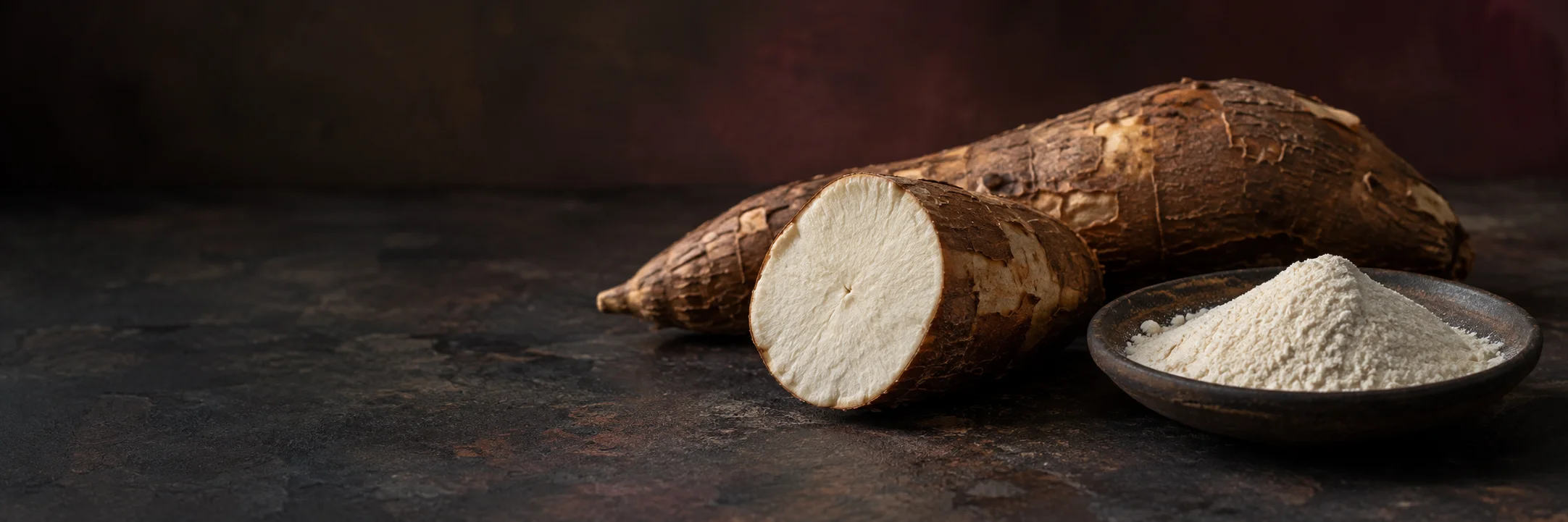
This page covers cassava (Manihot esculenta) root and the foods made directly from it: raw, boiled, fried or roasted root and its peel, cassava flour including fermented lafun and amala flour, gari, fufu, and cassava starch sold as tapioca.1GEMS/Food Contaminants database heavy-metal exportsGEMS/Food Contamination Monitoring and Assessment ProgrammeRead source →3Mercury in the Surface Soil and Cassava, Manihot esculenta (Flesh, Leaves and Peel) Near Goldmines at Bogoso and Prestea, GhanaBull Environ Contam ToxicolRead source →4Effect of home processing methods on the levels of heavy metal contaminants in four food crops grown in and around two mining towns in GhanaToxicology Reports 8 (2021) 1830–1838Read source →10OPEN ACCESS potential toxic levels of cyanidePeer-reviewed articleRead source →11Toxic and Essential Metals in Staple Foods Commonly Consumed by Students in Ekiti State, South West, NigeriaInternational Journal of ChemistryRead source →13Preliminary characterization and probabilistic risk assessment of microplastics and potentially toxic elements (PTEs) in garri (cassava flake), a common staple food consumed in West AfricaEnvironmental Analysis Health and ToxicologyRead source → Each form is kept separate because drying, fermentation, roasting and starch extraction change both the food and the basis on which a result is reported.1GEMS/Food Contaminants database heavy-metal exportsGEMS/Food Contamination Monitoring and Assessment ProgrammeRead source →9In vitro evaluation of bio-fortification effects on the nutritional quality, toxicological safety, and antioxidant of cassava (Manihot esculenta) flour, and environmental safety of processing water, using natural additivesFrontiers in NutritionRead source →
Cassava leaves, eaten as a vegetable in parts of Africa, are a different food and are not covered here; nor are animal feeds, snacks or infant foods that only contain cassava or tapioca.1GEMS/Food Contaminants database heavy-metal exportsGEMS/Food Contamination Monitoring and Assessment ProgrammeRead source →15Toxic elements in baby and young children’s foods in the US and correlation to ingredientsFood Additives & Contaminants: Part BRead source → Cyanide from cassava’s cyanogenic glycosides is a natural toxicant rather than a heavy metal, so it is outside this page even though the EU sets limits of 50 mg/kg for fresh peeled root and 10 mg/kg for cassava and tapioca flour.2Commission Regulation (EU) 2023/915 of 25 April 2023 on maximum levels for certain contaminants in food and repealing Regulation (EC) No 1881/2006Official Journal of the European UnionRead source →
Names need care. GEMS/Food includes results labelled only “Tapioca” or “tapioca, see cassava”, which may describe the root or the starch, so this page reports them as tapioca of unstated form.1GEMS/Food Contaminants database heavy-metal exportsGEMS/Food Contamination Monitoring and Assessment ProgrammeRead source → In Nigerian studies, amala and fufu are named dishes whose raw material and moisture state are not always stated.11Toxic and Essential Metals in Staple Foods Commonly Consumed by Students in Ekiti State, South West, NigeriaInternational Journal of ChemistryRead source →
Heavy metal contamination profile of cassava
The table holds every cassava result extracted from WHO GEMS/Food and eleven field, market, mining-area and processing studies: one row for each statistic a source reports for a form of cassava, group and metal.1GEMS/Food Contaminants database heavy-metal exportsGEMS/Food Contamination Monitoring and Assessment ProgrammeRead source →3Mercury in the Surface Soil and Cassava, Manihot esculenta (Flesh, Leaves and Peel) Near Goldmines at Bogoso and Prestea, GhanaBull Environ Contam ToxicolRead source →4Effect of home processing methods on the levels of heavy metal contaminants in four food crops grown in and around two mining towns in GhanaToxicology Reports 8 (2021) 1830–1838Read source →5Trace elements in farmland soils and crops, and probabilistic health risk assessment in areas influenced by mining activity in EcuadorEnvironmental Geochemistry and HealthRead source →6Effect of Boiling on Heavy Metal and Cyanide Concentrations and Associated Health Risks in Cassava and Cocoyam From a Gold Mining Area in Kade, GhanaInternational Journal of Food ScienceRead source →8Evaluation of pesticide residues and heavy metalsPeer-reviewed articleRead source →9In vitro evaluation of bio-fortification effects on the nutritional quality, toxicological safety, and antioxidant of cassava (Manihot esculenta) flour, and environmental safety of processing water, using natural additivesFrontiers in NutritionRead source →10OPEN ACCESS potential toxic levels of cyanidePeer-reviewed articleRead source →11Toxic and Essential Metals in Staple Foods Commonly Consumed by Students in Ekiti State, South West, NigeriaInternational Journal of ChemistryRead source →12Accumulation of Heavy Metals and Metalloid in Foodstuffs from Agricultural Soils around Tarkwa Area in Ghana, and Associated Human Health RisksInternational Journal of Environmental Research and Public Health (2015)Read source →13Preliminary characterization and probabilistic risk assessment of microplastics and potentially toxic elements (PTEs) in garri (cassava flake), a common staple food consumed in West AfricaEnvironmental Analysis Health and ToxicologyRead source →14Heavy metals health risk assessment for population via consumption of food crops and fruits in Owerri, South Eastern, NigeriaChemistry Central Journal 2012, 6:77Read source → GEMS/Food rows are HMI-calculated medians of individual national submissions by WHO region and sampling type; non-detects remain intervals between zero and the reporting limit and are never read as zero.1GEMS/Food Contaminants database heavy-metal exportsGEMS/Food Contamination Monitoring and Assessment ProgrammeRead source → Ratings place a result against an HMI reference for the same form and basis, built from GEMS/Food region-by-year medians and, for flour, the five market values in a Nigerian lafun survey.1GEMS/Food Contaminants database heavy-metal exportsGEMS/Food Contamination Monitoring and Assessment ProgrammeRead source →10OPEN ACCESS potential toxic levels of cyanidePeer-reviewed articleRead source →
Dry-weight laboratory results and results with no stated basis are never pooled with as-sold monitoring results.8Evaluation of pesticide residues and heavy metalsPeer-reviewed articleRead source →9In vitro evaluation of bio-fortification effects on the nutritional quality, toxicological safety, and antioxidant of cassava (Manihot esculenta) flour, and environmental safety of processing water, using natural additivesFrontiers in NutritionRead source →11Toxic and Essential Metals in Staple Foods Commonly Consumed by Students in Ekiti State, South West, NigeriaInternational Journal of ChemistryRead source → Values that fail a check against their own paper are held and stay visible with the reason: low arsenic measured by atomic absorption without hydride generation in three studies, implausible chromium and nickel in garri, and cadmium and roasted-cassava lead cells that contradict their own tables.4Effect of home processing methods on the levels of heavy metal contaminants in four food crops grown in and around two mining towns in GhanaToxicology Reports 8 (2021) 1830–1838Read source →6Effect of Boiling on Heavy Metal and Cyanide Concentrations and Associated Health Risks in Cassava and Cocoyam From a Gold Mining Area in Kade, GhanaInternational Journal of Food ScienceRead source →9In vitro evaluation of bio-fortification effects on the nutritional quality, toxicological safety, and antioxidant of cassava (Manihot esculenta) flour, and environmental safety of processing water, using natural additivesFrontiers in NutritionRead source →10OPEN ACCESS potential toxic levels of cyanidePeer-reviewed articleRead source →11Toxic and Essential Metals in Staple Foods Commonly Consumed by Students in Ekiti State, South West, NigeriaInternational Journal of ChemistryRead source →13Preliminary characterization and probabilistic risk assessment of microplastics and potentially toxic elements (PTEs) in garri (cassava flake), a common staple food consumed in West AfricaEnvironmental Analysis Health and ToxicologyRead source →
Comparison methods and scope
Each row is one statistic a source reports for one form of cassava, group and metal. Raw root, cooked cassava, flour, gari, fufu and starch are kept apart, and dry-weight results never share a reference with fresh or as-sold results. Ratings place a result against an HMI reference built from monitoring results for the same form of cassava. Same-study contrasts compare a treated flour with its untreated control, or cooked dried with cooked fresh cassava. Held rows failed a check against their own paper and are shown but not compared.
First displayed analyte: Lead: 49 findings from 9 sources. Each row retains its statistic and measurement basis.
Filter findings
226 of 226 findings · 8 analytes
About this table
| Food form | Collection scope | Finding (µg/kg) | Comparison | Evidence |
|---|---|---|---|---|
11 findings · 6 studies · 2 spread figures folded in | ||||
| Cassava rootWHO GEMS/Food | EURO, random2008–2019As sold / fresh | median. | ||
| Cassava rootWHO GEMS/Food | EURO, sampling unstated2011–2015As sold / fresh | median. | ||
| Cassava rootWHO GEMS/Food | PAHO, random2014–2016As sold / fresh | median. | ||
| Cassava rootAdjei-Mensah et al. 2021 | Akwatia mining town2019Basis not stated | mean. | ||
| Cassava rootAdjei-Mensah et al. 2021 | Obuasi mining town2019Basis not stated | mean. | ||
| Cassava rootBortey-Sam et al. 2015 | Tarkwa farms, samples above 300 µg/kgCollection date unreportedBasis unresolved | range. | ||
| Cassava rootBortey-Sam et al. 2015 | Tarkwa farms, 11 communitiesCollection date unreportedBasis unresolved | median.Same samples: 17 µg/kg (minimum); 450 µg/kg (maximum) | ||
| Cassava rootBortey-Sam et al. 2015 | Tarkwa farms, 11 communitiesCollection date unreportedBasis unresolved | geometric mean. | ||
| Cassava rootBortey-Sam et al. 2015 | Tarkwa farms, 11 communitiesCollection date unreportedBasis unresolved | min. | ||
| Cassava rootBortey-Sam et al. 2015 | Tarkwa farms, 11 communitiesCollection date unreportedBasis unresolved | max. | ||
| Cassava rootOmeje et al. 2024 | Nsukka market, Nigeria2022Basis not stated | not detected. | ||
| Cassava rootOrisakwe et al. 2012 | Owerri area, NigeriaCollection date unreportedBasis not stated | mean. | ||
| Cassava rootRomero-Crespo et al. 2023 | Mining-area orchard, Ecuador2021As sold / fresh | below LOD. | ||
2 findings · 1 study | ||||
| Boiled cassavaAdjei-Mensah et al. 2021 | Akwatia mining town2019Basis not stated | mean. | ||
| Boiled cassavaAdjei-Mensah et al. 2021 | Obuasi mining town2019Basis not stated | mean. | ||
2 findings · 1 study | ||||
| Fried cassavaAdjei-Mensah et al. 2021 | Akwatia mining town2019Basis not stated | mean. | ||
| Fried cassavaAdjei-Mensah et al. 2021 | Obuasi mining town2019Basis not stated | mean. | ||
2 findings · 1 study | ||||
| Roasted cassavaAdjei-Mensah et al. 2021 | Akwatia mining town2019Basis not stated | mean. | ||
| Roasted cassavaAdjei-Mensah et al. 2021 | Obuasi mining town2019Basis not stated | mean. | ||
1 finding · 1 study | ||||
| Fresh cassava, cookedWHO GEMS/Food | AFRO, random2018As sold / fresh | median. | ||
1 finding · 1 study | ||||
| Dried cassava, cookedWHO GEMS/Food | AFRO, random2018As sold / fresh | median. | ||
10 findings · 4 studies · 1 spread figure folded in | ||||
| Cassava flourWHO GEMS/Food | PAHO, random2013–2014As sold / fresh | median. | ||
| Cassava flourAlbishi et al. 2026 | Control A (unsoaked)2024–2025Dry weight | mean. | ||
| Cassava flourAlbishi et al. 2026 | Control B (water-soaked)2024–2025Dry weight | mean. | ||
| Cassava flourIyabo et al. 2015 | Amala (Cassava Flour)Collection date unreportedBasis not stated | sample value. | ||
| Fermented cassava flour (lafun)Jacob et al. 2023 | All five Oke Ogun marketsCollection date unreportedAs sold / fresh | mean.Same samples: 28–53 µg/kg (range) | ||
| Fermented cassava flour (lafun)Jacob et al. 2023 | All five Oke Ogun marketsCollection date unreportedAs sold / fresh | range. | ||
| Fermented cassava flour (lafun)Jacob et al. 2023 | K1 IgbohoCollection date unreportedAs sold / fresh | sample value. | ||
| Fermented cassava flour (lafun)Jacob et al. 2023 | K2 IgbetiCollection date unreportedAs sold / fresh | sample value. | ||
| Fermented cassava flour (lafun)Jacob et al. 2023 | K3 IseyinCollection date unreportedAs sold / fresh | sample value. | ||
| Fermented cassava flour (lafun)Jacob et al. 2023 | K4 KishiCollection date unreportedAs sold / fresh | sample value. | ||
| Fermented cassava flour (lafun)Jacob et al. 2023 | K5 ShakiCollection date unreportedAs sold / fresh | sample value. | ||
1 finding · 1 study | ||||
| GariIyabo et al. 2015 | Fried Cassava (Garri)Collection date unreportedBasis not stated | sample value. | ||
1 finding · 1 study | ||||
| FufuIyabo et al. 2015 | FufuCollection date unreportedBasis not stated | sample value. | ||
2 findings · 1 study | ||||
| Cassava starch / tapioca flourWHO GEMS/Food | PAHO, random2013–2017As sold / fresh | median. | ||
| Cassava starch / tapioca flourWHO GEMS/Food | WPRO, random2013As sold / fresh | median. | ||
2 findings · 1 study | ||||
| Tapioca, form not statedWHO GEMS/Food | EURO, random2003–2019As sold / fresh | median. | ||
| Tapioca, form not statedWHO GEMS/Food | WPRO, random2005As sold / fresh | median. | ||
11 findings · 1 study | ||||
| Treated cassava flourAlbishi et al. 2026 | F1 (1% CSP + 2% CSE)2024–2025Dry weight | mean. | ||
| Treated cassava flourAlbishi et al. 2026 | F2 (1% CSP + 4% CSE)2024–2025Dry weight | mean. | ||
| Treated cassava flourAlbishi et al. 2026 | F3 (1% TP + 2% TE)2024–2025Dry weight | mean. | ||
| Treated cassava flourAlbishi et al. 2026 | F4 (1% TP + 4%TE)2024–2025Dry weight | mean. | ||
| Treated cassava flourAlbishi et al. 2026 | F5 (1% MLP + 2% MLE)2024–2025Dry weight | mean. | ||
| Treated cassava flourAlbishi et al. 2026 | F6 (1% MLP 4% MLE)2024–2025Dry weight | mean. | ||
| Treated cassava flourAlbishi et al. 2026 | F7 (1% CSP + 2% CSE + 2%TE)2024–2025Dry weight | mean. | ||
| Treated cassava flourAlbishi et al. 2026 | F8 (1% CSP + 2% CSE + 2% MLE)2024–2025Dry weight | mean. | ||
| Treated cassava flourAlbishi et al. 2026 | F9 (1% TP + 2% TE + 2% MLE)2024–2025Dry weight | mean. | ||
| Treated cassava flourAlbishi et al. 2026 | F10 (1% TP + 2% CSE + 2% TE + 2% MLE)2024–2025Dry weight | mean. | ||
| Treated cassava flourAlbishi et al. 2026 | F11 (1% TP + 4% CSE + 4% TE + 4% MLE)2024–2025Dry weight | mean. | ||
15 findings · 7 studies · 2 spread figures folded in | ||||
| Cassava rootWHO GEMS/Food | EURO, random2008–2019As sold / fresh | median. | ||
| Cassava rootWHO GEMS/Food | EURO, sampling unstated2011–2015As sold / fresh | median. | ||
| Cassava rootAdjei-Mensah et al. 2021 | Akwatia mining town2019Basis not stated | below LOD. | ||
| Cassava rootAdjei-Mensah et al. 2021 | Obuasi mining town2019Basis not stated | below LOD. | ||
| Cassava rootBortey-Sam et al. 2015 | Tarkwa farms, 11 communitiesCollection date unreportedBasis unresolved | median.Same samples: 2 µg/kg (minimum); 16 µg/kg (maximum) | ||
| Cassava rootBortey-Sam et al. 2015 | Tarkwa farms, 11 communitiesCollection date unreportedBasis unresolved | geometric mean. | ||
| Cassava rootBortey-Sam et al. 2015 | Tarkwa farms, 11 communitiesCollection date unreportedBasis unresolved | min. | ||
| Cassava rootBortey-Sam et al. 2015 | Tarkwa farms, 11 communitiesCollection date unreportedBasis unresolved | max. | ||
| Cassava rootFobi et al. 2025 | Kade mining area, P12024Dry weight | mean. | ||
| Cassava rootFobi et al. 2025 | Kade mining area, P22024Dry weight | mean. | ||
| Cassava rootFobi et al. 2025 | Kade mining area, P32024Dry weight | mean. | ||
| Cassava rootFobi et al. 2025 | Kade mining area, P42024Dry weight | mean. | ||
| Cassava rootFobi et al. 2025 | Kade mining area, P52024Dry weight | mean. | ||
| Cassava rootFobi et al. 2025 | Kade mining area, P62024Dry weight | mean. | ||
| Cassava rootOmeje et al. 2024 | Nsukka market, Nigeria2022Basis not stated | not detected. | ||
| Cassava rootOrisakwe et al. 2012 | Owerri area, NigeriaCollection date unreportedBasis not stated | mean. | ||
| Cassava rootRomero-Crespo et al. 2023 | Mining-area orchard, Ecuador2021As sold / fresh | sample value. | ||
8 findings · 2 studies | ||||
| Boiled cassavaAdjei-Mensah et al. 2021 | Akwatia mining town2019Basis not stated | not detected. | ||
| Boiled cassavaAdjei-Mensah et al. 2021 | Obuasi mining town2019Basis not stated | below LOD. | ||
| Boiled cassavaFobi et al. 2025 | Kade mining area, P12024Basis not stated | mean. | ||
| Boiled cassavaFobi et al. 2025 | Kade mining area, P22024Basis not stated | mean. | ||
| Boiled cassavaFobi et al. 2025 | Kade mining area, P32024Basis not stated | mean. | ||
| Boiled cassavaFobi et al. 2025 | Kade mining area, P42024Basis not stated | mean. | ||
| Boiled cassavaFobi et al. 2025 | Kade mining area, P52024Basis not stated | not detected. | ||
| Boiled cassavaFobi et al. 2025 | Kade mining area, P62024Basis not stated | not detected. | ||
2 findings · 1 study | ||||
| Fried cassavaAdjei-Mensah et al. 2021 | Akwatia mining town2019Basis not stated | not detected. | ||
| Fried cassavaAdjei-Mensah et al. 2021 | Obuasi mining town2019Basis not stated | not detected. | ||
2 findings · 1 study | ||||
| Roasted cassavaAdjei-Mensah et al. 2021 | Akwatia mining town2019Basis not stated | below LOD. | ||
| Roasted cassavaAdjei-Mensah et al. 2021 | Obuasi mining town2019Basis not stated | not detected. | ||
1 finding · 1 study | ||||
| Fresh cassava, cookedWHO GEMS/Food | AFRO, random2018As sold / fresh | median. | ||
1 finding · 1 study | ||||
| Dried cassava, cookedWHO GEMS/Food | AFRO, random2018As sold / fresh | median. | ||
9 findings · 3 studies · 1 spread figure folded in | ||||
| Cassava flourAlbishi et al. 2026 | Control A (unsoaked)2024–2025Dry weight | mean. | ||
| Cassava flourAlbishi et al. 2026 | Control B (water-soaked)2024–2025Dry weight | mean. | ||
| Cassava flourIyabo et al. 2015 | Amala (Cassava Flour)Collection date unreportedBasis not stated | sample value. | ||
| Fermented cassava flour (lafun)Jacob et al. 2023 | All five Oke Ogun marketsCollection date unreportedAs sold / fresh | mean.Same samples: 34–65 µg/kg (range) | ||
| Fermented cassava flour (lafun)Jacob et al. 2023 | All five Oke Ogun marketsCollection date unreportedAs sold / fresh | range. | ||
| Fermented cassava flour (lafun)Jacob et al. 2023 | K1 IgbohoCollection date unreportedAs sold / fresh | sample value. | ||
| Fermented cassava flour (lafun)Jacob et al. 2023 | K2 IgbetiCollection date unreportedAs sold / fresh | sample value. | ||
| Fermented cassava flour (lafun)Jacob et al. 2023 | K3 IseyinCollection date unreportedAs sold / fresh | sample value. | ||
| Fermented cassava flour (lafun)Jacob et al. 2023 | K4 KishiCollection date unreportedAs sold / fresh | sample value. | ||
| Fermented cassava flour (lafun)Jacob et al. 2023 | K5 ShakiCollection date unreportedAs sold / fresh | sample value. | ||
1 finding · 1 study | ||||
| GariIyabo et al. 2015 | Fried Cassava (Garri)Collection date unreportedBasis not stated | below LOD. | ||
2 findings · 1 study | ||||
| Tapioca, form not statedWHO GEMS/Food | EURO, random2003–2019As sold / fresh | median. | ||
| Tapioca, form not statedWHO GEMS/Food | WPRO, random2005As sold / fresh | median. | ||
11 findings · 1 study | ||||
| Treated cassava flourAlbishi et al. 2026 | F1 (1% CSP + 2% CSE)2024–2025Dry weight | mean. | ||
| Treated cassava flourAlbishi et al. 2026 | F2 (1% CSP + 4% CSE)2024–2025Dry weight | mean. | ||
| Treated cassava flourAlbishi et al. 2026 | F3 (1% TP + 2% TE)2024–2025Dry weight | mean. | ||
| Treated cassava flourAlbishi et al. 2026 | F4 (1% TP + 4%TE)2024–2025Dry weight | mean. | ||
| Treated cassava flourAlbishi et al. 2026 | F5 (1% MLP + 2% MLE)2024–2025Dry weight | mean. | ||
| Treated cassava flourAlbishi et al. 2026 | F6 (1% MLP 4% MLE)2024–2025Dry weight | mean. | ||
| Treated cassava flourAlbishi et al. 2026 | F7 (1% CSP + 2% CSE + 2%TE)2024–2025Dry weight | mean. | ||
| Treated cassava flourAlbishi et al. 2026 | F8 (1% CSP + 2% CSE + 2% MLE)2024–2025Dry weight | mean. | ||
| Treated cassava flourAlbishi et al. 2026 | F9 (1% TP + 2% TE + 2% MLE)2024–2025Dry weight | mean. | ||
| Treated cassava flourAlbishi et al. 2026 | F10 (1% TP + 2% CSE + 2% TE + 2% MLE)2024–2025Dry weight | mean. | ||
| Treated cassava flourAlbishi et al. 2026 | F11 (1% TP + 4% CSE + 4% TE + 4% MLE)2024–2025Dry weight | mean. | ||
16 findings · 6 studies · 2 spread figures folded in | ||||
| Cassava rootWHO GEMS/Food | EURO, random2010–2023As sold / fresh | median. | ||
| Cassava rootWHO GEMS/Food | EURO, sampling unstated2011–2012As sold / fresh | median. | ||
| Cassava rootWHO GEMS/Food | European Union, random2013As sold / fresh | median. | ||
| Cassava rootWHO GEMS/Food | European Union, sampling unstated2012As sold / fresh | median. | ||
| Cassava rootAdjei-Mensah et al. 2021 | Akwatia mining town2019Basis not stated | mean. | ||
| Cassava rootAdjei-Mensah et al. 2021 | Obuasi mining town2019Basis not stated | mean. | ||
| Cassava rootBortey-Sam et al. 2015 | Tarkwa farms, 11 communitiesCollection date unreportedBasis unresolved | median.Same samples: 3 µg/kg (minimum); 17 µg/kg (maximum) | ||
| Cassava rootBortey-Sam et al. 2015 | Tarkwa farms, 11 communitiesCollection date unreportedBasis unresolved | geometric mean. | ||
| Cassava rootBortey-Sam et al. 2015 | Tarkwa farms, 11 communitiesCollection date unreportedBasis unresolved | min. | ||
| Cassava rootBortey-Sam et al. 2015 | Tarkwa farms, 11 communitiesCollection date unreportedBasis unresolved | max. | ||
| Cassava rootFobi et al. 2025 | Kade mining area, P12024Dry weight | mean. | ||
| Cassava rootFobi et al. 2025 | Kade mining area, P22024Dry weight | mean. | ||
| Cassava rootFobi et al. 2025 | Kade mining area, P32024Dry weight | mean. | ||
| Cassava rootFobi et al. 2025 | Kade mining area, P42024Dry weight | mean. | ||
| Cassava rootFobi et al. 2025 | Kade mining area, P52024Dry weight | mean. | ||
| Cassava rootFobi et al. 2025 | Kade mining area, P62024Dry weight | mean. | ||
| Cassava rootOmeje et al. 2024 | Nsukka market, Nigeria2022Basis not stated | mean. | ||
| Cassava rootRomero-Crespo et al. 2023 | Mining-area orchard, Ecuador2021As sold / fresh | below LOD. | ||
8 findings · 2 studies | ||||
| Boiled cassavaAdjei-Mensah et al. 2021 | Akwatia mining town2019Basis not stated | mean. | ||
| Boiled cassavaAdjei-Mensah et al. 2021 | Obuasi mining town2019Basis not stated | mean. | ||
| Boiled cassavaFobi et al. 2025 | Kade mining area, P12024Basis not stated | not detected. | ||
| Boiled cassavaFobi et al. 2025 | Kade mining area, P22024Basis not stated | mean. | ||
| Boiled cassavaFobi et al. 2025 | Kade mining area, P32024Basis not stated | not detected. | ||
| Boiled cassavaFobi et al. 2025 | Kade mining area, P42024Basis not stated | not detected. | ||
| Boiled cassavaFobi et al. 2025 | Kade mining area, P52024Basis not stated | mean. | ||
| Boiled cassavaFobi et al. 2025 | Kade mining area, P62024Basis not stated | not detected. | ||
2 findings · 1 study | ||||
| Fried cassavaAdjei-Mensah et al. 2021 | Akwatia mining town2019Basis not stated | below LOD. | ||
| Fried cassavaAdjei-Mensah et al. 2021 | Obuasi mining town2019Basis not stated | below LOD. | ||
2 findings · 1 study | ||||
| Roasted cassavaAdjei-Mensah et al. 2021 | Akwatia mining town2019Basis not stated | mean. | ||
| Roasted cassavaAdjei-Mensah et al. 2021 | Obuasi mining town2019Basis not stated | mean. | ||
1 finding · 1 study | ||||
| Fresh cassava, cookedWHO GEMS/Food | AFRO, random2018As sold / fresh | median. | ||
1 finding · 1 study | ||||
| Dried cassava, cookedWHO GEMS/Food | AFRO, random2018As sold / fresh | median. | ||
10 findings · 3 studies | ||||
| Cassava flourWHO GEMS/Food | EURO, random2018–2023As sold / fresh | median. | ||
| Cassava flourAlbishi et al. 2026 | Control A (unsoaked)2024–2025Dry weight | mean. | ||
| Cassava flourAlbishi et al. 2026 | Control B (water-soaked)2024–2025Dry weight | mean. | ||
| Fermented cassava flour (lafun)Jacob et al. 2023 | All five Oke Ogun marketsCollection date unreportedAs sold / fresh | mean. | ||
| Fermented cassava flour (lafun)Jacob et al. 2023 | All five Oke Ogun marketsCollection date unreportedAs sold / fresh | range. | ||
| Fermented cassava flour (lafun)Jacob et al. 2023 | K1 IgbohoCollection date unreportedAs sold / fresh | sample value. | ||
| Fermented cassava flour (lafun)Jacob et al. 2023 | K2 IgbetiCollection date unreportedAs sold / fresh | sample value. | ||
| Fermented cassava flour (lafun)Jacob et al. 2023 | K3 IseyinCollection date unreportedAs sold / fresh | sample value. | ||
| Fermented cassava flour (lafun)Jacob et al. 2023 | K4 KishiCollection date unreportedAs sold / fresh | sample value. | ||
| Fermented cassava flour (lafun)Jacob et al. 2023 | K5 ShakiCollection date unreportedAs sold / fresh | sample value. | ||
1 finding · 1 study | ||||
| Cassava starch / tapioca flourWHO GEMS/Food | EURO, random2014–2023As sold / fresh | median. | ||
2 findings · 1 study | ||||
| Tapioca, form not statedWHO GEMS/Food | EURO, random2013–2014As sold / fresh | median. | ||
| Tapioca, form not statedWHO GEMS/Food | WPRO, random2005As sold / fresh | median. | ||
11 findings · 1 study | ||||
| Treated cassava flourAlbishi et al. 2026 | F1 (1% CSP + 2% CSE)2024–2025Dry weight | mean. | ||
| Treated cassava flourAlbishi et al. 2026 | F2 (1% CSP + 4% CSE)2024–2025Dry weight | mean. | ||
| Treated cassava flourAlbishi et al. 2026 | F3 (1% TP + 2% TE)2024–2025Dry weight | mean. | ||
| Treated cassava flourAlbishi et al. 2026 | F4 (1% TP + 4%TE)2024–2025Dry weight | mean. | ||
| Treated cassava flourAlbishi et al. 2026 | F5 (1% MLP + 2% MLE)2024–2025Dry weight | mean. | ||
| Treated cassava flourAlbishi et al. 2026 | F6 (1% MLP 4% MLE)2024–2025Dry weight | mean. | ||
| Treated cassava flourAlbishi et al. 2026 | F7 (1% CSP + 2% CSE + 2%TE)2024–2025Dry weight | mean. | ||
| Treated cassava flourAlbishi et al. 2026 | F8 (1% CSP + 2% CSE + 2% MLE)2024–2025Dry weight | mean. | ||
| Treated cassava flourAlbishi et al. 2026 | F9 (1% TP + 2% TE + 2% MLE)2024–2025Dry weight | mean. | ||
| Treated cassava flourAlbishi et al. 2026 | F10 (1% TP + 2% CSE + 2% TE + 2% MLE)2024–2025Dry weight | mean. | ||
| Treated cassava flourAlbishi et al. 2026 | F11 (1% TP + 4% CSE + 4% TE + 4% MLE)2024–2025Dry weight | mean. | ||
2 findings · 1 study | ||||
| Cassava starch / tapioca flourWHO GEMS/Food | PAHO, random2016As sold / fresh | median. | ||
| Cassava starch / tapioca flourWHO GEMS/Food | WPRO, random2021As sold / fresh | median. | ||
16 findings · 6 studies · 2 spread figures folded in | ||||
| Cassava rootWHO GEMS/Food | EURO, random2010–2016As sold / fresh | median. | ||
| Cassava rootAdjei-Mensah et al. 2021 | Akwatia mining town2019Basis not stated | mean. | ||
| Cassava rootAdjei-Mensah et al. 2021 | Obuasi mining town2019Basis not stated | mean. | ||
| Cassava rootAdjorlolo-Gasokpoh et al. 2012 | Dumasi, 5.5 km from mineCollection date unreportedBasis not stated | mean. | ||
| Cassava rootAdjorlolo-Gasokpoh et al. 2012 | Bogoso mine entrance, 1.5 kmCollection date unreportedBasis not stated | mean. | ||
| Cassava rootAdjorlolo-Gasokpoh et al. 2012 | Prestea, Ankobra, 14 kmCollection date unreportedBasis not stated | mean. | ||
| Cassava rootAdjorlolo-Gasokpoh et al. 2012 | River Bogo bank, 8.4 kmCollection date unreportedBasis not stated | mean. | ||
| Cassava rootBortey-Sam et al. 2015 | Tarkwa farms, 11 communitiesCollection date unreportedBasis unresolved | median.Same samples: 1 µg/kg (minimum); 10 µg/kg (maximum) | ||
| Cassava rootBortey-Sam et al. 2015 | Tarkwa farms, 11 communitiesCollection date unreportedBasis unresolved | geometric mean. | ||
| Cassava rootBortey-Sam et al. 2015 | Tarkwa farms, 11 communitiesCollection date unreportedBasis unresolved | min. | ||
| Cassava rootBortey-Sam et al. 2015 | Tarkwa farms, 11 communitiesCollection date unreportedBasis unresolved | max. | ||
| Cassava rootFobi et al. 2025 | Kade mining area, P12024Dry weight | mean. | ||
| Cassava rootFobi et al. 2025 | Kade mining area, P22024Dry weight | mean. | ||
| Cassava rootFobi et al. 2025 | Kade mining area, P32024Dry weight | mean. | ||
| Cassava rootFobi et al. 2025 | Kade mining area, P42024Dry weight | mean. | ||
| Cassava rootFobi et al. 2025 | Kade mining area, P52024Dry weight | mean. | ||
| Cassava rootFobi et al. 2025 | Kade mining area, P62024Dry weight | mean. | ||
| Cassava rootOmeje et al. 2024 | Nsukka market, Nigeria2022Basis not stated | not detected. | ||
8 findings · 1 study | ||||
| Cassava peel (outer skin)Adjorlolo-Gasokpoh et al. 2012 | Dumasi, 5.5 km from mineCollection date unreportedBasis not stated | mean. | ||
| Cassava peel (inner cortex)Adjorlolo-Gasokpoh et al. 2012 | Dumasi, 5.5 km from mineCollection date unreportedBasis not stated | mean. | ||
| Cassava peel (outer skin)Adjorlolo-Gasokpoh et al. 2012 | Bogoso mine entrance, 1.5 kmCollection date unreportedBasis not stated | mean. | ||
| Cassava peel (inner cortex)Adjorlolo-Gasokpoh et al. 2012 | Bogoso mine entrance, 1.5 kmCollection date unreportedBasis not stated | mean. | ||
| Cassava peel (outer skin)Adjorlolo-Gasokpoh et al. 2012 | Prestea, Ankobra, 14 kmCollection date unreportedBasis not stated | mean. | ||
| Cassava peel (inner cortex)Adjorlolo-Gasokpoh et al. 2012 | Prestea, Ankobra, 14 kmCollection date unreportedBasis not stated | mean. | ||
| Cassava peel (outer skin)Adjorlolo-Gasokpoh et al. 2012 | River Bogo bank, 8.4 kmCollection date unreportedBasis not stated | mean. | ||
| Cassava peel (inner cortex)Adjorlolo-Gasokpoh et al. 2012 | River Bogo bank, 8.4 kmCollection date unreportedBasis not stated | mean. | ||
8 findings · 2 studies | ||||
| Boiled cassavaAdjei-Mensah et al. 2021 | Akwatia mining town2019Basis not stated | mean. | ||
| Boiled cassavaAdjei-Mensah et al. 2021 | Obuasi mining town2019Basis not stated | mean. | ||
| Boiled cassavaFobi et al. 2025 | Kade mining area, P12024Basis not stated | mean. | ||
| Boiled cassavaFobi et al. 2025 | Kade mining area, P22024Basis not stated | mean. | ||
| Boiled cassavaFobi et al. 2025 | Kade mining area, P32024Basis not stated | mean. | ||
| Boiled cassavaFobi et al. 2025 | Kade mining area, P42024Basis not stated | mean. | ||
| Boiled cassavaFobi et al. 2025 | Kade mining area, P52024Basis not stated | mean. | ||
| Boiled cassavaFobi et al. 2025 | Kade mining area, P62024Basis not stated | mean. | ||
2 findings · 1 study | ||||
| Fried cassavaAdjei-Mensah et al. 2021 | Akwatia mining town2019Basis not stated | mean. | ||
| Fried cassavaAdjei-Mensah et al. 2021 | Obuasi mining town2019Basis not stated | mean. | ||
2 findings · 1 study | ||||
| Roasted cassavaAdjei-Mensah et al. 2021 | Akwatia mining town2019Basis not stated | mean. | ||
| Roasted cassavaAdjei-Mensah et al. 2021 | Obuasi mining town2019Basis not stated | mean. | ||
1 finding · 1 study | ||||
| Fresh cassava, cookedWHO GEMS/Food | AFRO, random2018As sold / fresh | median. | ||
1 finding · 1 study | ||||
| Dried cassava, cookedWHO GEMS/Food | AFRO, random2018As sold / fresh | median. | ||
1 finding · 1 study | ||||
| Tapioca, form not statedWHO GEMS/Food | EURO, random2007–2013As sold / fresh | median. | ||
5 findings · 4 studies · 2 spread figures folded in | ||||
| Cassava rootBortey-Sam et al. 2015 | Tarkwa farms, 11 communitiesCollection date unreportedBasis unresolved | median.Same samples: 2,700 µg/kg (minimum); 5,400 µg/kg (maximum) | ||
| Cassava rootBortey-Sam et al. 2015 | Tarkwa farms, 11 communitiesCollection date unreportedBasis unresolved | geometric mean. | ||
| Cassava rootBortey-Sam et al. 2015 | Tarkwa farms, 11 communitiesCollection date unreportedBasis unresolved | min. | ||
| Cassava rootBortey-Sam et al. 2015 | Tarkwa farms, 11 communitiesCollection date unreportedBasis unresolved | max. | ||
| Cassava rootOmeje et al. 2024 | Nsukka market, Nigeria2022Basis not stated | mean. | ||
| Cassava rootOrisakwe et al. 2012 | Owerri area, NigeriaCollection date unreportedBasis not stated | mean. | ||
| Cassava rootRomero-Crespo et al. 2023 | Mining-area orchard, Ecuador2021As sold / fresh | sample value. | ||
5 findings · 1 study | ||||
| GariEnyoh et al. 2023 | S1 open market, NigeriaCollection date unreportedDry weight | mean. | ||
| GariEnyoh et al. 2023 | S2 supermarket, NigeriaCollection date unreportedDry weight | mean. | ||
| GariEnyoh et al. 2023 | S3 shop, JapanCollection date unreportedDry weight | mean. | ||
| GariEnyoh et al. 2023 | S4 shop, JapanCollection date unreportedDry weight | mean. | ||
| GariEnyoh et al. 2023 | S5 yellow garri, JapanCollection date unreportedDry weight | mean. | ||
4 findings · 3 studies · 2 spread figures folded in | ||||
| Cassava rootBortey-Sam et al. 2015 | Tarkwa farms, 11 communitiesCollection date unreportedBasis unresolved | median.Same samples: 10 µg/kg (minimum); 200 µg/kg (maximum) | ||
| Cassava rootBortey-Sam et al. 2015 | Tarkwa farms, 11 communitiesCollection date unreportedBasis unresolved | geometric mean. | ||
| Cassava rootBortey-Sam et al. 2015 | Tarkwa farms, 11 communitiesCollection date unreportedBasis unresolved | min. | ||
| Cassava rootBortey-Sam et al. 2015 | Tarkwa farms, 11 communitiesCollection date unreportedBasis unresolved | max. | ||
| Cassava rootOmeje et al. 2024 | Nsukka market, Nigeria2022Basis not stated | mean. | ||
| Cassava rootRomero-Crespo et al. 2023 | Mining-area orchard, Ecuador2021As sold / fresh | sample value. | ||
2 findings · 1 study | ||||
| Cassava flourAlbishi et al. 2026 | Control A (unsoaked)2024–2025Dry weight | mean. | ||
| Cassava flourAlbishi et al. 2026 | Control B (water-soaked)2024–2025Dry weight | mean. | ||
5 findings · 1 study | ||||
| GariEnyoh et al. 2023 | S1 open market, NigeriaCollection date unreportedDry weight | mean. | ||
| GariEnyoh et al. 2023 | S2 supermarket, NigeriaCollection date unreportedDry weight | mean. | ||
| GariEnyoh et al. 2023 | S3 shop, JapanCollection date unreportedDry weight | mean. | ||
| GariEnyoh et al. 2023 | S4 shop, JapanCollection date unreportedDry weight | mean. | ||
| GariEnyoh et al. 2023 | S5 yellow garri, JapanCollection date unreportedDry weight | not detected. | ||
11 findings · 1 study | ||||
| Treated cassava flourAlbishi et al. 2026 | F1 (1% CSP + 2% CSE)2024–2025Dry weight | mean. | ||
| Treated cassava flourAlbishi et al. 2026 | F2 (1% CSP + 4% CSE)2024–2025Dry weight | mean. | ||
| Treated cassava flourAlbishi et al. 2026 | F3 (1% TP + 2% TE)2024–2025Dry weight | mean. | ||
| Treated cassava flourAlbishi et al. 2026 | F4 (1% TP + 4%TE)2024–2025Dry weight | mean. | ||
| Treated cassava flourAlbishi et al. 2026 | F5 (1% MLP + 2% MLE)2024–2025Dry weight | mean. | ||
| Treated cassava flourAlbishi et al. 2026 | F6 (1% MLP 4% MLE)2024–2025Dry weight | mean. | ||
| Treated cassava flourAlbishi et al. 2026 | F7 (1% CSP + 2% CSE + 2%TE)2024–2025Dry weight | mean. | ||
| Treated cassava flourAlbishi et al. 2026 | F8 (1% CSP + 2% CSE + 2% MLE)2024–2025Dry weight | mean. | ||
| Treated cassava flourAlbishi et al. 2026 | F9 (1% TP + 2% TE + 2% MLE)2024–2025Dry weight | mean. | ||
| Treated cassava flourAlbishi et al. 2026 | F10 (1% TP + 2% CSE + 2% TE + 2% MLE)2024–2025Dry weight | mean. | ||
| Treated cassava flourAlbishi et al. 2026 | F11 (1% TP + 4% CSE + 4% TE + 4% MLE)2024–2025Dry weight | mean. | ||
1 finding · 1 study | ||||
| Tapioca, form not statedWHO GEMS/Food | WPRO, random2005As sold / fresh | median. | ||
Shared dataset methods and interpretation
Source summaries retain their original statistic, material, basis and censoring. Each source drawer identifies methods and overlapping samples. No matched reference or pooled distribution is inferred.
HMI cassava Pb reference · Cassava root
Reference and scope
HMI cassava Pb reference · Cassava root. Cassava root; As sold, as eaten or fresh weight, µg/kg; no moisture conversion. Distribution of subgroup median concentration values.
| Reference (µg/kg) | Q1 | Median | Q3 |
|---|---|---|---|
| Primary HMI reference | 7.5–9 (bounded) | 31.4–36 (bounded) | 80 |
| Alternative weighting | 7.5–9 (bounded) | 31.4–36 (bounded) | 80 |
13 reference units; 1 sampling family. Counts describe evidence units, not independent studies or certainty.
| Contributing family | Reference units | Weight |
|---|---|---|
| WHO GEMS/Food | 13 | 100% |
Methods
HMI pools subgroup medians of individual WHO GEMS/Food cassava root results, one unit per WHO region, sampling type and collection year, with per-market values from market surveys of the same form where they exist, in the result basis as reported (as sold or as eaten). Each sampling family has equal total weight. Non-detects stay as zero-to-limit intervals, so quartiles carry lower and upper bounds. Means, ranges and maxima never enter as observations. Other forms of cassava, dry-weight results and results without a stated basis are kept out of this reference.
Inverse weighted empirical CDF; midpoint at exact cumulative-weight boundaries. At least four reference units and a definitely positive Q1–Q3 spread are required. This is a display eligibility rule, not statistical validation.
Limitations
GEMS/Food is the only compatible sampling family for cassava root in the completed cassava ledger, so this single-family reference cannot represent other markets. WHO regions are reporting regions, not growing areas. Many results are non-detects with differing limits, which widens the bounds. A position is descriptive concentration, not a safety or compliance judgment.
Admitted source families
Reference version and interpretation
Frozen evidence selection: 2026-10-22. Method: hmi-pooled-reference-v2.
hmi-pooled-reference-v2:cassava-root-fw-Pb:c8751e17edba
The reference is computed by HMI from admitted evidence, not copied from a study baseline. It describes the evidence currently in this scope; it is not a worldwide or current-lot benchmark. Source, year and region filters do not change it. Different HMI scopes are not one common ranking.
HMI cassava Pb reference · Fresh cassava, cooked
Reference and scope
HMI cassava Pb reference · Fresh cassava, cooked. Fresh cassava, cooked; As sold, as eaten or fresh weight, µg/kg; no moisture conversion. Distribution of subgroup median concentration values.
| Reference (µg/kg) | Q1 | Median | Q3 |
|---|---|---|---|
| Primary HMI reference | 35 | 35 | 35 |
| Alternative weighting | 35 | 35 | 35 |
1 reference units; 1 sampling family. Counts describe evidence units, not independent studies or certainty.
| Contributing family | Reference units | Weight |
|---|---|---|
| WHO GEMS/Food | 1 | 100% |
Methods
HMI pools subgroup medians of individual WHO GEMS/Food fresh cassava, cooked results, one unit per WHO region, sampling type and collection year, with per-market values from market surveys of the same form where they exist, in the result basis as reported (as sold or as eaten). Each sampling family has equal total weight. Non-detects stay as zero-to-limit intervals, so quartiles carry lower and upper bounds. Means, ranges and maxima never enter as observations. Other forms of cassava, dry-weight results and results without a stated basis are kept out of this reference.
Inverse weighted empirical CDF; midpoint at exact cumulative-weight boundaries. At least four reference units and a definitely positive Q1–Q3 spread are required. This is a display eligibility rule, not statistical validation.
Limitations
GEMS/Food is the only compatible sampling family for fresh cassava, cooked in the completed cassava ledger, so this single-family reference cannot represent other markets. WHO regions are reporting regions, not growing areas. Many results are non-detects with differing limits, which widens the bounds. A position is descriptive concentration, not a safety or compliance judgment.
Admitted source families
Reference version and interpretation
Frozen evidence selection: 2026-10-22. Method: hmi-pooled-reference-v2.
hmi-pooled-reference-v2:cassava-cooked_root-fw-Pb:d7afad9b460a
The reference is computed by HMI from admitted evidence, not copied from a study baseline. It describes the evidence currently in this scope; it is not a worldwide or current-lot benchmark. Source, year and region filters do not change it. Different HMI scopes are not one common ranking.
HMI cassava Pb reference · Dried cassava, cooked
Reference and scope
HMI cassava Pb reference · Dried cassava, cooked. Dried cassava, cooked; As sold, as eaten or fresh weight, µg/kg; no moisture conversion. Distribution of subgroup median concentration values.
| Reference (µg/kg) | Q1 | Median | Q3 |
|---|---|---|---|
| Primary HMI reference | 82 | 82 | 82 |
| Alternative weighting | 82 | 82 | 82 |
1 reference units; 1 sampling family. Counts describe evidence units, not independent studies or certainty.
| Contributing family | Reference units | Weight |
|---|---|---|
| WHO GEMS/Food | 1 | 100% |
Methods
HMI pools subgroup medians of individual WHO GEMS/Food dried cassava, cooked results, one unit per WHO region, sampling type and collection year, with per-market values from market surveys of the same form where they exist, in the result basis as reported (as sold or as eaten). Each sampling family has equal total weight. Non-detects stay as zero-to-limit intervals, so quartiles carry lower and upper bounds. Means, ranges and maxima never enter as observations. Other forms of cassava, dry-weight results and results without a stated basis are kept out of this reference.
Inverse weighted empirical CDF; midpoint at exact cumulative-weight boundaries. At least four reference units and a definitely positive Q1–Q3 spread are required. This is a display eligibility rule, not statistical validation.
Limitations
GEMS/Food is the only compatible sampling family for dried cassava, cooked in the completed cassava ledger, so this single-family reference cannot represent other markets. WHO regions are reporting regions, not growing areas. Many results are non-detects with differing limits, which widens the bounds. A position is descriptive concentration, not a safety or compliance judgment.
Admitted source families
Reference version and interpretation
Frozen evidence selection: 2026-10-22. Method: hmi-pooled-reference-v2.
hmi-pooled-reference-v2:cassava-cooked_dry-fw-Pb:73cd7d37e4a8
The reference is computed by HMI from admitted evidence, not copied from a study baseline. It describes the evidence currently in this scope; it is not a worldwide or current-lot benchmark. Source, year and region filters do not change it. Different HMI scopes are not one common ranking.
HMI cassava Pb reference · Cassava flour
Reference and scope
HMI cassava Pb reference · Cassava flour. Cassava flour; As sold, as eaten or fresh weight, µg/kg; no moisture conversion. Distribution of subgroup median concentration values.
| Reference (µg/kg) | Q1 | Median | Q3 |
|---|---|---|---|
| Primary HMI reference | 10 | 19 | 36 |
| Alternative weighting | 10 | 19 | 36 |
7 reference units; 2 sampling families. Counts describe evidence units, not independent studies or certainty.
| Contributing family | Reference units | Weight |
|---|---|---|
| WHO GEMS/Food | 2 | 50% |
| Jacob et al. 2023 | 5 | 50% |
Methods
HMI pools subgroup medians of individual WHO GEMS/Food cassava flour results, one unit per WHO region, sampling type and collection year, with per-market values from market surveys of the same form where they exist, in the result basis as reported (as sold or as eaten). Each sampling family has equal total weight. Non-detects stay as zero-to-limit intervals, so quartiles carry lower and upper bounds. Means, ranges and maxima never enter as observations. Other forms of cassava, dry-weight results and results without a stated basis are kept out of this reference.
Inverse weighted empirical CDF; midpoint at exact cumulative-weight boundaries. At least four reference units and a definitely positive Q1–Q3 spread are required. This is a display eligibility rule, not statistical validation.
Limitations
Two sampling families with different designs; neither is a probability sample of world supply. WHO regions are reporting regions, not growing areas. Many results are non-detects with differing limits, which widens the bounds. A position is descriptive concentration, not a safety or compliance judgment.
Admitted source families
Reference version and interpretation
Frozen evidence selection: 2026-10-22. Method: hmi-pooled-reference-v2.
hmi-pooled-reference-v2:cassava-flour-fw-Pb:61637ee00917
The reference is computed by HMI from admitted evidence, not copied from a study baseline. It describes the evidence currently in this scope; it is not a worldwide or current-lot benchmark. Source, year and region filters do not change it. Different HMI scopes are not one common ranking.
HMI cassava Pb reference · Cassava starch / tapioca flour
Reference and scope
HMI cassava Pb reference · Cassava starch / tapioca flour. Cassava starch / tapioca flour; As sold, as eaten or fresh weight, µg/kg; no moisture conversion. Distribution of subgroup median concentration values.
| Reference (µg/kg) | Q1 | Median | Q3 |
|---|---|---|---|
| Primary HMI reference | 10 | 10–11.3 (bounded) | 12.7–25.5 (bounded) |
| Alternative weighting | 10 | 10–11.3 (bounded) | 12.7–25.5 (bounded) |
6 reference units; 1 sampling family. Counts describe evidence units, not independent studies or certainty.
| Contributing family | Reference units | Weight |
|---|---|---|
| WHO GEMS/Food | 6 | 100% |
Methods
HMI pools subgroup medians of individual WHO GEMS/Food cassava starch / tapioca flour results, one unit per WHO region, sampling type and collection year, with per-market values from market surveys of the same form where they exist, in the result basis as reported (as sold or as eaten). Each sampling family has equal total weight. Non-detects stay as zero-to-limit intervals, so quartiles carry lower and upper bounds. Means, ranges and maxima never enter as observations. Other forms of cassava, dry-weight results and results without a stated basis are kept out of this reference.
Inverse weighted empirical CDF; midpoint at exact cumulative-weight boundaries. At least four reference units and a definitely positive Q1–Q3 spread are required. This is a display eligibility rule, not statistical validation.
Limitations
GEMS/Food is the only compatible sampling family for cassava starch / tapioca flour in the completed cassava ledger, so this single-family reference cannot represent other markets. WHO regions are reporting regions, not growing areas. Many results are non-detects with differing limits, which widens the bounds. A position is descriptive concentration, not a safety or compliance judgment.
Admitted source families
Reference version and interpretation
Frozen evidence selection: 2026-10-22. Method: hmi-pooled-reference-v2.
hmi-pooled-reference-v2:cassava-starch-fw-Pb:e7370a7a19ea
The reference is computed by HMI from admitted evidence, not copied from a study baseline. It describes the evidence currently in this scope; it is not a worldwide or current-lot benchmark. Source, year and region filters do not change it. Different HMI scopes are not one common ranking.
HMI cassava Pb reference · Tapioca, form not stated
Reference and scope
HMI cassava Pb reference · Tapioca, form not stated. Tapioca, form not stated; As sold, as eaten or fresh weight, µg/kg; no moisture conversion. Distribution of subgroup median concentration values.
| Reference (µg/kg) | Q1 | Median | Q3 |
|---|---|---|---|
| Primary HMI reference | ≤90 | 55–105 (bounded) | 230 |
| Alternative weighting | ≤90 | 55–105 (bounded) | 230 |
6 reference units; 1 sampling family. Counts describe evidence units, not independent studies or certainty.
| Contributing family | Reference units | Weight |
|---|---|---|
| WHO GEMS/Food | 6 | 100% |
Methods
HMI pools subgroup medians of individual WHO GEMS/Food tapioca, form not stated results, one unit per WHO region, sampling type and collection year, with per-market values from market surveys of the same form where they exist, in the result basis as reported (as sold or as eaten). Each sampling family has equal total weight. Non-detects stay as zero-to-limit intervals, so quartiles carry lower and upper bounds. Means, ranges and maxima never enter as observations. Other forms of cassava, dry-weight results and results without a stated basis are kept out of this reference.
Inverse weighted empirical CDF; midpoint at exact cumulative-weight boundaries. At least four reference units and a definitely positive Q1–Q3 spread are required. This is a display eligibility rule, not statistical validation.
Limitations
GEMS/Food is the only compatible sampling family for tapioca, form not stated in the completed cassava ledger, so this single-family reference cannot represent other markets. WHO regions are reporting regions, not growing areas. Many results are non-detects with differing limits, which widens the bounds. A position is descriptive concentration, not a safety or compliance judgment.
Admitted source families
Reference version and interpretation
Frozen evidence selection: 2026-10-22. Method: hmi-pooled-reference-v2.
hmi-pooled-reference-v2:cassava-tapioca-fw-Pb:5f35b58cf7e6
The reference is computed by HMI from admitted evidence, not copied from a study baseline. It describes the evidence currently in this scope; it is not a worldwide or current-lot benchmark. Source, year and region filters do not change it. Different HMI scopes are not one common ranking.
HMI cassava Cd reference · Cassava root
Reference and scope
HMI cassava Cd reference · Cassava root. Cassava root; As sold, as eaten or fresh weight, µg/kg; no moisture conversion. Distribution of subgroup median concentration values.
| Reference (µg/kg) | Q1 | Median | Q3 |
|---|---|---|---|
| Primary HMI reference | ≤2 | 1.8–3 (bounded) | 3.5–5 (bounded) |
| Alternative weighting | ≤2 | 1.8–3 (bounded) | 3.5–5 (bounded) |
10 reference units; 1 sampling family. Counts describe evidence units, not independent studies or certainty.
| Contributing family | Reference units | Weight |
|---|---|---|
| WHO GEMS/Food | 10 | 100% |
Methods
HMI pools subgroup medians of individual WHO GEMS/Food cassava root results, one unit per WHO region, sampling type and collection year, with per-market values from market surveys of the same form where they exist, in the result basis as reported (as sold or as eaten). Each sampling family has equal total weight. Non-detects stay as zero-to-limit intervals, so quartiles carry lower and upper bounds. Means, ranges and maxima never enter as observations. Other forms of cassava, dry-weight results and results without a stated basis are kept out of this reference.
Inverse weighted empirical CDF; midpoint at exact cumulative-weight boundaries. At least four reference units and a definitely positive Q1–Q3 spread are required. This is a display eligibility rule, not statistical validation.
Limitations
GEMS/Food is the only compatible sampling family for cassava root in the completed cassava ledger, so this single-family reference cannot represent other markets. WHO regions are reporting regions, not growing areas. Many results are non-detects with differing limits, which widens the bounds. A position is descriptive concentration, not a safety or compliance judgment.
Admitted source families
Reference version and interpretation
Frozen evidence selection: 2026-10-22. Method: hmi-pooled-reference-v2.
hmi-pooled-reference-v2:cassava-root-fw-Cd:93aab0028c50
The reference is computed by HMI from admitted evidence, not copied from a study baseline. It describes the evidence currently in this scope; it is not a worldwide or current-lot benchmark. Source, year and region filters do not change it. Different HMI scopes are not one common ranking.
HMI cassava Cd reference · Fresh cassava, cooked
Reference and scope
HMI cassava Cd reference · Fresh cassava, cooked. Fresh cassava, cooked; As sold, as eaten or fresh weight, µg/kg; no moisture conversion. Distribution of subgroup median concentration values.
| Reference (µg/kg) | Q1 | Median | Q3 |
|---|---|---|---|
| Primary HMI reference | 0.5–0.65 (bounded) | 0.5–0.65 (bounded) | 0.5–0.65 (bounded) |
| Alternative weighting | 0.5–0.65 (bounded) | 0.5–0.65 (bounded) | 0.5–0.65 (bounded) |
1 reference units; 1 sampling family. Counts describe evidence units, not independent studies or certainty.
| Contributing family | Reference units | Weight |
|---|---|---|
| WHO GEMS/Food | 1 | 100% |
Methods
HMI pools subgroup medians of individual WHO GEMS/Food fresh cassava, cooked results, one unit per WHO region, sampling type and collection year, with per-market values from market surveys of the same form where they exist, in the result basis as reported (as sold or as eaten). Each sampling family has equal total weight. Non-detects stay as zero-to-limit intervals, so quartiles carry lower and upper bounds. Means, ranges and maxima never enter as observations. Other forms of cassava, dry-weight results and results without a stated basis are kept out of this reference.
Inverse weighted empirical CDF; midpoint at exact cumulative-weight boundaries. At least four reference units and a definitely positive Q1–Q3 spread are required. This is a display eligibility rule, not statistical validation.
Limitations
GEMS/Food is the only compatible sampling family for fresh cassava, cooked in the completed cassava ledger, so this single-family reference cannot represent other markets. WHO regions are reporting regions, not growing areas. Many results are non-detects with differing limits, which widens the bounds. A position is descriptive concentration, not a safety or compliance judgment.
Admitted source families
Reference version and interpretation
Frozen evidence selection: 2026-10-22. Method: hmi-pooled-reference-v2.
hmi-pooled-reference-v2:cassava-cooked_root-fw-Cd:35bae1d133d6
The reference is computed by HMI from admitted evidence, not copied from a study baseline. It describes the evidence currently in this scope; it is not a worldwide or current-lot benchmark. Source, year and region filters do not change it. Different HMI scopes are not one common ranking.
HMI cassava Cd reference · Dried cassava, cooked
Reference and scope
HMI cassava Cd reference · Dried cassava, cooked. Dried cassava, cooked; As sold, as eaten or fresh weight, µg/kg; no moisture conversion. Distribution of subgroup median concentration values.
| Reference (µg/kg) | Q1 | Median | Q3 |
|---|---|---|---|
| Primary HMI reference | 1 | 1 | 1 |
| Alternative weighting | 1 | 1 | 1 |
1 reference units; 1 sampling family. Counts describe evidence units, not independent studies or certainty.
| Contributing family | Reference units | Weight |
|---|---|---|
| WHO GEMS/Food | 1 | 100% |
Methods
HMI pools subgroup medians of individual WHO GEMS/Food dried cassava, cooked results, one unit per WHO region, sampling type and collection year, with per-market values from market surveys of the same form where they exist, in the result basis as reported (as sold or as eaten). Each sampling family has equal total weight. Non-detects stay as zero-to-limit intervals, so quartiles carry lower and upper bounds. Means, ranges and maxima never enter as observations. Other forms of cassava, dry-weight results and results without a stated basis are kept out of this reference.
Inverse weighted empirical CDF; midpoint at exact cumulative-weight boundaries. At least four reference units and a definitely positive Q1–Q3 spread are required. This is a display eligibility rule, not statistical validation.
Limitations
GEMS/Food is the only compatible sampling family for dried cassava, cooked in the completed cassava ledger, so this single-family reference cannot represent other markets. WHO regions are reporting regions, not growing areas. Many results are non-detects with differing limits, which widens the bounds. A position is descriptive concentration, not a safety or compliance judgment.
Admitted source families
Reference version and interpretation
Frozen evidence selection: 2026-10-22. Method: hmi-pooled-reference-v2.
hmi-pooled-reference-v2:cassava-cooked_dry-fw-Cd:b29ab604a44e
The reference is computed by HMI from admitted evidence, not copied from a study baseline. It describes the evidence currently in this scope; it is not a worldwide or current-lot benchmark. Source, year and region filters do not change it. Different HMI scopes are not one common ranking.
HMI cassava Cd reference · Cassava flour
Reference and scope
HMI cassava Cd reference · Cassava flour. Cassava flour; As sold, as eaten or fresh weight, µg/kg; no moisture conversion. Distribution of subgroup median concentration values.
| Reference (µg/kg) | Q1 | Median | Q3 |
|---|---|---|---|
| Primary HMI reference | 36 | 45 | 61 |
| Alternative weighting | 36 | 45 | 61 |
5 reference units; 1 sampling family. Counts describe evidence units, not independent studies or certainty.
| Contributing family | Reference units | Weight |
|---|---|---|
| Jacob et al. 2023 | 5 | 100% |
Methods
HMI pools subgroup medians of individual WHO GEMS/Food cassava flour results, one unit per WHO region, sampling type and collection year, with per-market values from market surveys of the same form where they exist, in the result basis as reported (as sold or as eaten). Each sampling family has equal total weight. Non-detects stay as zero-to-limit intervals, so quartiles carry lower and upper bounds. Means, ranges and maxima never enter as observations. Other forms of cassava, dry-weight results and results without a stated basis are kept out of this reference.
Inverse weighted empirical CDF; midpoint at exact cumulative-weight boundaries. At least four reference units and a definitely positive Q1–Q3 spread are required. This is a display eligibility rule, not statistical validation.
Limitations
One market survey is the only compatible sampling family for cassava flour in the completed cassava ledger, so this single-family reference cannot represent other markets. WHO regions are reporting regions, not growing areas. Many results are non-detects with differing limits, which widens the bounds. A position is descriptive concentration, not a safety or compliance judgment.
Admitted source families
Reference version and interpretation
Frozen evidence selection: 2026-10-22. Method: hmi-pooled-reference-v2.
hmi-pooled-reference-v2:cassava-flour-fw-Cd:8b611dd8a864
The reference is computed by HMI from admitted evidence, not copied from a study baseline. It describes the evidence currently in this scope; it is not a worldwide or current-lot benchmark. Source, year and region filters do not change it. Different HMI scopes are not one common ranking.
HMI cassava Cd reference · Tapioca, form not stated
Reference and scope
HMI cassava Cd reference · Tapioca, form not stated. Tapioca, form not stated; As sold, as eaten or fresh weight, µg/kg; no moisture conversion. Distribution of subgroup median concentration values.
| Reference (µg/kg) | Q1 | Median | Q3 |
|---|---|---|---|
| Primary HMI reference | ≤4.3 | ≤8.33 | ≤39 |
| Alternative weighting | ≤4.3 | ≤8.33 | ≤39 |
6 reference units; 1 sampling family. Counts describe evidence units, not independent studies or certainty.
| Contributing family | Reference units | Weight |
|---|---|---|
| WHO GEMS/Food | 6 | 100% |
Methods
HMI pools subgroup medians of individual WHO GEMS/Food tapioca, form not stated results, one unit per WHO region, sampling type and collection year, with per-market values from market surveys of the same form where they exist, in the result basis as reported (as sold or as eaten). Each sampling family has equal total weight. Non-detects stay as zero-to-limit intervals, so quartiles carry lower and upper bounds. Means, ranges and maxima never enter as observations. Other forms of cassava, dry-weight results and results without a stated basis are kept out of this reference.
Inverse weighted empirical CDF; midpoint at exact cumulative-weight boundaries. At least four reference units and a definitely positive Q1–Q3 spread are required. This is a display eligibility rule, not statistical validation.
Limitations
GEMS/Food is the only compatible sampling family for tapioca, form not stated in the completed cassava ledger, so this single-family reference cannot represent other markets. WHO regions are reporting regions, not growing areas. Many results are non-detects with differing limits, which widens the bounds. A position is descriptive concentration, not a safety or compliance judgment.
Admitted source families
Reference version and interpretation
Frozen evidence selection: 2026-10-22. Method: hmi-pooled-reference-v2.
hmi-pooled-reference-v2:cassava-tapioca-fw-Cd:2dcc06e4530e
The reference is computed by HMI from admitted evidence, not copied from a study baseline. It describes the evidence currently in this scope; it is not a worldwide or current-lot benchmark. Source, year and region filters do not change it. Different HMI scopes are not one common ranking.
HMI cassava tAs reference · Cassava root
Reference and scope
HMI cassava tAs reference · Cassava root. Cassava root; As sold, as eaten or fresh weight, µg/kg; no moisture conversion. Distribution of subgroup median concentration values.
| Reference (µg/kg) | Q1 | Median | Q3 |
|---|---|---|---|
| Primary HMI reference | ≤30.5 | ≤60 | ≤90 |
| Alternative weighting | ≤30.5 | ≤60 | ≤90 |
12 reference units; 1 sampling family. Counts describe evidence units, not independent studies or certainty.
| Contributing family | Reference units | Weight |
|---|---|---|
| WHO GEMS/Food | 12 | 100% |
Methods
HMI pools subgroup medians of individual WHO GEMS/Food cassava root results, one unit per WHO region, sampling type and collection year, with per-market values from market surveys of the same form where they exist, in the result basis as reported (as sold or as eaten). Each sampling family has equal total weight. Non-detects stay as zero-to-limit intervals, so quartiles carry lower and upper bounds. Means, ranges and maxima never enter as observations. Other forms of cassava, dry-weight results and results without a stated basis are kept out of this reference.
Inverse weighted empirical CDF; midpoint at exact cumulative-weight boundaries. At least four reference units and a definitely positive Q1–Q3 spread are required. This is a display eligibility rule, not statistical validation.
Limitations
GEMS/Food is the only compatible sampling family for cassava root in the completed cassava ledger, so this single-family reference cannot represent other markets. WHO regions are reporting regions, not growing areas. Many results are non-detects with differing limits, which widens the bounds. A position is descriptive concentration, not a safety or compliance judgment.
Admitted source families
Reference version and interpretation
Frozen evidence selection: 2026-10-22. Method: hmi-pooled-reference-v2.
hmi-pooled-reference-v2:cassava-root-fw-tAs:048ba32bb61b
The reference is computed by HMI from admitted evidence, not copied from a study baseline. It describes the evidence currently in this scope; it is not a worldwide or current-lot benchmark. Source, year and region filters do not change it. Different HMI scopes are not one common ranking.
HMI cassava tAs reference · Fresh cassava, cooked
Reference and scope
HMI cassava tAs reference · Fresh cassava, cooked. Fresh cassava, cooked; As sold, as eaten or fresh weight, µg/kg; no moisture conversion. Distribution of subgroup median concentration values.
| Reference (µg/kg) | Q1 | Median | Q3 |
|---|---|---|---|
| Primary HMI reference | ≤1 | ≤1 | ≤1 |
| Alternative weighting | ≤1 | ≤1 | ≤1 |
1 reference units; 1 sampling family. Counts describe evidence units, not independent studies or certainty.
| Contributing family | Reference units | Weight |
|---|---|---|
| WHO GEMS/Food | 1 | 100% |
Methods
HMI pools subgroup medians of individual WHO GEMS/Food fresh cassava, cooked results, one unit per WHO region, sampling type and collection year, with per-market values from market surveys of the same form where they exist, in the result basis as reported (as sold or as eaten). Each sampling family has equal total weight. Non-detects stay as zero-to-limit intervals, so quartiles carry lower and upper bounds. Means, ranges and maxima never enter as observations. Other forms of cassava, dry-weight results and results without a stated basis are kept out of this reference.
Inverse weighted empirical CDF; midpoint at exact cumulative-weight boundaries. At least four reference units and a definitely positive Q1–Q3 spread are required. This is a display eligibility rule, not statistical validation.
Limitations
GEMS/Food is the only compatible sampling family for fresh cassava, cooked in the completed cassava ledger, so this single-family reference cannot represent other markets. WHO regions are reporting regions, not growing areas. Many results are non-detects with differing limits, which widens the bounds. A position is descriptive concentration, not a safety or compliance judgment.
Admitted source families
Reference version and interpretation
Frozen evidence selection: 2026-10-22. Method: hmi-pooled-reference-v2.
hmi-pooled-reference-v2:cassava-cooked_root-fw-tAs:de0d6fca1b6e
The reference is computed by HMI from admitted evidence, not copied from a study baseline. It describes the evidence currently in this scope; it is not a worldwide or current-lot benchmark. Source, year and region filters do not change it. Different HMI scopes are not one common ranking.
HMI cassava tAs reference · Dried cassava, cooked
Reference and scope
HMI cassava tAs reference · Dried cassava, cooked. Dried cassava, cooked; As sold, as eaten or fresh weight, µg/kg; no moisture conversion. Distribution of subgroup median concentration values.
| Reference (µg/kg) | Q1 | Median | Q3 |
|---|---|---|---|
| Primary HMI reference | ≤1 | ≤1 | ≤1 |
| Alternative weighting | ≤1 | ≤1 | ≤1 |
1 reference units; 1 sampling family. Counts describe evidence units, not independent studies or certainty.
| Contributing family | Reference units | Weight |
|---|---|---|
| WHO GEMS/Food | 1 | 100% |
Methods
HMI pools subgroup medians of individual WHO GEMS/Food dried cassava, cooked results, one unit per WHO region, sampling type and collection year, with per-market values from market surveys of the same form where they exist, in the result basis as reported (as sold or as eaten). Each sampling family has equal total weight. Non-detects stay as zero-to-limit intervals, so quartiles carry lower and upper bounds. Means, ranges and maxima never enter as observations. Other forms of cassava, dry-weight results and results without a stated basis are kept out of this reference.
Inverse weighted empirical CDF; midpoint at exact cumulative-weight boundaries. At least four reference units and a definitely positive Q1–Q3 spread are required. This is a display eligibility rule, not statistical validation.
Limitations
GEMS/Food is the only compatible sampling family for dried cassava, cooked in the completed cassava ledger, so this single-family reference cannot represent other markets. WHO regions are reporting regions, not growing areas. Many results are non-detects with differing limits, which widens the bounds. A position is descriptive concentration, not a safety or compliance judgment.
Admitted source families
Reference version and interpretation
Frozen evidence selection: 2026-10-22. Method: hmi-pooled-reference-v2.
hmi-pooled-reference-v2:cassava-cooked_dry-fw-tAs:cb3f05fc88b1
The reference is computed by HMI from admitted evidence, not copied from a study baseline. It describes the evidence currently in this scope; it is not a worldwide or current-lot benchmark. Source, year and region filters do not change it. Different HMI scopes are not one common ranking.
HMI cassava tAs reference · Cassava flour
Reference and scope
HMI cassava tAs reference · Cassava flour. Cassava flour; As sold, as eaten or fresh weight, µg/kg; no moisture conversion. Distribution of subgroup median concentration values.
| Reference (µg/kg) | Q1 | Median | Q3 |
|---|---|---|---|
| Primary HMI reference | ≤17 | ≤32.5 | ≤37.5 |
| Alternative weighting | ≤17 | ≤32.5 | ≤37.5 |
4 reference units; 1 sampling family. Counts describe evidence units, not independent studies or certainty.
| Contributing family | Reference units | Weight |
|---|---|---|
| WHO GEMS/Food | 4 | 100% |
Methods
HMI pools subgroup medians of individual WHO GEMS/Food cassava flour results, one unit per WHO region, sampling type and collection year, with per-market values from market surveys of the same form where they exist, in the result basis as reported (as sold or as eaten). Each sampling family has equal total weight. Non-detects stay as zero-to-limit intervals, so quartiles carry lower and upper bounds. Means, ranges and maxima never enter as observations. Other forms of cassava, dry-weight results and results without a stated basis are kept out of this reference.
Inverse weighted empirical CDF; midpoint at exact cumulative-weight boundaries. At least four reference units and a definitely positive Q1–Q3 spread are required. This is a display eligibility rule, not statistical validation.
Limitations
GEMS/Food is the only compatible sampling family for cassava flour in the completed cassava ledger, so this single-family reference cannot represent other markets. WHO regions are reporting regions, not growing areas. Many results are non-detects with differing limits, which widens the bounds. A position is descriptive concentration, not a safety or compliance judgment.
Admitted source families
Reference version and interpretation
Frozen evidence selection: 2026-10-22. Method: hmi-pooled-reference-v2.
hmi-pooled-reference-v2:cassava-flour-fw-tAs:08acc9751fa9
The reference is computed by HMI from admitted evidence, not copied from a study baseline. It describes the evidence currently in this scope; it is not a worldwide or current-lot benchmark. Source, year and region filters do not change it. Different HMI scopes are not one common ranking.
HMI cassava tAs reference · Cassava starch / tapioca flour
Reference and scope
HMI cassava tAs reference · Cassava starch / tapioca flour. Cassava starch / tapioca flour; As sold, as eaten or fresh weight, µg/kg; no moisture conversion. Distribution of subgroup median concentration values.
| Reference (µg/kg) | Q1 | Median | Q3 |
|---|---|---|---|
| Primary HMI reference | ≤21.5 | ≤44.5 | ≤70 |
| Alternative weighting | ≤21.5 | ≤44.5 | ≤70 |
4 reference units; 1 sampling family. Counts describe evidence units, not independent studies or certainty.
| Contributing family | Reference units | Weight |
|---|---|---|
| WHO GEMS/Food | 4 | 100% |
Methods
HMI pools subgroup medians of individual WHO GEMS/Food cassava starch / tapioca flour results, one unit per WHO region, sampling type and collection year, with per-market values from market surveys of the same form where they exist, in the result basis as reported (as sold or as eaten). Each sampling family has equal total weight. Non-detects stay as zero-to-limit intervals, so quartiles carry lower and upper bounds. Means, ranges and maxima never enter as observations. Other forms of cassava, dry-weight results and results without a stated basis are kept out of this reference.
Inverse weighted empirical CDF; midpoint at exact cumulative-weight boundaries. At least four reference units and a definitely positive Q1–Q3 spread are required. This is a display eligibility rule, not statistical validation.
Limitations
GEMS/Food is the only compatible sampling family for cassava starch / tapioca flour in the completed cassava ledger, so this single-family reference cannot represent other markets. WHO regions are reporting regions, not growing areas. Many results are non-detects with differing limits, which widens the bounds. A position is descriptive concentration, not a safety or compliance judgment.
Admitted source families
Reference version and interpretation
Frozen evidence selection: 2026-10-22. Method: hmi-pooled-reference-v2.
hmi-pooled-reference-v2:cassava-starch-fw-tAs:d7bccd4b5355
The reference is computed by HMI from admitted evidence, not copied from a study baseline. It describes the evidence currently in this scope; it is not a worldwide or current-lot benchmark. Source, year and region filters do not change it. Different HMI scopes are not one common ranking.
HMI cassava tAs reference · Tapioca, form not stated
Reference and scope
HMI cassava tAs reference · Tapioca, form not stated. Tapioca, form not stated; As sold, as eaten or fresh weight, µg/kg; no moisture conversion. Distribution of subgroup median concentration values.
| Reference (µg/kg) | Q1 | Median | Q3 |
|---|---|---|---|
| Primary HMI reference | ≤40 | ≤80 | ≤90 |
| Alternative weighting | ≤40 | ≤80 | ≤90 |
3 reference units; 1 sampling family. Counts describe evidence units, not independent studies or certainty.
| Contributing family | Reference units | Weight |
|---|---|---|
| WHO GEMS/Food | 3 | 100% |
Methods
HMI pools subgroup medians of individual WHO GEMS/Food tapioca, form not stated results, one unit per WHO region, sampling type and collection year, with per-market values from market surveys of the same form where they exist, in the result basis as reported (as sold or as eaten). Each sampling family has equal total weight. Non-detects stay as zero-to-limit intervals, so quartiles carry lower and upper bounds. Means, ranges and maxima never enter as observations. Other forms of cassava, dry-weight results and results without a stated basis are kept out of this reference.
Inverse weighted empirical CDF; midpoint at exact cumulative-weight boundaries. At least four reference units and a definitely positive Q1–Q3 spread are required. This is a display eligibility rule, not statistical validation.
Limitations
GEMS/Food is the only compatible sampling family for tapioca, form not stated in the completed cassava ledger, so this single-family reference cannot represent other markets. WHO regions are reporting regions, not growing areas. Many results are non-detects with differing limits, which widens the bounds. A position is descriptive concentration, not a safety or compliance judgment.
Admitted source families
Reference version and interpretation
Frozen evidence selection: 2026-10-22. Method: hmi-pooled-reference-v2.
hmi-pooled-reference-v2:cassava-tapioca-fw-tAs:173e80285f54
The reference is computed by HMI from admitted evidence, not copied from a study baseline. It describes the evidence currently in this scope; it is not a worldwide or current-lot benchmark. Source, year and region filters do not change it. Different HMI scopes are not one common ranking.
HMI cassava iAs reference · Cassava starch / tapioca flour
Reference and scope
HMI cassava iAs reference · Cassava starch / tapioca flour. Cassava starch / tapioca flour; As sold, as eaten or fresh weight, µg/kg; no moisture conversion. Distribution of subgroup median concentration values.
| Reference (µg/kg) | Q1 | Median | Q3 |
|---|---|---|---|
| Primary HMI reference | ≤0.03 | ≤10 | ≤20 |
| Alternative weighting | ≤0.03 | ≤10 | ≤20 |
2 reference units; 1 sampling family. Counts describe evidence units, not independent studies or certainty.
| Contributing family | Reference units | Weight |
|---|---|---|
| WHO GEMS/Food | 2 | 100% |
Methods
HMI pools subgroup medians of individual WHO GEMS/Food cassava starch / tapioca flour results, one unit per WHO region, sampling type and collection year, with per-market values from market surveys of the same form where they exist, in the result basis as reported (as sold or as eaten). Each sampling family has equal total weight. Non-detects stay as zero-to-limit intervals, so quartiles carry lower and upper bounds. Means, ranges and maxima never enter as observations. Other forms of cassava, dry-weight results and results without a stated basis are kept out of this reference.
Inverse weighted empirical CDF; midpoint at exact cumulative-weight boundaries. At least four reference units and a definitely positive Q1–Q3 spread are required. This is a display eligibility rule, not statistical validation.
Limitations
GEMS/Food is the only compatible sampling family for cassava starch / tapioca flour in the completed cassava ledger, so this single-family reference cannot represent other markets. WHO regions are reporting regions, not growing areas. Many results are non-detects with differing limits, which widens the bounds. A position is descriptive concentration, not a safety or compliance judgment.
Admitted source families
Reference version and interpretation
Frozen evidence selection: 2026-10-22. Method: hmi-pooled-reference-v2.
hmi-pooled-reference-v2:cassava-starch-fw-iAs:72becbdb0e3d
The reference is computed by HMI from admitted evidence, not copied from a study baseline. It describes the evidence currently in this scope; it is not a worldwide or current-lot benchmark. Source, year and region filters do not change it. Different HMI scopes are not one common ranking.
HMI cassava tHg reference · Cassava root
Reference and scope
HMI cassava tHg reference · Cassava root. Cassava root; As sold, as eaten or fresh weight, µg/kg; no moisture conversion. Distribution of subgroup median concentration values.
| Reference (µg/kg) | Q1 | Median | Q3 |
|---|---|---|---|
| Primary HMI reference | ≤11 | ≤30 | 6–50 (bounded) |
| Alternative weighting | ≤11 | ≤30 | 6–50 (bounded) |
3 reference units; 1 sampling family. Counts describe evidence units, not independent studies or certainty.
| Contributing family | Reference units | Weight |
|---|---|---|
| WHO GEMS/Food | 3 | 100% |
Methods
HMI pools subgroup medians of individual WHO GEMS/Food cassava root results, one unit per WHO region, sampling type and collection year, with per-market values from market surveys of the same form where they exist, in the result basis as reported (as sold or as eaten). Each sampling family has equal total weight. Non-detects stay as zero-to-limit intervals, so quartiles carry lower and upper bounds. Means, ranges and maxima never enter as observations. Other forms of cassava, dry-weight results and results without a stated basis are kept out of this reference.
Inverse weighted empirical CDF; midpoint at exact cumulative-weight boundaries. At least four reference units and a definitely positive Q1–Q3 spread are required. This is a display eligibility rule, not statistical validation.
Limitations
GEMS/Food is the only compatible sampling family for cassava root in the completed cassava ledger, so this single-family reference cannot represent other markets. WHO regions are reporting regions, not growing areas. Many results are non-detects with differing limits, which widens the bounds. A position is descriptive concentration, not a safety or compliance judgment.
Admitted source families
Reference version and interpretation
Frozen evidence selection: 2026-10-22. Method: hmi-pooled-reference-v2.
hmi-pooled-reference-v2:cassava-root-fw-tHg:caaea4a4c0ef
The reference is computed by HMI from admitted evidence, not copied from a study baseline. It describes the evidence currently in this scope; it is not a worldwide or current-lot benchmark. Source, year and region filters do not change it. Different HMI scopes are not one common ranking.
HMI cassava tHg reference · Fresh cassava, cooked
Reference and scope
HMI cassava tHg reference · Fresh cassava, cooked. Fresh cassava, cooked; As sold, as eaten or fresh weight, µg/kg; no moisture conversion. Distribution of subgroup median concentration values.
| Reference (µg/kg) | Q1 | Median | Q3 |
|---|---|---|---|
| Primary HMI reference | ≤4.2 | ≤4.2 | ≤4.2 |
| Alternative weighting | ≤4.2 | ≤4.2 | ≤4.2 |
1 reference units; 1 sampling family. Counts describe evidence units, not independent studies or certainty.
| Contributing family | Reference units | Weight |
|---|---|---|
| WHO GEMS/Food | 1 | 100% |
Methods
HMI pools subgroup medians of individual WHO GEMS/Food fresh cassava, cooked results, one unit per WHO region, sampling type and collection year, with per-market values from market surveys of the same form where they exist, in the result basis as reported (as sold or as eaten). Each sampling family has equal total weight. Non-detects stay as zero-to-limit intervals, so quartiles carry lower and upper bounds. Means, ranges and maxima never enter as observations. Other forms of cassava, dry-weight results and results without a stated basis are kept out of this reference.
Inverse weighted empirical CDF; midpoint at exact cumulative-weight boundaries. At least four reference units and a definitely positive Q1–Q3 spread are required. This is a display eligibility rule, not statistical validation.
Limitations
GEMS/Food is the only compatible sampling family for fresh cassava, cooked in the completed cassava ledger, so this single-family reference cannot represent other markets. WHO regions are reporting regions, not growing areas. Many results are non-detects with differing limits, which widens the bounds. A position is descriptive concentration, not a safety or compliance judgment.
Admitted source families
Reference version and interpretation
Frozen evidence selection: 2026-10-22. Method: hmi-pooled-reference-v2.
hmi-pooled-reference-v2:cassava-cooked_root-fw-tHg:c985cc3817a3
The reference is computed by HMI from admitted evidence, not copied from a study baseline. It describes the evidence currently in this scope; it is not a worldwide or current-lot benchmark. Source, year and region filters do not change it. Different HMI scopes are not one common ranking.
HMI cassava tHg reference · Dried cassava, cooked
Reference and scope
HMI cassava tHg reference · Dried cassava, cooked. Dried cassava, cooked; As sold, as eaten or fresh weight, µg/kg; no moisture conversion. Distribution of subgroup median concentration values.
| Reference (µg/kg) | Q1 | Median | Q3 |
|---|---|---|---|
| Primary HMI reference | ≤4.2 | ≤4.2 | ≤4.2 |
| Alternative weighting | ≤4.2 | ≤4.2 | ≤4.2 |
1 reference units; 1 sampling family. Counts describe evidence units, not independent studies or certainty.
| Contributing family | Reference units | Weight |
|---|---|---|
| WHO GEMS/Food | 1 | 100% |
Methods
HMI pools subgroup medians of individual WHO GEMS/Food dried cassava, cooked results, one unit per WHO region, sampling type and collection year, with per-market values from market surveys of the same form where they exist, in the result basis as reported (as sold or as eaten). Each sampling family has equal total weight. Non-detects stay as zero-to-limit intervals, so quartiles carry lower and upper bounds. Means, ranges and maxima never enter as observations. Other forms of cassava, dry-weight results and results without a stated basis are kept out of this reference.
Inverse weighted empirical CDF; midpoint at exact cumulative-weight boundaries. At least four reference units and a definitely positive Q1–Q3 spread are required. This is a display eligibility rule, not statistical validation.
Limitations
GEMS/Food is the only compatible sampling family for dried cassava, cooked in the completed cassava ledger, so this single-family reference cannot represent other markets. WHO regions are reporting regions, not growing areas. Many results are non-detects with differing limits, which widens the bounds. A position is descriptive concentration, not a safety or compliance judgment.
Admitted source families
Reference version and interpretation
Frozen evidence selection: 2026-10-22. Method: hmi-pooled-reference-v2.
hmi-pooled-reference-v2:cassava-cooked_dry-fw-tHg:a752d9472c51
The reference is computed by HMI from admitted evidence, not copied from a study baseline. It describes the evidence currently in this scope; it is not a worldwide or current-lot benchmark. Source, year and region filters do not change it. Different HMI scopes are not one common ranking.
HMI cassava tHg reference · Tapioca, form not stated
Reference and scope
HMI cassava tHg reference · Tapioca, form not stated. Tapioca, form not stated; As sold, as eaten or fresh weight, µg/kg; no moisture conversion. Distribution of subgroup median concentration values.
| Reference (µg/kg) | Q1 | Median | Q3 |
|---|---|---|---|
| Primary HMI reference | ≤20 | ≤35 | ≤50 |
| Alternative weighting | ≤20 | ≤35 | ≤50 |
2 reference units; 1 sampling family. Counts describe evidence units, not independent studies or certainty.
| Contributing family | Reference units | Weight |
|---|---|---|
| WHO GEMS/Food | 2 | 100% |
Methods
HMI pools subgroup medians of individual WHO GEMS/Food tapioca, form not stated results, one unit per WHO region, sampling type and collection year, with per-market values from market surveys of the same form where they exist, in the result basis as reported (as sold or as eaten). Each sampling family has equal total weight. Non-detects stay as zero-to-limit intervals, so quartiles carry lower and upper bounds. Means, ranges and maxima never enter as observations. Other forms of cassava, dry-weight results and results without a stated basis are kept out of this reference.
Inverse weighted empirical CDF; midpoint at exact cumulative-weight boundaries. At least four reference units and a definitely positive Q1–Q3 spread are required. This is a display eligibility rule, not statistical validation.
Limitations
GEMS/Food is the only compatible sampling family for tapioca, form not stated in the completed cassava ledger, so this single-family reference cannot represent other markets. WHO regions are reporting regions, not growing areas. Many results are non-detects with differing limits, which widens the bounds. A position is descriptive concentration, not a safety or compliance judgment.
Admitted source families
Reference version and interpretation
Frozen evidence selection: 2026-10-22. Method: hmi-pooled-reference-v2.
hmi-pooled-reference-v2:cassava-tapioca-fw-tHg:298217b9cf88
The reference is computed by HMI from admitted evidence, not copied from a study baseline. It describes the evidence currently in this scope; it is not a worldwide or current-lot benchmark. Source, year and region filters do not change it. Different HMI scopes are not one common ranking.
HMI cassava Sn reference · Tapioca, form not stated
Reference and scope
HMI cassava Sn reference · Tapioca, form not stated. Tapioca, form not stated; As sold, as eaten or fresh weight, µg/kg; no moisture conversion. Distribution of subgroup median concentration values.
| Reference (µg/kg) | Q1 | Median | Q3 |
|---|---|---|---|
| Primary HMI reference | ≤60 | ≤60 | ≤60 |
| Alternative weighting | ≤60 | ≤60 | ≤60 |
1 reference units; 1 sampling family. Counts describe evidence units, not independent studies or certainty.
| Contributing family | Reference units | Weight |
|---|---|---|
| WHO GEMS/Food | 1 | 100% |
Methods
HMI pools subgroup medians of individual WHO GEMS/Food tapioca, form not stated results, one unit per WHO region, sampling type and collection year, with per-market values from market surveys of the same form where they exist, in the result basis as reported (as sold or as eaten). Each sampling family has equal total weight. Non-detects stay as zero-to-limit intervals, so quartiles carry lower and upper bounds. Means, ranges and maxima never enter as observations. Other forms of cassava, dry-weight results and results without a stated basis are kept out of this reference.
Inverse weighted empirical CDF; midpoint at exact cumulative-weight boundaries. At least four reference units and a definitely positive Q1–Q3 spread are required. This is a display eligibility rule, not statistical validation.
Limitations
GEMS/Food is the only compatible sampling family for tapioca, form not stated in the completed cassava ledger, so this single-family reference cannot represent other markets. WHO regions are reporting regions, not growing areas. Many results are non-detects with differing limits, which widens the bounds. A position is descriptive concentration, not a safety or compliance judgment.
Admitted source families
Reference version and interpretation
Frozen evidence selection: 2026-10-22. Method: hmi-pooled-reference-v2.
hmi-pooled-reference-v2:cassava-tapioca-fw-Sn:7906f1eaaf1c
The reference is computed by HMI from admitted evidence, not copied from a study baseline. It describes the evidence currently in this scope; it is not a worldwide or current-lot benchmark. Source, year and region filters do not change it. Different HMI scopes are not one common ranking.
The source reports only a percentile, range or maximum for these samples, with no mean or median to place against the reference. Spread figures that do have a mean or median are shown on that row instead.
The value could not be reconciled with its own paper, so it is shown but not compared.
The result is below a reporting limit, and the range from zero to that limit crosses more than one band.
No medians or sample values exist for this form and metal, so no HMI reference could be built.
The HMI reference for this form has fewer than four units or no measurable spread, below the display minimum.
The result is on a basis (dry weight, or not stated) that no HMI reference for this form uses, so it cannot be placed.
Reporting limits overlap the study comparison, so no direction can be shown.
No findings match these filters. Change the selection or reset to show all source findings.
How metals reach cassava
Cassava takes up metals from the soil it grows in.5Trace elements in farmland soils and crops, and probabilistic health risk assessment in areas influenced by mining activity in EcuadorEnvironmental Geochemistry and HealthRead source → In an orchard on gold-mining waste in Ponce Enríquez, Ecuador, where soils held 1.06–1.94 mg/kg cadmium and up to 422 mg/kg arsenic, the cassava root carried 60 µg/kg cadmium and 2,350 µg/kg nickel but arsenic and lead below 200 and 100 µg/kg.5Trace elements in farmland soils and crops, and probabilistic health risk assessment in areas influenced by mining activity in EcuadorEnvironmental Geochemistry and HealthRead source → In the same orchards cassava was one of three crops with arsenic below detection and among the lowest in cadmium of nine crops, while lettuce reached 12,500 µg/kg arsenic.5Trace elements in farmland soils and crops, and probabilistic health risk assessment in areas influenced by mining activity in EcuadorEnvironmental Geochemistry and HealthRead source →
Most of the lead found in monitoring is likely surface or soil-related contamination of the root or post-harvest contact rather than a property of the plant, but no source in the ledger tested that directly. The EU limit for root and tuber vegetables applies after washing and separating the edible part, which shows where regulators expect soil to be removed.2Commission Regulation (EU) 2023/915 of 25 April 2023 on maximum levels for certain contaminants in food and repealing Regulation (EC) No 1881/2006Official Journal of the European UnionRead source → A Nigerian lafun survey attributes its low cadmium to reduced use of cadmium-containing fertilisers, without data on fertiliser use.10OPEN ACCESS potential toxic levels of cyanidePeer-reviewed articleRead source →
Gold mining is the clearest source in the evidence. Near goldmines at Bogoso and Prestea in Ghana, peeled cassava flesh carried 122–168 µg/kg mercury at sites 1.5 to 14 km from the mines, with no clear fall-off with distance.3Mercury in the Surface Soil and Cassava, Manihot esculenta (Flesh, Leaves and Peel) Near Goldmines at Bogoso and Prestea, GhanaBull Environ Contam ToxicolRead source → In the Kade mining area, raw cassava held 301–426 µg/kg mercury and 24–30 µg/kg cadmium on a dry-weight basis, and peeled roots bought in the mining towns of Obuasi and Akwatia averaged 2,110 µg/kg lead and 120–160 µg/kg mercury, on a basis the paper does not state.4Effect of home processing methods on the levels of heavy metal contaminants in four food crops grown in and around two mining towns in GhanaToxicology Reports 8 (2021) 1830–1838Read source →6Effect of Boiling on Heavy Metal and Cyanide Concentrations and Associated Health Risks in Cassava and Cocoyam From a Gold Mining Area in Kade, GhanaInternational Journal of Food ScienceRead source → Around Tarkwa’s gold mines, 33 cassava roots from 11 farming communities had a geometric mean of 180 µg/kg lead, with about 30% at 370–450 µg/kg, but only 4 µg/kg mercury; the paper labels its results as both wet and dry weight, so the basis is unresolved.12Accumulation of Heavy Metals and Metalloid in Foodstuffs from Agricultural Soils around Tarkwa Area in Ghana, and Associated Human Health RisksInternational Journal of Environmental Research and Public Health (2015)Read source → Mercury sat in the edible flesh as well as the peel: at all four Ghanaian sites the outer skin held less mercury than the flesh beneath it, and the inner cortex held less at three.3Mercury in the Surface Soil and Cassava, Manihot esculenta (Flesh, Leaves and Peel) Near Goldmines at Bogoso and Prestea, GhanaBull Environ Contam ToxicolRead source →
Processing water is another route. When peeled roots were soaked for flour, the soaking water itself gained lead, cadmium and chromium, showing that metals move between the root and the water in both directions depending on its quality.9In vitro evaluation of bio-fortification effects on the nutritional quality, toxicological safety, and antioxidant of cassava (Manihot esculenta) flour, and environmental safety of processing water, using natural additivesFrontiers in NutritionRead source →
Which forms and markets measured lower
For lead in raw cassava root, the lowest results in the evidence are those submitted to GEMS/Food from the Americas: a median of 9 µg/kg across 26 imported roots in 2014–2016, with a maximum of 82 µg/kg.1GEMS/Food Contaminants database heavy-metal exportsGEMS/Food Contamination Monitoring and Assessment ProgrammeRead source → European submissions were higher, with medians of 46 µg/kg under random sampling and 92 µg/kg where sampling was not described.1GEMS/Food Contaminants database heavy-metal exportsGEMS/Food Contamination Monitoring and Assessment ProgrammeRead source → WHO regions are reporting regions, not growing areas, so this is a lowest observed pattern by market, not a ranking of producing countries.
Within Europe, lead fell over time and differed by origin label.1GEMS/Food Contaminants database heavy-metal exportsGEMS/Food Contamination Monitoring and Assessment ProgrammeRead source → 17 of 39 root results from 2008–2012 exceeded 100 µg/kg against 1 of 11 from 2013–2019, and roots labelled imported had a median of 140 µg/kg against 64 µg/kg for those labelled domestic.1GEMS/Food Contaminants database heavy-metal exportsGEMS/Food Contamination Monitoring and Assessment ProgrammeRead source → These are national monitoring submissions, not a fixed panel of suppliers, and the export does not name the country of growth.1GEMS/Food Contaminants database heavy-metal exportsGEMS/Food Contamination Monitoring and Assessment ProgrammeRead source →
Among processed forms, cassava starch and flour submitted from the Americas were lowest for lead, at a median of 10 µg/kg (15 starch and 3 flour results).1GEMS/Food Contaminants database heavy-metal exportsGEMS/Food Contamination Monitoring and Assessment ProgrammeRead source → Results labelled “Tapioca” in Europe were among the highest, with a median of 115 µg/kg and 12 of 22 above 100 µg/kg, but their form is not stated.1GEMS/Food Contaminants database heavy-metal exportsGEMS/Food Contamination Monitoring and Assessment ProgrammeRead source → In Nigeria, market lafun ranged from 28 to 53 µg/kg lead across five towns, while single vendor samples of amala flour, fufu and garri reported 140, 150 and 300 µg/kg, and cassava from around Owerri 330 µg/kg lead and 100 µg/kg cadmium, all on an unstated basis.10OPEN ACCESS potential toxic levels of cyanidePeer-reviewed articleRead source →11Toxic and Essential Metals in Staple Foods Commonly Consumed by Students in Ekiti State, South West, NigeriaInternational Journal of ChemistryRead source →14Heavy metals health risk assessment for population via consumption of food crops and fruits in Owerri, South Eastern, NigeriaChemistry Central Journal 2012, 6:77Read source →
The highest values in the evidence come from cassava grown in gold-mining districts, not from any market.3Mercury in the Surface Soil and Cassava, Manihot esculenta (Flesh, Leaves and Peel) Near Goldmines at Bogoso and Prestea, GhanaBull Environ Contam ToxicolRead source →4Effect of home processing methods on the levels of heavy metal contaminants in four food crops grown in and around two mining towns in GhanaToxicology Reports 8 (2021) 1830–1838Read source →6Effect of Boiling on Heavy Metal and Cyanide Concentrations and Associated Health Risks in Cassava and Cocoyam From a Gold Mining Area in Kade, GhanaInternational Journal of Food ScienceRead source → Ghanaian mining-area roots carried mercury of 120–430 µg/kg, far above the European monitoring results, where most mercury results were below detection.1GEMS/Food Contaminants database heavy-metal exportsGEMS/Food Contamination Monitoring and Assessment ProgrammeRead source →3Mercury in the Surface Soil and Cassava, Manihot esculenta (Flesh, Leaves and Peel) Near Goldmines at Bogoso and Prestea, GhanaBull Environ Contam ToxicolRead source →6Effect of Boiling on Heavy Metal and Cyanide Concentrations and Associated Health Risks in Cassava and Cocoyam From a Gold Mining Area in Kade, GhanaInternational Journal of Food ScienceRead source → Because the mining studies report dry-weight or unstated bases while monitoring reports fresh weight, these are not rated against the market references.3Mercury in the Surface Soil and Cassava, Manihot esculenta (Flesh, Leaves and Peel) Near Goldmines at Bogoso and Prestea, GhanaBull Environ Contam ToxicolRead source →4Effect of home processing methods on the levels of heavy metal contaminants in four food crops grown in and around two mining towns in GhanaToxicology Reports 8 (2021) 1830–1838Read source →6Effect of Boiling on Heavy Metal and Cyanide Concentrations and Associated Health Risks in Cassava and Cocoyam From a Gold Mining Area in Kade, GhanaInternational Journal of Food ScienceRead source →
For cadmium, monitored cassava root is consistently low, with a European median below 4 µg/kg and a maximum of 22 µg/kg.1GEMS/Food Contaminants database heavy-metal exportsGEMS/Food Contamination Monitoring and Assessment ProgrammeRead source → Nigerian flours measured higher, 34–65 µg/kg in market lafun and about 60 µg/kg dry weight in laboratory flour from one farm, so the cadmium evidence for flour comes from few studies in one country.9In vitro evaluation of bio-fortification effects on the nutritional quality, toxicological safety, and antioxidant of cassava (Manihot esculenta) flour, and environmental safety of processing water, using natural additivesFrontiers in NutritionRead source →10OPEN ACCESS potential toxic levels of cyanidePeer-reviewed articleRead source →
Which form of cassava measured lowest in lead?
Starch and flour submitted to GEMS/Food from the Americas were lowest, at a median of 10 µg/kg, followed by raw root from the same region at 9 µg/kg median.1GEMS/Food Contaminants database heavy-metal exportsGEMS/Food Contamination Monitoring and Assessment ProgrammeRead source → European “tapioca” of unstated form and European root were higher, and Nigerian vendor samples of garri, fufu and amala reported 140–300 µg/kg on an unstated basis.1GEMS/Food Contaminants database heavy-metal exportsGEMS/Food Contamination Monitoring and Assessment ProgrammeRead source →11Toxic and Essential Metals in Staple Foods Commonly Consumed by Students in Ekiti State, South West, NigeriaInternational Journal of ChemistryRead source → These forms come from different markets and laboratories, so the pattern is a lowest observed comparison, not a ranking of processing methods.
Is imported cassava higher in lead than locally grown cassava?
In European GEMS/Food submissions, roots labelled imported had a median of 140 µg/kg lead against 64 µg/kg for those labelled domestic, and 12 of 21 imported roots exceeded 100 µg/kg against 6 of 28 domestic ones.1GEMS/Food Contaminants database heavy-metal exportsGEMS/Food Contamination Monitoring and Assessment ProgrammeRead source → The export does not name the country of growth, so this cannot identify which producing countries are higher.1GEMS/Food Contaminants database heavy-metal exportsGEMS/Food Contamination Monitoring and Assessment ProgrammeRead source →
Soaking, drying and cooking
Two kinds of processing evidence exist, and neither is large. In a laboratory experiment with one cultivar from one farm, soaking peeled roots in tap water for 48 hours before drying and milling gave flour about 11% lower in lead (61 against 69 µg/kg dry weight), 8% lower in cadmium and 4% lower in chromium than unsoaked roots.9In vitro evaluation of bio-fortification effects on the nutritional quality, toxicological safety, and antioxidant of cassava (Manihot esculenta) flour, and environmental safety of processing water, using natural additivesFrontiers in NutritionRead source → Soaking in plant-extract solutions with 1% plant powder added to the flour gave larger reductions, down to 21 µg/kg lead and 27 µg/kg cadmium, but the extracts and powders were never tested for metals and the results are repeat analyses of a single lot per treatment.9In vitro evaluation of bio-fortification effects on the nutritional quality, toxicological safety, and antioxidant of cassava (Manihot esculenta) flour, and environmental safety of processing water, using natural additivesFrontiers in NutritionRead source →
Cooking lowered lead and mercury per kilogram in the one study that measured the same roots before and after.4Effect of home processing methods on the levels of heavy metal contaminants in four food crops grown in and around two mining towns in GhanaToxicology Reports 8 (2021) 1830–1838Read source → In two Ghanaian mining towns, peeled cassava averaged 2,110 µg/kg lead; boiling for 30 minutes gave 600–610 µg/kg, frying 70–80 µg/kg and roasting 100 µg/kg in Akwatia, while mercury fell from 120–160 to 50–60 µg/kg when boiled and 20–30 µg/kg when fried, and fell least when roasted (110 µg/kg in both towns).4Effect of home processing methods on the levels of heavy metal contaminants in four food crops grown in and around two mining towns in GhanaToxicology Reports 8 (2021) 1830–1838Read source → The results were not corrected for water lost or gained or oil taken up during cooking, and heat does not destroy metals, so part of the drop may reflect transfer to cooking water or dilution rather than removal.4Effect of home processing methods on the levels of heavy metal contaminants in four food crops grown in and around two mining towns in GhanaToxicology Reports 8 (2021) 1830–1838Read source →
A second Ghanaian study reports large reductions in mercury and cadmium after boiling, but it measured raw cassava on a dry-weight basis and does not state the basis for boiled cassava, so its raw-to-boiled differences cannot be read as a cooking effect.6Effect of Boiling on Heavy Metal and Cyanide Concentrations and Associated Health Risks in Cassava and Cocoyam From a Gold Mining Area in Kade, GhanaInternational Journal of Food ScienceRead source → African total diet monitoring adds that cooked dried cassava had a median of 82 µg/kg lead against 35 µg/kg for cooked fresh cassava in 2018 submissions; these are different foods sampled as eaten.1GEMS/Food Contaminants database heavy-metal exportsGEMS/Food Contamination Monitoring and Assessment ProgrammeRead source →
Does soaking cassava remove heavy metals?
Only partly, and the evidence is one laboratory experiment. Soaking peeled roots in tap water for 48 hours lowered flour lead by about 11% and cadmium by 8%, and the metals appeared in the soaking water.9In vitro evaluation of bio-fortification effects on the nutritional quality, toxicological safety, and antioxidant of cassava (Manihot esculenta) flour, and environmental safety of processing water, using natural additivesFrontiers in NutritionRead source → No study measured the traditional long fermentation used for fufu or lafun against unfermented flour.
Mitigation from field to flour
Controls for metals in cassava act at the field, during flour processing and at lot release. The only measured processing comparison is laboratory soaking, which lowered lead by about a tenth in water alone; the larger plant-extract effects come from one experiment without a check on the added materials.9In vitro evaluation of bio-fortification effects on the nutritional quality, toxicological safety, and antioxidant of cassava (Manihot esculenta) flour, and environmental safety of processing water, using natural additivesFrontiers in NutritionRead source → Field evidence is observational: cassava from a mining-waste orchard stayed below detection for lead and arsenic but exceeded the EU cadmium limit for tropical roots.2Commission Regulation (EU) 2023/915 of 25 April 2023 on maximum levels for certain contaminants in food and repealing Regulation (EC) No 1881/2006Official Journal of the European UnionRead source →5Trace elements in farmland soils and crops, and probabilistic health risk assessment in areas influenced by mining activity in EcuadorEnvironmental Geochemistry and HealthRead source →
Boiling or frying peeled roots lowered lead and mercury per kilogram in one laboratory comparison from Ghanaian mining towns, but peeling did not remove mercury, which was present in the flesh.3Mercury in the Surface Soil and Cassava, Manihot esculenta (Flesh, Leaves and Peel) Near Goldmines at Bogoso and Prestea, GhanaBull Environ Contam ToxicolRead source →4Effect of home processing methods on the levels of heavy metal contaminants in four food crops grown in and around two mining towns in GhanaToxicology Reports 8 (2021) 1830–1838Read source → The measured cooking effects come from one study without moisture correction, so they are tentative.4Effect of home processing methods on the levels of heavy metal contaminants in four food crops grown in and around two mining towns in GhanaToxicology Reports 8 (2021) 1830–1838Read source →
Sourcing controls rest on monitoring patterns rather than tested interventions.1GEMS/Food Contaminants database heavy-metal exportsGEMS/Food Contamination Monitoring and Assessment ProgrammeRead source → European lead results were higher for imported roots and before 2013, and testing a lot detects lead but does not remove it.1GEMS/Food Contaminants database heavy-metal exportsGEMS/Food Contamination Monitoring and Assessment ProgrammeRead source →2Commission Regulation (EU) 2023/915 of 25 April 2023 on maximum levels for certain contaminants in food and repealing Regulation (EC) No 1881/2006Official Journal of the European UnionRead source →
Filter findings
11 control comparisons
About this table
| Control | Material | Effects | Evidence | |||||||||||||||||||||||||||||||||||||||||||||||||||||||||||
|---|---|---|---|---|---|---|---|---|---|---|---|---|---|---|---|---|---|---|---|---|---|---|---|---|---|---|---|---|---|---|---|---|---|---|---|---|---|---|---|---|---|---|---|---|---|---|---|---|---|---|---|---|---|---|---|---|---|---|---|---|---|---|
| Avoid growing cassava on mining waste or contaminated soilcultivation · As reported | Cassava | Cd · Context tAs · Context | 1Romero-Crespo et al. 2023 HMI source record · Original source One dataset family. Linked analytes, repeated seasons and reports are not independent studies. Effects and comparators CadmiumAbove the EU 50 µg/kg tropical-root limit (one sample)Root cadmium, fresh weightMining-area cassava versus EU limitCassava root, fresh weightContext · No supported numerical treatment contrast is retained for this finding. A direction, market association, source-selection strategy or guidance statement alone does not establish a percentage change. Total arsenicBelow detection (<200 µg/kg), as in two other cropsRoot arsenic, fresh weightCassava versus other crops on the same landCassava root, fresh weightContext · No supported numerical treatment contrast is retained for this finding. A direction, market association, source-selection strategy or guidance statement alone does not establish a percentage change. Cassava against eight other crops from the same orchards and against the EU tropical-root cadmium limit; one cassava sample, June 2021. How magnitude is classified HMI editorial magnitude bands: Low is a change greater than 0% and below 25%; Moderate is 25% to below 50%; High is 50% or more, relative to that control’s own comparator. Direction is shown separately. These are descriptive display bands, not validated efficacy cutoffs, occurrence-baseline positions, statistical significance, evidence certainty, safety or net benefit. A range spanning bands retains both labels; a qualitative label has no implied percentage. Control in context Cassava grown on mining-influenced soil had lead and arsenic below detection but cadmium at 60 µg/kg, above the EU limit for tropical roots, and nickel at 2,350 µg/kg; it was one of three of nine crops grown there with arsenic below detection.
Design, applicability and operating conditions Observational survey. One mining district; one cassava sample. One study family. As reported by the source Reduces metal reaching or remaining in cassava, or detects it before release. Source measurements and linked outcomes
Observational; no siting intervention was tested. Percentages are calculated from the source means shown in outcomes. Basis as stated in outcomes; no mass balance reported. Trade-offs and implementation Cyanide is outside this table. Not assessed. Not assessed. Not quantified. Not assessed. Applicability and verification One mining district; one cassava sample. Lot testing. See source. Extraction limits and next actions
Provenance and assessment As disclosed by the source. Source facts and HMI calculations are distinguished above. These selected source findings do not constitute a systematic review; outcome-level appraisal remains incomplete. | |||||||||||||||||||||||||||||||||||||||||||||||||||||||||||
| Limit cadmium-containing fertiliser on cassava fieldscultivation · As reported | Cassava | Cd · Context | GuidanceJacob et al. 2023 HMI source record · Original source Official guidance; not an independent experimental dataset. Reused across actions without adding studies. Effects and comparators CadmiumGuidance; effect not measuredFlour cadmiumFertiliser practiceFermented cassava flour, as soldContext · No supported numerical treatment contrast is retained for this finding. A direction, market association, source-selection strategy or guidance statement alone does not establish a percentage change. Guidance; no measured comparison. How magnitude is classified HMI editorial magnitude bands: Low is a change greater than 0% and below 25%; Moderate is 25% to below 50%; High is 50% or more, relative to that control’s own comparator. Direction is shown separately. These are descriptive display bands, not validated efficacy cutoffs, occurrence-baseline positions, statistical significance, evidence certainty, safety or net benefit. A range spanning bands retains both labels; a qualitative label has no implied percentage. Control in context The authors recommend prohibiting cadmium-containing fertilisers and attribute the cadmium they found to fertiliser use, without measuring it.
Design, applicability and operating conditions Regulatory or author guidance. Applies where phosphate or cadmium-bearing fertilisers are used. One study family. As reported by the source Reduces metal reaching or remaining in cassava, or detects it before release. Source measurements and linked outcomes
No measured effect size. Percentages are calculated from the source means shown in outcomes. Basis as stated in outcomes; no mass balance reported. Trade-offs and implementation Cyanide is outside this table. Not assessed. Not assessed. Not quantified. Not assessed. Applicability and verification Applies where phosphate or cadmium-bearing fertilisers are used. Lot testing. See source. Extraction limits and next actions
Provenance and assessment As disclosed by the source. Source facts and HMI calculations are distinguished above. These selected source findings do not constitute a systematic review; outcome-level appraisal remains incomplete. | |||||||||||||||||||||||||||||||||||||||||||||||||||||||||||
| Wash and separate the edible part before testing or processingfood processing · As reported | Cassava | Pb · Context Cd · Context | GuidanceCommission Regulation (EU) 2023/915 HMI source record · Original source Official guidance; not an independent experimental dataset. Reused across actions without adding studies. Effects and comparators LeadRegulatory definition; effect not measuredLead limit basisEdible part after washingFresh root, wet weightContext · No supported numerical treatment contrast is retained for this finding. A direction, market association, source-selection strategy or guidance statement alone does not establish a percentage change. CadmiumRegulatory definition; effect not measuredCadmium limit basisEdible part after washingFresh root, wet weightContext · No supported numerical treatment contrast is retained for this finding. A direction, market association, source-selection strategy or guidance statement alone does not establish a percentage change. Regulatory definition; no measured comparison of peeled and unpeeled cassava. How magnitude is classified HMI editorial magnitude bands: Low is a change greater than 0% and below 25%; Moderate is 25% to below 50%; High is 50% or more, relative to that control’s own comparator. Direction is shown separately. These are descriptive display bands, not validated efficacy cutoffs, occurrence-baseline positions, statistical significance, evidence certainty, safety or net benefit. A range spanning bands retains both labels; a qualitative label has no implied percentage. Control in context EU limits for lead, cadmium and nickel in root and tuber vegetables apply on a wet-weight basis after washing and separating the edible part, which defines where soil is expected to be removed.
Design, applicability and operating conditions Regulatory or author guidance. Fresh cassava placed on the EU market. One study family. As reported by the source Reduces metal reaching or remaining in cassava, or detects it before release. Source measurements and linked outcomes
No measured effect size for peeling or washing cassava. Percentages are calculated from the source means shown in outcomes. Basis as stated in outcomes; no mass balance reported. Trade-offs and implementation Cyanide is outside this table. Not assessed. Not assessed. Not quantified. Not assessed. Applicability and verification Fresh cassava placed on the EU market. Lot testing. See source. Extraction limits and next actions
Provenance and assessment As disclosed by the source. Source facts and HMI calculations are distinguished above. These selected source findings do not constitute a systematic review; outcome-level appraisal remains incomplete. | |||||||||||||||||||||||||||||||||||||||||||||||||||||||||||
| Soak peeled roots in clean water before drying and millingfood processing · As reported | Cassava | Pb · Decreased Cd · Decreased Cr · Decreased | 1Albishi et al. 2026 HMI source record · Original source One dataset family. Linked analytes, repeated seasons and reports are not independent studies. Effects and comparators LeadDecreasedAbout 11% lowerFlour lead, dry weightWater-soaked versus unsoakedCassava flour, dry weightLow · HMI calculates the relative change from the retained source means: (61.33 − 68.67) / 68.67 × 100 = -10.7%. This is a descriptive contrast of means; no confidence interval or significance test is inferred. CadmiumDecreasedAbout 8% lowerFlour cadmium, dry weightWater-soaked versus unsoakedCassava flour, dry weightLow · HMI calculates the relative change from the retained source means: (57.67 − 63) / 63 × 100 = -8.5%. This is a descriptive contrast of means; no confidence interval or significance test is inferred. Total chromiumDecreasedAbout 4% lowerFlour chromium, dry weightWater-soaked versus unsoakedCassava flour, dry weightLow · HMI calculates the relative change from the retained source means: (65 − 68) / 68 × 100 = -4.4%. This is a descriptive contrast of means; no confidence interval or significance test is inferred. Control B (water-soaked) against Control A (unsoaked), one flour lot each, three repeat determinations. How magnitude is classified HMI editorial magnitude bands: Low is a change greater than 0% and below 25%; Moderate is 25% to below 50%; High is 50% or more, relative to that control’s own comparator. Direction is shown separately. These are descriptive display bands, not validated efficacy cutoffs, occurrence-baseline positions, statistical significance, evidence certainty, safety or net benefit. A range spanning bands retains both labels; a qualitative label has no implied percentage. Control in context Soaking peeled roots in tap water for 48 hours gave flour about 11% lower in lead, 8% lower in cadmium and 4% lower in chromium than unsoaked roots; the soaking water gained these metals.
Design, applicability and operating conditions Laboratory processing experiment. Laboratory flour from one cultivar, farm and season. One study family. As reported by the source Reduces metal reaching or remaining in cassava, or detects it before release. Source measurements and linked outcomes
Repeat analyses of one lot per arm; not independent samples or a significance test. Percentages are calculated from the source means shown in outcomes. Basis as stated in outcomes; no mass balance reported. Trade-offs and implementation Cyanide is outside this table. Not assessed. Not assessed. Not quantified. Not assessed. Applicability and verification Laboratory flour from one cultivar, farm and season. Lot testing. See source. Extraction limits and next actions
Provenance and assessment As disclosed by the source. Source facts and HMI calculations are distinguished above. These selected source findings do not constitute a systematic review; outcome-level appraisal remains incomplete. | |||||||||||||||||||||||||||||||||||||||||||||||||||||||||||
| Soak roots in plant-extract solutions (experimental)food processing · As reported | Cassava | Pb · Decreased Cd · Decreased Cr · Decreased | 1Albishi et al. 2026 HMI source record · Original source One dataset family. Linked analytes, repeated seasons and reports are not independent studies. Effects and comparators LeadDecreasedAbout 69% lower (experimental)Flour lead, dry weightF11 versus unsoakedCassava flour, dry weightHigh · HMI calculates the relative change from the retained source means: (21.33 − 68.67) / 68.67 × 100 = -68.9%. This is a descriptive contrast of means; no confidence interval or significance test is inferred. CadmiumDecreasedAbout 57% lower (experimental)Flour cadmium, dry weightF11 versus unsoakedCassava flour, dry weightHigh · HMI calculates the relative change from the retained source means: (27.33 − 63) / 63 × 100 = -56.6%. This is a descriptive contrast of means; no confidence interval or significance test is inferred. Total chromiumDecreasedAbout 19% lower (experimental)Flour chromium, dry weightF11 versus unsoakedCassava flour, dry weightLow · HMI calculates the relative change from the retained source means: (55.33 − 68) / 68 × 100 = -18.6%. This is a descriptive contrast of means; no confidence interval or significance test is inferred. Treatment F11 against Control A (unsoaked), one flour lot each, three repeat determinations. How magnitude is classified HMI editorial magnitude bands: Low is a change greater than 0% and below 25%; Moderate is 25% to below 50%; High is 50% or more, relative to that control’s own comparator. Direction is shown separately. These are descriptive display bands, not validated efficacy cutoffs, occurrence-baseline positions, statistical significance, evidence certainty, safety or net benefit. A range spanning bands retains both labels; a qualitative label has no implied percentage. Control in context Soaking in clove, turmeric and moringa extracts with 1% plant powder blended into the flour gave the lowest values, down to 21 µg/kg lead and 27 µg/kg cadmium; the added plant materials were not tested for metals.
Design, applicability and operating conditions Laboratory processing experiment. Laboratory experiment only; not an established or approved processing method. One study family. As reported by the source Reduces metal reaching or remaining in cassava, or detects it before release. Source measurements and linked outcomes
Additives untested for metals; one lot per arm; arsenic results held. Percentages are calculated from the source means shown in outcomes. Basis as stated in outcomes; no mass balance reported. Trade-offs and implementation Cyanide is outside this table. Not assessed. Not assessed. Not quantified. Not assessed. Applicability and verification Laboratory experiment only; not an established or approved processing method. Lot testing. See source. Extraction limits and next actions
Provenance and assessment As disclosed by the source. Source facts and HMI calculations are distinguished above. These selected source findings do not constitute a systematic review; outcome-level appraisal remains incomplete. | |||||||||||||||||||||||||||||||||||||||||||||||||||||||||||
| Ask for origin and lot lead results on imported rootssourcing and procurement · As reported | Cassava | Pb · Increased | 1WHO GEMS/Food HMI source record · Original source One dataset family. Linked analytes, repeated seasons and reports are not independent studies. Effects and comparators LeadIncreasedImported roots higher (observational)Median root leadImported against domestic labelCassava root, as soldHigh · HMI calculates the relative change from the retained source means: (140 − 64) / 64 × 100 = 118.8%. This is a descriptive contrast of means; no confidence interval or significance test is inferred. Imported against domestic labels within European cassava root submissions, 2008–2019. How magnitude is classified HMI editorial magnitude bands: Low is a change greater than 0% and below 25%; Moderate is 25% to below 50%; High is 50% or more, relative to that control’s own comparator. Direction is shown separately. These are descriptive display bands, not validated efficacy cutoffs, occurrence-baseline positions, statistical significance, evidence certainty, safety or net benefit. A range spanning bands retains both labels; a qualitative label has no implied percentage. Control in context In European submissions, roots labelled imported had a median of 140 µg/kg lead against 64 µg/kg for those labelled domestic, and 12 of 21 imported roots exceeded 100 µg/kg.
Design, applicability and operating conditions Observational survey. European market submissions; country of growth not identified. One study family. As reported by the source Reduces metal reaching or remaining in cassava, or detects it before release. Source measurements and linked outcomes
Observational; labels describe origin relative to the reporting country only. Percentages are calculated from the source means shown in outcomes. Basis as stated in outcomes; no mass balance reported. Trade-offs and implementation Cyanide is outside this table. Not assessed. Not assessed. Not quantified. Not assessed. Applicability and verification European market submissions; country of growth not identified. Lot testing. See source. Extraction limits and next actions
Provenance and assessment As disclosed by the source. Source facts and HMI calculations are distinguished above. These selected source findings do not constitute a systematic review; outcome-level appraisal remains incomplete. | |||||||||||||||||||||||||||||||||||||||||||||||||||||||||||
| Test lots with a method able to see well below 100 µg/kglot acceptance and release · As reported | Cassava | Pb · Context | ContextWHO GEMS/Food HMI source record · Original source Contextual literature cited by this report; not a new intervention dataset. Effects and comparators LeadDetection, not removalMethod reporting limitReported limits versus required sensitivityAs soldContext · No supported numerical treatment contrast is retained for this finding. A direction, market association, source-selection strategy or guidance statement alone does not establish a percentage change. Reporting limits in submissions against the 100 µg/kg lead limit. How magnitude is classified HMI editorial magnitude bands: Low is a change greater than 0% and below 25%; Moderate is 25% to below 50%; High is 50% or more, relative to that control’s own comparator. Direction is shown separately. These are descriptive display bands, not validated efficacy cutoffs, occurrence-baseline positions, statistical significance, evidence certainty, safety or net benefit. A range spanning bands retains both labels; a qualitative label has no implied percentage. Control in context Laboratories reporting cassava lead from the Americas used limits of 1–5 µg/kg, while many European arsenic non-detects carried limits of 80–300 µg/kg, too high to show whether levels of interest are present; testing detects metals and does not remove them.
Design, applicability and operating conditions Regulatory or author guidance. Any lot-release testing for cassava. One study family. As reported by the source Reduces metal reaching or remaining in cassava, or detects it before release. Source measurements and linked outcomes
Method fitness only. Percentages are calculated from the source means shown in outcomes. Basis as stated in outcomes; no mass balance reported. Trade-offs and implementation Cyanide is outside this table. Not assessed. Not assessed. Not quantified. Not assessed. Applicability and verification Any lot-release testing for cassava. Lot testing. See source. Extraction limits and next actions
Provenance and assessment As disclosed by the source. Source facts and HMI calculations are distinguished above. These selected source findings do not constitute a systematic review; outcome-level appraisal remains incomplete. | |||||||||||||||||||||||||||||||||||||||||||||||||||||||||||
| Boiling peeled cassava before eatinghome preparation · As reported | Cassava | Pb · Decreased Pb · Decreased tHg · Decreased tHg · Decreased | 1Adjei-Mensah et al. 2021 HMI source record · Original source One dataset family. Linked analytes, repeated seasons and reports are not independent studies. Effects and comparators LeadDecreasedLower lead per kilogram, ObuasiCassava leadBoiling versus unprocessed, ObuasiCassava as prepared; basis not statedHigh · HMI calculates the relative change from the retained source means: (610 − 2110) / 2110 × 100 = -71.1%. This is a descriptive contrast of means; no confidence interval or significance test is inferred. LeadDecreasedLower lead per kilogram, AkwatiaCassava leadBoiling versus unprocessed, AkwatiaCassava as prepared; basis not statedHigh · HMI calculates the relative change from the retained source means: (600 − 2110) / 2110 × 100 = -71.6%. This is a descriptive contrast of means; no confidence interval or significance test is inferred. Total mercuryDecreasedLower mercury per kilogram, ObuasiCassava total mercuryBoiling versus unprocessed, ObuasiCassava as prepared; basis not statedHigh · HMI calculates the relative change from the retained source means: (60 − 120) / 120 × 100 = -50.0%. This is a descriptive contrast of means; no confidence interval or significance test is inferred. Total mercuryDecreasedLower mercury per kilogram, AkwatiaCassava total mercuryBoiling versus unprocessed, AkwatiaCassava as prepared; basis not statedHigh · HMI calculates the relative change from the retained source means: (50 − 160) / 160 × 100 = -68.8%. This is a descriptive contrast of means; no confidence interval or significance test is inferred. Boiling (30 minutes in deionised water) against unprocessed portions of the same peeled roots, Obuasi and Akwatia. How magnitude is classified HMI editorial magnitude bands: Low is a change greater than 0% and below 25%; Moderate is 25% to below 50%; High is 50% or more, relative to that control’s own comparator. Direction is shown separately. These are descriptive display bands, not validated efficacy cutoffs, occurrence-baseline positions, statistical significance, evidence certainty, safety or net benefit. A range spanning bands retains both labels; a qualitative label has no implied percentage. Control in context Boiling peeled roots in the laboratory lowered lead and mercury per kilogram in both mining towns; results were not corrected for water lost or gained or oil taken up.
Design, applicability and operating conditions Laboratory processing experiment. Peeled roots from gold-mining towns; laboratory preparation. One study family. As reported by the source Reduces metal reaching or remaining in cassava, or detects it before release. Source measurements and linked outcomes
One study; n per cell not reported; no moisture correction. Percentages are calculated from the source means shown in outcomes. Basis as stated in outcomes; no mass balance reported. Trade-offs and implementation Cyanide is outside this table. Not assessed. Not assessed. Not quantified. Not assessed. Applicability and verification Peeled roots from gold-mining towns; laboratory preparation. Lot testing. See source. Extraction limits and next actions
Provenance and assessment As disclosed by the source. Source facts and HMI calculations are distinguished above. These selected source findings do not constitute a systematic review; outcome-level appraisal remains incomplete. | |||||||||||||||||||||||||||||||||||||||||||||||||||||||||||
| Frying peeled cassava before eatinghome preparation · As reported | Cassava | Pb · Decreased Pb · Decreased tHg · Decreased tHg · Decreased | 1Adjei-Mensah et al. 2021 HMI source record · Original source One dataset family. Linked analytes, repeated seasons and reports are not independent studies. Effects and comparators LeadDecreasedLower lead per kilogram, ObuasiCassava leadFrying versus unprocessed, ObuasiCassava as prepared; basis not statedHigh · HMI calculates the relative change from the retained source means: (70 − 2110) / 2110 × 100 = -96.7%. This is a descriptive contrast of means; no confidence interval or significance test is inferred. LeadDecreasedLower lead per kilogram, AkwatiaCassava leadFrying versus unprocessed, AkwatiaCassava as prepared; basis not statedHigh · HMI calculates the relative change from the retained source means: (80 − 2110) / 2110 × 100 = -96.2%. This is a descriptive contrast of means; no confidence interval or significance test is inferred. Total mercuryDecreasedLower mercury per kilogram, ObuasiCassava total mercuryFrying versus unprocessed, ObuasiCassava as prepared; basis not statedHigh · HMI calculates the relative change from the retained source means: (20 − 120) / 120 × 100 = -83.3%. This is a descriptive contrast of means; no confidence interval or significance test is inferred. Total mercuryDecreasedLower mercury per kilogram, AkwatiaCassava total mercuryFrying versus unprocessed, AkwatiaCassava as prepared; basis not statedHigh · HMI calculates the relative change from the retained source means: (30 − 160) / 160 × 100 = -81.3%. This is a descriptive contrast of means; no confidence interval or significance test is inferred. Frying (25 minutes in oil) against unprocessed portions of the same peeled roots, Obuasi and Akwatia. How magnitude is classified HMI editorial magnitude bands: Low is a change greater than 0% and below 25%; Moderate is 25% to below 50%; High is 50% or more, relative to that control’s own comparator. Direction is shown separately. These are descriptive display bands, not validated efficacy cutoffs, occurrence-baseline positions, statistical significance, evidence certainty, safety or net benefit. A range spanning bands retains both labels; a qualitative label has no implied percentage. Control in context Frying peeled roots in the laboratory lowered lead and mercury per kilogram in both mining towns; results were not corrected for water lost or gained or oil taken up.
Design, applicability and operating conditions Laboratory processing experiment. Peeled roots from gold-mining towns; laboratory preparation. One study family. As reported by the source Reduces metal reaching or remaining in cassava, or detects it before release. Source measurements and linked outcomes
One study; n per cell not reported; no moisture correction. Percentages are calculated from the source means shown in outcomes. Basis as stated in outcomes; no mass balance reported. Trade-offs and implementation Cyanide is outside this table. Not assessed. Not assessed. Not quantified. Not assessed. Applicability and verification Peeled roots from gold-mining towns; laboratory preparation. Lot testing. See source. Extraction limits and next actions
Provenance and assessment As disclosed by the source. Source facts and HMI calculations are distinguished above. These selected source findings do not constitute a systematic review; outcome-level appraisal remains incomplete. | |||||||||||||||||||||||||||||||||||||||||||||||||||||||||||
| Do not rely on peeling to remove mercuryhome preparation · As reported | Cassava | tHg · Decreased tHg · Increased | 1Adjorlolo-Gasokpoh et al. 2012 HMI source record · Original source One dataset family. Linked analytes, repeated seasons and reports are not independent studies. Effects and comparators Total mercuryDecreasedOuter skin lower than flesh (Bogoso entrance)Cassava mercury by tissueOuter skin versus fleshDried tissue; basis not statedModerate · HMI calculates the relative change from the retained source means: (66.6 − 127.45) / 127.45 × 100 = -47.7%. This is a descriptive contrast of means; no confidence interval or significance test is inferred. Total mercuryIncreasedInner cortex higher than flesh (Prestea)Cassava mercury by tissueInner cortex versus fleshDried tissue; basis not statedModerate · HMI calculates the relative change from the retained source means: (195.47 − 152.11) / 152.11 × 100 = 28.5%. This is a descriptive contrast of means; no confidence interval or significance test is inferred. Outer peel against flesh of the same roots at four sites 1.5–14 km from mines. How magnitude is classified HMI editorial magnitude bands: Low is a change greater than 0% and below 25%; Moderate is 25% to below 50%; High is 50% or more, relative to that control’s own comparator. Direction is shown separately. These are descriptive display bands, not validated efficacy cutoffs, occurrence-baseline positions, statistical significance, evidence certainty, safety or net benefit. A range spanning bands retains both labels; a qualitative label has no implied percentage. Control in context Peeled flesh held 122–168 µg/kg mercury; the outer skin held less than the flesh at all four sites, so peeling did not remove mercury from the part that is eaten.
Design, applicability and operating conditions Laboratory processing experiment. Gold-mining areas using mercury amalgamation. One study family. As reported by the source Reduces metal reaching or remaining in cassava, or detects it before release. Source measurements and linked outcomes
Four sites; number of independent plants unclear. Percentages are calculated from the source means shown in outcomes. Basis as stated in outcomes; no mass balance reported. Trade-offs and implementation Cyanide is outside this table. Not assessed. Not assessed. Not quantified. Not assessed. Applicability and verification Gold-mining areas using mercury amalgamation. Lot testing. See source. Extraction limits and next actions
Provenance and assessment As disclosed by the source. Source facts and HMI calculations are distinguished above. These selected source findings do not constitute a systematic review; outcome-level appraisal remains incomplete. | |||||||||||||||||||||||||||||||||||||||||||||||||||||||||||
| Boil cassava from mining areas (basis caveat)home preparation · As reported | Cassava | tHg · Context Cd · Context | 1Fobi et al. 2025 HMI source record · Original source One dataset family. Linked analytes, repeated seasons and reports are not independent studies. Effects and comparators Total mercuryEffect size not established (bases differ)Cassava mercuryBoiled versus rawRaw: dry weight; boiled: not statedContext · No supported numerical treatment contrast is retained for this finding. A direction, market association, source-selection strategy or guidance statement alone does not establish a percentage change. CadmiumEffect size not established (bases differ)Cassava cadmiumBoiled versus rawRaw: dry weight; boiled: not statedContext · No supported numerical treatment contrast is retained for this finding. A direction, market association, source-selection strategy or guidance statement alone does not establish a percentage change. Boiled against raw cassava from the same sampling points; bases differ. How magnitude is classified HMI editorial magnitude bands: Low is a change greater than 0% and below 25%; Moderate is 25% to below 50%; High is 50% or more, relative to that control’s own comparator. Direction is shown separately. These are descriptive display bands, not validated efficacy cutoffs, occurrence-baseline positions, statistical significance, evidence certainty, safety or net benefit. A range spanning bands retains both labels; a qualitative label has no implied percentage. Control in context The authors report large drops in mercury and cadmium after boiling, but raw cassava was measured on a dry-weight basis and the boiled basis is not stated, so the size of the effect cannot be established.
Design, applicability and operating conditions Laboratory processing experiment. Gold-mining area; one composite per sampling point. One study family. As reported by the source Reduces metal reaching or remaining in cassava, or detects it before release. Source measurements and linked outcomes
Basis mismatch between raw and boiled results; no detection limits. Percentages are calculated from the source means shown in outcomes. Basis as stated in outcomes; no mass balance reported. Trade-offs and implementation Cyanide is outside this table. Not assessed. Not assessed. Not quantified. Not assessed. Applicability and verification Gold-mining area; one composite per sampling point. Lot testing. See source. Extraction limits and next actions
Provenance and assessment As disclosed by the source. Source facts and HMI calculations are distinguished above. These selected source findings do not constitute a systematic review; outcome-level appraisal remains incomplete. | |||||||||||||||||||||||||||||||||||||||||||||||||||||||||||
No matching controls in this selected evidence. This is a coverage boundary, not proof that no control exists. Change or reset the filters.
Trade-offs and limits of controls
Soaking that leaches metals also moves them into the soaking water, which then needs to be treated as waste rather than reused.9In vitro evaluation of bio-fortification effects on the nutritional quality, toxicological safety, and antioxidant of cassava (Manihot esculenta) flour, and environmental safety of processing water, using natural additivesFrontiers in NutritionRead source → The plant-extract treatments added clove, turmeric and moringa material that was not tested for lead, so a lower measured value in the flour could hide a contribution from the additive.9In vitro evaluation of bio-fortification effects on the nutritional quality, toxicological safety, and antioxidant of cassava (Manihot esculenta) flour, and environmental safety of processing water, using natural additivesFrontiers in NutritionRead source →
Cooking changes the food as well as its metal content. Frying gave the lowest lead and mercury per kilogram in the Ghanaian comparison, but it adds oil and removes water in ways the study did not measure, and boiling moves metals into water that is then discarded.4Effect of home processing methods on the levels of heavy metal contaminants in four food crops grown in and around two mining towns in GhanaToxicology Reports 8 (2021) 1830–1838Read source →
Choosing a crop for contaminated land involves trade-offs between metals. In the Ecuadorian mining area cassava was one of three crops with arsenic below detection but carried more nickel than most of the nine crops and cadmium above the EU tropical-root limit.2Commission Regulation (EU) 2023/915 of 25 April 2023 on maximum levels for certain contaminants in food and repealing Regulation (EC) No 1881/2006Official Journal of the European UnionRead source →5Trace elements in farmland soils and crops, and probabilistic health risk assessment in areas influenced by mining activity in EcuadorEnvironmental Geochemistry and HealthRead source → Drying cassava into flour or gari concentrates whatever metal the root carried, so a fresh-weight root result cannot be read directly against a dry product.1GEMS/Food Contaminants database heavy-metal exportsGEMS/Food Contamination Monitoring and Assessment ProgrammeRead source →9In vitro evaluation of bio-fortification effects on the nutritional quality, toxicological safety, and antioxidant of cassava (Manihot esculenta) flour, and environmental safety of processing water, using natural additivesFrontiers in NutritionRead source →
Testing cassava for metals
A useful cassava lead test must be able to see well below 100 µg/kg.2Commission Regulation (EU) 2023/915 of 25 April 2023 on maximum levels for certain contaminants in food and repealing Regulation (EC) No 1881/2006Official Journal of the European UnionRead source →7General Standard for Contaminants and Toxins in Food and Feed (CXS 193-1995)Codex Alimentarius (Joint FAO/WHO Food Standards Programme)Read source → Laboratories reporting to GEMS/Food from the Americas used limits of 1–5 µg/kg for root lead, but many European arsenic non-detects carried limits of 80–300 µg/kg, too high to show whether arsenic is present at levels of interest.1GEMS/Food Contaminants database heavy-metal exportsGEMS/Food Contamination Monitoring and Assessment ProgrammeRead source → Several Nigerian and Ghanaian studies reported no detection limit, reference material or recovery, one reported non-detects as 0.00 without a limit, and a garri study used X-ray fluorescence that gave implausible chromium and nickel values.6Effect of Boiling on Heavy Metal and Cyanide Concentrations and Associated Health Risks in Cassava and Cocoyam From a Gold Mining Area in Kade, GhanaInternational Journal of Food ScienceRead source →8Evaluation of pesticide residues and heavy metalsPeer-reviewed articleRead source →9In vitro evaluation of bio-fortification effects on the nutritional quality, toxicological safety, and antioxidant of cassava (Manihot esculenta) flour, and environmental safety of processing water, using natural additivesFrontiers in NutritionRead source →10OPEN ACCESS potential toxic levels of cyanidePeer-reviewed articleRead source →13Preliminary characterization and probabilistic risk assessment of microplastics and potentially toxic elements (PTEs) in garri (cassava flake), a common staple food consumed in West AfricaEnvironmental Analysis Health and ToxicologyRead source →
State the form and basis on every result: raw root on a fresh-weight basis, flour or gari as sold, and laboratory flour on a dry-weight basis are not interchangeable.2Commission Regulation (EU) 2023/915 of 25 April 2023 on maximum levels for certain contaminants in food and repealing Regulation (EC) No 1881/2006Official Journal of the European UnionRead source →9In vitro evaluation of bio-fortification effects on the nutritional quality, toxicological safety, and antioxidant of cassava (Manihot esculenta) flour, and environmental safety of processing water, using natural additivesFrontiers in NutritionRead source → Arsenic in cassava should be read as total arsenic unless speciated; only six inorganic arsenic results exist, all for starch, and all but one were below detection.1GEMS/Food Contaminants database heavy-metal exportsGEMS/Food Contamination Monitoring and Assessment ProgrammeRead source →
Buying and verifying cassava
Ask for lot-specific lead results on the form being bought, with the laboratory’s quantification limit, compared with the destination-market limit.2Commission Regulation (EU) 2023/915 of 25 April 2023 on maximum levels for certain contaminants in food and repealing Regulation (EC) No 1881/2006Official Journal of the European UnionRead source →7General Standard for Contaminants and Toxins in Food and Feed (CXS 193-1995)Codex Alimentarius (Joint FAO/WHO Food Standards Programme)Read source → The EU sets 0.10 mg/kg lead, 0.050 mg/kg cadmium and 0.90 mg/kg nickel for fresh root and tuber vegetables including tropical roots, on a wet-weight basis after washing and separating the edible part.2Commission Regulation (EU) 2023/915 of 25 April 2023 on maximum levels for certain contaminants in food and repealing Regulation (EC) No 1881/2006Official Journal of the European UnionRead source → Codex sets 0.1 mg/kg for both lead and cadmium in root and tuber vegetables.7General Standard for Contaminants and Toxins in Food and Feed (CXS 193-1995)Codex Alimentarius (Joint FAO/WHO Food Standards Programme)Read source → Neither sets a lead or cadmium limit specific to cassava flour, gari or tapioca starch.2Commission Regulation (EU) 2023/915 of 25 April 2023 on maximum levels for certain contaminants in food and repealing Regulation (EC) No 1881/2006Official Journal of the European UnionRead source →7General Standard for Contaminants and Toxins in Food and Feed (CXS 193-1995)Codex Alimentarius (Joint FAO/WHO Food Standards Programme)Read source →
Record where the cassava was grown as well as where it was packed or bought, because monitoring datasets identify only the reporting market and an imported or domestic label.1GEMS/Food Contaminants database heavy-metal exportsGEMS/Food Contamination Monitoring and Assessment ProgrammeRead source → Avoid roots grown on mining waste or in gold-mining districts unless lot testing shows otherwise; Ghanaian and Ecuadorian mining-area cassava carried the highest mercury, lead and cadmium in the evidence.3Mercury in the Surface Soil and Cassava, Manihot esculenta (Flesh, Leaves and Peel) Near Goldmines at Bogoso and Prestea, GhanaBull Environ Contam ToxicolRead source →4Effect of home processing methods on the levels of heavy metal contaminants in four food crops grown in and around two mining towns in GhanaToxicology Reports 8 (2021) 1830–1838Read source →5Trace elements in farmland soils and crops, and probabilistic health risk assessment in areas influenced by mining activity in EcuadorEnvironmental Geochemistry and HealthRead source →6Effect of Boiling on Heavy Metal and Cyanide Concentrations and Associated Health Risks in Cassava and Cocoyam From a Gold Mining Area in Kade, GhanaInternational Journal of Food ScienceRead source →
Exposure from cassava
Cassava is a staple in much of Africa, Latin America and Asia, so intake can be large where it is eaten daily, but no source in the ledger estimated lead or cadmium exposure from cassava with verified concentrations. A Colombian study reported a cadmium hazard quotient of 1.32 for cassava in one municipality, but the quotient cannot be reproduced from the reference dose the paper states and its concentrations are only in a supplement that is not in the library.16Health Risk Assessment for Human Exposure to Heavy MetalsPeer-reviewed articleRead source → A Ghanaian mining-area study reports daily intake estimates for boiled cassava, but they cannot be reproduced from its own tables.6Effect of Boiling on Heavy Metal and Cyanide Concentrations and Associated Health Risks in Cassava and Cocoyam From a Gold Mining Area in Kade, GhanaInternational Journal of Food ScienceRead source → In the United States, one children’s dry food whose main ingredient was cassava flour had 44 µg/kg total mercury, which the authors treated as an outlier needing follow-up rather than a property of cassava.15Toxic elements in baby and young children’s foods in the US and correlation to ingredientsFood Additives & Contaminants: Part BRead source →
Evidence review and remaining gaps
This assessment covers every source record in the HMI library that names cassava, plus every cassava, manioc and tapioca row in the WHO GEMS/Food exports; each has a recorded decision based on its content.1GEMS/Food Contaminants database heavy-metal exportsGEMS/Food Contamination Monitoring and Assessment ProgrammeRead source → Twelve sources contribute results for cassava itself, including four open-access papers added in a targeted gap search, and six are held in part because their values could not be reconciled with their own methods.3Mercury in the Surface Soil and Cassava, Manihot esculenta (Flesh, Leaves and Peel) Near Goldmines at Bogoso and Prestea, GhanaBull Environ Contam ToxicolRead source →4Effect of home processing methods on the levels of heavy metal contaminants in four food crops grown in and around two mining towns in GhanaToxicology Reports 8 (2021) 1830–1838Read source →6Effect of Boiling on Heavy Metal and Cyanide Concentrations and Associated Health Risks in Cassava and Cocoyam From a Gold Mining Area in Kade, GhanaInternational Journal of Food ScienceRead source →9In vitro evaluation of bio-fortification effects on the nutritional quality, toxicological safety, and antioxidant of cassava (Manihot esculenta) flour, and environmental safety of processing water, using natural additivesFrontiers in NutritionRead source →10OPEN ACCESS potential toxic levels of cyanidePeer-reviewed articleRead source →11Toxic and Essential Metals in Staple Foods Commonly Consumed by Students in Ekiti State, South West, NigeriaInternational Journal of ChemistryRead source →12Accumulation of Heavy Metals and Metalloid in Foodstuffs from Agricultural Soils around Tarkwa Area in Ghana, and Associated Human Health RisksInternational Journal of Environmental Research and Public Health (2015)Read source →13Preliminary characterization and probabilistic risk assessment of microplastics and potentially toxic elements (PTEs) in garri (cassava flake), a common staple food consumed in West AfricaEnvironmental Analysis Health and ToxicologyRead source →14Heavy metals health risk assessment for population via consumption of food crops and fruits in Owerri, South Eastern, NigeriaChemistry Central Journal 2012, 6:77Read source → Remaining gaps are the concentrations behind a Colombian exposure study, held only in its supplement, and several Nigerian cassava surveys cited in reviews that are not yet in the library.16Health Risk Assessment for Human Exposure to Heavy MetalsPeer-reviewed articleRead source →
References identify the sources used in these answers. The Sources index preserves additional discovery links; inclusion there does not mean a source has been reviewed for this assessment. Corrections, completed searches, new direct evidence and changes in requirements should reopen the relevant answer.
Cassava FAQs
What heavy metals are found in cassava?
Lead is the metal most often found at levels that matter; cadmium, arsenic and mercury are usually low or below detection in monitored cassava.1GEMS/Food Contaminants database heavy-metal exportsGEMS/Food Contamination Monitoring and Assessment ProgrammeRead source → Nickel and chromium have been measured only in a few small studies, with one mining-area root reaching 2,350 µg/kg nickel.5Trace elements in farmland soils and crops, and probabilistic health risk assessment in areas influenced by mining activity in EcuadorEnvironmental Geochemistry and HealthRead source →8Evaluation of pesticide residues and heavy metalsPeer-reviewed articleRead source →9In vitro evaluation of bio-fortification effects on the nutritional quality, toxicological safety, and antioxidant of cassava (Manihot esculenta) flour, and environmental safety of processing water, using natural additivesFrontiers in NutritionRead source →
How do heavy metals get into cassava?
Cassava takes up metals from soil, and lead can also come from soil clinging to the root or from handling after harvest.2Commission Regulation (EU) 2023/915 of 25 April 2023 on maximum levels for certain contaminants in food and repealing Regulation (EC) No 1881/2006Official Journal of the European UnionRead source →5Trace elements in farmland soils and crops, and probabilistic health risk assessment in areas influenced by mining activity in EcuadorEnvironmental Geochemistry and HealthRead source → On mining-waste soil in Ecuador cassava took up cadmium and nickel but stayed below detection for arsenic and lead.5Trace elements in farmland soils and crops, and probabilistic health risk assessment in areas influenced by mining activity in EcuadorEnvironmental Geochemistry and HealthRead source →
Which forms of cassava have the lowest levels?
For lead, starch and flour submitted from the Americas were lowest at a median of 10 µg/kg, while European tapioca of unstated form was highest at 115 µg/kg.1GEMS/Food Contaminants database heavy-metal exportsGEMS/Food Contamination Monitoring and Assessment ProgrammeRead source → For cadmium, monitored root was lowest, below 4 µg/kg median, and Nigerian flours measured 34–65 µg/kg.1GEMS/Food Contaminants database heavy-metal exportsGEMS/Food Contamination Monitoring and Assessment ProgrammeRead source →10OPEN ACCESS potential toxic levels of cyanidePeer-reviewed articleRead source →
Which countries or regions produce cassava with the lowest lead?
Cassava root submitted to GEMS/Food from the Americas had the lowest lead, a median of 9 µg/kg, against 46–92 µg/kg in European submissions.1GEMS/Food Contaminants database heavy-metal exportsGEMS/Food Contamination Monitoring and Assessment ProgrammeRead source → These are reporting markets, mostly of imported roots, so the evidence cannot name the producing countries with the lowest lead.1GEMS/Food Contaminants database heavy-metal exportsGEMS/Food Contamination Monitoring and Assessment ProgrammeRead source →
Do foods made with cassava also contain heavy metals?
Yes, at levels that depend on the food: Nigerian market lafun carried 28–53 µg/kg lead, and vendor garri, fufu and amala 140–300 µg/kg on an unstated basis.10OPEN ACCESS potential toxic levels of cyanidePeer-reviewed articleRead source →11Toxic and Essential Metals in Staple Foods Commonly Consumed by Students in Ekiti State, South West, NigeriaInternational Journal of ChemistryRead source → One US children’s dry food made mainly from cassava flour had 44 µg/kg mercury, which its authors treated as an outlier.15Toxic elements in baby and young children’s foods in the US and correlation to ingredientsFood Additives & Contaminants: Part BRead source →
What do the levels in cassava mean for health?
No source in the ledger estimated exposure from cassava with verified concentrations, so the evidence cannot say how much cassava contributes to lead or cadmium intake. A Colombian study reported a cadmium hazard quotient above 1 for cassava in one municipality, but the figure cannot be reproduced from its own stated reference dose.16Health Risk Assessment for Human Exposure to Heavy MetalsPeer-reviewed articleRead source →
Are there legal limits for heavy metals in cassava?
Yes, for fresh root: the EU allows 0.10 mg/kg lead, 0.050 mg/kg cadmium and 0.90 mg/kg nickel in tropical roots and tubers, and Codex sets 0.1 mg/kg for lead and cadmium in root and tuber vegetables.2Commission Regulation (EU) 2023/915 of 25 April 2023 on maximum levels for certain contaminants in food and repealing Regulation (EC) No 1881/2006Official Journal of the European UnionRead source →7General Standard for Contaminants and Toxins in Food and Feed (CXS 193-1995)Codex Alimentarius (Joint FAO/WHO Food Standards Programme)Read source → Neither sets a metal limit specific to cassava flour, gari or tapioca, although both regulate cyanide in those products.2Commission Regulation (EU) 2023/915 of 25 April 2023 on maximum levels for certain contaminants in food and repealing Regulation (EC) No 1881/2006Official Journal of the European UnionRead source →7General Standard for Contaminants and Toxins in Food and Feed (CXS 193-1995)Codex Alimentarius (Joint FAO/WHO Food Standards Programme)Read source →
Can processing reduce heavy metals in cassava?
Modestly, in the only measured case: soaking peeled roots in water for 48 hours lowered lead in the resulting flour by about 11% and cadmium by 8%.9In vitro evaluation of bio-fortification effects on the nutritional quality, toxicological safety, and antioxidant of cassava (Manihot esculenta) flour, and environmental safety of processing water, using natural additivesFrontiers in NutritionRead source → Larger reductions with plant-extract soaks come from one laboratory lot and untested additives, so they are not an established method.9In vitro evaluation of bio-fortification effects on the nutritional quality, toxicological safety, and antioxidant of cassava (Manihot esculenta) flour, and environmental safety of processing water, using natural additivesFrontiers in NutritionRead source →
Does cooking cassava get rid of heavy metals?
Heat does not destroy metals, but boiling and frying lowered lead and mercury per kilogram in one study of peeled roots from Ghanaian mining towns: lead fell from 2,110 µg/kg to about 600 µg/kg when boiled and 70–80 µg/kg when fried.4Effect of home processing methods on the levels of heavy metal contaminants in four food crops grown in and around two mining towns in GhanaToxicology Reports 8 (2021) 1830–1838Read source → The study did not correct for water or oil, so some of the drop may be dilution or transfer to cooking water; roasting lowered mercury least.4Effect of home processing methods on the levels of heavy metal contaminants in four food crops grown in and around two mining towns in GhanaToxicology Reports 8 (2021) 1830–1838Read source →
Does peeling cassava remove mercury?
Not reliably: near Ghanaian goldmines, the peeled flesh held 122–168 µg/kg mercury, and the outer skin held less than the flesh at all four sites.3Mercury in the Surface Soil and Cassava, Manihot esculenta (Flesh, Leaves and Peel) Near Goldmines at Bogoso and Prestea, GhanaBull Environ Contam ToxicolRead source → Peeling remains standard practice and the EU lead and cadmium limits apply to the edible part after washing, but no study measured lead or cadmium in peel against flesh.2Commission Regulation (EU) 2023/915 of 25 April 2023 on maximum levels for certain contaminants in food and repealing Regulation (EC) No 1881/2006Official Journal of the European UnionRead source →
Does soaking cassava overnight help?
Soaking for 48 hours in plain water lowered flour lead and cadmium by about a tenth in a laboratory study, and the metals moved into the water.9In vitro evaluation of bio-fortification effects on the nutritional quality, toxicological safety, and antioxidant of cassava (Manihot esculenta) flour, and environmental safety of processing water, using natural additivesFrontiers in NutritionRead source → Overnight soaking and traditional fermentation have not been measured for metals.
Is the cyanide in cassava a heavy metal?
No; cyanide comes from natural compounds in the plant and is controlled separately, for example at 50 mg/kg in fresh peeled root and 10 mg/kg in cassava and tapioca flour in the EU.2Commission Regulation (EU) 2023/915 of 25 April 2023 on maximum levels for certain contaminants in food and repealing Regulation (EC) No 1881/2006Official Journal of the European UnionRead source → Proper processing to remove cyanide does not by itself show anything about lead or cadmium.
Has lead in cassava been falling?
In European GEMS/Food submissions, 17 of 39 root results from 2008–2012 exceeded 100 µg/kg against 1 of 11 from 2013–2019.1GEMS/Food Contaminants database heavy-metal exportsGEMS/Food Contamination Monitoring and Assessment ProgrammeRead source → These are national monitoring submissions with changing coverage, not a fixed panel of producers.1GEMS/Food Contaminants database heavy-metal exportsGEMS/Food Contamination Monitoring and Assessment ProgrammeRead source →
Is tapioca lower in metals than cassava root?
Starch labelled as cassava or tapioca starch from the Americas was low in lead (median 10 µg/kg), similar to root from the same region.1GEMS/Food Contaminants database heavy-metal exportsGEMS/Food Contamination Monitoring and Assessment ProgrammeRead source → European results labelled only “Tapioca” were higher (median 115 µg/kg), but their form is not stated, so the evidence does not show that starch is reliably lower.1GEMS/Food Contaminants database heavy-metal exportsGEMS/Food Contamination Monitoring and Assessment ProgrammeRead source →
Is cassava grown near gold mines higher in metals?
Yes, in the evidence available: cassava from Ghanaian gold-mining districts carried 120–430 µg/kg mercury near Bogoso and Kade, peeled roots from two mining towns averaged 2,110 µg/kg lead, about 30% of roots around Tarkwa had 370–450 µg/kg lead, and an Ecuadorian mining-orchard root had 60 µg/kg cadmium, above the EU limit of 50 µg/kg for tropical roots.2Commission Regulation (EU) 2023/915 of 25 April 2023 on maximum levels for certain contaminants in food and repealing Regulation (EC) No 1881/2006Official Journal of the European UnionRead source →3Mercury in the Surface Soil and Cassava, Manihot esculenta (Flesh, Leaves and Peel) Near Goldmines at Bogoso and Prestea, GhanaBull Environ Contam ToxicolRead source →4Effect of home processing methods on the levels of heavy metal contaminants in four food crops grown in and around two mining towns in GhanaToxicology Reports 8 (2021) 1830–1838Read source →5Trace elements in farmland soils and crops, and probabilistic health risk assessment in areas influenced by mining activity in EcuadorEnvironmental Geochemistry and HealthRead source →6Effect of Boiling on Heavy Metal and Cyanide Concentrations and Associated Health Risks in Cassava and Cocoyam From a Gold Mining Area in Kade, GhanaInternational Journal of Food ScienceRead source →12Accumulation of Heavy Metals and Metalloid in Foodstuffs from Agricultural Soils around Tarkwa Area in Ghana, and Associated Human Health RisksInternational Journal of Environmental Research and Public Health (2015)Read source → These studies used different bases and small samples, so roots from mining areas need lot testing rather than an assumed safe level.4Effect of home processing methods on the levels of heavy metal contaminants in four food crops grown in and around two mining towns in GhanaToxicology Reports 8 (2021) 1830–1838Read source →6Effect of Boiling on Heavy Metal and Cyanide Concentrations and Associated Health Risks in Cassava and Cocoyam From a Gold Mining Area in Kade, GhanaInternational Journal of Food ScienceRead source →
Are gari and fufu higher in lead than cassava root?
Single vendor samples in Ado-Ekiti, Nigeria, reported 300 µg/kg lead in garri and 150 µg/kg in fufu, but the basis was not stated and the same 300 µg/kg figure is printed for six different tuber foods.11Toxic and Essential Metals in Staple Foods Commonly Consumed by Students in Ekiti State, South West, NigeriaInternational Journal of ChemistryRead source → A garri study from Nigeria and Japan measured only chromium and nickel, with implausibly high values, so it adds no usable lead or cadmium evidence.13Preliminary characterization and probabilistic risk assessment of microplastics and potentially toxic elements (PTEs) in garri (cassava flake), a common staple food consumed in West AfricaEnvironmental Analysis Health and ToxicologyRead source →
How can I tell whether a cassava lead test is good enough?
Check that the quantification limit is far below 100 µg/kg; laboratories reporting cassava to GEMS/Food from the Americas used 1–5 µg/kg.1GEMS/Food Contaminants database heavy-metal exportsGEMS/Food Contamination Monitoring and Assessment ProgrammeRead source →2Commission Regulation (EU) 2023/915 of 25 April 2023 on maximum levels for certain contaminants in food and repealing Regulation (EC) No 1881/2006Official Journal of the European UnionRead source → Ask for the form and basis tested, because a dry flour result and a fresh root result are not directly comparable.2Commission Regulation (EU) 2023/915 of 25 April 2023 on maximum levels for certain contaminants in food and repealing Regulation (EC) No 1881/2006Official Journal of the European UnionRead source →9In vitro evaluation of bio-fortification effects on the nutritional quality, toxicological safety, and antioxidant of cassava (Manihot esculenta) flour, and environmental safety of processing water, using natural additivesFrontiers in NutritionRead source →
References
Works cited on this page, in citation-number order. See Sources for this page’s source inventory. Each title links to a source record with bibliographic details, reported findings, and document provenance.
- GEMS/Food Contaminants database heavy-metal exportsDataset
- Commission Regulation (EU) 2023/915 of 25 April 2023 on maximum levels for certain contaminants in food and repealing Regulation (EC) No 1881/2006Regulation
- Mercury in the Surface Soil and Cassava, Manihot esculenta (Flesh, Leaves and Peel) Near Goldmines at Bogoso and Prestea, GhanaPeer-reviewed
- Effect of home processing methods on the levels of heavy metal contaminants in four food crops grown in and around two mining towns in GhanaPeer-reviewed
- Trace elements in farmland soils and crops, and probabilistic health risk assessment in areas influenced by mining activity in EcuadorPeer-reviewed
- Effect of Boiling on Heavy Metal and Cyanide Concentrations and Associated Health Risks in Cassava and Cocoyam From a Gold Mining Area in Kade, GhanaPeer-reviewed
- General Standard for Contaminants and Toxins in Food and Feed (CXS 193-1995)Government
- Evaluation of pesticide residues and heavy metalsPeer-reviewed
- In vitro evaluation of bio-fortification effects on the nutritional quality, toxicological safety, and antioxidant of cassava (Manihot esculenta) flour, and environmental safety of processing water, using natural additivesPeer-reviewed
- OPEN ACCESS potential toxic levels of cyanidePeer-reviewed
- Toxic and Essential Metals in Staple Foods Commonly Consumed by Students in Ekiti State, South West, NigeriaPeer-reviewed
- Accumulation of Heavy Metals and Metalloid in Foodstuffs from Agricultural Soils around Tarkwa Area in Ghana, and Associated Human Health RisksPeer-reviewed
- Preliminary characterization and probabilistic risk assessment of microplastics and potentially toxic elements (PTEs) in garri (cassava flake), a common staple food consumed in West AfricaPeer-reviewed
- Heavy metals health risk assessment for population via consumption of food crops and fruits in Owerri, South Eastern, NigeriaPeer-reviewed
- Toxic elements in baby and young children’s foods in the US and correlation to ingredientsPeer-reviewed
- Health Risk Assessment for Human Exposure to Heavy MetalsPeer-reviewed
Sources
Browse Cassava Sources for sources cited on this page and additional discovery candidates. The searchable index distinguishes verified citation use from discovery relationships whose relevance has not been established.
Update history
22 October 2026 — First published from every cassava record in the library: WHO GEMS/Food monitoring results for root, cooked cassava, flour and starch, five field, market and processing studies, verified limits and stage-led controls.